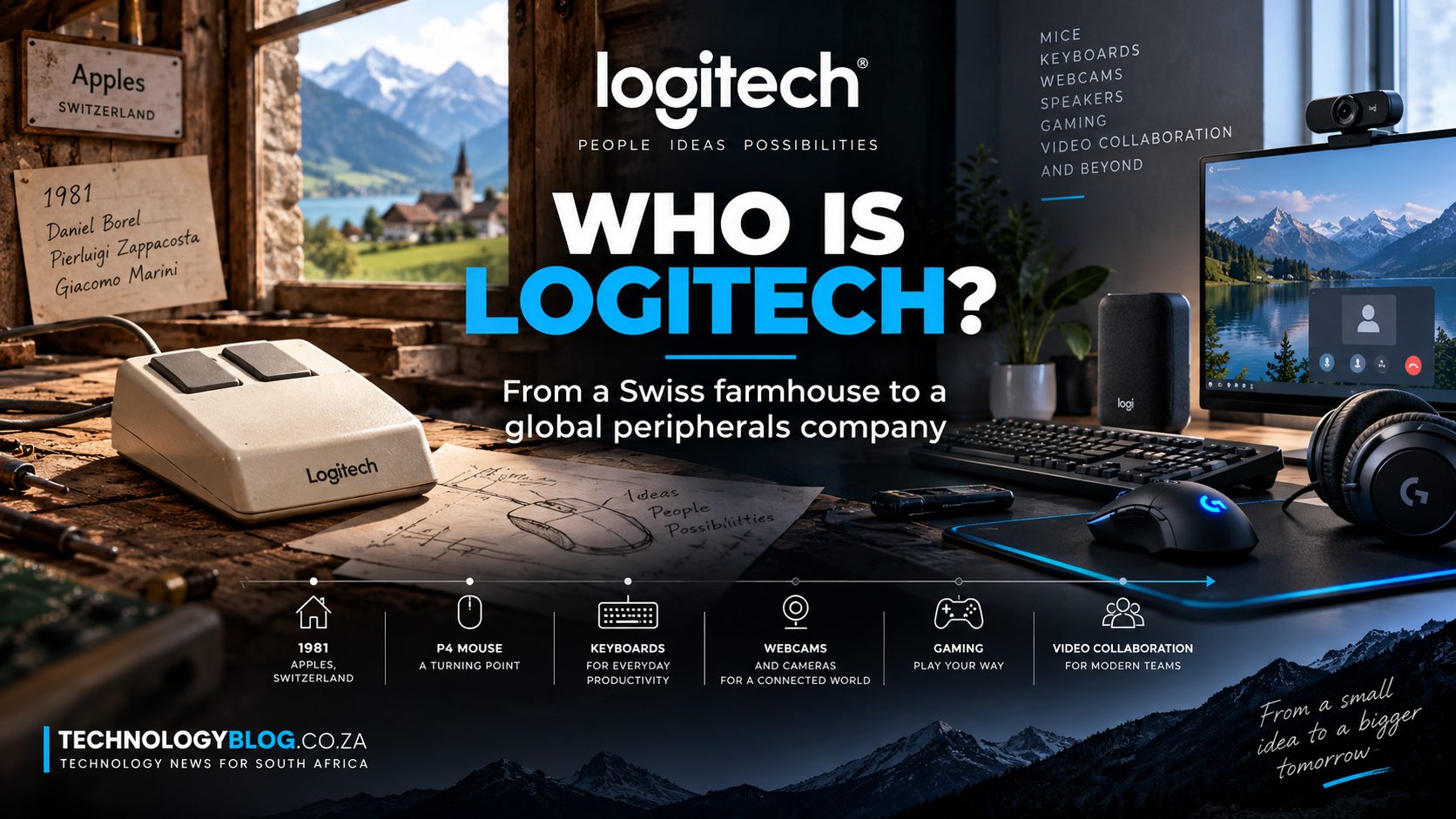
A mouse built in a Swiss farmhouse became Logitech’s route into personal computing
Daniel Borel, Pierluigi Zappacosta and Giacomo Marini founded Logitech in 1981 in Apples, Switzerland, working from a farm building after backgrounds in software and engineering.
The founders experimented with several computer projects before recognising that the mouse could become a mass-market interface as graphical personal computing expanded.
The early business looks very different from the company visible today. Following the milestones in order shows which decisions changed Logitech’s direction and which capabilities remained constant.
The P4 mouse turned a costly pointing device into a scalable product
Logitech’s early P4 mouse used optical encoders, and manufacturing partnerships helped drive the price down from specialist-equipment levels.
In semiconductor and electronics markets, this kind of capability compounds over time. Manufacturing know-how, yields, supplier relationships and process experience are difficult to recreate quickly, so each generation can strengthen the next.
OEM deals put Logitech hardware beside PCs made by other brands
The company supplied mice to major computer manufacturers while also building its own retail brand.
The AI era increased the value of capabilities Logitech had already been developing. Compute, data, networking, software or infrastructure that once served narrower workloads became relevant to much larger AI systems.
Webcams, keyboards and gaming broadened the desktop footprint
Logitech expanded from pointing devices into keyboards, cameras, speakers and later gaming peripherals.
This was an important turning point because it expanded what Logitech could offer or the markets it could address. The effect becomes clearer when viewed as part of the longer sequence of changes that followed.
Video collaboration pushed the company into offices
Products and acquisitions broadened Logitech into enterprise video conferencing, where cameras, microphones and room systems became part of hybrid work.
This was an important turning point because it expanded what Logitech could offer or the markets it could address. The effect becomes clearer when viewed as part of the longer sequence of changes that followed.
Hanneke Faber became chief executive in 2023
Logitech appointed Hanneke Faber as CEO, marking the first female chief executive in the company’s history.
In semiconductor and electronics markets, this kind of capability compounds over time. Manufacturing know-how, yields, supplier relationships and process experience are difficult to recreate quickly, so each generation can strengthen the next.
How an accessory company kept finding the next human-computer interface
As of 18 September 2026, logitech now spans personal workspaces, gaming, streaming, audio and enterprise collaboration while retaining the peripheral expertise built around the mouse.
Seen chronologically, the company is less a collection of unrelated products than a chain of decisions in which one capability created the conditions for the next.
For TechnologyBlog.co.za, this page is intended to serve as the company-history cornerstone for future Logitech coverage, so product and company-news articles can link back to one factual brand background instead of repeating the full origin story.
Primary sources reviewed include Logitech’s official corporate history and company biography material. Official company identity cross-checked against https://www.logitech.com.

Pingback: Logitech G512 X 98 mixes TMR analogue and mechanical switches
Pingback: Logitech G316 X 98 adds hot-swap switches and 8kHz polling
Pingback: Logitech G316 X 75 brings hot-swap switches and 8kHz polling
Pingback: Logitech RS50 McLaren bundle brings 8 Nm direct drive
Pingback: Logitech PRO X3 SUPERSTRIKE adds adjustable HITS clicks
Pingback: Logitech G Yeti 2 adds AI noise reduction and voice tracking