e storage requirement deserves attention for another reason.
Modern games can consume enormous amounts of drive space.
SPRAWL zero asks for approximately 4GB.
That makes it unusually compact by current standards.
Smaller file size does not automatically indicate a simpler game.
It reflects decisions around assets, visual design and technology.
The deliberate Y2K aesthetic likely helps.
For players managing limited SSD space, the result is welcome.
Sixty-one achievements encourage mastery
Steam includes 61 achievements.
That is a substantial number for a focused single-player FPS.
The weapon mastery systems, alternate approaches and combat mechanics provide obvious opportunities for challenge-based achievements.
This also fits the game’s emphasis on replayability.
A player can complete the campaign once.
Then another run can focus on different weapons, abilities or routes.
Handcrafted levels become more valuable when the systems allow them to be approached differently.
SPRAWL zero understands why older shooters are remembered
Nostalgia is easy.
Understanding the reason behind nostalgia is harder.
Players do not remember F.E.A.R. only because of its graphics.
They remember enemies appearing to coordinate.
They remember firefights moving through environments.
They remember bullet time.
Half-Life 2 is not remembered simply because it released in 2004.
Its physics changed how players interacted with the world.
Halo did more than put a gun on a screen.
Its encounter design, enemy behaviour and combat spaces helped define console FPS design.
SPRAWL zero appears interested in those underlying ideas.
Modern systems can improve old design principles
The irony is that revisiting older design does not require rejecting modern technology.
MAETH can take ideas associated with the 2000s and implement them with systems that would have been difficult at the time.
Physics can be more consistent.
Enemy behaviour can be more complex.
Controls can be more responsive.
Visual effects can be more elaborate.
The result does not need to reproduce an old game exactly.
It can ask what made those games interesting and then build from there.
That is a more useful form of nostalgia.
SPRAWL zero gives players tools rather than one solution
That may be the game’s clearest design philosophy.
Shoot.
Manipulate physics.
Catch bullets.
Slow time.
Rush an enemy.
Change weapons.
Find another route.
Use the environment.
The player has options.
The enemies then create pressure that forces those options to matter.
That relationship is what keeps an FPS encounter interesting.
A huge arsenal means little if every weapon solves the same problem.
Complex AI means little if the level gives enemies nowhere to manoeuvre.
Physics mean little if nothing useful can be manipulated.
SPRAWL zero tries to connect these systems.
What South African PC gamers should know
SPRAWL zero is a single-player game.
That immediately removes one common concern for South African players: there is no dependence on overseas multiplayer matchmaking for the core experience.
Latency therefore does not determine whether the campaign is playable.
The relatively modest PC requirements and small storage footprint also make it accessible to a broader range of gaming PCs than many major 2026 releases.
TechnologyBlog has not independently tested performance, so actual frame-rate claims should still be avoided without measured results.
SPRAWL zero is small, but its Steam reception is strong
It is important not to confuse popularity with quality or vice versa.
SPRAWL zero has not produced enormous Steam concurrency.
Its all-time peak remains below 1,000 players.
At the same time, the Steam audience that has reviewed the game is overwhelmingly leaning positive.
Both facts can exist together.
This is a relatively small FPS release with a strongly positive reception among its Steam players.
That may actually be the more interesting story.
Not every worthwhile game needs to become one of Steam’s most-played releases.
Is SPRAWL zero worth playing?
TechnologyBlog has not independently completed SPRAWL zero, so this is not a scored review.
What can be established is that MAETH has built the game around a clear design philosophy.
The 2000s FPS influence is not limited to graphics.
Enemy behaviour matters.
Level design matters.
Physics matter.
Weapon variety matters.
Bullet time matters.
Player choice matters.
The Gravity Gloves and Gravity Shield add their own identity to those familiar influences.
For players who miss the era when shooters experimented heavily with AI, physics and handcrafted combat spaces, SPRAWL zero has an unusually clear proposition.
SPRAWL zero remembers when shooters gave players a playground
SPRAWL zero is built around an old idea that still works.
Give players interesting tools.
Give enemies enough intelligence to create pressure.
Build levels that allow different approaches.
Then get out of the way.
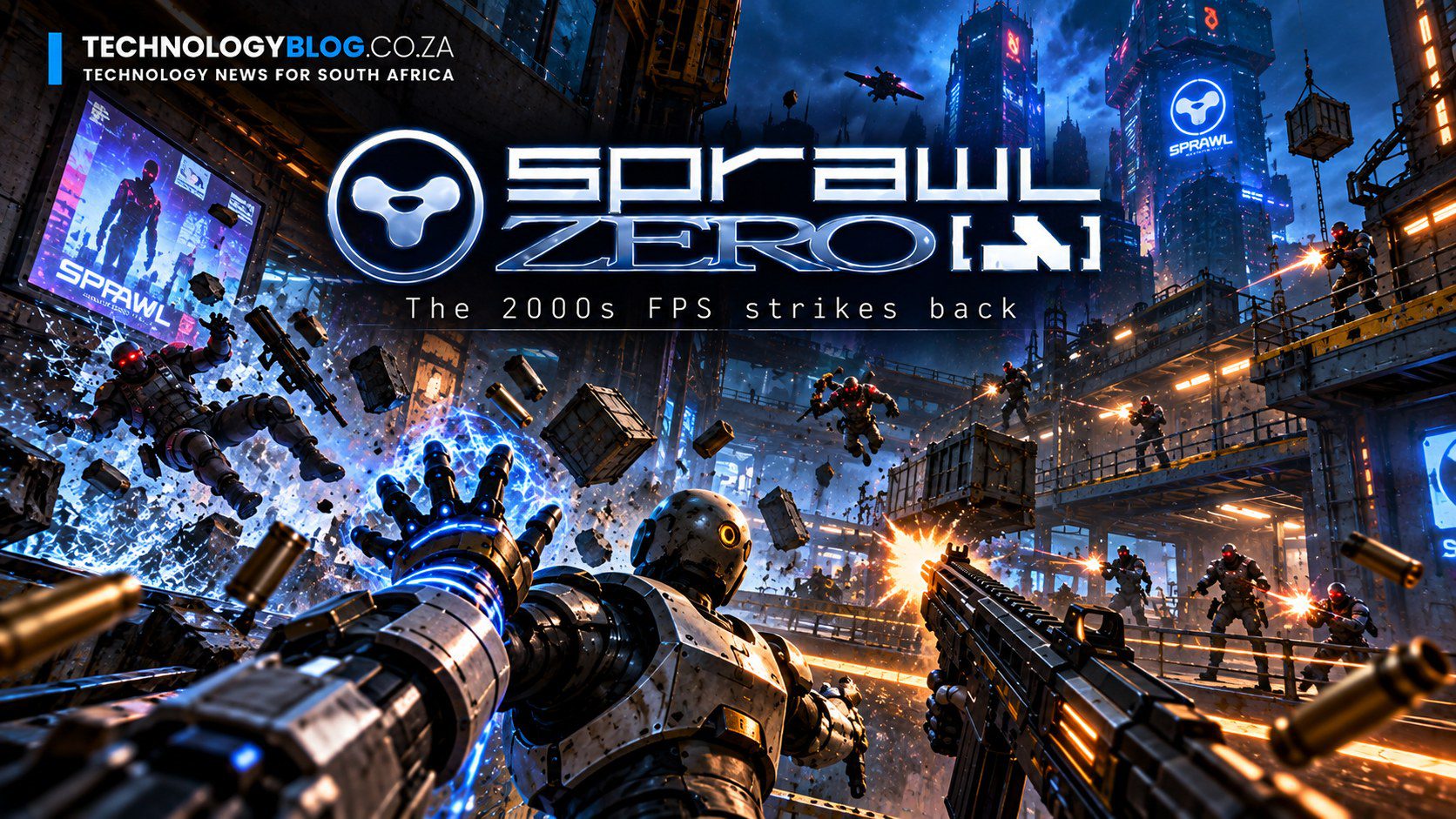
FIVE has more than 40 weapons.
Bullet time bends the pace of a firefight.
Gravity Gloves turn objects into opportunities.
The Gravity Shield turns enemy bullets against them.
Rushdown rewards aggression.
Enemies communicate and flank.
Levels provide alternate routes.
None of those systems is particularly important in isolation.
Together, they create possibilities.
That is what many of the best shooters of the early 2000s understood.
More than twenty years later, MAETH is trying to prove that those lessons still matter.
