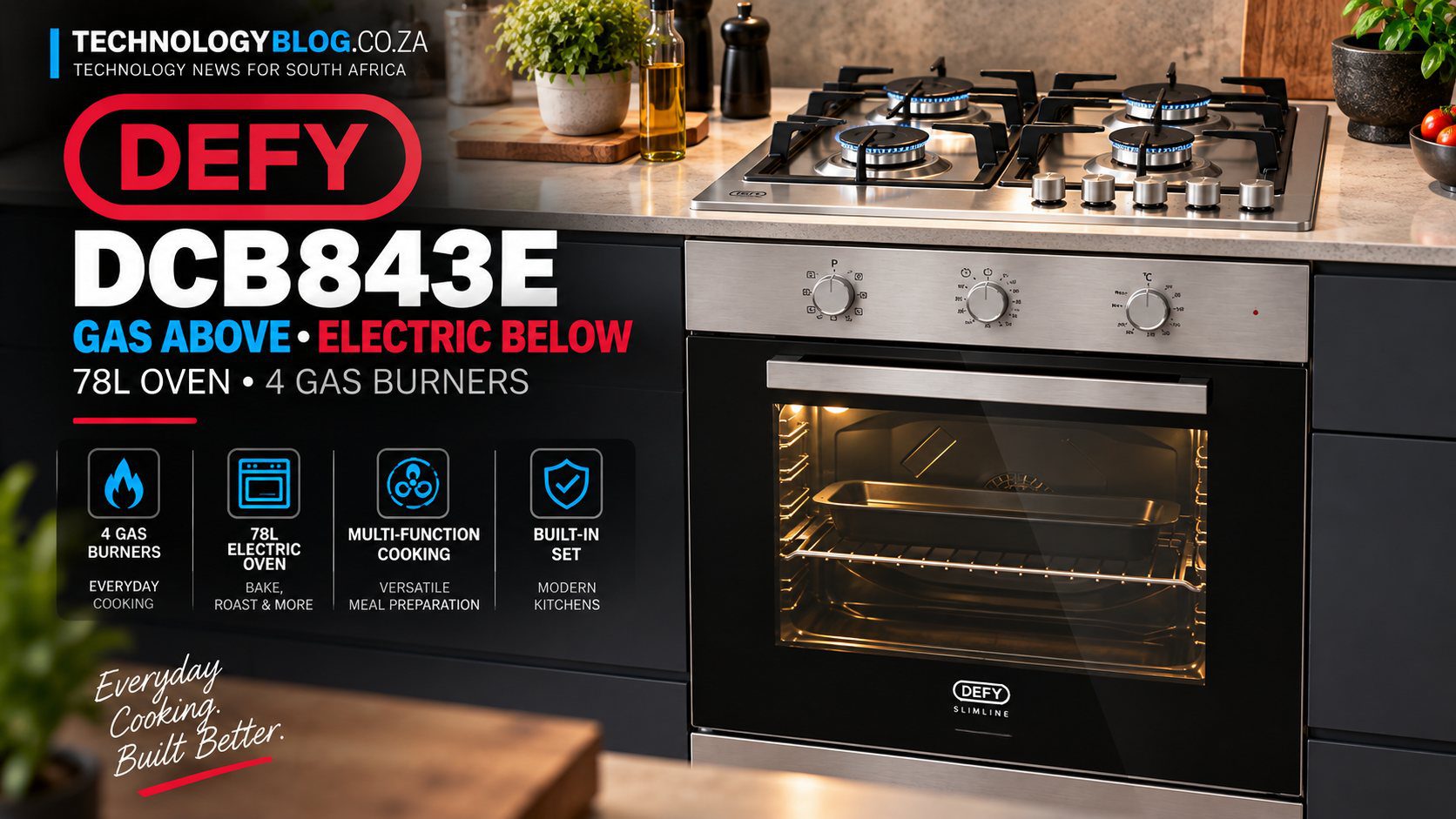
Defy DCB843E combines a 78L electric oven with a four-burner gas hob
The Defy DCB843E takes a mixed approach to built-in cooking.
Instead of using electricity for both parts of the appliance set, Defy pairs a four-burner gas hob with a 78-litre electric oven.
That distinction is particularly relevant in South Africa.
Gas provides direct flame control on the hob, while the oven retains conventional electric heating for baking, roasting and grilling.
The DCB843E is actually a two-appliance Slimline box set. It combines Defy’s DBO484E built-in oven with the DHG133 gas hob.
There are no touchscreens, Wi-Fi features or app controls here. Instead, Defy concentrates on conventional cooking hardware, including cast-iron pan supports, integrated gas ignition, a removable oven-door glass panel and steam-assisted cleaning.
Defy DCB843E combines gas and electric cooking
The Defy DCB843E uses gas for the hob and electricity for the oven.
That gives the kitchen two different heat sources within one coordinated built-in set.
Gas burners provide a visible flame and immediate adjustment at the hob. Turn the control down and the flame responds without waiting for an electric plate to cool.
The oven takes a more conventional electric approach.
Defy lists top and bottom heating elements alongside an electric grill.
For households that prefer cooking over gas but still want a conventional electric oven, the combination makes practical sense.
Four gas burners handle stovetop cooking
The DHG133 component provides four gas burners.
Defy’s current DCB843E product page lists integrated ignition, so users do not need to light the burners manually during normal operation.
Variable burner control lets the cook adjust the flame according to the pan and cooking task.
That can be useful when moving between very different jobs.
Bringing a large pot to temperature requires considerably more heat than maintaining a gentle simmer.
Gas makes that change immediately visible.
Cast-iron pan supports provide a substantial cooking surface
Defy fits the hob with cast-iron pan supports.
These create a stable platform above the four burners.
That matters when heavier cookware is involved.
Large pots and cast-iron pans place more weight on the support structure than a small saucepan.
The continuous support layout also helps when moving cookware between burners because the pan remains supported as it crosses the hob.
The surface underneath uses a stainless-steel finish, matching the Silver Inox appearance of the overall set.
Flame-failure protection adds an important gas safeguard
The DCB843E’s gas hob includes a flame-failure safety device.
This is one of the most important features on a gas cooking appliance.
A burner flame can occasionally go out because of a spill, draught or another interruption.
Without a safety system, gas could potentially continue flowing after the flame disappears.
The flame-failure device is designed to stop that gas supply when the flame is no longer present.
It does not remove the need for correct gas installation or normal gas-safety precautions, but it provides an important additional protection layer.
Integrated ignition removes the need for a separate lighter
The hob also has integrated ignition.
That means ignition is incorporated into the appliance controls rather than requiring a match or separate lighter every time the hob is used.
It is a small feature, but one that affects daily convenience.
Gas cooking itself remains mechanically straightforward.
There is no digital interface between the cook and the flame.
The control knob regulates the burner, and the flame provides immediate visual feedback.
A 78-litre oven sits below the gas hob
The electric half of the Defy DCB843E provides a 78-litre usable oven capacity.
That gives the DBO484E useful room for larger dishes, roasting trays and baking.
Defy describes the oven as an eye-level static model in its current catalogue documentation.
The cavity includes five rack levels.
That allows the position of the wire rack or roasting pan to change according to what is being cooked.
Rack position matters because food placed close to the upper heating element behaves differently from food positioned lower in the cavity.
Conventional electric cooking keeps the oven simple
The DCB843E does not attempt to become a heavily automated multifunction oven.
Defy lists conventional cooking, baking and grilling among its functions.
The current product specification identifies both top and bottom heating elements.
Conventional electric cooking uses these heating sources to create the oven environment.
There is no need to navigate digital menus simply to select a basic cooking function.
For someone who wants a traditional built-in oven rather than a connected appliance, that simplicity may be an advantage.
An electric grill adds another cooking option
The oven also includes an electric grill.
Grilling concentrates heat from above.
That makes it useful for browning food, finishing certain dishes or cooking foods that benefit from direct radiant heat.
It also means the gas/electric split extends beyond simply having an electric baking cavity.
The oven’s electrical system handles both conventional heating and grilling.
Users should therefore account for the oven’s electrical requirements even though the hob itself uses gas.
Steam-assisted cleaning targets oven residue
Cleaning is one area where Defy adds a more modern convenience feature.
The DCB843E supports simple steam cleaning, described as steam-assisted cleaning in Defy’s catalogue.
Steam helps soften residue inside the oven so that it can be wiped away more easily afterwards.
This should not be confused with a high-temperature pyrolytic self-cleaning system.
The oven is not burning residue into ash.
Instead, steam assists the manual cleaning process.
That is a simpler system, but it can still reduce the effort required after spills and repeated cooking.
Removable inner glass helps with door cleaning
The oven door uses removable inner glass.
Grease and food residue can collect on oven-door glass over time.
Making the inner section removable gives users better access when a more thorough clean becomes necessary.
Defy also specifies a full-glass inner-door design.
This complements the steam-cleaning function.
Steam can loosen residue inside the cavity, while removable glass improves physical access to another area that regularly needs attention.
The oven carries an A energy rating
Defy publishes an A energy-efficiency rating for the oven.
The current product page also specifies 0.91kWh energy consumption for the main cavity under its conventional-cooking test measurement.
That figure is more useful than treating the A rating as a prediction of household electricity consumption.
Actual energy use depends on temperature, cooking duration, preheating and how frequently the oven operates.
Opening the door repeatedly can also release heat and extend cooking time.
The published rating therefore provides a standardised reference rather than a guarantee of what every meal will consume.
The oven uses a 220–240V, 50Hz electrical supply
Defy specifies 220–240V at 50Hz for the oven.
That matches the normal electrical range expected for a major appliance sold through Defy’s South African catalogue.
However, built-in cooking appliances require correct installation.
The electrical connection needs to comply with the manufacturer’s requirements and applicable installation standards.
The gas hob introduces its own installation requirements.
Consequently, the DCB843E should not be treated like a portable countertop appliance that can simply be unpacked and connected anywhere.
Gas can keep stovetop cooking available during an outage — with an important caveat
The gas hob creates an obvious South African consideration.
Gas itself does not depend on an electric heating element.
However, the DCB843E uses integrated electrical ignition.
During a power outage, that ignition system may not operate normally.
Whether a burner may safely be lit manually must be determined from Defy’s instructions for the exact appliance rather than assumed.
The electric oven, meanwhile, requires electricity to cook.
The DCB843E therefore should not be described as a completely load-shedding-proof cooking system.
Its mixed-energy design simply means the hob and oven have different energy requirements.
Gas installation needs to be treated seriously
A built-in gas hob requires more planning than placing a portable gas cooker on a countertop.
The gas supply, regulator, cylinder or fixed installation and ventilation all need to be appropriate for the appliance and installation.
South African owners should use a suitably qualified gas installer and retain the relevant compliance documentation where required.
This matters for safety first.
It can also matter later when selling a property or dealing with insurance requirements.
The flame-failure device is an important appliance feature, but it does not replace correct installation.
The DCB843E keeps controls intentionally conventional
One of the most noticeable aspects of the Defy DCB843E is what it does not have.
There is no touchscreen.
There is no Wi-Fi connection.
There is no companion app.
Defy’s current web specification even lists no display for the oven.
The cooking set instead relies on conventional physical controls.
That makes the DCB843E very different from appliances trying to turn every kitchen function into a connected feature.
For an oven and gas hob, many households may prefer exactly that approach.
Built-in design creates a cleaner kitchen layout
The DCB843E is designed as a built-in set rather than a freestanding stove.
That separates the oven and hob into their own installation positions within the kitchen cabinetry and worktop.
The result can create a cleaner integrated appearance.
It also gives kitchen designers more flexibility than a single freestanding cooker.
However, built-in appliances require accurate planning.
Cabinet dimensions, ventilation, countertop cut-outs and service access need to comply with Defy’s installation documentation.
The catalogue lists the oven itself at approximately 595 × 595 × 570mm and the hob at 100 × 580 × 510mm.
Those external dimensions should not be substituted for the official installation and cut-out instructions.
Defy DCB843E specifications
| Specification | Defy DCB843E |
|---|---|
| Product type | Built-in oven and gas hob set |
| Oven | DBO484E |
| Hob | DHG133 |
| Oven type | Eye-level static electric |
| Oven usable capacity | 78L |
| Oven energy rating | A |
| Conventional energy consumption | 0.91kWh published test figure |
| Conventional cooking | Yes |
| Electric grill | Yes |
| Baking | Yes |
| Steam-assisted cleaning | Yes |
| Inner door glass | Removable |
| Rack levels | 5 |
| Oven supply | 220–240V, 50Hz |
| Hob type | Gas |
| Gas burners | 4 |
| Ignition | Integrated |
| Flame-failure protection | Yes |
| Pan supports | Cast iron |
| Hob surface | Stainless steel |
| Oven dimensions | Approx. 595 × 595 × 570mm |
| Hob dimensions | Approx. 100 × 580 × 510mm |
| Colour | Silver Inox |
| Official South African listing | Yes |
Defy DCB843E has a clear South African use case
The Defy DCB843E does not need smart features to make an interesting case.
Its defining feature is much simpler.
It splits cooking between gas and electricity.
The four-burner hob gives users direct flame control, integrated ignition, cast-iron supports and flame-failure protection.
Below it, the 78-litre electric oven handles conventional cooking, baking and grilling.
Steam-assisted cleaning and removable inner-door glass make maintenance easier without turning the oven into a complicated appliance.
That mixed-energy configuration will be particularly relevant to South African households that already prefer gas for stovetop cooking but still want the familiar behaviour of an electric oven.
There are limitations.
The oven still depends on electricity. Gas installation needs to be handled correctly. The appliance also offers none of the connected or advanced digital functions appearing on more expensive cooking systems.
For many kitchens, however, those omissions may not matter.
The Defy DCB843E concentrates on the parts of cooking technology that users interact with every day: controllable heat, useful oven capacity, straightforward controls and a combination of two different energy sources in one coordinated built-in set.


