The history of Yealink: building the hardware behind the modern office
From USB handsets for Skype to equipment for Teams and Zoom meeting rooms, Yealink’s development reveals how much business communication has changed—and how much it still depends on physical devices.
In 2004, Yealink developed a USB telephone for Skype. It was a modest piece of equipment with a useful purpose: giving people a familiar handset for a call carried through a computer. The company was three years old, and video-equipped boardrooms were still some distance from the centre of its business.
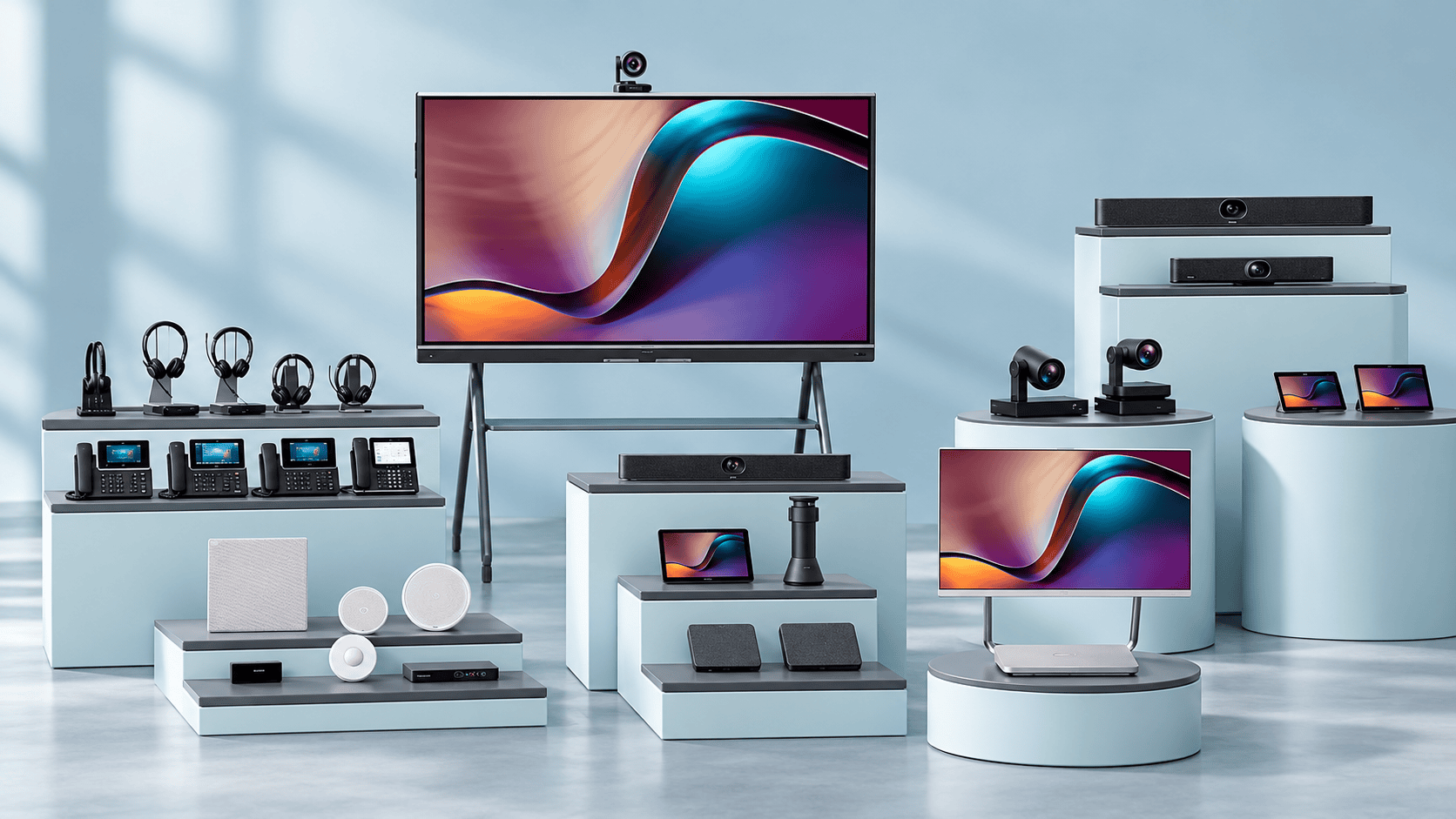
Two decades later, Yealink’s catalogue stretches across desk phones, wireless headsets, cameras, conference systems and room audio. A consistent commercial thread connects those products: supplying the equipment people use to communicate through networks and software.
That thread gives the history of Yealink its shape. The company grew by extending its reach from the individual caller’s desk to the shared meeting room, while continuing to serve the telephone business that helped establish it.
Four founders and an opening in internet calling
Yealink was established in Xiamen, China, on 5 November 2001. Its IPO prospectus identifies four founding shareholders: Wu Zhongyi, Chen Zhisong, Zhou Jiwei and Lu Rongfu.
Its early opportunity lay in internet telephony. The prospectus describes an initial phase centred on USB communication devices, including the Skype handset developed in 2004. Between 2005 and 2009, the business shifted towards devices using Session Initiation Protocol, or SIP, and began establishing its own brand in that market.
This brought Yealink further into business telephone systems. Instead of relying on a handset attached to a computer, an employee could use a dedicated IP phone connected to the organisation’s communication platform.
Compatibility was commercially important. In its prospectus, Yealink described a strategy of integrating its equipment with other suppliers’ telephone systems and hosted services, particularly for small and medium-sized businesses. It was building a place within a wider communications industry, where the company supplying the handset did not necessarily supply the service behind it.
South Africa enters the story
Yealink’s South African presence predates the widespread adoption of pandemic-era video meetings.
Nology dates its local distribution relationship to 2009, an account repeated in distributor-issued material published by ITWeb. The relationship placed Yealink within a channel serving South African service providers, operators and resellers.
That distribution model helps explain how a manufacturer in Xiamen became familiar to local businesses. Communication equipment reaches offices through installers, resellers and service providers that combine devices with configuration, telephone services and support.
Kathea subsequently added another connection. A partner announcement published by MyBroadband documented its appointment to distribute Yealink’s voice and video solutions for Microsoft Teams and Skype for Business in South Africa. The appointment concerned that portfolio, reflecting the growing importance of equipment designed around particular software environments.
For local customers, Yealink’s development was therefore experienced through successive generations of equipment and the businesses supplying it.
Video takes Yealink beyond the desk
In March 2015, Yealink announced its VC400 and VC120 video-conferencing systems, targeting head offices and branches respectively. The launch release, preserved by the Cloud Communications Alliance, positioned the range towards small and medium-sized businesses.
Video introduced a more demanding setting. A desk phone serves someone sitting close to its microphone. A conference system must accommodate several people, the acoustics of a room, a camera’s view and participants joining from other locations.
The move expanded Yealink’s role within the office. Its equipment could now sit at both ends of a working day: on the desk where an employee handled calls and in the room where colleagues gathered for a meeting.
It also puts the company’s later history in perspective. Yealink had entered room-based video conferencing five years before COVID-19 transformed the urgency around remote collaboration.
A public listing, then closer ties to workplace platforms
On 17 March 2017, Yealink listed on the Shenzhen Stock Exchange’s ChiNext board under stock code 300628. The date is recorded in its articles of association.
Alongside that corporate development, its relationship with workplace software was becoming more visible.
Yealink dates its strategic Microsoft partnership to 2015. Microsoft’s own announcement in March 2018 named Yealink among manufacturers offering desk and conference phones running a native Teams application.
The handset was becoming an extension of the software platform. For an organisation standardising on Teams, the purchasing decision included how employees would move between calls, computers and meeting spaces.
Zoom provided another route into that environment. TechnologyBlog.co.za’s 2021 coverage of Yealink’s Zoom Rooms solutions documented packages combining conferencing hardware with the Zoom Rooms platform.
The pandemic years reveal a broader business
By 2020, Yealink’s conferencing portfolio included the MeetingEye series. TechnologyBlog.co.za covered the MeetingEye 400 and 600 that September, describing all-in-one equipment intended for different room sizes.
The following March, the publication reported on the WH6 wireless headset range. Those products addressed the other side of workplace communication: the individual taking calls and joining meetings through a personal workspace.
Together, these categories show the breadth Yealink had developed. Room systems served groups; headsets served individuals; phones retained their place on desks.
That last point is easy to miss in a history dominated by newer technology. Yealink’s expansion did not require abandoning the dedicated telephone. Its continuing handset business is visible in products such as the T31P business IP phone, covered by TechnologyBlog.co.za in 2026.
The infrastructure behind the equipment
More recently, Yealink has expanded its international operating infrastructure.
The company announced the full operation of its Singapore Global Operational Headquarters in June 2025, followed by an upgraded headquarters and a new Customer Experience Center in June 2026.
Reporting on the 2026 opening, TNGlobal attributed to Yealink a remit encompassing operational coordination, supply-chain collaboration, customer support and cloud-service management. These functions reflect the demands of supporting a business whose products now span several parts of the workplace.
Yealink’s history is often told through launches and partnerships. Its more revealing continuity is the connection between them. A USB Skype handset, a Teams phone and a Zoom room system belong to different generations of office technology, yet each gives people a physical way into a software-based conversation.
For South African businesses that have encountered the brand through local distributors since 2009, that continuity explains the name appearing across an increasingly varied office. The equipment has spread beyond the telephone desk. The task—making a conversation work—remains recognisable.
