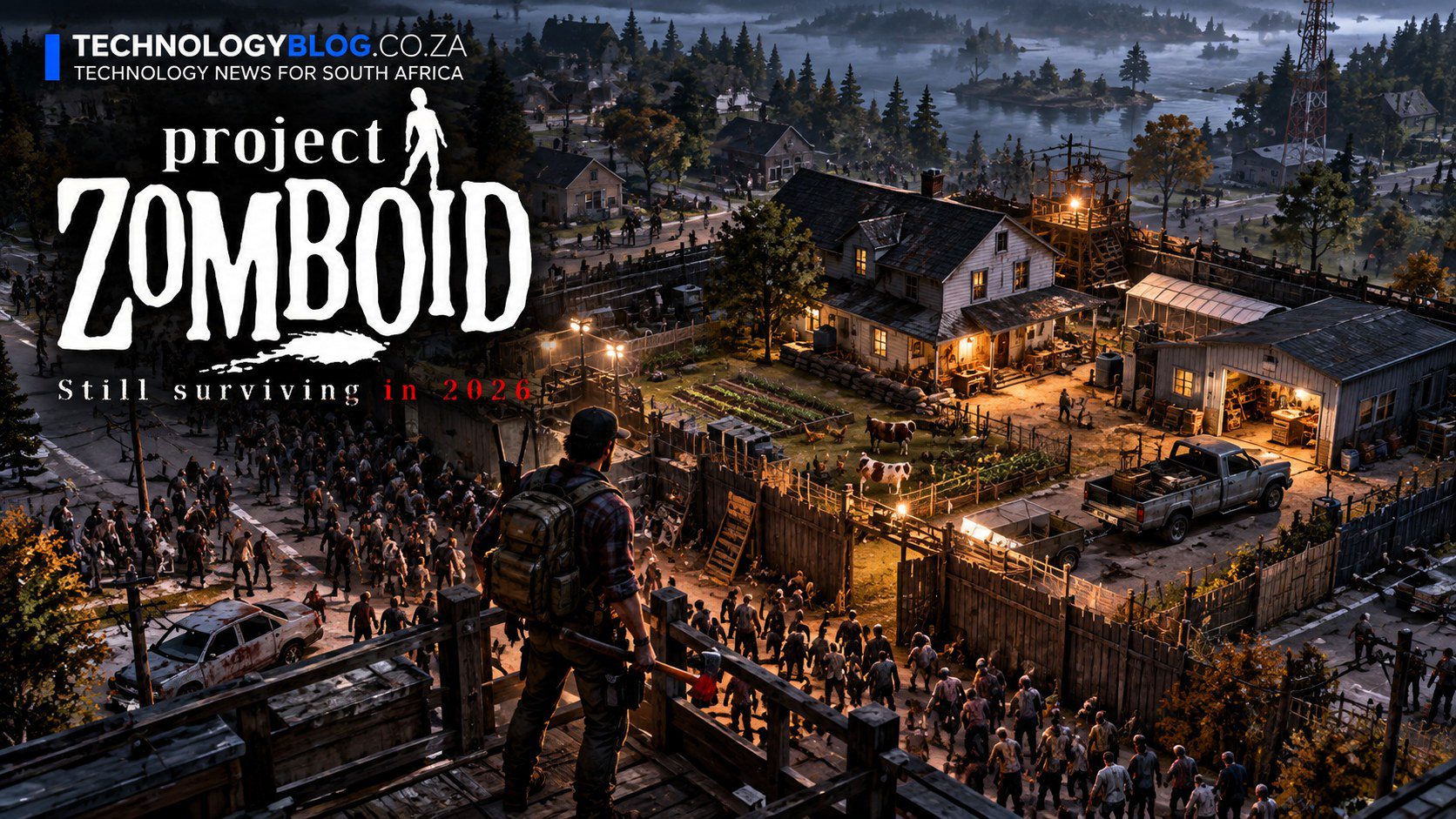
Project Zomboid in 2026: Why tens of thousands still return to the zombie apocalypse
Project Zomboid in 2026 presents one of PC gaming’s stranger success stories.
The game entered Steam Early Access on 8 November 2013.
It is still in Early Access.
Normally, that sentence would raise an obvious question.
What has taken so long?
Project Zomboid gives a more interesting answer when you actually look at what exists today.
This is no longer a small zombie game waiting for somebody to finish it.
It has become an enormous survival simulation with a vast Kentucky map, multiplayer, vehicles, farming, fishing, construction, injuries, disease, weather, electricity, plumbing, animals, crafting, firearms, character progression and an enormous modding community.
Build 42 expanded those systems again in 2026.
Meanwhile, tens of thousands of people are still playing simultaneously on Steam.
Project Zomboid may not be finished.
It is certainly not empty.
Project Zomboid starts by telling you the ending
Most games begin by telling players what they need to accomplish.
Project Zomboid tells you what will happen.
You are going to die.
The question is how.
That simple idea changes everything.
There is no final helicopter waiting to rescue every successful survivor.
There is no requirement to eliminate the zombie population.
You cannot win the apocalypse.
You can only survive it for longer.
That makes Project Zomboid less about reaching an ending and more about creating the story that happens before it.
Every survivor begins another story
A new character might last several hours.
Another might survive for weeks.
Experienced players can keep survivors alive for months.
Then one mistake can end everything.
A door opens at the wrong moment.
A zombie appears behind the player.
A car attracts a horde.
A wound becomes a problem.
Supplies run out.
A carefully constructed base becomes surrounded.
That possibility gives mundane decisions weight.
Going to a supermarket for canned food can become a major expedition when dying means losing the character who needs it.
Zombies are only one part of the problem
Project Zomboid is technically a zombie game.
However, zombies are not the only enemy.
Hunger matters.
Thirst matters.
Fatigue matters.
Temperature matters.
Injuries matter.
Illness matters.
Mental state matters.
A survivor can become bored or depressed.
They can panic.
They can become exhausted.
A player who focuses entirely on killing zombies may discover that ordinary survival is equally capable of ending a run.
That is where Project Zomboid separates itself from many action-focused zombie games.
Survival is the game.
Knox Country is enormous
Project Zomboid takes place in Knox Country, Kentucky.
The map includes towns, suburbs, farmland, industrial areas, forests, roads and the city of Louisville.
Build 42 made it considerably larger.
The Indie Stone says the map’s surface area has approximately doubled.
That does not simply mean stretching the boundaries.
Existing locations have also received substantial work.
Riverside, West Point, Rosewood, Fallas Lake, Muldraugh, Ekron and Dixie are among the areas that received major improvements.
The world is becoming denser as it becomes larger.
Build 42 added around 1,400 unique buildings
One of the most impressive numbers behind the map overhaul is the building count.
The Indie Stone says Build 42 delivered around 1,400 unique buildings.
It also added roughly 20,000 new tiles.
Buildings and houses in revamped areas have been made more distinctive, while landscaping and local visual details help towns develop their own identities.
That matters because players spend enormous amounts of time entering buildings.
Every house can contain supplies.
Every shop can become an objective.
Every warehouse can become a base.
Making those places less repetitive directly improves exploration.
Project Zomboid can now go underground
Build 42 also expanded the vertical limits of the map.
Basements are now possible.
Players can find underground spaces including bunkers and panic rooms.
Some locations are generated differently between runs.
That creates another layer of uncertainty.
A familiar house may contain something unexpected beneath it.
For a game built around repeated playthroughs, these differences matter.
Players gradually learn Knox Country.
The game then finds new ways to surprise them.
It can also go much higher
The same technical work allows Project Zomboid to build upwards.
Some Louisville skyscrapers can reach as high as 32 floors.
That changes exploration.
A tall building is no longer simply a large structure represented across a limited number of levels.
Players can move much further vertically.
Of course, height creates its own problems during a zombie apocalypse.
Going upstairs is easy.
Getting back down when the building is full of zombies may be considerably harder.
Build 42 added three major towns
Knox Country also expanded geographically.
Build 42 added Ekron, Irvington and Brandenburg as significant new towns alongside numerous smaller locations.
There are stranger destinations too.
Players can discover locations such as a Wild West tourist town, a race track, a docked steamboat and an abandoned sanatorium.
These places provide more than scenery.
They create destinations.
In a sandbox without a traditional campaign directing the player, interesting places become objectives of their own.
Sometimes the reason for leaving a safe base is simply curiosity.
That can be dangerous.
Build 42 changes what happens after the supermarkets are empty
The biggest change may not be geographical.
Build 42 puts much more emphasis on long-term survival.
Early Project Zomboid survival often revolves around scavenging.
Find food.
Find weapons.
Find medicine.
Find tools.
Find somewhere defensible.
But the apocalypse continues.
Electricity eventually disappears.
Water supplies fail.
Fresh food spoils.
Fuel becomes increasingly precious.
The world created before the outbreak cannot supply the player forever.
Build 42 pushes much harder into the question of what comes next.
Crafting has become much deeper
The crafting overhaul is central to that answer.
Players have more ways to create, repair and maintain what they need.
Workstations form part of the expanded system.
Construction has grown.
Food preservation has expanded.
Clay and stone construction add more possibilities.
Drying racks and shelters support longer-term survival.
The goal is not simply to give players more recipes.
The Indie Stone wants the late game to support communities that can continue after the old world’s supply chains have disappeared.
That fundamentally changes the survival fantasy.
The apocalypse eventually becomes civilisation building
At first, Project Zomboid is about surviving what remains of civilisation.
Eventually, it becomes about replacing parts of it.
That is where Build 42 becomes especially interesting.
A survivor who lasts long enough needs sustainable food.
They need tools.
They need shelter.
They need ways to preserve resources.
They may need livestock.
A multiplayer group has even greater requirements.
The question gradually changes from:
“What can we find?”
to:
“What can we make?”
That is a natural progression for a survival game designed around extremely long runs.
Animals have finally arrived
Build 42 also introduces animals and animal husbandry.
That adds another dimension to rural survival.
Animals can contribute to food production and the wider crafting economy.
Players can build around livestock rather than depending entirely on scavenged resources and crops.
It also makes the countryside feel more like a place that existed before the outbreak.
The world was not created solely for the player.
Farms had purposes.
Animals lived there.
The apocalypse interrupted an existing environment.
That philosophy appears throughout the Build 42 map overhaul.
Farming has a larger role
Agriculture has always made sense in Project Zomboid.
Build 42 makes long-term food production even more important.
A successful survivor eventually needs to think beyond tomorrow.
Seeds matter.
Growing conditions matter.
Food preservation matters.
Protecting a productive base matters.
In multiplayer, farming can become somebody’s actual job within the group.
One player may specialise in combat.
Another repairs vehicles.
Someone builds.
Someone grows food.
Project Zomboid gradually becomes a cooperative simulation of people attempting to create a functioning settlement after society collapses.
Firearms have been reworked
Build 42 also changes guns.
The aiming system now allows more precise targeting.
Character condition still matters.
Panic affects performance.
Stress matters.
Aiming skill matters.
Players therefore cannot expect a firearm to turn an inexperienced survivor into an action hero.
The gun itself may be powerful.
The person holding it remains human.
New weapon models, animations, muzzle effects, ammunition and sound work accompany the revised system.
Additional firearms have also joined the arsenal.
Guns solve one problem and create another
Project Zomboid understands something important about firearms in a zombie apocalypse.
They are loud.
A gun can save a survivor from an immediate threat.
The noise can create a much larger problem.
That means combat requires judgement.
A firearm might be the fastest way to eliminate several zombies.
It may also tell every zombie nearby where the player is.
Melee weapons avoid some of that attention.
They require getting dangerously close.
Neither option is universally correct.
That uncertainty makes encounters interesting.
Cars completely change survival
Vehicles are another major part of Project Zomboid.
A working car changes how much of Knox Country becomes accessible.
Players can carry more supplies.
They can travel between towns.
They can move heavy equipment.
They can escape danger quickly.
Cars also create problems.
They require fuel.
They require maintenance.
Parts deteriorate.
Engines make noise.
Roads can become blocked.
Driving too quickly can turn an otherwise successful survivor into a corpse because of one badly timed collision.
Project Zomboid rarely gives players something useful without attaching another responsibility to it.
Darkness is more dangerous in Build 42
Lighting and atmosphere received substantial work in Build 42.
That has practical consequences.
Project Zomboid uses darkness as part of survival.
Exploring a building when visibility is poor is dangerous.
Travelling at night changes how the player reads the environment.
Losing electricity changes familiar places.
A supermarket that felt ordinary during the day becomes another problem when the lights no longer work.
Atmosphere and mechanics reinforce each other.
The darkness looks better.
It also matters.
Multiplayer creates completely different stories
Project Zomboid supports solo survival, but multiplayer changes its character.
A group can divide responsibilities.
Players can build a settlement together.
They can collect vehicles.
They can establish supply routes.
They can specialise.
They can also make catastrophic mistakes together.
Human behaviour adds another unpredictable system to an already complicated sandbox.
A friend may save the group.
A friend may also crash the only working vehicle into a tree.
Both become stories players remember.
Build 42 has required substantial multiplayer work
Moving Build 42 to Stable did not mean development stopped.
The Indie Stone has continued working on multiplayer behaviour, bugs and performance.
Build 42.21 entered Unstable testing on 23 September 2026.
One major fix targets zombies disappearing when players left and re-entered sections of the world.
Zombie duplication in multiplayer has also been addressed.
The anti-cheat system has expanded.
Safehouse exploits have received fixes.
Steam authentication problems have been addressed.
The update demonstrates why Project Zomboid’s development model continues after major builds reach Stable.
High-ping multiplayer is also receiving attention
Build 42.21 includes improvements specifically aimed at multiplayer problems when driving with higher latency.
The Indie Stone cites issues around roughly 150ms and above, including parts of the map failing to load ahead of moving vehicles, passenger teleportation and general juddering.
The update also addresses Z-level synchronisation.
That is particularly relevant to geographically distant multiplayer groups.
For South African players connecting to overseas servers, high latency can be part of the experience.
However, actual latency depends on server location and connection routing, so TechnologyBlog will not assign a universal South African ping figure.
Project Zomboid has one of its greatest strengths in modding
Then there are the mods.
Project Zomboid supports Steam Workshop and Lua modding.
The community has built vehicles, maps, weapons, clothing, interface changes, gameplay systems and countless other additions.
Modding dramatically extends the game’s lifespan.
Someone who has played hundreds of hours can change the experience.
A server can build its own identity around a particular collection of mods.
Players can modify relatively small quality-of-life details or transform major parts of the game.
The base game creates the framework.
The community keeps expanding it.
The Indie Stone is expanding mod support further
Build 42 temporarily disrupted parts of that ecosystem because major game changes require mods to adapt.
The Indie Stone’s post-Build 42 plans include releasing updated mapping tools such as WorldZed and TileZed.
Its AnimZed animation editor and integration tools are also planned for community release.
The developer has additionally promised more extensive modding documentation and further improvements to the modding experience.
That is significant.
Modding is not being treated as an accidental side effect of Project Zomboid’s popularity.
It remains part of the game’s future.
The sandbox can be changed dramatically
Project Zomboid is also highly configurable without installing mods.
Players can alter many of the rules governing their apocalypse.
Zombie populations can change.
Loot scarcity can change.
The passage of time can change.
The world can become more forgiving or considerably more brutal.
This is one reason different Project Zomboid players can describe very different experiences.
One player may want an unforgiving simulation.
Another may want to build.
A multiplayer server may create its own rules.
The game provides the systems and lets players decide how hostile those systems should become.
Death still gives the game meaning
Customisation does not change the central principle.
Characters die.
That possibility gives survival weight.
A base matters because the player spent time building it.
A vehicle matters because it took effort to repair.
Skills matter because they took time to develop.
The character matters because survival created history.
Permadeath turns ordinary progress into something valuable.
Losing a veteran survivor therefore hurts in a way that simply reloading a checkpoint does not.
The player remembers how that character died.
Your old world can survive your character
There is another unusual consequence.
Death does not necessarily erase everything.
Players can continue in the same world with another character.
The base can still exist.
Supplies may remain.
Vehicles may remain.
The previous survivor may also still exist in a considerably less friendly condition.
That creates another story.
The new character can encounter what remains of the old one.
Recovering possessions from your former survivor can become its own grim mission.
Few games turn a previous player character into part of the world’s environmental history quite like Project Zomboid.
The game is still in Early Access after more than a decade
The unavoidable issue remains.
Project Zomboid entered Steam Early Access in 2013.
It is 2026.
The game still has an Early Access label.
That development period is extraordinary.
Players are entitled to consider that when deciding whether to buy it.
However, simply describing Project Zomboid as an unfinished 2013 Early Access game misses what happened during those years.
The game has grown enormously.
Its current Steam activity demonstrates that players are not simply waiting for a hypothetical future product.
They are playing the game that exists now.
More than 40,000 players were simultaneously surviving on Steam
The current Steam activity is remarkable for a game of this age.
SteamDB’s latest checked snapshot showed approximately 42,900 players in-game simultaneously.
That number changes constantly.
It should not be interpreted as unique players.
It does not represent everyone who played that day.
It is not a sales figure.
It is simply the number of Steam users observed in the game at roughly the same time.
Even with those limitations, tens of thousands of concurrent players more than a decade after the Steam Early Access launch demonstrates substantial continuing activity.
Almost half a million Steam reviews provide another perspective
Steam’s current dataset contains roughly 483,000 reviews across languages and purchase types.
The overall reception remains Very Positive.
Recent reviews are also Very Positive, with roughly 90% positive during the latest 30-day window.
English-language reviews sit around 93% positive.
Those percentages matter because Project Zomboid is not relying entirely on old goodwill.
Recent players are still responding positively.
Build 42 has introduced problems and changes that not everyone likes, but the broader Steam reception remains strong.
Build 42 gave returning players another reason to start over
Major survival-game updates have a useful effect.
They make experienced players curious again.
Build 42 changes the map.
It changes crafting.
It changes firearms.
It adds animals.
It expands long-term survival.
It changes lighting.
It adds buildings and locations.
A player who already knows how to survive Build 41 suddenly has things to learn again.
That is extremely valuable for a sandbox.
Familiarity can eventually remove fear.
Change puts some uncertainty back.
Build 42.20 is only the beginning of the new cycle
The July Stable release did not mark the end of Build 42 development.
The Indie Stone plans further hotfixes, balance work, optimisation, modding support, multiplayer improvements, controller improvements and additional player-requested polish.
Build 42.21 already demonstrates that process.
The studio says Unstable will increasingly function as an actual testing branch before updates move to Stable.
That should allow broader testing without turning every public update into an immediate change for the entire player base.
Human NPC survivors remain one of the biggest missing pieces
Project Zomboid still has major ambitions beyond Build 42.
Human NPC survivors remain planned.
The Indie Stone has discussed systems in which NPCs can survive, form groups, perform tasks and participate in stories that continue even when the player is elsewhere.
The concept goes far beyond placing simple AI companions around the map.
The developer has discussed procedural narrative systems that track events happening away from the player.
NPCs could eventually arrive with histories created by what happened to them while the player was somewhere else.
However, these systems remain future work.
They should not be described as current Project Zomboid features.
NPCs could fundamentally change the apocalypse
The potential impact is enormous.
Project Zomboid currently creates stories primarily from the player, zombies and simulation systems.
Human NPCs could add another unpredictable layer.
A survivor might become an ally.
A group could become dangerous.
Another community could consume resources.
People could disappear.
Relationships could form.
Conflict could emerge.
If those systems ultimately work as envisioned, Knox Country would become less like an empty world filled with zombies and more like a collapsing society containing other people trying to survive.
That remains a future promise rather than something players can rely on today.
Steam Deck support makes Project Zomboid portable
Valve currently rates Project Zomboid Verified for Steam Deck.
That is notable for a game with this many systems.
Project Zomboid was built around a PC interface containing inventories, menus, character systems and detailed interactions.
Being able to take that survival sandbox onto a handheld gives the game another way to fit into players’ lives.
Controller support also remains an area The Indie Stone plans to continue improving during the Build 42 support cycle.
The hardware requirements remain modest
Project Zomboid does not demand cutting-edge hardware.
Steam lists 10GB of storage and a dedicated graphics card with at least 4GB of VRAM among its current requirements.
That accessibility helps.
A survival sandbox benefits from being playable on a wide range of PCs.
Players can also dedicate hardware to hosting multiplayer servers without requiring the kind of infrastructure associated with visually intensive modern AAA releases.
The game’s isometric presentation has aged differently from a game pursuing photorealism.
South African players can play without depending on multiplayer
For South African players, Project Zomboid’s structure provides flexibility.
The entire survival experience can be played solo.
That means overseas server latency does not determine whether the game is viable.
Players interested in multiplayer should consider server location, especially for vehicle-heavy sessions.
Build 42.21 specifically includes work targeting high-ping driving behaviour, which is encouraging.
However, local performance should be judged from the actual server being used rather than assuming every international connection will behave the same way.
Project Zomboid succeeds because it lets failure become content
Many games treat death as something to undo.
Project Zomboid turns it into part of the experience.
The best run eventually ends.
The base that seemed safe fails.
The character with months of progress makes one mistake.
Then the player thinks about what went wrong.
Perhaps the next survivor needs a safer base.
More food.
A second vehicle.
Better weapons.
A generator.
A farm.
A quieter route through town.
Failure teaches the player how to create the next story.
That loop can continue almost indefinitely.
Is Project Zomboid worth playing in 2026?
TechnologyBlog has not conducted a fresh scored review of Project Zomboid for this article.
What can be established is that the game is extraordinarily active for its age.
Build 42 has substantially expanded it.
The Steam community remains large.
Recent user reviews remain strongly positive.
Modding support is extensive.
Multiplayer continues receiving work.
The sandbox is deeply customisable.
There is also considerably more planned.
The main reservation remains equally obvious.
Project Zomboid is still an Early Access game after more than a decade.
Anyone uncomfortable buying into an unfinished development roadmap should take that seriously.
Everyone else can judge the enormous game already available rather than the version that may eventually receive a 1.0 label.
Project Zomboid is still asking the same question
After all these years, Project Zomboid still begins with essentially the same proposition.
This is how you died.
Build 42 has simply created far more ways to fill in everything between the outbreak and that final moment.
You can build a home.
Repair a car.
Raise animals.
Grow food.
Explore Louisville.
Disappear into the wilderness.
Join friends.
Create a community.
Install hundreds of mods.
Survive for months.
Then open the wrong door.
More than a decade after Project Zomboid arrived on Steam Early Access, tens of thousands of players are still opening that door.
And then starting again.
