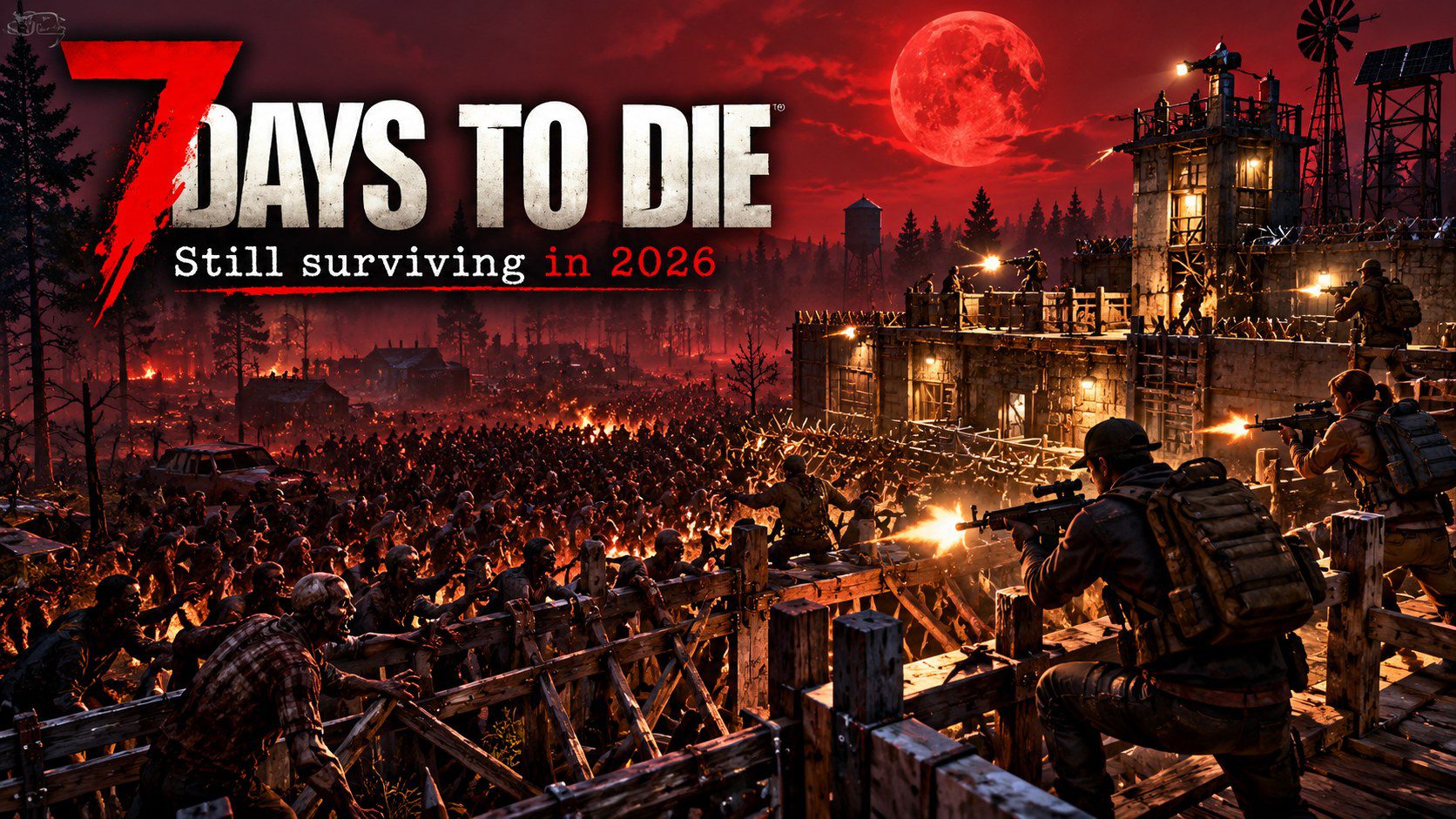
7 Days to Die in 2026: Why the zombie survival sandbox is still thriving
7 Days to Die in 2026 is almost unrecognisable from the survival game that began development more than a decade ago. Yet its central idea remains surprisingly simple: survive for as long as possible.
That means finding food, gathering resources and building somewhere safe. Players also need weapons, transport and increasingly elaborate defences. Eventually, however, every carefully prepared base faces its real test when the Blood Moon arrives.
Developed by The Fun Pimps, 7 Days to Die combines ideas normally spread across several genres. It is a first-person shooter, survival game, RPG, crafting sandbox and base builder. During a Blood Moon, it also becomes something remarkably close to tower defence.
That unusual combination has helped the game survive an extraordinarily long development cycle. More than 20 million copies have now been sold, while tens of thousands of Steam players continue to play simultaneously.
Meanwhile, development is far from finished.
V3.2 is Stable, V4.0 is under development, and The Fun Pimps entered a new era in 2026 after joining Behaviour Interactive.
7 Days to Die started with two brothers and an idea
The story began around Thanksgiving 2012.
According to The Fun Pimps, two brothers came up with the idea that eventually became 7 Days to Die. Their concept grew far beyond what they originally imagined.
More than a decade later, the developer says over 20 million copies have been sold.
That scale is remarkable for a project that spent much of its life associated with Steam Early Access. However, players did not simply wait for a finished game. They played while it evolved.
Outbound link: Link the first substantial The Fun Pimps reference above to the developer’s official website.
Early Access became part of the game’s identity
For years, 7 Days to Die and Early Access seemed inseparable.
Major Alpha releases repeatedly changed substantial parts of the experience. Progression evolved, graphics improved and world generation changed. Zombies, skills and crafting also went through major revisions.
As a result, returning players sometimes discovered a game that felt very different from the one they remembered.
That constant rebuilding frustrated parts of the community. At the same time, however, it kept the project moving forward.
Version 1.0 finally arrived in 2024
The symbolic turning point came on 25 July 2024 when 7 Days to Die reached version 1.0.
That ended one of PC gaming’s longest Early Access periods.
However, version 1.0 did not mark the end of development. The Fun Pimps had already made clear that additional systems, content and major updates were planned.
Therefore, the transition to 1.0 represented a milestone rather than a finish line.
Outbound link: Add the official 7 Days to Die Steam page here.
7 Days to Die in 2026 remains a true sandbox
One reason 7 Days to Die in 2026 remains so replayable is that there is no single correct way to survive.
Players can explore, build, craft, fight, farm, trade, hunt and mine. They can repair vehicles, build elaborate defences or simply try to survive another night.
Friends add another layer because multiplayer groups can divide responsibilities.
Consequently, players create many of their own objectives inside the larger survival loop.
The same systems can produce completely different stories depending on the choices a survivor makes.
Navezgane provides a handcrafted apocalypse
The best-known setting is Navezgane.
This fictional Arizona county provides a handcrafted environment filled with towns, wilderness, traders and dangerous points of interest.
Over time, players begin learning the map. Roads become familiar, useful buildings turn into landmarks and dangerous locations become objectives.
Knowledge therefore becomes a form of progression.
An experienced survivor may recognise a building in the distance and know what resources it could contain. Unfortunately, they may also know what is probably waiting inside.
Supporting image: Navezgane landscape or settlement.
Alt: 7 Days to Die in 2026 Navezgane survival world
Random worlds bring uncertainty back
Players who do not want that familiarity can generate another world.
Procedural generation is an important part of 7 Days to Die’s longevity. Roads change, towns move and points of interest appear in different arrangements.
Useful resources are no longer exactly where players remember them.
As a result, exploration becomes meaningful again.
For a survival sandbox capable of supporting hundreds or thousands of hours, that uncertainty is valuable.
Almost everything can be destroyed
The voxel-based world remains one of the game’s defining features.
Buildings are not simply static scenery. Players can break through walls, excavate terrain and modify existing structures.
They can also construct entire bases from scratch.
More importantly, zombies interact with those structures.
A wall is not an absolute boundary. Instead, it is an obstacle with a limited ability to absorb damage.
Given enough time, the horde can change the architecture.
That makes construction part of combat.
A base is something you have to engineer
Many survival games allow players to build attractive homes.
7 Days to Die asks another question:
Will the house survive the horde?
Walls need strength. Entrances matter. Routes matter. Traps matter. Structural stability matters too.
A beautiful base that collapses during a Blood Moon is not necessarily a good base.
Therefore, players gradually become amateur apocalypse engineers.
Every failed defence teaches another lesson.
Supporting image: Player-built fortified base.
Alt: 7 Days to Die base building and zombie defences
Blood Moons define the rhythm
The Blood Moon horde gives 7 Days to Die its distinctive cycle.
Normal survival provides time to explore, build and prepare. Eventually, however, the deadline approaches.
The sky turns red.
The horde arrives.
Suddenly, all those resources collected during quieter days have a purpose.
A weak section of wall becomes obvious. A badly positioned trap becomes a problem. Meanwhile, a forgotten repair can become catastrophic.
Preparation turns into a test.
Survival becomes tower defence.
Supporting image: Blood Moon horde attacking a fortified base.
Alt: 7 Days to Die in 2026 Blood Moon zombie horde
The seven-day rule can be changed
The title makes the seven-day cycle famous, but the sandbox is considerably more flexible.
Server and world settings allow players to alter many aspects of the experience. Horde frequency can change, difficulty can change and loot availability can change.
Recent updates have pushed even further into sandbox customisation.
Therefore, 7 Days to Die does not force every community into one definition of survival.
Players can make the apocalypse fit the experience they want.
Combat has evolved considerably
Fighting zombies is only one part of the game, but it remains unavoidable.
Players begin with crude equipment. Progress gradually opens access to better melee weapons and firearms.
Weapon choice changes the risk.
Melee conserves ammunition but requires getting dangerously close. Firearms create distance but consume valuable resources.
Explosives can solve larger problems quickly. They can also create new ones.
Consequently, players constantly balance immediate survival against what they may need tomorrow.
Loot keeps survivors moving
A fortified base creates safety.
It does not create everything the player needs.
Survivors must eventually return to the world.
Buildings become loot runs. A house may contain food, while a garage may provide tools. Medical locations can contain valuable supplies, and military sites may offer better equipment alongside greater danger.
Points of interest therefore become miniature adventures.
Enter.
Clear the threat.
Search.
Take what you can carry.
Then try to make it home.
Traders create another progression route
Traders provide quests, rewards and another way to obtain useful equipment.
They also give players reasons to leave their bases.
That helps structure a sandbox that otherwise leaves players responsible for creating many of their own objectives.
Recent updates continue refining those interactions.
V3.2.0, for example, added the ability to open a trader’s outer doors by honking a vehicle horn.
It is a small change. Nevertheless, it illustrates the newer approach to updates between major releases.
V3.2 changed the update strategy
V3.2.0 became Stable in August 2026.
The update is smaller than one of the game’s huge milestone releases. That is deliberate.
The Fun Pimps says it has established a dedicated team focused on smaller updates. That team can deliver bug fixes, quality-of-life improvements and additional cosmetic content more consistently.
As a result, players do not necessarily need to wait for another enormous version update to receive improvements.
Outbound link: Link this section to the official V3.2.0 Stable announcement.
V4.0 development continues separately
There is an important detail behind the new strategy.
The smaller-update team is separate from the developers working on major releases.
According to The Fun Pimps, V4.0 development continues in parallel.
That distinction matters because frequent minor updates could otherwise create concern that resources were being diverted from larger promised features.
Instead, one group can improve the game players have now while another works on what comes next.
Henpocalypse brought chicken farming
V3.1 arrived in July 2026 under the memorable name Henpocalypse.
Among its additions was chicken farming through the Chicken Coop workstation.
That may sound almost comically ordinary beside hordes of zombies. In a survival game, however, renewable resources matter.
Food production changes long-term planning.
Animals add another system to manage.
Gradually, the apocalypse becomes less about finding what civilisation left behind and more about producing what survivors need themselves.
Survival extends far beyond zombies
Hunger matters.
Water matters.
Resources matter.
Equipment degrades, ammunition disappears and vehicles require support. Building also consumes enormous quantities of material.
Meanwhile, the horde keeps returning.
This is why the game continues to work despite zombies being familiar territory.
The undead are one pressure inside a much larger system.
Players are not merely fighting enemies. They are maintaining an entire survival operation.
Quiet work becomes part of survival
7 Days to Die can produce strangely mundane sessions.
One player may spend hours mining. Another may organise storage while someone else reinforces the walls.
A fourth player might farm or repair vehicles.
Then the Blood Moon arrives.
Suddenly, those quiet jobs become connected.
The mined resources became ammunition. Organised storage made repairs easier. Farming kept the group supplied, while stronger walls kept the zombies outside.
The game turns chores into preparation.
Multiplayer makes specialisation valuable
That relationship becomes even stronger with friends.
A multiplayer group can divide responsibilities. Someone builds, someone explores and another player specialises in combat.
Others may manage farming, mining or vehicles.
Skills and preferences naturally create roles.
The base then becomes a shared project.
When something goes wrong, it becomes a shared disaster.
Few things expose questionable architecture as efficiently as a Blood Moon.
Supporting image: Multiplayer survivors preparing a base.
Alt: 7 Days to Die multiplayer survival and base building
Dedicated servers create persistent worlds
PC players can run dedicated servers.
That allows communities to create worlds that continue beyond one person’s play session.
Server settings can also reshape the experience dramatically.
Some communities emphasise cooperation. Others introduce PvP or extensive modifications.
Persistent servers therefore turn 7 Days to Die into something closer to a long-running survival world than a conventional campaign.
That has contributed significantly to its longevity.
Character progression creates another long-term loop
7 Days to Die also incorporates RPG progression.
Players improve their capabilities through attributes, perks and equipment.
Therefore, a new survivor is not simply missing better weapons. They are less capable.
Time invested in progression matters.
A dangerous expedition becomes more stressful when failure threatens hours of development.
The game uses that investment to make otherwise ordinary decisions feel important.
Vehicles transform the world
Travelling on foot makes the map feel enormous.
Vehicles change that.
They allow survivors to travel farther, carry more equipment and reach distant traders. They also make longer loot runs practical.
Better transport therefore feels significant because it changes what players can accomplish during a day.
Eventually, the apocalypse becomes less about surviving one neighbourhood and more about operating across an entire region.
Building becomes the endgame for many players
There may be no traditional final boss waiting at the end of 7 Days to Die.
Instead, construction becomes the long-term objective for many players.
Build a better fortress.
Test another design.
Create automated defences.
Try something unusual.
Then see whether the zombies can destroy it.
The destructible voxel world makes this experimentation possible.
The environment is not simply where gameplay happens.
Changing the environment is gameplay.
Every Blood Moon becomes a design review
This creates a cruel but effective feedback system.
A player can believe a base is brilliant.
Then the horde arrives.
Zombies find another route. A support fails. Part of the structure collapses.
Suddenly, the design has a flaw.
The next base incorporates that lesson.
As a result, construction has more purpose than decoration.
Players are solving an engineering problem against an enemy that repeatedly tests their solution.
More than 20 million copies have been sold
By March 2026, The Fun Pimps said 7 Days to Die had sold more than 20 million copies.
That figure changes how the game’s history should be viewed.
This is no longer simply a long-running Early Access experiment.
It became a major commercial success.
Its long development cycle did not prevent a huge audience from forming.
At the same time, that audience creates responsibility. Major changes affect millions of existing customers who may have different ideas about what the game should become.
Not every change has been popular
The current Steam reception shows some of that tension.
Lifetime reviews remain strongly positive. Recent reviews, however, are weaker.
The latest checked Steam data showed approximately 72% positive recent reviews, while the longer-term English-language score was substantially higher.
Steam has also identified periods of off-topic review activity and excludes some of that activity from its default score.
Therefore, the numbers require context.
They should not be reduced to a claim that the community simply loves or hates the current game.
Long-term players remember different games
Someone who began playing 7 Days to Die more than a decade ago has effectively experienced several versions of the same concept.
Systems disappeared.
Others became deeper.
Progression changed.
World generation evolved.
The visual presentation improved.
Survival mechanics changed.
Consequently, some players remain nostalgic for particular Alpha versions.
A game that evolves for this long will inevitably leave some people preferring an earlier version.
7 Days to Die in 2026 still attracts tens of thousands
Whatever those disagreements, Steam activity remains substantial.
SteamDB’s latest checked data recorded roughly 27,000 concurrent Steam players.
That figure represents simultaneous players.
It is not a sales total.
It is not the number of unique players who played during the day.
Furthermore, it does not include console users.
Concurrent activity remains useful because it tells us whether people are actively launching the game.
In 2026, they clearly are.
Outbound link: Add SteamDB here as the source for live concurrent-player information.
The Fun Pimps entered a new era in 2026
The biggest company-level change came in March 2026.
The Fun Pimps joined Behaviour Interactive.
For a developer that spent more than a decade independently building one enormous game, the change is significant.
However, The Fun Pimps says its development vision remains intact.
The existing team remains in place, and it continues to lead development of 7 Days to Die.
What changes is the amount of support available behind it.
Internal link: Link Behaviour Interactive here to TechnologyBlog’s existing Behaviour Interactive developer profile.
Outbound link: Link the acquisition details to The Fun Pimps’ official announcement.
Behaviour brings greater resources
Behaviour Interactive is a much larger organisation.
It is best known for Dead by Daylight, another long-running game built around a large community and years of continuing development.
The deal gives The Fun Pimps access to additional resources while it continues working on 7 Days to Die.
The Fun Pimps says that support should allow its team to grow.
The practical effect will become clearer over time. Nevertheless, the deal gives the studio greater backing as it works towards increasingly ambitious future systems.
V4.0 is the next major milestone
The next major release is V4.0.
The Fun Pimps has not provided a firm release date that should be treated as guaranteed.
What is clear is that development remains active.
The V3.2 announcement explicitly states that work on V4.0 continues in parallel.
Its headline planned feature is particularly important.
Bandits are coming.
Bandits could change 7 Days to Die considerably
Zombies are dangerous, but they are predictable in one important sense.
They are zombies.
Human enemies can create different situations.
Bandits can use weapons, occupy locations and potentially force players into another kind of tactical encounter.
Therefore, their introduction could substantially change exploration and combat.
The feature has also been discussed for years, making its planned arrival especially important to long-term players.
Until V4.0 ships, however, bandits remain a future feature.
They should not be described as part of the current Stable game.
7 Days to Die has become a platform
That may be the best way to understand the game’s longevity.
Players do not necessarily finish 7 Days to Die.
Instead, they create another world.
They change the settings.
They install mods.
They join another server.
They build another base.
They experiment with another progression path.
The game provides systems rather than one tightly scripted journey.
As those systems evolve, experienced players have reasons to return.
Meanwhile, newcomers inherit more than a decade of accumulated development.
What South African players should know
For South African players, 7 Days to Die does not depend on an overseas multiplayer population.
The entire game can be played solo.
Private cooperative games can also be organised around friends rather than public matchmaking.
Dedicated servers provide another option.
For online sessions, latency depends heavily on the location of the host or dedicated server. Therefore, there is no responsible universal latency figure for South African players.
The important distinction is that network conditions affect multiplayer.
They do not determine whether the game itself remains playable.
7 Days to Die is still difficult to place in one genre
Steam describes 7 Days to Die as a combination of FPS, survival horror, tower defence and RPG.
That description remains surprisingly accurate.
During a loot run, it can feel like a shooter.
Back at the base, it becomes a construction game.
Resource management turns it into survival.
During a Blood Moon, the defences create tower defence.
Progression adds RPG systems to everything else.
The combination should feel incoherent.
Instead, the systems support one another because they all serve the same objective:
stay alive.
Why players still return in 2026
The secret may be that survival creates endless unfinished business.
The base can always be stronger.
A better weapon exists.
Another town remains unexplored.
The next vehicle would make life easier.
Resources are running low.
The next Blood Moon is approaching.
A friend wants to start another server.
Meanwhile, another update has changed something.
There is always another reason to prepare.
That is powerful in a sandbox.
Is 7 Days to Die worth playing in 2026?
TechnologyBlog has not conducted a fresh scored review for this article, so this is not a purchase recommendation.
What we can establish is that 7 Days to Die in 2026 remains extremely active.
More than 20 million copies have been sold. Tens of thousands of Steam users continue to play simultaneously, while substantial development continues.
The Fun Pimps also has additional support through Behaviour Interactive, and V4.0 remains in active development.
The main caveat is equally clear.
7 Days to Die has changed repeatedly throughout its life. Its recent Steam reception is also weaker than its long-term rating.
Therefore, players returning from much older Alpha versions should expect a game that may behave differently from the one they remember.
7 Days to Die survived its own development story
7 Days to Die probably should have collapsed under the weight of its own ambition.
A zombie FPS became a survival game.
The survival game became an RPG.
The RPG became a crafting sandbox.
Vehicles expanded exploration.
Building evolved into tower defence.
Procedural worlds created replayability.
Dedicated servers created long-running communities.
Then the entire game spent more than a decade changing underneath the people playing it.
Yet 7 Days to Die in 2026 remains alive and active.
More than 20 million copies have been sold.
Tens of thousands still play simultaneously on Steam.
A larger development organisation now stands behind The Fun Pimps.
Another major version is under construction.
And another Blood Moon is approaching.
After all these years, 7 Days to Die still understands one of the simplest tricks in survival gaming.
Give players enough time to build something they care about.
Then send the horde.


