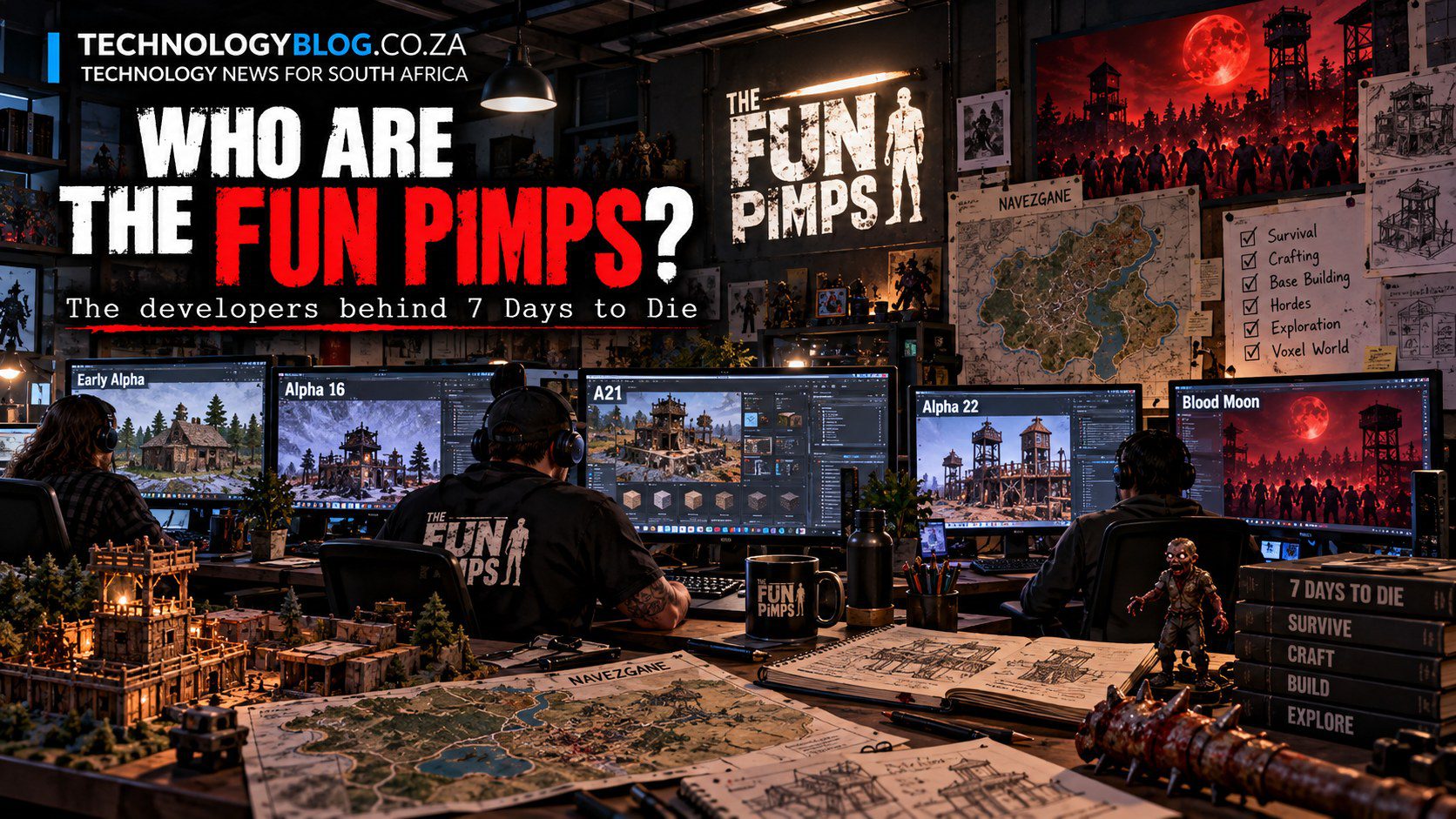
Who are The Fun Pimps? The developers behind 7 Days to Die
The Fun Pimps started with three experienced developers, an ambitious idea for a zombie game and a plan that, in hindsight, was wildly optimistic.
The original concept was called 30 Days to Die.
It would combine hardcore zombie survival with tower defence, day and night cycles and a world players could build and destroy.
Then the developers decided the idea was too ambitious.
They reduced the scope, changed the name to 7 Days to Die and planned to finish it by July 2013.
More than a decade later, The Fun Pimps is still developing it.
Along the way, 7 Days to Die became one of the most recognisable survival games on PC. More than 20 million copies have been sold, console versions followed, and the game eventually reached version 1.0 in 2024.
Then another major change arrived.
In March 2026, Behaviour Interactive acquired The Fun Pimps.
However, the studio says its existing team remains intact and continues to lead development.
For a developer that spent most of its history building one enormous survival sandbox, it marks the beginning of a very different era.
The Fun Pimps began in late 2012
The Fun Pimps was founded in late 2012 by Richard Huenink, Joel Huenink and Christian Lang.
According to the studio’s own history, the founders had their day jobs, a dream of making an independent game and a short Google design document.
The idea behind that document came from Richard and Joel Huenink around Thanksgiving dinner in 2012.
They wanted to create a hardcore zombie survival game.
However, shooting zombies would only be one part of it.
Players would build.
Zombies would destroy.
Day would become night.
Defences would matter.
The world itself would be editable.
Those ideas eventually became the foundation of 7 Days to Die.
Before 7 Days to Die there was 30 Days to Die
The original title was 30 Days to Die.
Even The Fun Pimps realised the proposed game might be too ambitious.
So the scope was reduced.
Thirty days became seven.
The plan was to get the game finished by July 2013.
That did not happen.
Instead, the project expanded into something considerably larger than its creators originally expected.
It is difficult to find a better illustration of 7 Days to Die’s entire development history.
The developers reduced the original concept because it seemed too ambitious.
Then they spent more than a decade making the smaller version increasingly ambitious.
Kickstarter changed the plan
A Kickstarter campaign followed in 2013.
Its success gave The Fun Pimps the opportunity to push the project further.
Players were not simply buying another zombie shooter.
The pitch combined several systems that were becoming increasingly important in PC gaming.
Survival.
Crafting.
Construction.
Exploration.
First-person combat.
Character progression.
Most importantly, the world could be changed.
Players could build it.
They could destroy it.
So could the zombies.
That concept became central to everything that followed.
Modding was part of the studio’s DNA
The Fun Pimps says its team grew from humble beginnings making game mods.
That history matters.
Modding teaches developers to look at existing systems and ask what else they could do.
7 Days to Die often feels built around exactly that question.
What if a zombie game had deeper construction?
What if buildings were destructible?
What if players could dig?
What if survival had RPG progression?
What if a base had to withstand increasingly dangerous hordes?
The result became difficult to classify within a single genre.
The Fun Pimps leaned into that complexity rather than simplifying it.
The studio wanted something AAA developers might avoid
The Fun Pimps has long presented itself as a team willing to take risks that larger studios might avoid.
That description fits 7 Days to Die.
A fully destructible voxel world creates technical complications.
So does multiplayer.
Add vehicles, procedural generation, structural stability, crafting, AI, building and hundreds of points of interest, and those complications multiply.
A more conservative project might have removed systems.
The Fun Pimps kept adding them.
That decision helps explain both the game’s appeal and its unusually long development.
7 Days to Die became The Fun Pimps
Some studios become known for a catalogue.
The Fun Pimps became known for one game.
7 Days to Die effectively grew alongside the company.
As sales increased, the development team expanded. New systems arrived, technology improved and the world became more detailed.
The game’s audience also changed.
Early supporters became long-term players.
Multiplayer communities formed.
Servers appeared.
Modders began extending the game.
Eventually, 7 Days to Die became more than the studio’s first successful project.
It became its identity.
The game crossed several development eras
A player who experienced early 7 Days to Die would recognise the fundamental concept today.
Much of everything else changed.
Graphics improved.
World generation evolved.
Character progression changed.
Weapons changed.
Skills changed.
Traders arrived and evolved.
Vehicles became increasingly important.
Building expanded.
Zombie behaviour changed.
Entire systems were replaced.
Therefore, 7 Days to Die’s long development period is not simply a story about waiting for a game to be completed.
It is also a story about repeatedly rebuilding one.
That approach came with a cost
Constant evolution creates disagreement.
A system that one player dislikes may replace something another player loved.
Progression changes can invalidate established strategies.
World-generation changes alter exploration.
Major releases can affect mods and servers.
Long-term players remember different versions of the game.
Consequently, discussions around 7 Days to Die often include people who prefer specific Alpha releases.
That criticism is part of The Fun Pimps’ history too.
The studio’s willingness to keep changing the game helped it grow. At the same time, those changes sometimes alienated players who preferred what came before.
Early Access lasted more than a decade
Few elements of The Fun Pimps’ story are more striking than the length of 7 Days to Die’s Early Access period.
The game remained under active development for years.
Then years became a decade.
For some players, the development timeline became a running joke.
Others accumulated thousands of hours before version 1.0 existed.
That creates an unusual contradiction.
7 Days to Die was technically unfinished for much of its life.
Yet millions of people had already bought and played it.
Entire communities existed around an unfinished game that was already functioning as a mature survival sandbox.
Version 1.0 finally arrived in 2024
The Fun Pimps eventually reached the symbolic milestone in July 2024.
7 Days to Die launched as version 1.0.
However, development did not stop.
That distinction is important.
Version 1.0 ended the Early Access chapter.
It did not end The Fun Pimps’ plans for the game.
Further updates followed, systems continued evolving and the roadmap moved ahead.
By 2026, the studio was already working across multiple post-1.0 versions.
The Fun Pimps built a game around interconnected systems
The studio’s design philosophy becomes clearer when looking at how 7 Days to Die works.
Building affects survival.
Survival creates demand for resources.
Resources encourage exploration.
Exploration creates combat.
Combat requires equipment.
Equipment requires crafting and looting.
Vehicles expand exploration.
Larger bases consume more resources.
Then the Blood Moon arrives and tests everything.
Each system gives another system a reason to exist.
That is why 7 Days to Die can feel like several games operating simultaneously.
Blood Moons gave the game its signature
Plenty of survival games allow players to build bases.
The Fun Pimps gave those bases an exam.
The Blood Moon horde turns construction into preparation.
Walls are not merely decorative.
Traps are not optional toys.
Entrances matter.
Structural stability matters.
Defensive positions matter.
Eventually, the zombies arrive and discover what the player got wrong.
That loop separates 7 Days to Die from many other survival games.
The player builds because the game intends to attack what they built.
The voxel world made destruction meaningful
The destructible environment is another major part of the studio’s identity.
Players can dig.
They can remove walls.
They can construct structures.
They can alter terrain.
Meanwhile, zombies can damage the environment too.
That changes how players think about safety.
A building is not automatically secure because it has walls.
Those walls have to survive.
As a result, the environment becomes part of the simulation rather than merely scenery surrounding it.
Navezgane became the studio’s apocalypse
The fictional Arizona county of Navezgane became synonymous with 7 Days to Die.
It provides the handcrafted version of the apocalypse.
Players learn its roads, towns, wilderness and points of interest.
However, The Fun Pimps also supports procedurally generated worlds.
That gives players another way to experience the same systems.
A familiar map rewards knowledge.
A generated map restores uncertainty.
Both approaches support the larger survival sandbox.
The community became part of development
A game developed for this long inevitably develops a long relationship with its players.
The Fun Pimps has a community that spans multiple generations of 7 Days to Die.
Some players backed the original project.
Others arrived during later Alpha versions.
Many discovered it after version 1.0.
Those groups do not always agree.
Nevertheless, their feedback has accompanied the project throughout its evolution.
The result is a studio that has spent much of its existence developing in public.
More than 20 million copies changed the scale
The Fun Pimps now says 7 Days to Die has sold more than 20 million copies.
That puts the studio’s history into perspective.
Three developers began with a design document and an independent game idea.
That project eventually reached an audience measured in tens of millions of sales.
The commercial success also gave The Fun Pimps something valuable:
time.
The studio could continue working on the game rather than immediately replacing it with a sequel.
That decision shaped everything that followed.
The Fun Pimps did not rush towards 7 Days to Die 2
A conventional path might have produced several sequels by now.
The Fun Pimps chose differently.
Instead of abandoning the original game, the studio kept expanding it.
That approach allowed years of systems to accumulate inside one product.
It also means 7 Days to Die carries the history of its development inside itself.
Today’s game is built on more than a decade of ideas, experiments, replacements and revisions.
The result can sometimes be messy.
It is also difficult to reproduce quickly.
The studio moved beyond a single project
Although 7 Days to Die remains its defining work, The Fun Pimps has started expanding the universe.
7 Days Blood Moons represents one example.
Developed by The Fun Pimps and iLLOGIKA, Blood Moons takes the setting in a different direction.
The game uses an asymmetric 4v1 structure.
Four survivors face another player controlling the zombie threat.
That changes the familiar formula.
Instead of simply surviving AI-driven hordes, players face a human opponent influencing the attack.
For The Fun Pimps, it also represents an important step beyond maintaining only the original game.
The studio still has unfinished business with 7 Days to Die
Expansion does not mean the original game has been abandoned.
Far from it.
7 Days to Die continues receiving updates in 2026.
The Fun Pimps has also changed how development is organised.
A dedicated team can handle smaller updates, bug fixes and quality-of-life improvements.
Meanwhile, another team can continue work on larger releases.
That approach should allow the studio to improve the current game without stopping work on major future systems.
V4.0 is already part of that future
The next major milestone is V4.0.
Bandits are its headline planned feature.
Their importance goes beyond adding another enemy type.
Zombies behave according to the logic of zombies.
Human opponents can create different combat situations.
They can use weapons.
They can occupy locations.
They can potentially force players to approach encounters differently.
The Fun Pimps has discussed bandits for years.
Therefore, their eventual arrival would close one of the longest-running chapters in the game’s roadmap.
Until V4.0 ships, however, they remain a planned feature.
Then everything changed in March 2026
The biggest corporate event in The Fun Pimps’ history arrived on 24 March 2026.
Behaviour Interactive acquired The Fun Pimps.
That ended the studio’s status as an independent company.
The distinction matters.
The Fun Pimps did not acquire Behaviour.
This was not simply a publishing arrangement.
The Fun Pimps became part of Behaviour Interactive.
For a studio built around independent development, the acquisition represents a fundamental change in ownership.
Why did The Fun Pimps join Behaviour Interactive?
The studio’s explanation focuses on resources and growth.
According to The Fun Pimps, there is still much it wants to do with 7 Days to Die.
Behaviour’s backing gives the developer additional support.
The Fun Pimps says it can now grow its team and deliver more for the game and its community.
That makes sense when viewed against the scale of modern 7 Days to Die.
Supporting one large live game across multiple platforms requires substantial resources.
Building future content requires more.
Expanding into additional projects adds another layer.
The studio is no longer managing the relatively small project it started in 2012.
The Fun Pimps says it remains in control of development
An acquisition naturally raises questions about creative control.
The Fun Pimps addressed that directly.
The studio says it will continue to lead development of 7 Days to Die.
It also says the existing team remains and its vision has not changed.
Behaviour provides additional support and resources.
That is the stated arrangement in 2026.
How the relationship develops over several years remains something to report as it happens rather than predict.
For now, the important fact is straightforward:
Behaviour owns The Fun Pimps, while The Fun Pimps continues leading 7 Days to Die development.
Some players were immediately concerned
Not everyone welcomed the acquisition.
Community discussion following the announcement included concerns about monetisation, downloadable content and Behaviour’s influence over the game.
Those concerns are understandable as reactions to a significant ownership change.
However, they should not be presented as confirmed plans.
The Fun Pimps has not announced that 7 Days to Die will adopt another Behaviour game’s monetisation model simply because Behaviour now owns the studio.
TechnologyBlog should therefore distinguish between what players fear and what the companies have actually announced.
At present, the confirmed change is ownership and additional development support.
Behaviour brings experience with long-running games
There is also an obvious connection between the companies.
Behaviour Interactive understands games that remain active for years.
Dead by Daylight is the clearest example.
That does not mean 7 Days to Die will follow the same business model.
The games are different.
Their communities are different.
Their development histories are different.
However, Behaviour has experience supporting a game with a large, long-term player community.
That experience could prove useful as The Fun Pimps enters the next phase of 7 Days to Die.
The acquisition gives The Fun Pimps room to grow
The Fun Pimps specifically identified team growth as one benefit of the deal.
That could become important.
7 Days to Die now exists across PC and current-generation consoles.
It requires ongoing updates.
V4.0 is in development.
Additional projects are expanding the wider 7 Days universe.
More platforms and more projects create more work.
A larger organisation behind the studio can provide resources that would be difficult for a smaller independent team to reproduce.
The real measure will be what those resources produce.
The Fun Pimps remains closely tied to one game
Despite everything that has changed, the studio’s identity remains unusually focused.
Mention The Fun Pimps and the immediate association is 7 Days to Die.
That is not necessarily a weakness.
Some developers build their reputation through dozens of games.
The Fun Pimps built its reputation through depth.
The studio kept taking one idea further.
A simple zombie-survival concept became a world-building platform, multiplayer sandbox and base-defence game.
Then it kept evolving.
Why The Fun Pimps matters in 2026
The Fun Pimps is an unusual example of what happens when an independent game refuses to stop growing.
The original plan was relatively modest.
Finish a zombie game.
The Kickstarter changed that.
Sales changed it again.
The community expanded.
The game became larger.
Then development continued for more than a decade.
By 2026, the project had sold more than 20 million copies and its developer had become valuable enough to attract Behaviour Interactive.
That is an extraordinary distance from a Google design document created by three developers with day jobs.
The studio’s biggest challenge may be what comes next
For most of its history, The Fun Pimps had a clear identity.
It was the independent developer making 7 Days to Die.
That description is no longer sufficient.
The studio now belongs to Behaviour Interactive.
7 Days to Die has passed 1.0.
V4.0 is coming.
Blood Moons expands the franchise.
The development team can grow.
Those changes create opportunities.
They also create expectations.
Players who supported the studio for years will watch closely to see what changes under Behaviour ownership.
The Fun Pimps now has to prove that greater resources can expand its work without erasing the identity that made the studio successful.
From 30 Days to Die to more than 20 million sales
There is something wonderfully appropriate about the beginning of The Fun Pimps’ story.
Richard Huenink, Joel Huenink and Christian Lang thought their original concept was too ambitious.
So 30 Days to Die became 7 Days to Die.
The smaller game was supposed to be finished in 2013.
Instead, it consumed more than a decade of development.
It survived Early Access.
It expanded onto consoles.
It built a huge community.
It passed 20 million copies sold.
It grew beyond its original studio.
Then Behaviour Interactive acquired the company behind it.
The Fun Pimps may no longer be independent, but the studio’s defining project remains very much alive.
More updates are coming.
V4.0 is in development.
The team is expected to grow.
And more than 13 years after three developers began planning their zombie game, The Fun Pimps is still building the apocalypse they thought they could finish in a few months.


