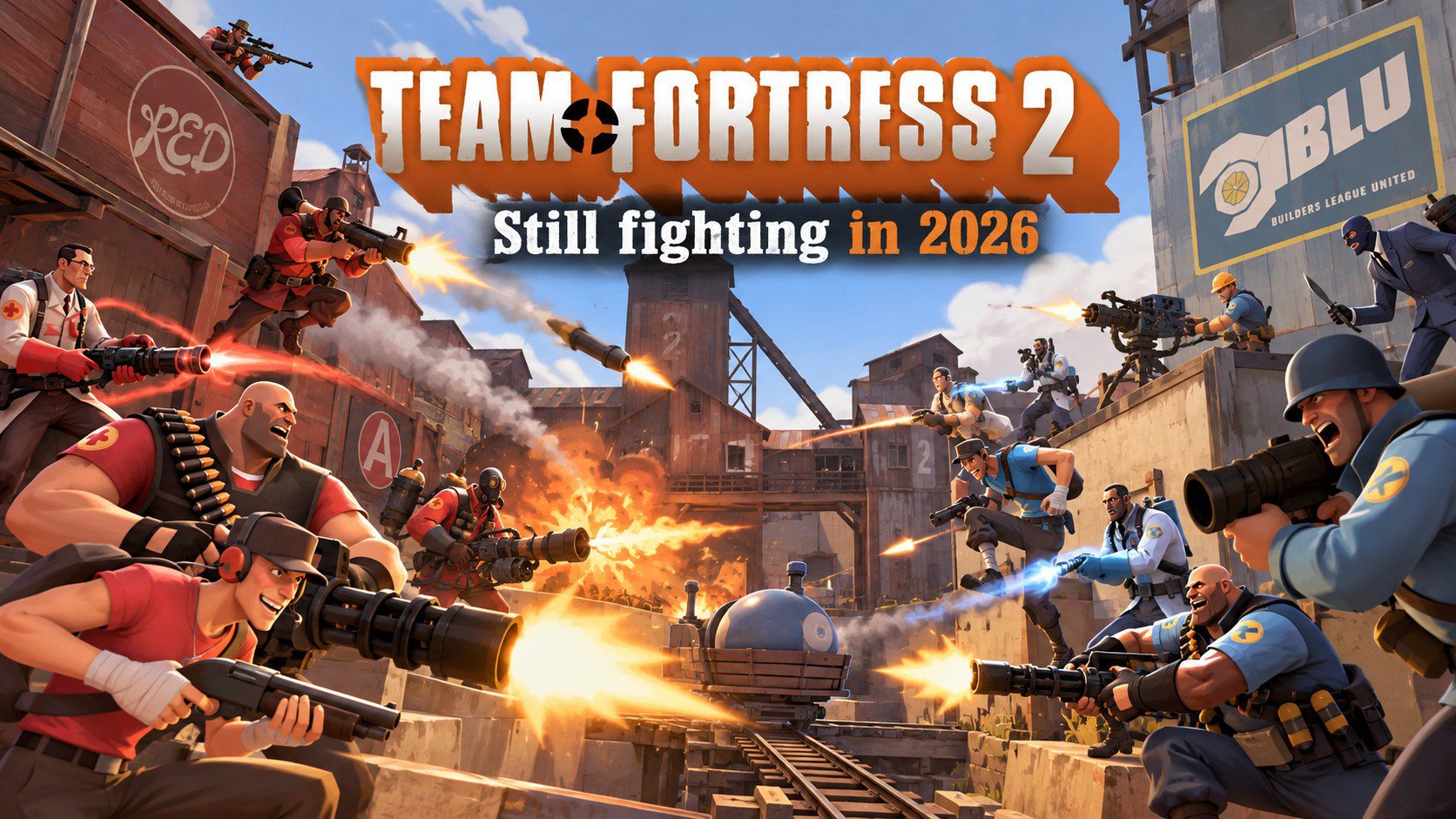
Team Fortress 2 in 2026: How Valve’s 19-year-old shooter refuses to die
Team Fortress 2 in 2026 should feel ancient.
Valve released it on 10 October 2007.
The original iPhone had launched only a few months earlier. Call of Duty 4: Modern Warfare had not yet arrived. Minecraft did not exist, Fortnite was years away, and Steam itself was still becoming the platform PC gamers know today.
Yet almost 19 years later, Team Fortress 2 is still running.
More importantly, people are still playing it.
During TechnologyBlog’s latest check, SteamDB was recording roughly 73,000 simultaneous Steam users in Team Fortress 2. Its 24-hour peak was around 75,000.
Those numbers change constantly and should not be confused with daily or unique players. TF2 has also faced a long history of automated bots, making raw concurrency especially important to treat carefully.
Nevertheless, one fact is difficult to dispute.
Team Fortress 2 remains enormously visible on Steam.
And somehow, after almost two decades, Valve is still updating it.
Team Fortress 2 arrived in a very different gaming industry
Team Fortress 2 launched as part of The Orange Box in 2007.
Valve packaged it alongside Half-Life 2: Episode Two and Portal.
Even within that extraordinary collection, TF2 stood out.
Its exaggerated characters looked nothing like the increasingly realistic military shooters dominating the period.
Instead of anonymous soldiers, Valve created nine instantly recognisable personalities.
The Heavy.
The Scout.
The Soldier.
The Pyro.
The Demoman.
The Engineer.
The Medic.
The Sniper.
The Spy.
Each looked different.
More importantly, each played differently.
Outbound link: Add the official Team Fortress 2 page here.
Nine classes created the foundation
The basic class structure remains one of TF2’s greatest strengths.
Scout is fast.
Heavy is slow and devastating at close range.
Sniper controls long sightlines.
Engineer builds equipment.
Medic keeps teammates alive and can transform a coordinated push through ÜberCharge.
Spy survives through deception.
Soldier and Demoman combine explosive firepower with unusual movement possibilities.
Pyro controls close-range space.
These classes do not simply carry different weapons.
They create different jobs.
As a result, changing class can fundamentally change how a match feels.
Valve made personality part of gameplay
TF2’s characters also became much more than loadouts.
Valve gave each class a distinctive voice, silhouette and personality.
The Meet the Team videos pushed that idea further.
Heavy became Heavy.
Spy became Spy.
Medic became one of gaming’s least reassuring doctors.
Those personalities helped Team Fortress 2 escape the limits of the game itself.
Characters became memes.
Voice lines became part of internet culture.
Animations appeared everywhere.
Community creators took Valve’s characters and produced years of artwork, videos and jokes.
That cultural afterlife became one reason TF2 proved so difficult to replace.
Team Fortress 2 never needed military realism
The visual style also aged unusually well.
TF2 does not depend on photorealism.
Its exaggerated shapes, strong colours and clear silhouettes were designed to communicate information.
Players need to identify a class quickly.
They need to recognise RED and BLU.
They need to understand where danger is coming from.
The stylised presentation supports that.
It also means a game released in 2007 does not simply look like a failed attempt at 2026 realism.
Team Fortress 2 looks like Team Fortress 2.
That distinction matters.
Supporting image: RED and BLU teams facing one another.
Alt: Team Fortress 2 in 2026 RED and BLU classes
The objective is usually more important than the kill count
TF2 also avoids making every match purely about eliminating the other team.
Payload asks one side to move a cart while the other tries to stop it.
Control Point creates battles over territory.
Capture the Flag sends teams after intelligence briefcases.
King of the Hill concentrates both sides around one critical location.
Attack/Defend creates another variation.
Those objectives give the classes something to organise around.
An Engineer’s sentry matters because it protects an important position.
A Medic’s ÜberCharge matters because it can break that defence.
A Spy matters because the Engineer is hiding behind it.
The systems create problems for one another.
The class system creates natural counters
That relationship is central to TF2.
A Heavy can dominate a corridor.
A Sniper can punish him from range.
A Spy can bypass the sightline.
Pyro can expose the Spy.
Engineer can lock down an area.
Demoman can bombard the position.
Medic can enable a push through the damage.
No class operates in isolation.
Consequently, a match constantly asks players to respond to what the opposing team is doing.
Sometimes the best move is not aiming better.
It is changing class.
Movement became deeper than Valve probably needed
Then players started discovering what the classes could really do.
Rocket jumping turned Soldier into something approaching an airborne assault class.
Sticky jumping gave Demoman enormous mobility.
Scout’s speed and double jump created another movement language.
Entire communities formed around mastering those mechanics.
Jump maps pushed them further.
Competitive players learned movement techniques that casual players might never need.
That depth gave TF2 another form of longevity.
The basic controls remain approachable.
Mastering them can take years.
Competitive Team Fortress 2 never disappeared
TF2 never became an esport on the scale of Counter-Strike.
Its competitive community survived anyway.
In 2026, organised TF2 is still producing physical LAN events.
The year’s events have included competitions in Europe, North America and Australia.
poLANd.tf brought international teams to Łódź.
RGL organised LAN playoffs in Philadelphia.
LAN Downunder continued Australian competition in Melbourne.
ÜBERFEST brought European players together in Stuttgart.
There are also specialised competitions built around individual movement skills.
TF2’s competitive scene may sit outside the largest modern esports circuits, but it remains remarkably persistent.
Supporting image: Official/community competitive TF2 event imagery.
Alt: Team Fortress 2 competitive community in 2026
Valve still acknowledges that competitive community
The official Team Fortress website continues promoting community competitions.
That support matters.
Valve may not operate TF2 like one of today’s heavily managed esports products, but the game’s official channels still provide visibility to tournaments and LANs.
Tournament medals also continue appearing through updates.
The relationship is unusual.
Much of TF2’s modern competitive infrastructure comes from the community.
Valve provides enough support to help that ecosystem remain connected to the game.
Free-to-play transformed the audience
Team Fortress 2 did not launch as a free game.
That changed in 2011.
Moving to free-to-play dramatically expanded its potential audience.
Anyone with Steam and a compatible PC could try it.
The Mann Co. Store and cosmetic economy became part of the new model.
Hats became an industry.
That sounds ridiculous.
In TF2, ridiculous was entirely appropriate.
The hats became part of the identity
Cosmetics are now inseparable from Team Fortress 2.
Players can customise their classes with an enormous range of items.
Some are subtle.
Others are absurd.
Many are community-created.
Unusual effects created another level of rarity.
Trading created an economy around desirable items.
For some players, cosmetics became almost as important as weapons.
That system also gave community artists a way to contribute directly to the game.
Community content helped TF2 survive
Valve increasingly incorporated community-created work into Team Fortress 2.
Maps.
Cosmetics.
War paints.
Unusual effects.
Taunts.
Fixes.
The official 2026 patch notes continue crediting community contributors for individual fixes.
That detail is easy to overlook.
Team Fortress 2 is no longer sustained exclusively by people sitting inside Valve.
Its community has become part of the development ecosystem.
Supporting image: Selection of community-created TF2 cosmetics or maps.
Alt: Team Fortress 2 community content and cosmetics
Valve is still patching Team Fortress 2 in 2026
Calling TF2 abandoned is therefore inaccurate.
Valve released multiple updates during 2026.
Some were small.
They fixed crashes, materials, map geometry, cosmetics and other problems.
Others updated community maps or tournament medals.
The July update cycle included adjustments across several maps and items.
This is not the development cadence of a modern seasonal shooter.
However, it is active maintenance.
For a game approaching its 19th birthday, even that distinction is significant.
Outbound link: Add Valve’s official TF2 update archive here.
Community fixes are appearing in official updates
Several 2026 patch notes specifically credit community fixes.
That reveals how TF2 is maintained today.
Players and creators identify problems.
Community members sometimes develop solutions.
Valve can incorporate those fixes into official releases.
It is a practical arrangement for a game with an enormous amount of legacy content.
It also demonstrates how deeply the community understands TF2’s technology.
After almost two decades, some players know the game extraordinarily well.
A new Mann vs. Machine update is still being developed
The most interesting current development may involve Mann vs. Machine.
MvM is TF2’s cooperative mode.
Instead of fighting another human team, players work together against waves of robots.
Money collected during the match funds upgrades.
Classes that normally fight one another become pieces of a cooperative defensive system.
In July 2026, Valve provided a wonderfully TF2-like update about the update.
The message was simple beneath the joke:
the team is still working on the Mann vs. Machine update.
Valve said sorting through the new content and changes was taking longer than expected but confirmed progress was continuing.
That means a game released in 2007 still has notable new work underway in 2026.
Outbound link: Add Valve’s official July 2026 Mann vs. Machine development update here.
The community already keeps Mann vs. Machine busy
Official development is only part of the MvM story.
Community organisations continue creating their own campaigns and charity events.
In May 2026, Potato.TF ran Operation Memes vs Machines: Re-Peeled.
Then September brought Operation Lithium Lunacy from Abyss MvM.
That event included dozens of missions across 28 maps, ranging from intermediate to extremely difficult expert content.
The fact that community creators are still producing substantial MvM campaigns shows how far TF2 extends beyond Valve’s own content pipeline.
Team Fortress 2 is partly a community platform now
This may be the best way to understand modern TF2.
Valve created the foundation.
The community built on top of it.
Servers can provide experiences that barely resemble standard matchmaking.
Creators produce maps and cosmetics.
Animators create videos.
Competitive organisations run leagues.
Mann vs. Machine groups build campaigns.
Traders participate in an economy.
Movement players build jump maps.
The game has become infrastructure for several overlapping communities.
That makes it harder to kill than a conventional multiplayer shooter.
Matchmaking is only one version of TF2
Modern multiplayer games often live or die according to their official matchmaking population.
Team Fortress 2 has another layer.
Community servers remain important.
They can run different maps, rules and modifications.
Some recreate more traditional TF2 experiences.
Others become chaotic experiments.
Players can find specialised servers built around particular modes or communities.
That decentralisation gives TF2 resilience.
Even if one part of the game changes, another part can continue.
The bot crisis nearly overwhelmed that resilience
Any discussion of modern Team Fortress 2 also needs to address its biggest recent problem.
Automated cheating bots became a severe issue on Valve’s official servers.
They could flood matches.
They used cheats.
They disrupted normal play.
Players became increasingly frustrated.
Community campaigns such as #SaveTF2 and later #FixTF2 attempted to pressure Valve into taking stronger action.
The issue became serious enough that the health of the entire game was being questioned.
Valve eventually took stronger action
Valve responded with enforcement and technical changes aimed at the bot problem.
The situation improved significantly compared with the worst periods of the crisis.
However, the history creates an important warning when interpreting TF2 player statistics.
Steam reports software sessions.
It does not certify that every concurrent instance represents one actively participating human player.
Therefore, TechnologyBlog should never translate TF2’s Steam concurrency directly into claims about exact human population.
The correct statement is simpler:
tens of thousands of Steam accounts are simultaneously running Team Fortress 2 during normal periods.
Team Fortress 2 in 2026 remains huge on Steam
Even with that caution, TF2’s position remains remarkable.
During TechnologyBlog’s latest check, SteamDB recorded roughly 73,000 concurrent users.
Its 24-hour peak was approximately 75,000.
SteamDB’s historical record shows an all-time Steam peak of 253,997 concurrent users.
At the time of the check, TF2 was sitting among Steam’s most-played games.
That is extraordinary for something released in October 2007.
Outbound link: Add SteamDB here for live statistics.
Do not confuse concurrency with total players
The distinction is especially important for this article.
73,000 concurrent users does not mean TF2 has 73,000 players.
It means roughly that many Steam sessions were running simultaneously at that particular moment.
A completely different group may play later.
Therefore, concurrency cannot tell us the number of daily, monthly or unique players without additional data.
It also cannot tell us how many sessions represent bots.
What it can demonstrate is continued activity.
TF2 has plenty of that.
Steam reviews remain remarkably positive
The review history is equally striking.
Steam currently lists Team Fortress 2 as Very Positive.
In the latest checked snapshot, 92% of approximately 5,500 recent reviews were positive.
The English-language lifetime dataset also remained Very Positive.
Across all languages and review types, Steam displayed more than 1.25 million reviews.
That is an enormous accumulated footprint.
Few games remain available long enough to collect review numbers on that scale.
Fewer still continue attracting strongly positive new reviews almost two decades later.
New players are entering a game older than some of them
That creates an unusual situation.
Someone discovering TF2 in 2026 may be younger than Team Fortress 2.
They enter a game filled with nearly two decades of accumulated culture.
Veterans know maps intimately.
Movement techniques have been refined for years.
Trading has its own terminology.
Community jokes have histories.
Weapons have stories behind their balance changes.
Even hats have histories.
Yet the basic game remains understandable.
Pick a class.
Join RED or BLU.
Follow the objective.
Shoot the other team.
That accessibility helps new players enter an incredibly old ecosystem.
TF2’s low hardware requirements also help
Age has another advantage.
Team Fortress 2 does not demand modern high-end hardware.
That lowers the barrier to entry.
Players with older PCs can still participate.
For regions where high-end gaming hardware remains expensive, that matters.
South African players do not need a current enthusiast GPU to experience TF2.
The game is also free-to-play.
Together, those factors make trying it considerably easier than entering many modern multiplayer shooters.
South African players still need to think about server location
Hardware is only one side of multiplayer.
Network conditions matter.
For South African players, latency depends on the server being used.
Community servers can be located in different regions, while matchmaking may connect players to infrastructure outside South Africa depending on availability and routing.
Therefore, there is no responsible single ping figure for TF2 in South Africa.
Players should evaluate the servers available to them rather than assume every match will provide the same experience.
The game’s age does not remove geography from online multiplayer.
TF2 influenced an entire generation of shooters
Team Fortress 2 also matters because so many later games adopted ideas it helped popularise.
Distinct heroes or classes.
Readable silhouettes.
Strong character personalities.
Team composition.
Ability-driven roles.
Cosmetic economies.
Ongoing content.
Stylised multiplayer presentation.
TF2 did not invent every one of those concepts.
However, it combined them years before the modern hero-shooter boom.
Games released much later entered a market that Team Fortress 2 had already helped shape.
Yet TF2 does not feel exactly like a modern hero shooter
The difference becomes obvious when playing it.
There are no seasonal battle passes defining the entire experience.
Heroes are not constantly being added to an expanding roster.
The nine classes remain the foundation.
Weapons modify those roles rather than replacing them.
Movement can become wildly technical.
Community servers remain important.
Matches can move from coordinated teamwork to complete nonsense within seconds.
TF2 belongs partly to an older era of multiplayer design.
That is now one of its strengths.
Comedy became a competitive advantage
Very few shooters are genuinely funny.
TF2 is.
The humour exists in character dialogue, animation, weapons, cosmetics and the situations players create.
A Heavy eating a sandwich in the middle of a firefight makes sense here.
So does a Spy disguising himself as the person he just killed.
So does an Engineer repeatedly hitting a sentry with a wrench while rockets explode around him.
The comedy prevents the game from taking its violence too seriously.
It also makes individual moments memorable.
Valve’s silence became part of TF2 culture too
There is another side to the relationship.
TF2 players have spent years waiting for major Valve communication.
Large content gaps created frustration.
The community learned not to expect a conventional live-service roadmap.
As a result, even relatively small signs of Valve activity can attract enormous attention.
That is hardly an ideal communication strategy.
Yet the community adapted.
TF2 continued through periods when its future looked uncertain.
Now, in 2026, official updates and an upcoming MvM project provide more concrete evidence that Valve has not completely walked away.
The community did much of the work required to keep TF2 alive
That deserves recognition.
Valve built Team Fortress 2.
Its community helped turn 19 years into a continuing culture.
Map makers created places to play.
Artists created cosmetics.
Competitive organisers created tournaments.
Server operators created communities.
Animators turned the characters into something larger than the game.
Modders experimented.
MvM creators built campaigns.
Players simply kept showing up.
Without that activity, TF2 could easily have become a nostalgic entry in Valve’s back catalogue.
Instead, it remains an active multiplayer game.
Why is Team Fortress 2 still popular in 2026?
There is no single answer.
It is free.
It runs on modest hardware.
The nine classes remain distinct.
The weapons create enormous variety.
The movement has surprising depth.
The visual style aged well.
Community servers offer alternatives to matchmaking.
Workshop creators keep contributing.
Competitive players keep organising.
The characters became cultural icons.
And underneath all of that, Team Fortress 2 remains extremely good at creating stories inside a match.
A coordinated push works.
A Spy ruins everything.
A Medic saves it.
A Scout steals the objective.
An Engineer’s sentry somehow survives.
Then somebody starts dancing.
Few multiplayer games move between competition and absurdity so naturally.
Is Team Fortress 2 worth playing in 2026?
TechnologyBlog has not conducted a fresh scored review for this article, so this is not a purchase recommendation.
The current evidence nevertheless tells us plenty about the game’s condition.
Valve continues releasing updates.
A Mann vs. Machine update remains in development.
Community events are active.
Competitive LANs still take place.
Steam reviews remain Very Positive.
Steam concurrency remains measured in tens of thousands.
The main caveats are equally important.
TF2 is an old game.
Its development cadence is nothing like a modern live-service shooter.
Its community has endured serious botting problems.
Network conditions vary by server and region.
Players should approach it as a living classic rather than expect Valve to operate it like a newly launched competitive shooter.
Team Fortress 2 in 2026 has outlived entire gaming trends
Nineteen years is an extraordinary amount of time in multiplayer gaming.
Franchises have appeared and disappeared during Team Fortress 2’s lifetime.
Online services have closed.
Consoles have gone through several generations.
The hero-shooter boom arrived long after TF2 and produced its own successes and failures.
Team Fortress 2 remained.
Its graphics are old.
Its engine is old.
Its code carries almost two decades of history.
Its development has been inconsistent.
Its community has fought through neglect, bots and long waits between major updates.
Yet tens of thousands still launch it simultaneously.
Players still make maps.
Artists still make cosmetics.
Teams still travel to LAN events.
Valve is still releasing patches.
And somewhere, apparently, somebody at Valve is still working on Mann vs. Machine.
Team Fortress 2 does not survive because it successfully pretends to be a modern shooter.
It survives because almost 19 years later, there is still nothing quite like Team Fortress 2.
