Steam Deck History: How Valve Turned Steam Into a Handheld PC Platform
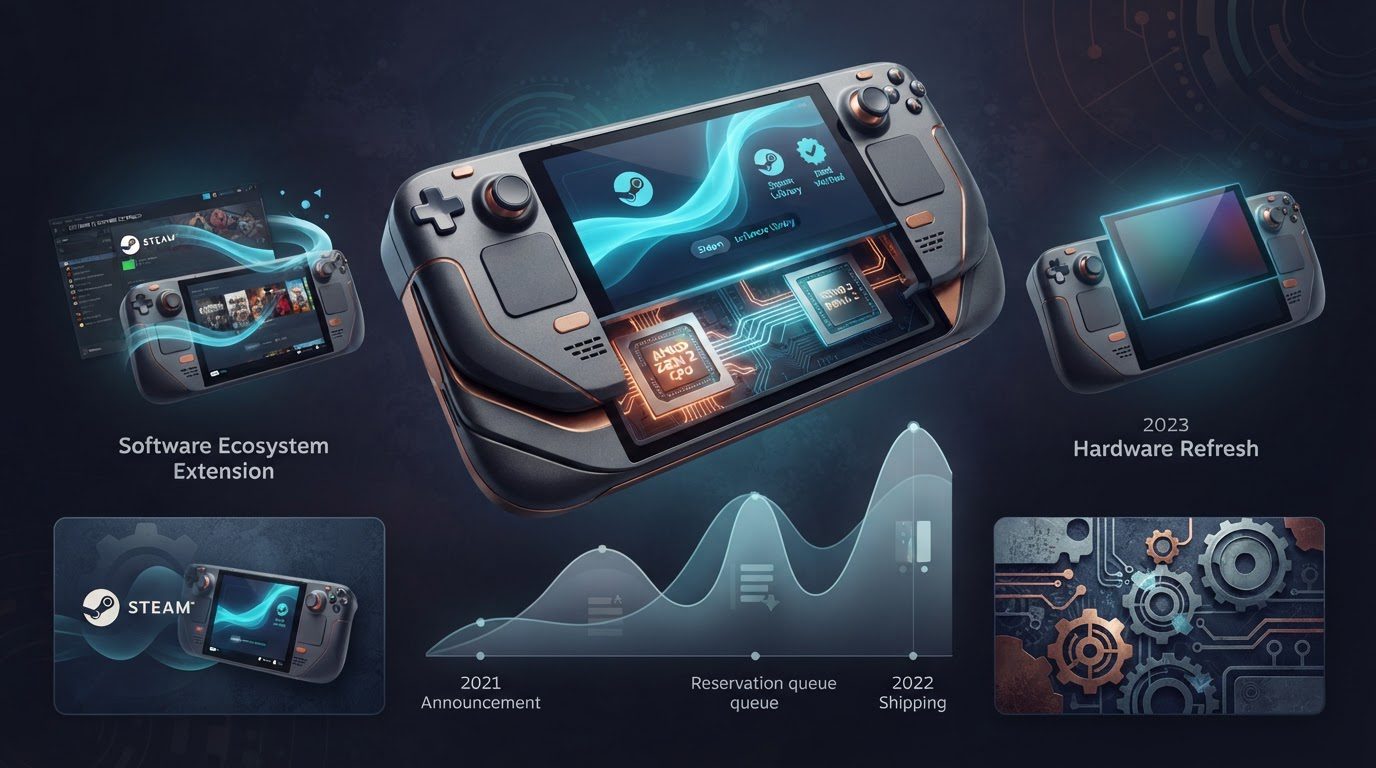
Steam Deck is not a company with a founding date of its own; it is a Valve hardware platform whose history starts with a product announcement. Valve unveiled the handheld gaming PC in 2021 and began shipping it in February 2022 after supply-chain shortages pushed the original launch timetable back. That distinction matters because the Deck’s story is really about Valve extending the Steam software ecosystem into a tightly integrated piece of PC hardware, rather than creating a separate gaming brand from scratch.
The original Steam Deck paired a custom AMD processor using Zen 2 CPU cores and RDNA 2 graphics with Valve’s Linux-based SteamOS. The engineering goal was unusual for handheld gaming: preserve the openness and software library of a PC while offering controls, suspend-and-resume behaviour and a user interface closer to a console. Valve also introduced its Deck Verified programme to help users understand how individual PC games behave on the smaller screen and controller-led interface. The result was a product whose value depended as much on compatibility work and software integration as on the processor inside it.
How Valve Turned Steam Into a Handheld PC Platform
Early demand turned supply into part of the launch story. Valve used a reservation queue while component shortages constrained production, then announced in October 2022 that it had cleared the queue and could sell the device without reservations. That change was consequential: Steam Deck moved from a scarce enthusiast product into a continuously available part of Valve’s platform strategy, giving developers and publishers a larger reason to consider handheld PC play when testing games.
Valve refreshed the hardware in 2023 with Steam Deck OLED. The update did more than replace the LCD panel: Valve moved to a more efficient 6 nm APU, increased display size and refresh rate, added Wi‑Fi 6E, improved thermals and fitted a larger battery. Valve says the OLED model delivers 30% to 50% more battery life, depending on use. The refresh showed how the company was treating the Deck as a sustained hardware family rather than a one-off experiment.
Steam Deck today
Valve still sells Steam Deck as an active hardware family in 2026, but its current retail line is centred on the 512GB and 1TB OLED models rather than the earlier LCD versions. The platform remains a portable PC rather than a closed console, with microSD expansion, desktop mode and ongoing SteamOS development central to the proposition.
What makes Steam Deck historically interesting is the layer of the technology stack it occupies. Valve did not try to lock PC gaming into a new closed catalogue. Instead it built dedicated hardware around an existing store, operating system work, controller technology and the huge Windows-oriented Steam library. The continuing importance of compatibility tools and software updates reflects that origin. Steam Deck’s defining contribution is therefore not simply that it is a handheld PC, but that Valve made the handheld form factor a first-class destination for the PC games ecosystem it already operated.