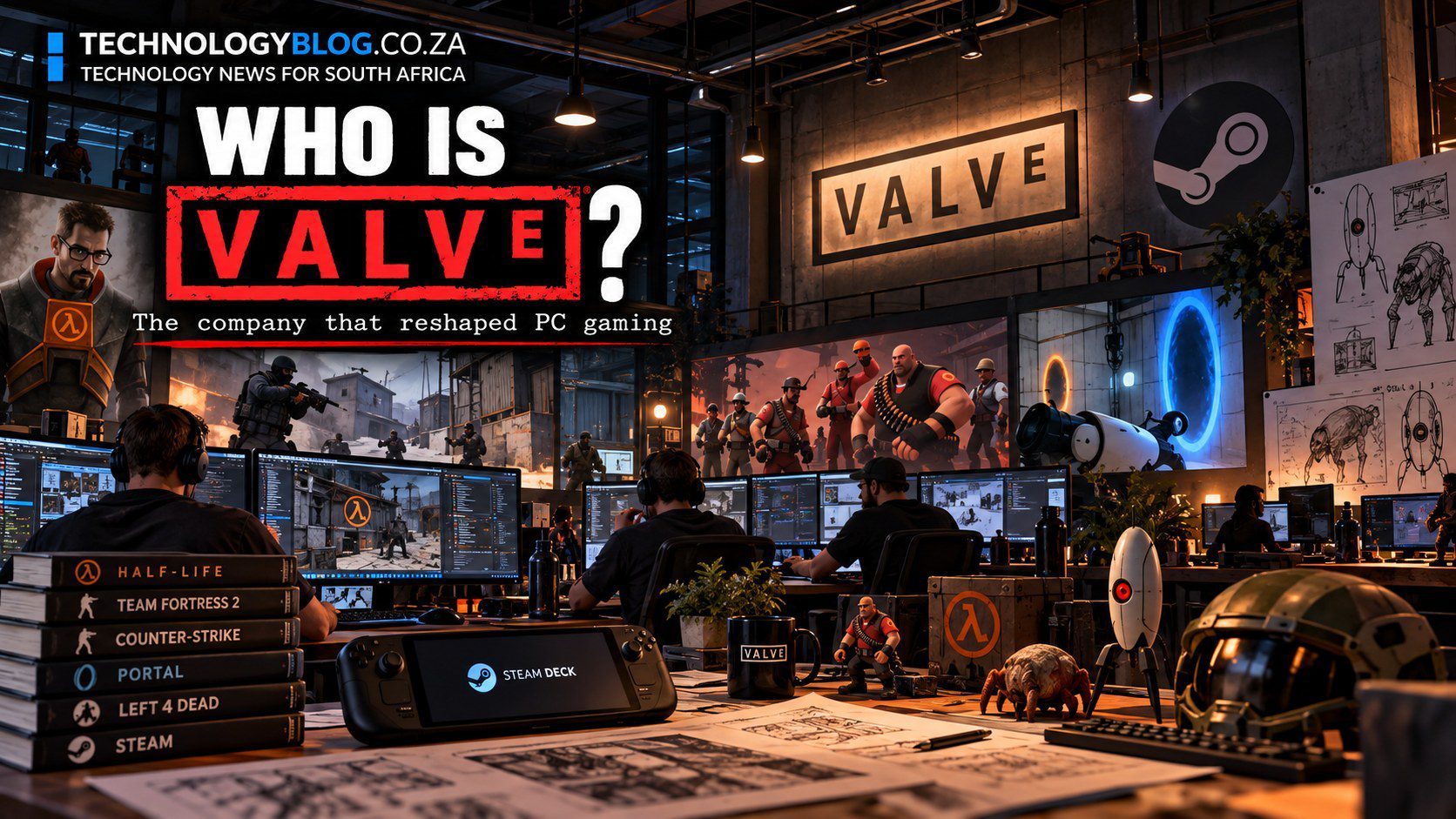
Who is Valve? The company behind Steam, Half-Life and Team Fortress 2
Valve occupies a position in gaming that almost no other company can replicate.
It develops games.
It operates one of the world’s largest PC gaming platforms.
It creates game engines.
It builds gaming hardware.
It has produced Half-Life, Counter-Strike, Team Fortress, Portal, Left 4 Dead and Dota.
Then there is Steam.
For millions of PC players, opening Steam is simply part of playing games. Buying something, downloading it, installing an update, joining friends or browsing a sale all happen through Valve’s platform.
That makes it easy to forget where the company started.
Valve began in 1996 with two former Microsoft employees and a plan to make games.
Its first project was Half-Life.
PC gaming was never quite the same afterwards.
Valve was founded by two former Microsoft employees
Gabe Newell and Mike Harrington founded Valve in 1996.
Both came from Microsoft.
Instead of remaining inside one of the world’s largest technology companies, they created a new studio focused on games.
The timing was significant.
PC gaming was changing rapidly.
3D graphics were advancing.
First-person shooters were booming.
Quake had demonstrated what fully 3D environments could do.
Valve entered that market with something considerably more ambitious than a straightforward shooter.
The result was Half-Life.
Half-Life established Valve immediately
Valve released Half-Life in 1998.
The game starred theoretical physicist Gordon Freeman, whose extremely bad day at the Black Mesa Research Facility became one of gaming’s most influential first-person adventures.
Half-Life still involved shooting.
However, Valve wanted more than a sequence of arenas filled with enemies.
Storytelling happened inside the game world.
Scripted sequences unfolded without constantly removing control from the player.
Characters interacted with Gordon.
Environmental details carried information.
The player experienced the disaster rather than simply being told about it.
That approach influenced an enormous number of first-person games that followed.
Black Mesa became one of gaming’s defining locations
Half-Life also demonstrated Valve’s interest in world building.
Black Mesa felt like a place.
Laboratories connected to offices.
Transit systems moved employees around.
Industrial areas existed beneath scientific facilities.
When the resonance cascade shattered normality, the disaster affected a world the player had already begun to understand.
That made the chaos more effective.
Valve would return to this idea repeatedly.
Its best games do not simply contain levels.
They create places players remember.
Valve understood modding early
Another decision would become equally important.
Valve embraced modding.
Players and developers could use its technology to create their own experiences.
That openness produced consequences even Valve could not have fully predicted.
One of those projects was Counter-Strike.
Another part of Valve’s future had effectively arrived from outside the company.
Counter-Strike started as a mod
Counter-Strike began as a Half-Life mod created by Minh Le and Jess Cliffe.
Its terrorist-versus-counter-terrorist structure was dramatically different from Half-Life’s single-player adventure.
Rounds were tense.
Death mattered.
Weapons behaved differently.
Teamwork mattered.
The mod became enormously popular.
Valve recognised what was happening and brought Counter-Strike into the company.
That decision helped create one of the most important competitive FPS franchises in gaming history.
Valve learned something important from its community
Counter-Strike demonstrated that players were not simply consumers.
They could become creators.
A mod could become a major commercial game.
That lesson appears repeatedly throughout Valve’s history.
Team Fortress had community roots.
Dota grew from the modding scene.
Steam Workshop later formalised community content across many games.
TF2 creators produce maps and cosmetics.
Valve repeatedly found value in letting people modify, create and experiment around its technology.
Sometimes the community built things Valve itself never would have designed.
Team Fortress followed another unusual path
Team Fortress also existed before the Valve version most players know today.
Its roots stretch back to the Quake modding scene.
Valve eventually developed Team Fortress Classic, followed years later by Team Fortress 2.
TF2 launched in 2007.
Instead of chasing military realism, Valve built a colourful class-based shooter around nine distinctive characters.
Almost 19 years later, those nine classes are still fighting.
Internal link: Link here to Team Fortress 2 in 2026: How Valve’s 19-year-old shooter refuses to die.
Steam started as a practical problem
While Valve was building games, another challenge was becoming increasingly obvious.
PC games needed updates.
Multiplayer games needed reliable version control.
Content distribution was changing.
Valve began developing its own solution.
That solution became Steam.
Steam launched in 2003.
At first, not everyone was happy about it.
Early Steam was controversial
Modern players are accustomed to digital distribution.
In 2003, the idea felt considerably less inevitable.
Steam required players to install another piece of software.
Internet connections were slower.
Digital ownership made some players uncomfortable.
Technical problems added frustration.
Valve persisted.
Then Half-Life 2 changed the stakes.
Half-Life 2 made Steam unavoidable
Half-Life 2 launched in 2004.
It was one of the most anticipated PC games of its era.
It also required Steam.
That decision ensured an enormous number of PC gamers installed Valve’s platform.
Half-Life 2 itself was another technical showcase.
Physics became part of gameplay.
Facial animation improved character interaction.
City 17 created another memorable Valve environment.
The Gravity Gun turned objects in the world into weapons and tools.
Yet the game’s influence extended beyond its design.
It helped establish Steam.
Steam became much bigger than Valve’s games
Valve did not keep Steam exclusively for its own catalogue.
Other publishers and developers joined.
More games appeared.
Digital purchasing became normal.
Automatic updates became expected.
Friends lists, achievements, cloud saves and community features expanded the platform.
Eventually, Steam stopped being merely Valve’s launcher.
It became infrastructure for PC gaming.
Valve currently says Steam contains more than 30,000 games and serves more than 100 million active users.
That scale gives Valve enormous influence over the PC games market.
Steam changed independent game distribution
The effect on smaller developers was particularly important.
Physical distribution created substantial barriers.
A developer needed manufacturing, logistics and retail access.
Digital distribution changed that equation.
Steam gave smaller studios access to a worldwide PC audience without needing boxes on shelves.
That did not guarantee success.
Discoverability became its own problem as the catalogue expanded.
Nevertheless, the route between making a PC game and selling it internationally became dramatically shorter.
Valve became a platform company
This is where Valve becomes difficult to classify.
Is it a game developer?
Yes.
Is it a publisher?
Yes.
Is it a digital storefront?
Yes.
Is it a technology platform?
Yes.
Does it develop game engines?
Yes.
Does it build hardware?
Also yes.
Steam fundamentally changed the nature of Valve.
Game development remained important, but the company now controlled a platform used by much of the PC gaming industry.
Source became another part of the ecosystem
Valve also developed its own game technology.
The Source engine powered Half-Life 2 and later Valve games.
It became closely associated with the company’s physics, multiplayer systems and modding environment.
Source also escaped Valve’s own catalogue.
Other developers licensed the technology.
Modders used it.
Entire communities learned how it behaved.
Then Valve began building its successor.
Source 2 carried Valve forward
Source 2 became Valve’s next major engine.
Dota 2 moved to it.
Half-Life: Alyx demonstrated what it could do in virtual reality.
Counter-Strike 2 brought Valve’s largest competitive shooter onto the newer technology.
Source 2 remains important because Valve does not simply operate games.
It develops much of the technology underneath them.
That gives the company control across multiple layers of its ecosystem.
2007 may have been Valve’s greatest single year
Few game releases have aged as well as The Orange Box.
Valve released the collection in 2007.
It included Half-Life 2, Episode One, Episode Two, Portal and Team Fortress 2.
For players who already owned parts of Half-Life 2, the most important new additions were Episode Two, Portal and TF2.
All three became significant.
Portal created a new franchise.
Team Fortress 2 became one of PC gaming’s longest-lived multiplayer shooters.
Episode Two continued one of Valve’s most famous stories.
The package now looks almost absurdly generous.
Portal started small and became enormous
The original Portal was compact.
Its central mechanic was brilliant.
Players could place linked portals on suitable surfaces and use them to manipulate space.
That alone would have been enough.
Then Valve added GLaDOS.
The artificial intelligence overseeing Aperture Science transformed the game.
Her dialogue, escalating hostility and dark humour gave Portal a personality completely separate from Half-Life.
The Companion Cube became an icon.
The cake became a meme.
A relatively short puzzle game became one of Valve’s defining properties.
Portal 2 proved the idea could carry a full sequel
Portal 2 arrived in 2011.
Valve expanded almost everything.
The environments became larger.
Aperture Science gained history.
New puzzle mechanics appeared.
Cooperative play created another way to use portals.
The writing became even more important.
Portal demonstrated something useful about Valve.
The company could build a game where shooting was almost irrelevant and still create something unmistakably its own.
Left 4 Dead showed another side of multiplayer
Valve’s multiplayer catalogue expanded again with Left 4 Dead in 2008.
Four survivors fought through campaigns filled with infected enemies.
The AI Director adjusted encounters dynamically.
That helped keep repeated playthroughs unpredictable.
Left 4 Dead 2 followed in 2009.
The games became another demonstration of Valve’s interest in replayable systems.
Players could know the map and still encounter different situations.
Cooperative survival became part of Valve’s identity alongside competitive shooters.
Dota brought another community-created genre into Valve
Valve’s history repeated itself with Dota.
The original Defense of the Ancients grew from Warcraft III’s modding community.
Valve hired IceFrog and developed Dota 2.
The game eventually launched publicly in 2013.
Dota 2 became one of Steam’s largest games.
It also became one of esports’ most important titles.
Once again, Valve had taken something born in a modding community and turned it into a major Valve platform.
The International changed esports prize money
Dota 2 also became closely associated with The International.
Valve’s tournament became famous for enormous prize pools.
Compendium and Battle Pass contributions from players helped push those totals to extraordinary levels during the event’s peak years.
The International demonstrated how digital game economies could connect directly to esports.
It also showed the scale Valve could generate when Steam, a major game and a global competitive community worked together.
Counter-Strike became another esports pillar
Counter-Strike followed a different path but achieved similar longevity.
The franchise moved through multiple generations.
Counter-Strike.
Condition Zero.
Counter-Strike: Source.
Counter-Strike: Global Offensive.
Then Counter-Strike 2.
CS2 replaced CS in 2023 and moved the franchise onto Source 2.
Counter-Strike remains one of Steam’s most active games.
A community mod created around Valve technology had become one of the foundations of competitive PC gaming.
Valve’s games often survive for extraordinary periods
This is one of the strangest features of Valve’s catalogue.
Counter-Strike has existed in various forms for decades.
Dota 2 remains huge.
Team Fortress 2 approaches its 19th anniversary.
Left 4 Dead 2 retains an active community long after release.
Portal remains culturally relevant.
Half-Life continues generating enormous interest despite long gaps between major entries.
Valve does not need to release annual sequels to keep its franchises visible.
Its games tend to become ecosystems.
Team Fortress 2 may be the clearest example
TF2 demonstrates both the strengths and weaknesses of Valve’s approach.
Valve created an extraordinary foundation.
Then the community carried an increasing share of its culture.
Creators produced maps, cosmetics and fixes.
Competitive organisations ran leagues.
Server operators created their own spaces.
Players kept the game alive through periods when major Valve updates became rare.
The result is a multiplayer game from 2007 that still attracts tens of thousands of simultaneous Steam sessions in 2026.
That longevity is impressive.
It also creates criticism.
Valve has frequently been criticised for communication
Valve can be remarkably quiet.
Players may wait years for meaningful information about franchises.
Development plans are often unclear.
Projects can disappear.
Major updates sometimes arrive with little warning.
The phrase “Valve Time” became part of gaming culture precisely because the company’s schedules could feel unpredictable.
That freedom may benefit development internally.
For communities waiting for information, it can be frustrating.
Half-Life became the ultimate example
Few unfinished gaming stories generated as much discussion as Half-Life.
Half-Life 2: Episode Two ended with major unresolved events.
Players expected another episode.
Years passed.
Episode Three never arrived.
Half-Life 3 became a meme.
Every Valve rumour seemed capable of restarting speculation.
For a company that had once released landmark games frequently, Valve appeared increasingly distant from traditional single-player development.
Then virtual reality changed the story.
Valve entered hardware
Software was no longer enough.
Valve began experimenting with PC gaming hardware and operating systems.
Steam Machines attempted to push PC gaming into the living room.
SteamOS provided a Linux-based gaming environment.
The Steam Controller experimented with alternative PC input.
Not every initiative succeeded commercially.
However, Valve kept learning.
Those experiments eventually contributed to something much more successful.
Valve Index pushed into premium VR
Valve launched Valve Index in 2019.
The headset targeted high-end PC virtual reality.
Valve had already invested heavily in VR technology, but Index gave the company its own complete premium hardware platform.
Then Valve did something many Half-Life fans had almost stopped expecting.
It released another Half-Life game.
Half-Life: Alyx brought Valve back
Half-Life: Alyx launched in 2020.
It was not Half-Life 3.
It was, however, a major new Half-Life game built specifically around virtual reality.
Valve used Alyx to demonstrate high-end VR interaction.
Objects could be manipulated naturally.
Environments rewarded physical exploration.
Combat was redesigned around VR rather than simply converting traditional Half-Life controls.
The game proved Valve still knew how to build an ambitious single-player experience.
It also demonstrated why the company had invested so heavily in VR.
Steam Deck changed Valve’s hardware story
Then came Steam Deck.
Valve launched the handheld PC in 2022.
Unlike Steam Machines, Deck had a clear proposition.
Take a Steam library and make much of it portable.
The device runs SteamOS and uses compatibility technology to run many Windows games on Linux.
Valve also built verification systems to indicate how well individual games work on the handheld.
Steam Deck became one of Valve’s most important hardware products.
More importantly, it connected hardware directly to the ecosystem Valve had spent years building.
Steam Deck makes more sense because Steam already exists
A new hardware company would need to convince customers to build a software library.
Valve did not have that problem.
Millions of Steam users already owned games.
Steam Deck offered another place to play them.
That is a powerful advantage.
Valve controls the store.
It develops the operating environment.
It can improve compatibility.
It sells the hardware.
It maintains Steam.
Few gaming companies operate across that many layers simultaneously.
Valve’s private ownership matters
Valve remains privately held.
That distinguishes it from many major gaming companies.
There are no public shareholders demanding quarterly explanations from management.
Valve therefore has more freedom to choose what it works on and when.
That does not automatically make every decision better.
It does help explain why the company can behave differently from publicly traded publishers.
Valve can spend years experimenting with technology that may never become a conventional commercial product.
The company also operates differently internally
Valve is famous for its unusual organisational philosophy.
The company describes itself as relatively flat.
Employees can move towards projects where they believe they can contribute.
Valve has historically emphasised hiring highly capable people and giving them significant autonomy.
That structure has become almost as famous as its games.
It also attracts debate.
A flat organisation can encourage experimentation.
However, outsiders have sometimes questioned how priorities emerge when formal hierarchy is reduced.
Whatever its limitations, Valve has maintained this culture through much of its history.
Steam gives Valve enormous influence
Valve’s greatest power in 2026 may not come from any individual game.
It comes from Steam.
Developers use it to reach customers.
Publishers launch major games through it.
Independent studios depend on its discovery systems.
Players build libraries containing hundreds or even thousands of games.
Community discussions happen there.
Mods are distributed through Workshop.
Items are traded through its marketplace.
PC gaming could continue without Steam.
However, removing Steam overnight would fundamentally disrupt the industry.
That illustrates how important Valve’s platform has become.
Steam sales changed PC buying habits
Steam also helped popularise another modern gaming ritual.
The sale.
Seasonal Steam sales turned enormous game discounts into events.
Players built backlogs faster than they could finish them.
Wishlists became important.
Publishers learned how discounts could revive older games.
Independent developers gained another opportunity for visibility.
The joke about buying games nobody has time to play became part of PC gaming culture.
Valve did not invent discounts.
Steam transformed them into platform-scale events.
Workshop gave creators another route into games
Steam Workshop extended Valve’s community philosophy beyond its own titles.
Players could distribute mods, maps and other content through Steam.
Developers could integrate Workshop support into their games.
That reduced friction.
Instead of manually finding and installing content, players could often subscribe through Steam.
Valve’s influence therefore extended beyond selling games.
It also shaped how communities modify them.
Valve’s marketplace created another economy
Digital items became another important part of the ecosystem.
TF2 demonstrated how cosmetics and trading could grow around a game.
Counter-Strike expanded that idea dramatically through weapon skins.
Steam’s Community Market created infrastructure for buying and selling eligible items.
That economy has also generated controversy, particularly around speculative trading and third-party gambling involving Counter-Strike items.
The system demonstrates both sides of Valve’s platform power.
Digital objects can become meaningful assets inside gaming communities.
Once real money enters the picture, however, regulation and player protection become more complicated.
Valve does not fit neatly into the console model
Microsoft, Sony and Nintendo operate tightly controlled console ecosystems.
Valve’s approach is different.
Steam runs primarily on PCs built by many manufacturers.
Valve does not control every machine.
Windows remains the dominant operating system for Steam users, even though Valve invests heavily in Linux and SteamOS.
This gives Steam openness that conventional consoles do not have.
At the same time, Valve still controls the platform itself.
That combination helped create a distinctive PC ecosystem.
SteamOS gives Valve strategic independence
Valve’s Linux work matters for another reason.
Most PC gaming traditionally depends heavily on Microsoft Windows.
That leaves Valve relying on another company’s operating system.
SteamOS provides an alternative.
Proton compatibility allows many Windows games to run on Linux.
Steam Deck demonstrated that the approach can work at consumer scale.
Valve therefore has more strategic flexibility than it did when Steam depended almost entirely on Windows.
Valve is still a game developer in 2026
Steam’s success can sometimes obscure this point.
Valve still makes games.
Counter-Strike 2 continues receiving updates.
Dota 2 remains active.
Team Fortress 2 continues receiving maintenance and content updates in 2026.
Deadlock has also demonstrated that Valve continues experimenting with new multiplayer concepts.
The company has not transformed completely into a storefront operator.
Game development remains part of its identity.
It simply shares that identity with several other businesses.
Team Fortress 2 shows Valve’s unusual relationship with old games
Most multiplayer games from 2007 are historical curiosities.
TF2 is not.
Valve continues issuing updates.
Community creators continue contributing content.
Competitive events still take place.
A new Mann vs. Machine update remains in development in 2026.
That does not mean TF2 receives the resources of a newly launched Valve game.
Clearly, it does not.
However, its continued existence shows that Valve can keep old games alive for extraordinary periods when a community remains around them.
Internal link: Add the TechnologyBlog Team Fortress 2 in 2026 article here.
Counter-Strike demonstrates the opposite approach
TF2 remained one evolving game.
Counter-Strike moved through major generations.
Counter-Strike 2 replaced CS and brought the franchise onto Source 2.
That demonstrates another Valve strategy.
When underlying technology or design requirements demand a major transition, Valve can replace the platform rather than continue extending it indefinitely.
The difficult part is bringing an enormous competitive community along for the change.
Valve’s influence extends far beyond its own catalogue
This may be the most important point.
A player can use Valve technology every day without playing a Valve game.
They may buy an independent RPG on Steam.
Download a demo during Steam Next Fest.
Install Workshop content.
Use Steam Input.
Play on Steam Deck.
Join friends through Steam.
Write a review.
Participate in a community discussion.
None of those activities require Half-Life or Counter-Strike.
Valve built an ecosystem where its influence extends far beyond the software carrying its logo.
What Valve means for South African PC gamers
South African PC players participate in the same global Steam ecosystem.
Games can be purchased digitally without depending on physical retail distribution.
Regional pricing may be available where publishers choose to support it.
Steam’s download infrastructure, community tools, cloud features and Workshop are available through the same platform.
However, multiplayer performance remains game-specific.
A Valve game being available in South Africa does not automatically mean it has local servers.
Latency depends on server infrastructure, routing and the particular title.
TechnologyBlog should therefore evaluate multiplayer connectivity individually rather than generalising across Valve’s catalogue.
Valve is approaching its fourth decade
In 2026, Valve turns 30.
The company that began by making Half-Life now occupies several different parts of the games industry.
Its games influenced first-person storytelling.
Its modding communities produced major franchises.
Steam transformed PC distribution.
Source and Source 2 became development platforms.
Dota and Counter-Strike became esports giants.
TF2 became one of gaming’s great multiplayer survivors.
Valve Index pushed high-end VR.
Half-Life: Alyx demonstrated what that hardware could enable.
Steam Deck brought Steam into handheld gaming.
Few developers have expanded their original role so dramatically.
Valve’s greatest product may no longer be a game
Half-Life changed shooters.
Counter-Strike changed competitive gaming.
Portal changed puzzle design.
Team Fortress 2 helped define class-based multiplayer.
Dota 2 became an esports institution.
Any one of those achievements could define a studio.
Yet Valve’s largest impact may ultimately be Steam.
Steam changed how PC games are bought.
It changed how they are updated.
It changed how independent developers reach players.
It changed how mods are distributed.
It helped normalise digital libraries.
It gave Valve a direct relationship with more than 100 million active users.
Games made Valve successful.
Steam made Valve infrastructure.
Valve became something much bigger than the studio that made Half-Life
The story began in 1996 with Gabe Newell and Mike Harrington leaving Microsoft to build games.
Half-Life validated that decision almost immediately.
Then Valve kept expanding.
A mod became Counter-Strike.
Another community lineage became Team Fortress.
A distribution tool became Steam.
A small puzzle experiment became Portal.
Warcraft III’s modding culture helped lead to Dota 2.
Game-engine development produced Source and Source 2.
VR experimentation produced Valve Index and Half-Life: Alyx.
Years of Linux and hardware work eventually produced Steam Deck.
That history makes Valve difficult to describe with one label.
It is a game developer.
It is a publisher.
It is a platform company.
It is an engine developer.
It is a hardware manufacturer.
Most importantly, Valve became one of the companies that built the infrastructure of modern PC gaming.
Thirty years after its founding, millions of players can spend an entire evening inside Valve’s ecosystem without ever thinking about Valve itself.
That may be the clearest measure of how influential the company became.


