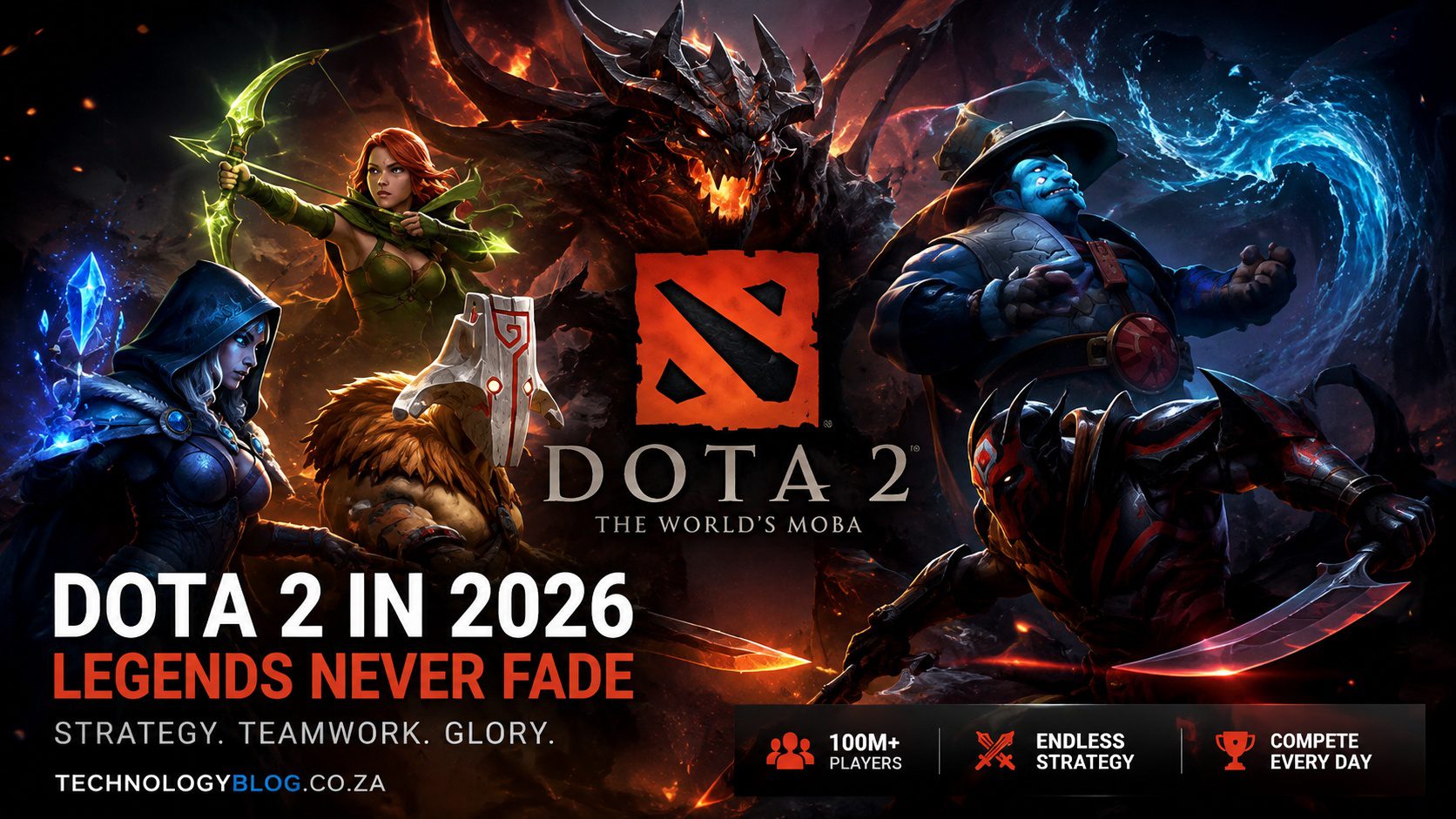
Dota 2 is still a Steam giant in 2026 – 13 years after release
More than 13 years after its official Steam release, Dota 2 remains one of the largest games on PC. Valve’s free-to-play MOBA continues to attract hundreds of thousands of simultaneous players, receives regular updates and supports an esports scene built around The International.
As of August 2026, SteamDB ranks Dota 2 second for daily active users on Steam. At the time of checking, approximately 485,000 players were in-game, while its 24-hour peak had reached more than 872,000 concurrent players.
Those numbers are remarkable for a game officially released on Steam on 9 July 2013.
The more interesting question is why.
What keeps players returning to Dota 2 when the multiplayer market has changed dramatically since 2013?
Dota 2 is simple to explain and incredibly difficult to master
The basic objective of Dota 2 has changed remarkably little.
Two teams of five players compete across a map, with each attempting to destroy the opposing team’s Ancient.
Getting there is considerably more complicated.
Players select from more than 100 heroes with different abilities and roles. Team composition, item builds, positioning, map awareness, farming, vision and communication can all influence the outcome of a match.
A new player can understand the objective relatively quickly.
Understanding everything happening between the beginning of a match and the destruction of an Ancient can take considerably longer.
Valve itself acknowledges this learning curve, noting that players can continue discovering new things whether they have played for ten hours or 1,000.
That depth is one of Dota 2’s greatest strengths, but also one of its biggest barriers for newcomers.
Every match can play differently
There is another reason Dota 2 does not necessarily become repetitive despite using the same basic objective.
The number of possible hero combinations is enormous.
A hero that works extremely well in one match can struggle against a different opposing lineup. An item that makes sense in one situation may be the wrong choice in another.
Then there are the players themselves.
Different skill levels, strategies and decisions mean two matches using similar heroes can develop completely differently.
This unpredictability creates a gameplay loop where improvement does not simply mean learning the map or memorising a collection of weapons.
Players are continually learning how heroes, items and strategies interact.
Valve keeps changing the game
A 13-year-old multiplayer game cannot rely entirely on its original design.
Valve has continued updating Dota 2, changing heroes, items, mechanics and other parts of the game over time.
That creates an unusual relationship between familiarity and change.
The fundamentals remain recognisable to long-term players, but the details continue evolving.
A player returning after several years may recognise the map, heroes and overall objective while still needing to learn substantial changes before becoming competitive again.
That constant evolution helps prevent Dota 2 from becoming a solved game.
It also means the competitive meta can change as players discover new combinations and strategies.
Nearly 1.3 million players once played simultaneously
Dota 2’s historical numbers demonstrate just how large the game became.
SteamDB records an all-time peak of 1,295,114 concurrent players on 6 March 2016.
It has not returned to that peak in 2026, but that doesn’t tell the whole story.
More than a decade after release, the game can still exceed 800,000 concurrent players within a 24-hour period.
At the time of checking in August 2026, SteamDB recorded:
| Dota 2 Steam activity | Players |
|---|---|
| Players at time checked | ~484,000 |
| 24-hour peak | ~872,000 |
| All-time peak | 1,295,114 |
| All-time peak date | 6 March 2016 |
Concurrent player counts change constantly, so these numbers represent a snapshot rather than a permanent ranking.
The broader point is more important: Dota 2 remains among Steam’s largest games more than 13 years after release.
The International still gives Dota 2 a competitive centre
Competitive gaming has also played an important role in keeping Dota 2 relevant.
The International remains the game’s flagship championship and one of the most recognisable tournaments in esports.
The 2026 tournament has once again put Dota 2 in front of a global audience, marking 15 years since the first International.
Valve co-founder Gabe Newell even appeared during The International 2026’s opening ceremony, reflecting on the history of the tournament and its players.
Esports gives Dota 2 something that player counts alone cannot provide.
Professional teams continually demonstrate strategies that ordinary players can study, copy and eventually encounter in their own matches.
Major tournaments can therefore influence how the wider community plays the game.
Dota 2 remains completely free to play
Accessibility also matters.
Dota 2 remains free to play on Steam.
Someone interested in trying the game does not need to purchase the base game first.
That significantly reduces the barrier to entry, particularly in markets where buying multiple full-price games every year can become expensive.
For South African PC gamers, that is an important advantage.
You need a suitable PC and internet connection, but there is no upfront game purchase required simply to start learning Dota 2.
The harder investment is time.
Learning heroes, abilities, items, lanes, positioning and team strategy can take considerably longer than downloading the game itself.
It can still run on relatively modest hardware
Another reason Dota 2 remains accessible is that it does not demand the type of PC hardware required by many current AAA games.
Valve supports Dota 2 on Windows, macOS and Linux.
That broad platform support gives it access to PC players who may not own the latest gaming hardware.
This matters in South Africa, where extending the useful life of an existing gaming PC can be considerably more practical than upgrading simply to meet the requirements of every new AAA release.
A competitive game does not need photorealistic graphics to remain relevant.
It needs responsive gameplay, an active population and enough depth to keep people returning.
Dota 2 continues to provide all three.
South African players aren’t isolated from Dota 2
There is another important advantage for local players.
Unlike many multiplayer games where South Africans must connect to Europe or another distant region, Dota 2 has historically supported South African matchmaking infrastructure.
That can make a substantial difference in a competitive MOBA.
Timing matters when casting abilities, escaping attacks, denying creeps or reacting to another player’s movement.
Lower latency does not make someone better at Dota 2, but it removes one potential disadvantage from an already demanding game.
For local competitive players, that makes Dota 2 considerably more practical than multiplayer games that require connecting to overseas servers.
But Dota 2 isn’t necessarily an easy recommendation
Large player numbers do not automatically make a game suitable for everyone.
Steam currently shows Dota 2’s English-language reviews as Very Positive overall, with 87% of more than 836,000 English reviews positive.
Its recent reviews tell a different story.
At the time of checking, only 68% of more than 22,000 reviews from the previous 30 days were positive, giving recent reviews a Mixed rating.
That difference is worth acknowledging.
A game can remain enormously popular while parts of its community disagree with particular updates, balance decisions or other changes.
Popularity and player satisfaction are not the same measurement.
The community is both Dota 2’s greatest strength and biggest challenge
Multiplayer games depend on other people.
In Dota 2, that dependence is particularly strong.
A match can last a substantial amount of time, and every player has a role in determining its outcome. Poor communication, players abandoning matches or teammates deliberately disrupting a game can therefore affect everyone involved.
The opposite is also true.
Few multiplayer experiences are as satisfying as a closely fought Dota 2 match where five players coordinate effectively and turn a losing situation around.
That emotional swing is part of what keeps the game compelling.
It can also make Dota 2 frustrating.
Why Dota 2 is still relevant in 2026
There is no single reason Dota 2 has survived for more than 13 years.
Being free helps.
Running on a broad range of PC hardware helps.
Valve’s continued updates help.
The International and professional esports help.
But none of those factors would matter if people no longer enjoyed the underlying game.
Dota 2 has something particularly valuable for a long-running multiplayer title: depth without requiring a completely new game every few years.
Valve can change heroes, items and mechanics while preserving the basic competitive structure players understand.
That gives experienced players a reason to keep learning while giving returning players something familiar to come back to.
Dota 2 doesn’t need Dota 3 to remain relevant
The gaming industry frequently treats sequels as the obvious solution to keeping a franchise alive.
Dota 2 demonstrates another approach.
Valve has spent more than a decade evolving one game rather than replacing it with Dota 3.
The result is a title released in 2013 that remains second on SteamDB’s daily-active-user ranking in August 2026 and can still attract more than 800,000 concurrent players during a 24-hour period.
There are newer MOBAs.
There are newer competitive games.
There are certainly games with more advanced graphics.
Yet hundreds of thousands of people continue launching Dota 2 simultaneously.
Thirteen years later, that may be the clearest evidence of its longevity.
The question is no longer whether Dota 2 can survive.
It already has.
The more interesting question is how many more years Valve can keep players defending the Ancient.


