Mario Kart World remains the game to beat on Nintendo Switch 2 in 2026
Mario Kart World has been available for more than a year, but Nintendo’s flagship racer remains one of the most important games on Nintendo Switch 2 in 2026.
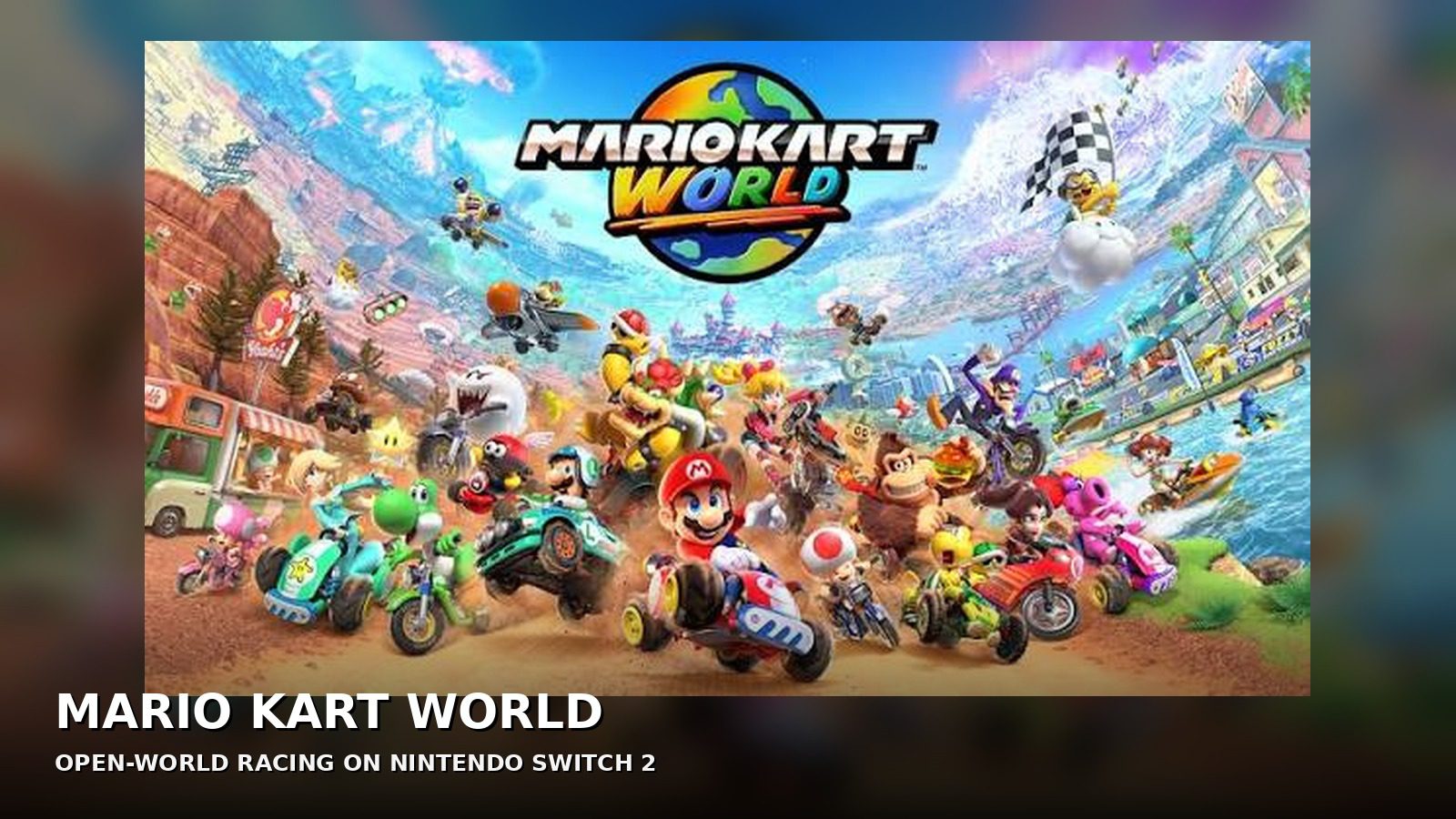
Released alongside the Switch 2 on 5 June 2025, Mario Kart World changed the traditional structure of the series by connecting its courses within a larger explorable world. It also increased races to 24 drivers, introduced Knockout Tour and Free Roam, and added new ways for friends to play together.
More importantly, players have continued buying it. Nintendo reported 15.39 million worldwide sales as of 30 June 2026, making Mario Kart World comfortably the best-selling Switch 2 game listed by the company.
Mario Kart World turns the entire map into a racetrack
The biggest change is right there in the name.
Rather than treating every circuit as a completely isolated location, Mario Kart World places courses throughout an interconnected environment.
Players race across cities, plains, forests, mountains, water and volcanic areas, with the roads between conventional courses becoming part of some races. The world also features changing weather and a day-and-night cycle.
It changes the rhythm of Mario Kart considerably.
Grand Prix still involves competing across four courses for points, but getting from one course to another can now form part of the race.
That gives Nintendo considerably more space to experiment with the series than simply creating another collection of self-contained circuits.
Races have grown to 24 drivers
Mario Kart World doubles the maximum grid from the 12 racers supported by Mario Kart 8 Deluxe to 24 drivers.
That creates substantially busier races.
More racers mean more opportunities to overtake, but also considerably more items and unpredictability when the pack closes together.
The larger field is particularly important in one of the game’s new modes.
Knockout Tour turns Mario Kart into an elimination race
Knockout Tour takes the 24-player grid and sends everyone racing continuously through interconnected sections of the world.
There are no conventional breaks between courses.
Instead, players must reach checkpoints in a sufficiently high position to remain in the competition.
The race begins with 24 drivers. At the first checkpoint, the field drops to 20. It then falls to 16, 12, eight and finally four before the remaining racers compete for the finish.
It creates a different type of pressure from Grand Prix.
Finishing first immediately isn’t always necessary. Staying far enough ahead to survive the next elimination becomes the priority.
Nintendo has also continued expanding the mode. Version 1.7.0, released on 30 June 2026, added two additional Knockout Tour routes: Drill Rally and Boomerang Rally.
That continued support is important for a multiplayer-focused game more than a year after release.
Free Roam lets you forget about racing
Perhaps the biggest departure from traditional Mario Kart is Free Roam.
Instead of immediately entering another competition, players can simply drive around the interconnected world.
There are locations to discover, scenic areas to photograph and hundreds of single-player missions spread throughout the world.
It gives the vehicles and environments a purpose outside conventional racing.
Players can explore at their own pace rather than constantly competing for first place.
That may sound like a small addition, but it changes something fundamental about Mario Kart. Previous games largely existed around selecting a race, completing it and moving to another.
Mario Kart World gives players somewhere to go between those races.
Mario Kart World still feels like Mario Kart
Despite the larger world, Nintendo has not abandoned the fundamentals of the series.
Players still drift around corners, collect items and use shortcuts while trying to disrupt everyone around them.
The game adds additional techniques that take advantage of the expanded environments. Racers can ride rails, jump from walls and skim across water as they search for faster routes.
Classic courses also return, although Nintendo has reworked them so they fit within the connected world rather than simply dropping the original tracks into the game unchanged.
That balance is important.
Mario Kart World needed to justify being a new generation of Mario Kart without losing the accessibility that helped make the series successful.
Four people can still race from the couch
The move towards a connected online experience hasn’t removed traditional local multiplayer.
Up to four players can race on a single Switch 2, using either button or motion controls.
Local wireless supports between two and eight players, while online races can support between two and 24 players.
Nintendo also supports original Switch Joy-Con controllers when they are connected wirelessly.
That means Mario Kart World retains one of the franchise’s most important characteristics: you don’t need four consoles and four televisions simply to play with people in the same room.
GameChat brings friends into online races
Switch 2’s GameChat functionality is also integrated into Mario Kart World.
Players can use the console’s built-in microphone to talk while racing or exploring together. A compatible USB-C camera can add video through CameraPlay, placing players’ faces alongside their racers during supported gameplay.
GameChat now requires a Nintendo Switch Online membership following the end of Nintendo’s original open-access period on 31 March 2026.
A Nintendo Switch Online membership is also required for Mario Kart World’s online features.
Mario Kart World is still receiving updates in 2026
Nintendo has not treated Mario Kart World purely as a launch title and moved on.
The 30 June 2026 Version 1.7.0 update added the Drill Rally and Boomerang Rally routes to Knockout Tour and introduced the ability to place stickers while using Photo Mode.
Nintendo also continues to run online events.
The Mario Kart World Open August 2026 took place on 15 and 16 August for players in North and South American regions, providing another indication that Nintendo continues to actively promote competitive participation more than a year after launch.
That continued activity matters because multiplayer games depend on having reasons for people to return.
Mario Kart World has sold more than 15 million copies
The strongest indication of Mario Kart World’s importance to Switch 2 is its sales performance.
Nintendo reported that the game had reached 15.39 million worldwide sales by 30 June 2026.
For comparison, Nintendo’s figures at the same date put:
| Nintendo Switch 2 game | Worldwide sales |
|---|---|
| Mario Kart World | 15.39 million |
| Donkey Kong Bananza | 4.78 million |
| Pokémon Legends: Z-A – Switch 2 Edition | 3.99 million |
| Pokémon Pokopia | 3.68 million |
| Kirby Air Riders | 1.90 million |
| Super Mario Party Jamboree – Switch 2 Edition | 1.15 million |
Nintendo’s figures include packaged and downloadable copies as well as games bundled with hardware.
That last point is important.
Mario Kart World was available as part of a Switch 2 launch bundle, so its sales cannot be interpreted purely as 15.39 million people independently choosing to purchase the standalone game.
Even with that qualification, the gap is substantial.
Why Mario Kart World remains important in 2026
Mario Kart World had an enormous advantage: it arrived alongside Nintendo Switch 2.
But remaining the system’s leading seller more than a year later requires more than being available on launch day.
Mario Kart has an unusually broad audience.
A child can understand the basic controls quickly. Experienced players can spend considerably longer learning drifting, shortcuts, items and advanced movement. Families can play together locally, while competitive players can race online.
Mario Kart World then adds another layer through Free Roam and Knockout Tour.
That gives someone who has spent years playing Mario Kart 8 Deluxe something genuinely different rather than simply providing another set of tracks with better graphics.
It also demonstrates what Nintendo wants from Switch 2
There is another reason Mario Kart World matters.
It acts as a demonstration of Nintendo’s approach to its new console.
The 24-player races take advantage of the larger multiplayer scope. GameChat and CameraPlay showcase Switch 2’s communication features. The connected world gives Nintendo considerably larger environments to work with, while local four-player support preserves the social gaming that helped define the original Switch.
The game therefore occupies two roles.
It is the next Mario Kart, but it is also one of Nintendo’s clearest demonstrations of what it wants Switch 2 games to become.
More than a Switch 2 launch game
By August 2026, Mario Kart World no longer needs to prove that it can sell Nintendo Switch 2 consoles.
Its 15.39 million sales have already established it as the system’s biggest-selling title according to Nintendo’s published figures.
The more interesting question is how long it can maintain that position.
Nintendo continues updating the game, running online events and offering Mario Kart World as one of the choices in its newer Switch 2 game bundles.
For South African Switch 2 owners, there is no special local gameplay limitation that changes the basic proposition. Local multiplayer remains available without relying on international connectivity, while online play requires Nintendo Switch Online and a suitable internet connection.
More than a year after launch, Mario Kart World remains the clearest example of Nintendo taking one of its most familiar series and rebuilding its structure around Switch 2.
It is still unmistakably Mario Kart.
There is simply a much bigger world to race through.


