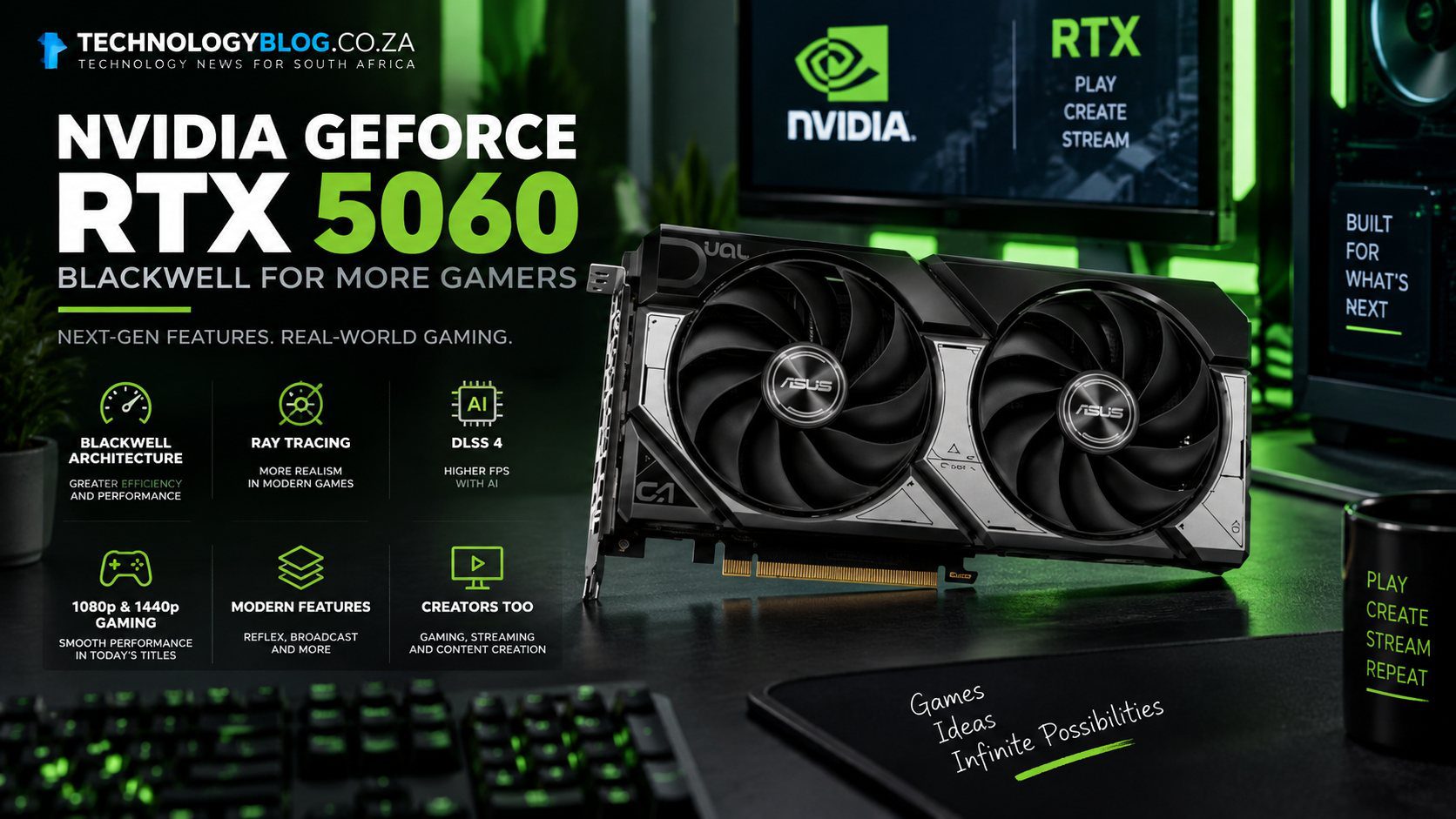
GeForce RTX 5060 in 2026: where Blackwell’s mainstream GPU fits
The GeForce RTX 5060 sits in the part of the graphics market where software techniques can change the experience almost as much as raw silicon. NVIDIA’s Blackwell generation brings newer ray-tracing and AI features into a mainstream desktop tier, making GeForce RTX 5060 less interesting as a single benchmark score than as a balance of board memory, power, target resolution and DLSS support.
That matters because the same card can look very different depending on the game. A title dominated by conventional raster rendering stresses one part of the GPU; a heavily ray-traced game stresses another; a game with modern upscaling and frame generation can use the tensor and software stack to alter perceived performance again.
Blackwell moves mainstream gaming deeper into AI-assisted rendering
NVIDIA’s RTX strategy has increasingly treated neural rendering as part of the graphics pipeline rather than an optional extra. DLSS can reconstruct a higher-resolution image from a lower internal resolution, while frame-generation techniques can insert generated frames between traditionally rendered ones. The result can raise displayed frame rates without requiring every visible frame to be produced through the old rendering path.
That does not make native rendering irrelevant. Image quality, latency and game support still determine how useful those features are. The 5060 therefore has to be understood as a GPU whose experience depends partly on whether the games a buyer actually plays support NVIDIA’s newer software stack well.
VRAM is a more practical limit than the family badge
Mainstream GPUs increasingly face games with large texture sets, high-resolution assets and ray-tracing data structures. Board memory can therefore become a constraint before the GPU’s theoretical compute capability is exhausted, particularly at higher resolutions or with aggressive quality settings.
This is why the exact RTX 5060 board configuration matters. “RTX 50-series” describes an architecture generation, not a guarantee that every card in the family is equally suited to the same resolution and workload. Buyers comparing models need to keep memory capacity and memory behaviour in view alongside shader and AI features.
Ray tracing changes the workload
Ray-traced lighting, reflections and shadows can produce effects that are difficult to reproduce with conventional raster techniques, but they also increase computational cost. NVIDIA has continued to invest in dedicated RT hardware because those workloads do not scale cleanly through ordinary shader performance alone.
For a mainstream GPU, the useful question is how much visual quality can be gained before the performance penalty becomes too large. Upscaling and frame generation are part of NVIDIA’s answer, which is why evaluating the 5060 only through native raster benchmarks misses a large part of how the product is meant to be used.
Power and cooling shape sustained performance
A desktop GPU is not only a chip. Board power, cooler design, case airflow and power-supply capacity all affect whether the card can sustain its intended clocks without excessive noise or temperature. Different partner cards can therefore provide different acoustic and thermal experiences while using the same underlying GPU.
That is especially relevant in compact systems, where a physically smaller or lower-power build may be more valuable than a marginal benchmark advantage. Mainstream graphics cards often live in less extravagant PCs than flagship models, so fit and power requirements matter directly to the upgrade decision.
The display can determine whether extra frames matter
A 60Hz monitor cannot display the same motion benefit as a high-refresh panel, while a 1440p or 4K display asks more of the GPU than a 1080p screen. The graphics card therefore belongs to a chain that includes CPU performance, game engine, monitor resolution and refresh rate.
This is why the RTX 5060’s strongest use case is not defined by a generic “mainstream” label. It is defined by a particular combination of games and display. A buyer targeting high-refresh 1080p esports has different priorities from somebody trying to use ray tracing at a higher resolution.
NVIDIA's adjacent products put GeForce RTX 5060 in context
NVIDIA’s wider portfolio gives GeForce RTX 5060 a clearer frame. TechnologyBlog.co.za has previously covered GeForce RTX 5060 Ti, GeForce RTX 5070 Ti and GeForce RTX 5070. Those products reach into compute silicon and hardware architecture, while GeForce RTX 5060 is being judged here through compute silicon and hardware architecture. The overlap can be commercially useful, but it does not erase the technical or product boundary between them.
That matters because the 2026 story here is where Blackwell’s mainstream GPU fits. Other NVIDIA releases can show the publisher’s platform strategy or technical direction, but they do not make one game or piece of gaming hardware a replacement for another. The useful comparison stays with the actual player experience, supported hardware and post-launch support.
The useful alternative is AMD Radeon RX 9060 XT
Both target mainstream PC gaming. NVIDIA’s RTX 5060 competes through Blackwell ray tracing, DLSS and the CUDA/creator ecosystem, while AMD’s rival typically competes on raster value, VRAM configuration and FSR. Local price determines which trade-off matters.
For players, the comparison should stay grounded in the actual experience: supported platforms, performance targets, controls, online population, progression and the cadence of updates. A marketing feature can matter, but only if it changes how GeForce RTX 5060 feels after dozens of hours rather than only how the launch trailer reads.
Another NVIDIA reference point
GeForce RTX 5070 adds a third piece of manufacturer context. It covers compute silicon and hardware architecture, whereas GeForce RTX 5060 is centred on compute silicon and hardware architecture. The significance is not that a buyer should own both; it is that NVIDIA’s roadmap is spreading across adjacent layers, so product names, bundles and support paths have to be read precisely.
That precision is especially valuable when older documentation remains searchable after a successor, rebrand or portfolio change. For GeForce RTX 5060, the current article’s lifecycle and regional position should therefore take precedence over an older family-level description.
What South African buyers should watch
South African pricing can make tier boundaries wider than they appear in US launch coverage because exchange rates, distributor margins and local stock affect the final shelf price. That makes comparisons between the 5060 and neighbouring cards highly dependent on real local pricing rather than converted dollar figures.
The GeForce RTX 5060 story in 2026 is therefore about a mainstream GPU whose performance increasingly comes from the combination of hardware and software. Blackwell brings NVIDIA’s newer rendering stack down the range, but the practical value still depends on memory, cooling, monitor resolution and whether the games the owner cares about actually use those features well.
Primary source: official product information, checked 19 September 2026.


