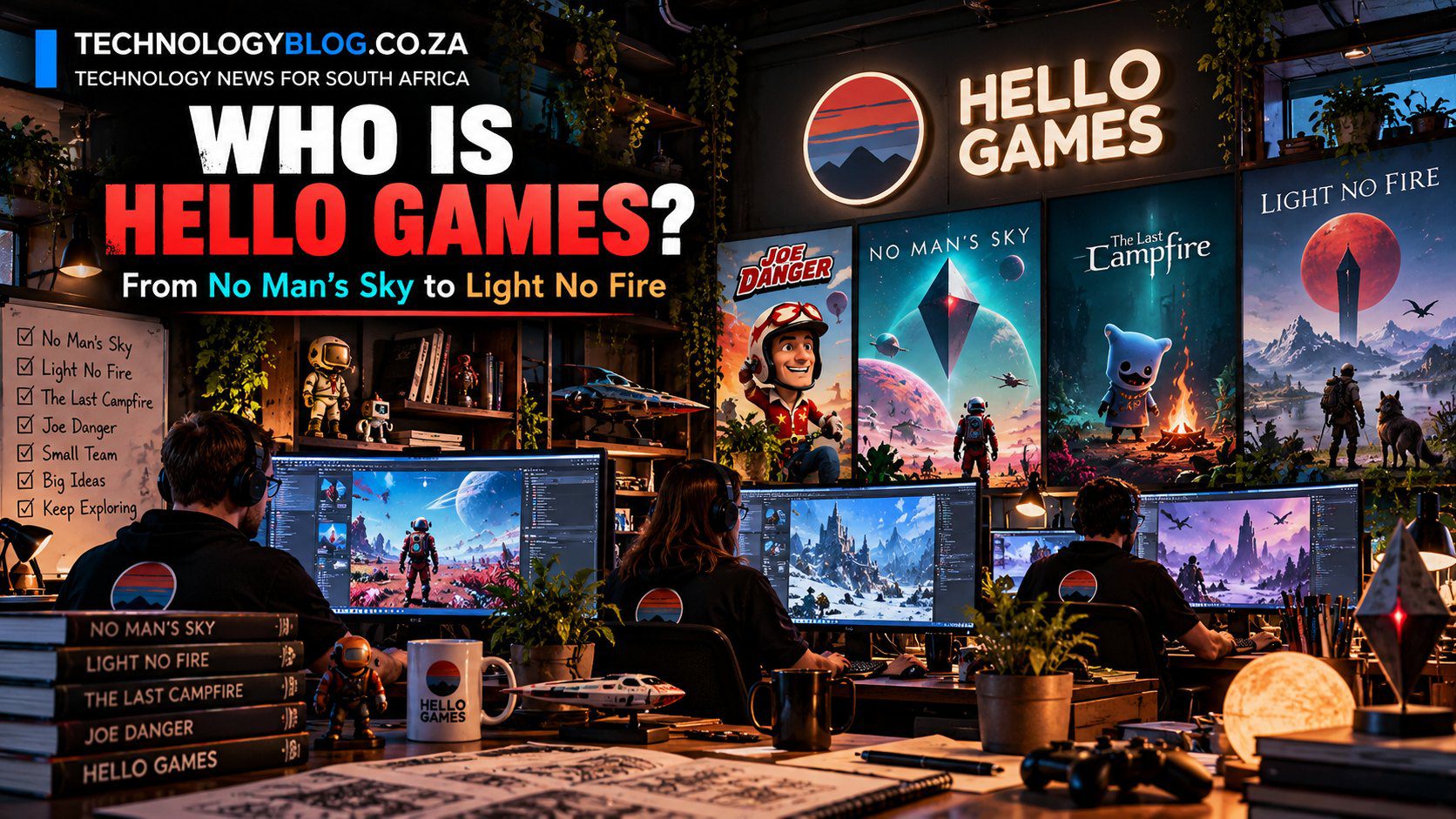
Hello Games: The small studio behind No Man’s Sky
Hello Games has one of the more unusual histories in modern game development. The independent British studio went from four developers creating Joe Danger above a tile shop to building No Man’s Sky, an enormous procedurally generated universe that would eventually become one of gaming’s most remarkable long-term development stories.
That journey was far from straightforward.
No Man’s Sky launched into intense controversy in 2016. Instead of abandoning the project, Hello Games spent the following decade expanding it. Bases, multiplayer, freighters, settlements, expeditions, new worlds and numerous other systems gradually transformed the game.
By September 2026, Hello Games said it had released 41 named updates for No Man’s Sky.
Now the studio is doing two things simultaneously. It continues to expand its decade-old space game while developing Light No Fire, another extraordinarily ambitious project built around a fantasy planet approximately the size of Earth.
The scale has changed enormously since Joe Danger.
The philosophy behind the studio has not.
Hello Games started with a very small team
Hello Games is an independent game developer and publisher based in Guildford and Cambridge in the United Kingdom.
Its origins were considerably more modest than the games now associated with the company.
Four people created Joe Danger while working from a small room above a tile shop.
There were no enormous development departments or hundreds of employees. Instead, a tiny team built an arcade stunt game that established Hello Games and provided the foundation for what followed.
Joe Danger eventually became a multi-million-selling series.
That success gave the developer an opportunity to attempt something dramatically larger.
Joe Danger established the studio
Joe Danger is easy to overlook when discussing Hello Games because No Man’s Sky became so much bigger.
However, the earlier game matters.
It established the studio’s independence and demonstrated that a small team could build and release a successful commercial game.
More importantly, that success created an opportunity.
Hello Games could make another Joe Danger.
Instead, it attempted something completely different.
The next project would require technology capable of creating an entire universe.
Hello Games wanted to build something enormous
No Man’s Sky represented a dramatic change in scale.
The central idea was easy to understand and extremely difficult to build.
Players would explore a procedurally generated universe filled with planets, creatures and environments.
They could walk across a planetary surface, enter a starship, leave the atmosphere and continue directly into space.
From there, another world could become the destination.
There would be no conventional level structure separating those environments.
It was an extraordinarily ambitious idea for a small independent developer.
Around 12 developers built the original No Man’s Sky
The contrast between No Man’s Sky and the team creating it was enormous.
Hello Games says around 12 developers built the original game while working from what the company describes as a leaking shed.
A project that appeared to require the resources of a major publisher was being created by a comparatively tiny independent studio.
Procedural generation made that scale possible.
Instead of manually designing every mountain, creature, plant and planet, Hello Games created systems capable of generating them.
The developers created the rules.
The technology generated enormous variation from those rules.
Procedural generation became central to Hello Games
Procedural generation was not simply a way to advertise an unusually large number of planets.
It became fundamental to the way Hello Games approached scale.
A small development team cannot manually create millions of worlds.
It can create systems capable of producing them.
That changes the developer’s role.
Instead of deciding exactly where every mountain should stand, developers determine how mountains can form.
Rather than designing every creature individually, systems combine characteristics according to underlying rules.
The results are less predictable than a completely handcrafted environment.
However, the potential scale becomes vastly greater.
No Man’s Sky became enormously anticipated
Interest grew rapidly as Hello Games demonstrated its universe.
The concept captured players’ imaginations.
Every presentation created more attention. Every new detail increased expectations.
Eventually, No Man’s Sky carried expectations that would have been difficult for any studio to satisfy.
For a small independent developer, the pressure was enormous.
Then the game launched.
No Man’s Sky changed Hello Games forever
No Man’s Sky arrived in August 2016.
Its release became intensely controversial.
Many players enjoyed its atmosphere, exploration and procedural environments. Others believed the finished game did not match expectations created before launch.
Criticism intensified rapidly.
Steam reviews suffered, while individual features became subjects of public arguments.
Hello Games and Sean Murray found themselves at the centre of one of gaming’s most discussed launches.
That moment could have defined the studio permanently.
Instead, it became the beginning of a much longer story.
Hello Games responded by continuing development
The developer eventually let the game do much of the talking.
Hello Games continued working.
Updates arrived.
Systems expanded.
Technical problems were addressed.
New mechanics appeared.
Features players wanted gradually became part of No Man’s Sky.
That process took years rather than months.
Hello Games could not change what happened during the original launch.
It could change what No Man’s Sky became afterwards.
Foundation began a much larger transformation
Early post-launch updates started broadening what players could do.
Base building gave Travellers reasons to remain on planets rather than constantly moving between them.
Freighters expanded the idea of having a home in space.
Vehicles changed planetary exploration.
New systems continued accumulating.
No Man’s Sky gradually became much larger than the game released in August 2016.
That process eventually became central to the identity of Hello Games itself.
NEXT became a major turning point
No Man’s Sky NEXT arrived in 2018.
It represented another substantial change.
Multiplayer expanded. Visual systems improved. Base building developed further, while numerous other mechanics changed.
The game also reached Xbox One.
By this stage, Hello Games was increasingly moving beyond simply addressing complaints about the original release.
No Man’s Sky was becoming an evolving platform.
The developer started adding ideas that had not necessarily formed part of the original 2016 discussion at all.
Multiplayer changed the universe
No Man’s Sky originally emphasised isolation.
That suited its enormous universe.
Players could travel across countless worlds without knowing whether another person had ever stood in the same location.
However, many players wanted more meaningful ways to explore together.
Hello Games gradually expanded multiplayer.
Players could meet, travel together, visit bases, complete missions and participate in expeditions.
The universe remained enormous.
It simply stopped requiring everyone to experience that scale alone.
Hello Games kept rebuilding existing systems
Later updates demonstrated another characteristic of the studio.
Hello Games was willing to revisit systems it had already built.
Origins expanded planetary variety.
NEXT Generation improved the game for newer consoles.
Expeditions introduced structured shared adventures.
Outlaws expanded space combat and criminal systems.
Interceptor added new technology and ships.
Worlds substantially changed planetary environments again.
The game continued evolving because the developer did not treat existing systems as permanently finished.
No Man’s Sky became an evolving game
That sustained development gradually changed the wider conversation around No Man’s Sky.
The game began receiving recognition specifically for how much it continued evolving.
Its reputation did not change because the original launch disappeared from history.
The change happened because years of additional development created a substantially different product.
That distinction matters.
The criticism surrounding 2016 was real.
So was the work that followed.
Both belong in the history of Hello Games.
Hello Games avoided a conventional sequel cycle
Another important decision was what the studio did not do.
No Man’s Sky 2 never replaced the original game.
Hello Games kept expanding No Man’s Sky itself.
Players who bought the game years earlier continued receiving major updates.
The universe evolved instead of being abandoned for a conventional sequel.
That gave the game something increasingly unusual.
Continuity.
The Last Campfire showed a different side of the developer
No Man’s Sky could easily have consumed the entire identity of Hello Games.
Instead, the studio also created something much smaller.
The Last Campfire is an intimate puzzle adventure centred on a lost ember searching for meaning and a way home.
Its scale is dramatically different from No Man’s Sky.
That makes it important when examining the studio.
Hello Games does not define ambition purely through physical size.
A focused puzzle adventure can exist alongside an enormous procedural universe.
Small teams remain important to Hello Games
The company’s own description of itself repeatedly emphasises small teams.
Hello Games believes small groups of talented developers can achieve unusually ambitious things.
Its history supports that philosophy.
Four developers made Joe Danger.
Around 12 created the original No Man’s Sky.
The company subsequently grew, but it did not transform itself into a conventional giant AAA organisation.
That structure affects how its developers work.
Smaller teams benefit from people capable of moving between disciplines and solving different types of problems.
Hello Games remains independent
The company’s independence is another important part of its identity.
Hello Games describes itself as self-funded, self-published and independent.
It is not an internal PlayStation studio.
It does not belong to Xbox.
It is not controlled by one of the industry’s major international publishers.
That gives the developer substantial control over its projects and development timelines.
No Man’s Sky’s decade of continued support demonstrates what that freedom can enable.
Commercial success gave the studio more freedom
No Man’s Sky fundamentally changed the company’s circumstances.
The success of the game gave Hello Games a degree of financial stability that relatively few independent developers achieve.
That security created options.
The studio could continue supporting an old game.
It could make something smaller such as The Last Campfire.
It could spend years developing another enormous project.
Those decisions do not need to fit an annual franchise schedule dictated by an external owner.
That freedom has become one of Hello Games’ most valuable assets.
Hello Games entered 2026 with No Man’s Sky still growing
August 2026 marked ten years since No Man’s Sky launched.
A decade had passed since the controversy surrounding its release.
The obvious expectation might have been for development to slow as Hello Games shifted towards its next major project.
Instead, 2026 brought substantial new No Man’s Sky content.
The anniversary became another development milestone rather than an ending.
Remnant opened the anniversary year
The Remnant update arrived in February 2026.
It introduced the Gravitino Coil, effectively giving players a gravity gun capable of manipulating large objects.
Vehicles also received additional customisation options.
Its accompanying expedition centred on players reclaiming a world filled with wreckage and salvage.
Even after almost a decade, Hello Games was still adding mechanics capable of changing how players interact with No Man’s Sky.
Xeno Arena expanded the role of alien creatures
April brought another unusual addition.
The Xeno Arena update allowed players to raise, train and battle alien creatures found throughout the universe.
That idea makes use of something No Man’s Sky already possessed in enormous quantities.
Procedurally generated wildlife.
Instead of creatures existing solely as animals to discover and catalogue, Hello Games turned their enormous variety into another gameplay system.
It demonstrates how the studio continues finding new uses for technology created years earlier.
Hello Games transformed space with Cosmos
Then came Cosmos.
Released on 9 September 2026, Cosmos became one of the most ambitious updates Hello Games had produced.
The reasoning behind it was surprisingly straightforward.
No Man’s Sky is a space game, yet the developer felt space itself had never received the same fundamental attention as many planetary systems.
Cosmos attempted to change that.
Players gained the ability to own and develop space stations.
Alliances expanded the social systems.
A redesigned star map introduced additional points of interest and exploration opportunities.
Ten years after launch, Hello Games was still redesigning fundamental parts of its biggest game.
Forty-one named updates tell the real story
Hello Games launched the tenth-anniversary expedition Our Journey Continues on 16 September 2026.
Alongside that celebration came an extraordinary figure.
No Man’s Sky had received 41 named updates.
That number helps explain why the current game differs so dramatically from its original form.
There was no single update responsible for the transformation.
The change accumulated.
One update became ten.
Ten became twenty.
Then the process continued across an entire decade.
No Man’s Sky’s long-term story is therefore less about one spectacular comeback than sustained development.
The anniversary expedition looks backwards
Our Journey Continues deliberately revisits the game’s history.
Hello Games resurrected elements from earlier versions of No Man’s Sky while adding nostalgic rewards, references and developer commentary.
That is unusual.
Games that evolve continuously often erase parts of their own history.
Systems change.
Visuals improve.
Old mechanics disappear.
New players may never experience what the game once looked like.
For the tenth anniversary, Hello Games turned some of that history into playable content.
Hello Games is building Light No Fire
No Man’s Sky is no longer the studio’s only enormous project.
Hello Games announced Light No Fire at The Game Awards in December 2023.
The studio describes it as a game about adventure, building, survival and exploration together.
Those ideas sound familiar.
However, the scale works differently.
No Man’s Sky looks outward across an enormous universe.
Light No Fire concentrates that ambition on one world.
The unusual part is how large that world is intended to be.
Light No Fire is built around an Earth-sized fantasy planet
Hello Games says Light No Fire takes place on a fantasy planet approximately the size of Earth.
The developer wants to combine role-playing elements with the freedom of a survival sandbox.
Players will encounter mountains, oceans, creatures and large environments while exploring and building within the world.
Instead of using procedural technology to create countless planets, Hello Games is concentrating its experience on one enormous fantasy world.
It is another project that appears far larger than the studio traditionally associated with it.
No Man’s Sky helped make Light No Fire possible
The relationship between the two projects is important.
Hello Games spent more than a decade solving difficult technical problems through No Man’s Sky.
Procedural terrain.
World generation.
Streaming.
Networking.
Large-scale exploration.
Cross-platform development.
Those lessons do not disappear because Light No Fire has a fantasy setting.
The new project can build on technology and experience accumulated through years of No Man’s Sky development.
In that sense, Light No Fire is not a rejection of the studio’s previous work.
It is another application of the same underlying ambition.
Hello Games is developing two enormous worlds at once
What makes the current period particularly interesting is that No Man’s Sky has not entered simple maintenance mode.
Hello Games is developing Light No Fire while still releasing substantial content for its existing game.
Cosmos demonstrates that.
So do Remnant and Xeno Arena.
So does the tenth-anniversary expedition.
The studio is therefore balancing a mature ten-year-old game with development of another highly ambitious project.
That would be challenging for any developer.
For a company that still emphasises comparatively small teams, it is particularly notable.
Technology remains part of the studio’s identity
Procedural generation gets much of the attention surrounding Hello Games.
However, creating games at this scale requires much more than generating landscapes.
The studio develops its own technology for rendering, optimisation, world generation and other low-level systems.
That work allows its games to create and display enormous environments across different hardware platforms.
The technology behind No Man’s Sky became part of the studio’s identity because the game’s central idea depended on it.
Light No Fire appears likely to continue that tradition.
Hello Games values developers who can work broadly
Smaller development teams function differently from huge production organisations.
Large studios can support hundreds of highly specialised roles.
Smaller companies benefit from developers capable of moving between problems.
Hello Games’ recruitment material reflects that approach.
Artists can contribute across different types of visual work, while programmers may work across multiple areas of development.
That structure fits a company whose history was built around small groups attempting disproportionately ambitious projects.
Independence gives Hello Games unusual freedom
No Man’s Sky gave the studio something many independent developers never obtain.
Time.
Commercial success created enough stability for Hello Games to make decisions without depending entirely on another company financing each new project.
That makes its current position unusual.
The studio can continue updating a decade-old game while developing something new.
It can experiment with smaller projects.
It can decide when a game is ready to reveal.
That independence does not guarantee success.
It does give Hello Games control over the risks it chooses to take.
No Man’s Sky remains the game that defines Hello Games
Joe Danger established the company.
The Last Campfire demonstrated another side of its creativity.
Light No Fire may eventually establish another major franchise.
For now, No Man’s Sky remains the project that defines Hello Games.
It transformed the company’s scale.
It tested its reputation.
It provided financial freedom.
It became a decade-long development platform.
Most importantly, Hello Games never walked away from it.
The No Man’s Sky turnaround should not become mythology
It is tempting to describe the game’s history as a simple redemption story.
Reality is more complicated.
The criticism in 2016 was real.
Player disappointment was real.
Technical and communication problems surrounding launch cannot be erased because the game later improved.
Likewise, the development work that followed is also real.
Both belong in the same history.
What makes No Man’s Sky unusual is how long Hello Games continued working after the moment when many developers might have moved on.
Hello Games rebuilt trust through the game
Public relations can change messaging.
Marketing can change perception.
Neither can substitute for the underlying product.
Hello Games gradually changed No Man’s Sky itself.
Players could see new systems.
They could play new content.
They experienced technical improvements.
They watched features accumulate.
That process took years.
Trust returned gradually because the product changed gradually.
Hello Games in 2026 occupies an unusual position
The developer now sits somewhere between traditional indie development and AAA-scale ambition.
It remains independent.
It continues emphasising relatively small teams.
Yet it operates a game with millions of owners across numerous platforms while developing another project built around an Earth-sized fantasy world.
Few independent studios reach that position.
Even fewer reach it while retaining control over their own creative direction.
What Hello Games means for South African gamers
For South African players, No Man’s Sky has one useful characteristic.
Its core experience does not depend on competitive regional matchmaking.
Players can explore alone or use multiplayer when they choose.
That makes the game less dependent on having an enormous local matchmaking population.
Network performance during multiplayer still depends on routing, connection quality and the locations of participating players.
There is therefore no responsible universal South African latency figure.
Light No Fire’s networking characteristics will need to be assessed once Hello Games provides enough information and the game becomes playable.
Light No Fire could define the next era
No Man’s Sky will always be central to the history of Hello Games.
Light No Fire represents the next major test.
Expectations are different this time.
Hello Games is no longer an unknown studio attempting something unexpectedly ambitious.
Players know what the developer has achieved technically.
They also remember what happened in 2016.
That combination creates both opportunity and pressure.
The studio has so far avoided recreating the enormous pre-release information cycle that surrounded No Man’s Sky.
That makes patience important.
Hello Games is still attempting unusually difficult projects
The common thread running through the studio’s games is not genre.
Joe Danger is very different from No Man’s Sky.
The Last Campfire is different again.
Light No Fire moves into fantasy survival.
What connects them is experimentation.
Hello Games repeatedly chooses projects that require the studio to solve unusual creative or technical problems.
Sometimes the project is small.
Sometimes it attempts to generate a universe.
Now the studio wants to build a fantasy planet the size of Earth.
Why Hello Games still matters
Hello Games has one of modern gaming’s more unusual development histories.
Four developers made Joe Danger above a tile shop.
Around a dozen later attempted a procedurally generated universe.
No Man’s Sky launched into controversy.
The studio kept working.
One update became ten.
Ten became dozens.
By September 2026, Hello Games had released 41 named No Man’s Sky updates.
At the same time, the company remained independent and began developing another enormous world.
That history does not need exaggeration.
Hello Games made mistakes.
It also spent years doing the work required to transform its biggest game.
Hello Games remains small, independent and ambitious
Hello Games is an independent British developer and publisher with operations in Guildford and Cambridge.
Joe Danger established it.
No Man’s Sky transformed it.
The Last Campfire showed another side of it.
Light No Fire points towards its future.
The studio now possesses something most independent developers spend years trying to achieve: enough commercial stability to decide what it wants to build next.
Hello Games appears determined to use that freedom in the same way it always has.
By attempting something difficult.
No Man’s Sky demonstrated how badly enormous expectations can collide with reality.
The decade that followed demonstrated something equally important.
A small studio can keep building.
Given enough time, an impossible project can become the foundation for the next one.


