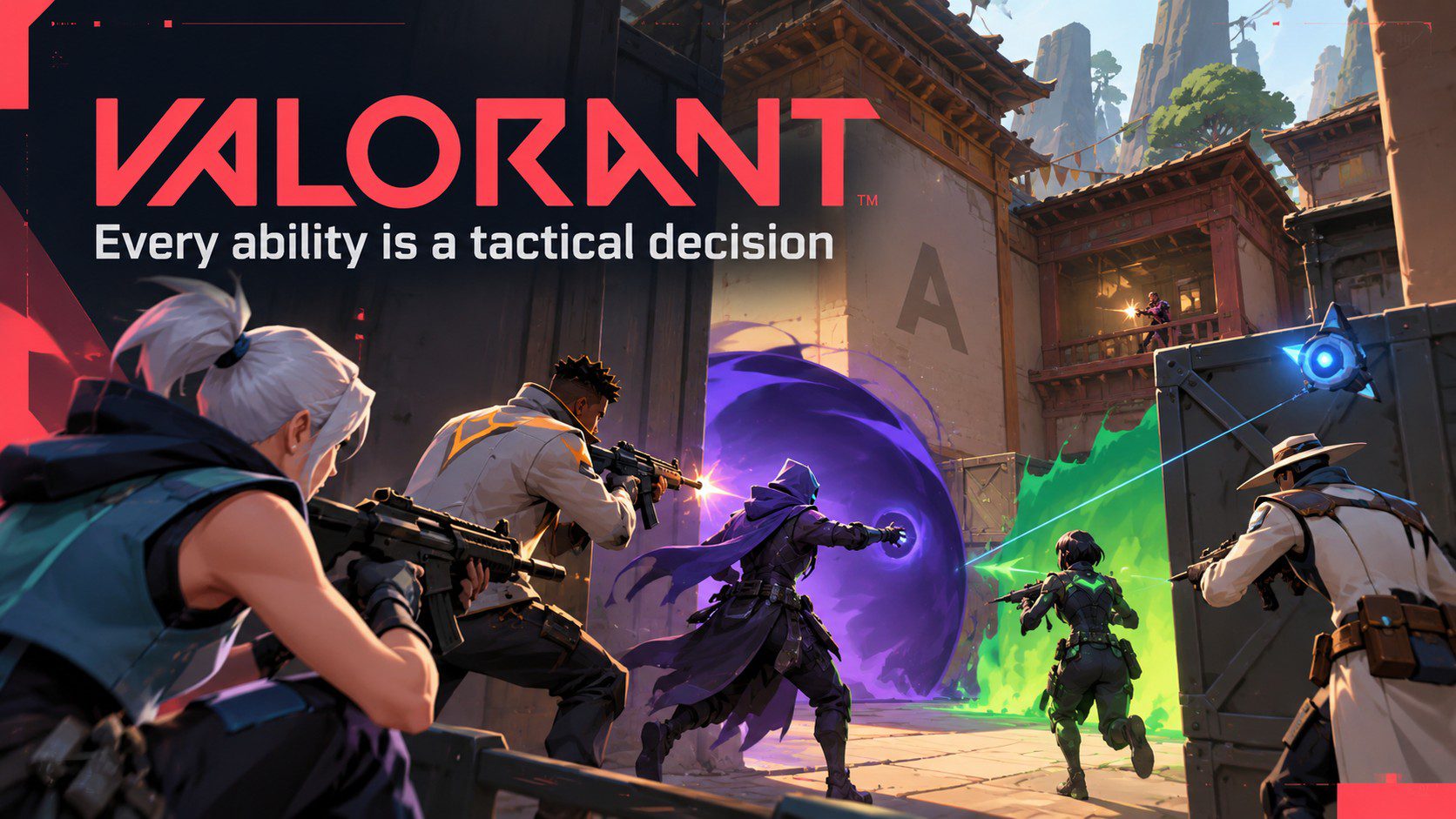
VALORANT turns every ability into a tactical decision
VALORANT can make a five-second decision more important than an entire minute of shooting.
A defender hears footsteps approaching a bombsite. Smoke blocks one entrance, but the attackers could still be waiting behind it. A reconnaissance ability reveals movement nearby. Then a flash forces the defender away from the angle they were holding.
The attackers have not fired a shot, yet the situation has already changed.
That is the central idea behind Riot Games’ tactical shooter. VALORANT combines precise gunplay with characters whose abilities influence positioning, visibility, movement and information. Players still need to land their shots, but the opportunities to take those shots often depend on decisions made moments earlier.
Originally released on 2 June 2020, VALORANT has grown into a competitive game with an expanding Agent roster, rotating maps, alternative modes and an international esports circuit. Its continued development in 2026 shows how Riot is building new experiences around a foundation that remains deliberately demanding.
VALORANT makes every round a contest for control
The standard experience places two teams of five against each other. One side attacks while the other defends, with the teams switching roles during the match.
Attackers generally aim to plant a device called the Spike at a designated site and protect it until detonation. Defenders must prevent that objective, eliminate the attacking team or defuse the Spike after it has been planted.
Eliminating every opponent can also secure a round, but VALORANT is not simply a contest to achieve the highest number of kills.
An attacker might eliminate two defenders yet leave the Spike exposed. A defender could survive an encounter but lose control of the site. In both cases, the result depends on whether the team can convert its advantage into the objective.
With one life per round in the standard tactical format, mistakes have immediate consequences. Players must consider how their decisions affect the remaining members of the team rather than treating each encounter as an isolated duel.
The economy influences what happens before the fighting starts
Every round begins with preparation. Players purchase weapons, shields and available abilities using credits earned through the match.
That economy introduces another layer of teamwork.
A player might have enough credits for an expensive rifle, but several teammates may be unable to afford comparable equipment. Buying independently can leave the team with an uneven loadout and fewer options for the following round.
Coordinated purchasing allows teams to manage these disadvantages. Sometimes saving credits is more useful than attempting to win immediately with limited equipment.
The economy also changes the significance of weapon choices.
A Sheriff pistol offers a different risk profile from a Vandal rifle. A cheaper weapon may allow a player to preserve resources, while a more expensive purchase can increase their effectiveness in a decisive round.
VALORANT therefore begins testing decision-making before anyone leaves the spawn area.
Agent abilities change how players approach gunfights
Every VALORANT player selects an Agent with a distinctive set of abilities.
These tools can reveal opponents, obstruct vision, create defensive barriers, disrupt movement or help a team enter contested territory. However, abilities do not remove the need for mechanical shooting skill.
A smoke may allow attackers to cross an exposed opening, but somebody still needs to clear the next corner. A flash can force a defender to retreat, although poor timing might prevent teammates from exploiting the opportunity.
The important distinction is that abilities create conditions for combat.
They can make an engagement easier, more difficult or temporarily avoidable. Successful teams understand how to combine those effects instead of activating abilities independently.
That relationship gives VALORANT much of its tactical depth.
VALORANT Agents bring different responsibilities to a team
Riot organises Agents into four broad roles: Duelists, Initiators, Controllers and Sentinels.
Duelists specialise in taking fights and creating openings. Initiators help teammates enter contested areas by gathering information or disrupting defenders.
Controllers influence the battlefield through abilities that obstruct vision or restrict access to important positions. Sentinels concentrate on protecting territory, watching flanks and making enemy advances more difficult.
These roles establish useful expectations, but they do not guarantee success.
A Duelist who enters a site without support can become an easy target. Meanwhile, a Controller who uses every smoke too early may leave the team without essential cover during the final seconds.
Strong teamwork depends on timing and coordination, not simply selecting one Agent from each category.
Information can be more valuable than an elimination
Imagine a defender holding a narrow entrance.
The defender knows where an attack might arrive but cannot see what is happening behind the walls. An Initiator’s reconnaissance ability could reveal that position, allowing the attacking team to prepare a coordinated push.
The defender now faces a choice.
Remain in place and risk being overwhelmed, or abandon the position and concede space.
Neither side has necessarily fired a shot, but information has changed the balance of the round.
The same principle applies to footsteps, weapon sounds and the use of abilities. Players constantly interpret incomplete information to estimate where opponents might be and what they intend to do.
Good communication turns those observations into useful decisions.
Poor communication can leave teammates acting on different assumptions.
Maps make positioning as important as aim
VALORANT’s maps are designed around contested spaces, narrow approaches, elevated positions and alternative routes.
A site may be difficult to attack from its main entrance but vulnerable to a coordinated approach through another part of the map. Defenders must decide whether to concentrate their resources or spread players across several possible threats.
Rotations add another consideration.
An attacking team can create pressure at one site before moving towards another. However, the strategy becomes less effective if defenders recognise the deception early enough to respond.
Map knowledge therefore develops beyond memorising corners.
Players learn common defensive setups, utility positions, timing windows and routes that can expose an opponent from an unexpected direction.
As Riot changes the competitive map rotation, those lessons must also evolve.
The Spike turns the final seconds into a different game
Planting the Spike changes the tactical problem.
Before the plant, attackers generally need to gain territory. Afterwards, they must protect the device long enough for it to detonate.
Defenders face the opposite challenge. They must regain control of the site and create enough time to defuse.
A player who is outnumbered may still have an opportunity if the remaining opponents are poorly positioned. Conversely, a team with a numerical advantage can lose by failing to account for the Spike timer.
This produces VALORANT’s clutch moments, where one surviving player attempts to overcome several opponents.
Success often depends on more than fast reactions.
The player must understand where opponents are likely to appear, which abilities remain available and how much time is left to complete the objective.
VALORANT rewards mechanical skill without making it the only skill
Precise aiming remains fundamental to VALORANT.
Movement affects shooting accuracy, while weapon handling and recoil require practice. Players must learn when to stop moving, where to position their crosshair and how to approach different engagement distances.
Yet excellent aim cannot compensate for every tactical mistake.
A player entering an exposed angle without information may be eliminated before reacting. Another who wastes an important ability could leave the team unable to execute its plan.
That balance explains why VALORANT can be demanding for newcomers.
Players need to learn weapons, maps, Agent abilities, the economy and team communication simultaneously.
Improvement comes from understanding how those systems interact rather than mastering one in isolation.
Alternative modes provide different ways to practise
The standard tactical format is only part of VALORANT.
Deathmatch offers an environment focused on repeated gunfights, making it useful for practising aim and weapon control. Other modes adjust match length, equipment rules or team objectives.
Riot has also experimented with smaller competitive formats.
In February 2026, Skirmish arrived as a queueable two-versus-two mode. April’s Skirmish: Ascension introduced a limited ranked experience involving selected Agents, restricted abilities and staged weapon rounds.
These modes provide different forms of competition without requiring every session to follow the complete standard match structure.
They also give Riot opportunities to test ideas that would not necessarily fit the main tactical format.
VALORANT expanded to consoles with a different control approach
VALORANT began as a PC-focused tactical shooter, where mouse precision and keyboard controls strongly influence gameplay.
Riot subsequently expanded the game to PlayStation 5 and Xbox Series X|S, adapting the experience for controllers.
The console version includes Focus Mode, which supports more controlled aiming without simply reproducing the PC input system.
Riot also separates PC and console matchmaking to protect the competitive experience across different input methods.
Account content can carry across supported platforms, although competitive rankings remain separate.
For South African players, regional availability is an important consideration. Riot’s published console support guidance does not currently list South Africa among its supported console regions, so local access should be checked rather than assumed.
VALORANT continues evolving in 2026
Six years after its original launch, VALORANT remains an actively developed competitive shooter.
Riot’s September 2026 Patch 13.06 introduced one of the year’s most substantial collections of changes.
The update added Agent Mastery, a revised lobby and post-match experience, competitive improvements and a new limited-time mode called Gauntlet: Glitched.
It also introduced The Warden and additional practice features.
These changes reflect a broader approach to development. Riot is not only adjusting individual weapons and abilities; it is also changing how players practise, track progress and experience the game outside standard matches.
That matters for an established competitive shooter, where the surrounding systems can influence whether players continue returning.
Agent Mastery gives players another form of progression
Agent Mastery, introduced with Patch 13.06, provides a way to track progress with individual Agents.
This expands progression beyond competitive rank alone.
A player might spend considerable time learning one Agent’s abilities, preferred positions and tactical responsibilities. Mastery systems offer recognition for that commitment even when the player’s overall rank changes slowly.
The system also gives players another reason to explore different Agents.
However, it does not replace the fundamentals of the game.
Knowing an Agent’s abilities remains more important during a round than any progression indicator attached to that character.
Gauntlet: Glitched experiments with the Agent formula
One of the most unusual additions in Patch 13.06 is Gauntlet: Glitched.
The mode places eight two-player teams into a competition built around two-versus-two encounters. Players can draft abilities from different Agents and improve them as the match progresses.
That breaks one of VALORANT’s familiar assumptions.
In the standard game, an Agent’s abilities are part of a fixed character identity. Gauntlet: Glitched allows combinations that would not normally occur within that structure.
The result is a more experimental format where ability selection becomes part of the competition itself.
It also shows how Riot can expand VALORANT’s possibilities without rewriting the rules of its main tactical mode.
Competitive integrity remains a major responsibility
Any competitive shooter depends on players believing that matches are reasonably fair.
Cheating, boosting and rank manipulation can undermine that confidence, particularly when competitive progression is a major reason people play.
Riot uses its Vanguard anti-cheat system and has continued developing tools intended to identify unfair behaviour.
In Patch 13.06, the company reported that its newer anti-boosting measures had resulted in more than 90,000 account bans since 20 July 2026.
That is Riot’s reported enforcement figure, not independent proof that cheating has been eliminated.
Maintaining competitive integrity remains an ongoing challenge, and the effectiveness of enforcement matters as much as announcing new detection systems.
VALORANT’s esports scene gives the game another identity
VALORANT also operates as an international esport.
The VALORANT Champions Tour provides a competitive structure through which professional teams compete at regional and international levels.
The annual Champions event serves as a major destination for the game’s highest-level competition.
In 2026, Champions Shanghai runs from 24 September to 18 October, bringing leading teams together for the year’s championship.
Riot also supports Game Changers, an esports initiative designed to create additional competitive opportunities for women and other marginalised genders.
The professional scene matters because high-level matches demonstrate how the game’s systems operate when communication, timing and execution are highly coordinated.
A strategy that appears straightforward during casual play can become much more complicated when both teams understand the same tactical possibilities.
Why VALORANT still matters in 2026
VALORANT remains distinctive because it gives players powerful abilities without allowing those abilities to replace the fundamentals of tactical shooting.
A smoke can block a sightline, but it cannot guarantee control of a site. Reconnaissance can reveal an opponent, but the team must still act on that information.
Even the most carefully planned attack can collapse when somebody misses an important shot or moves at the wrong moment.
That combination creates a game where teamwork and individual execution depend on each other.
Riot’s 2026 updates are expanding the experience through Agent Mastery, experimental modes and improvements to competitive systems. Yet the central challenge remains recognisable.
Five players need to understand the same situation, make decisions under pressure and execute them before their opponents do.
Sometimes the difference between winning and losing is not the ability itself.
It is knowing exactly when to use it.


