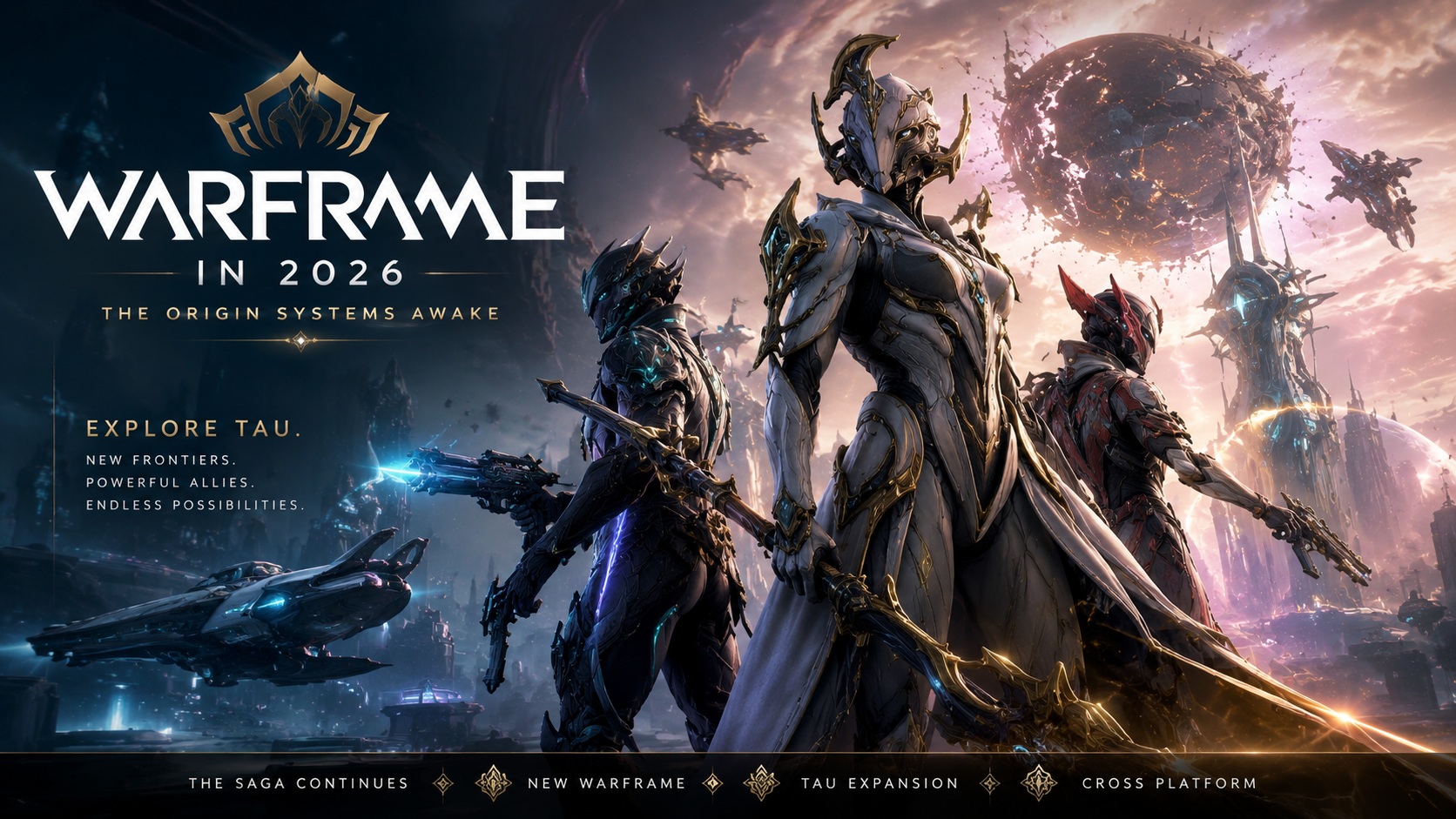
Warframe is 13 years old – so why are tens of thousands of players still playing it?
Warframe launched on Steam on 25 March 2013.
More than 13 years later, tens of thousands of players are still entering the Origin System every day, while developer Digital Extremes is preparing to take the game somewhere it has never been before.
When TechnologyBlog checked SteamDB in early September 2026, the game was recording a 24-hour peak of around 60,000 Steam players. Its all-time Steam peak stands at 189,837, reached in July 2021. SteamDB also ranked it among Steam’s most active games by daily users.
Those numbers only represent Steam.
Warframe is also available across PlayStation, Xbox, Nintendo Switch and mobile, while Cross Platform Save allows players to carry supported progression between linked platforms.
Yet longevity is only part of the story.
Digital Extremes is preparing Warframe: Tau, an expansion that will take players beyond the Origin System for the first time.
For a game released in 2013, that is remarkable.
A very different game from the one that launched in 2013
Anyone returning after several years may struggle to recognise the game they left behind.
At its core, Warframe remains a free-to-play third-person action game built around extremely mobile biomechanical warriors known as Warframes.
Players run missions, collect resources, craft weapons, unlock new frames and gradually build increasingly specialised loadouts.
However, that description barely captures what the game has become.
Over the years, Digital Extremes has added open environments, cinematic quests, spacecraft, companions, new combat systems, vehicles, extensive storylines and dozens of playable Warframes.
As a result, the modern game feels less like a single 2013-era looter shooter and more like layers of different games built on top of one another.
That could easily have become a weakness.
Instead, constant reinvention has become one of the reasons players continue returning.
Movement still makes the game feel different
One of its greatest strengths has barely changed conceptually.
Movement matters.
Warframes are fast.
Players sprint, slide, jump, bullet-jump and move rapidly through environments while combining firearms and melee attacks.
The result is combat that rarely feels static.
A player does not simply enter a room, hide behind cover and fire until everything is dead.
Instead, fights can involve launching across the room, attacking in mid-air, sliding beneath enemy fire and immediately switching between ranged and melee combat.
Once the movement system becomes familiar, travelling through missions can become almost rhythmic.
That mobility remains one of the clearest parts of the game’s identity.
There are now dozens of Warframes to master
Character variety is another major reason the game has lasted.
The Old Peace update introduced Uriel as the 63rd Warframe in December 2025.
Since then, Digital Extremes has continued expanding the roster, and its TennoCon 2026 roadmap confirmed that the 66th Warframe is planned as part of the Iceblade of Narin update.
Each frame brings its own abilities and play style.
Some specialise in damage.
Others focus on defence, crowd control or support.
Many combine several roles.
Weapons then create another layer of variety.
Steam’s description notes that players can craft hundreds of weapons, alongside companions, vehicles and other equipment.
That gives players an enormous amount to experiment with.
Someone can spend hundreds of hours using one set of frames and weapons, then change their loadout and effectively create a new way of approaching the game.
The grind is both the attraction and the problem
Of course, the name Digital Extremes chose for the loop is practically written into the game.
There is a lot to grind.
Warframes need components.
Weapons need materials.
Mods need upgrading.
Prime equipment requires farming.
Reputation systems need progression.
Resources feed other resources.
One unlock often leads to another.
For some players, that becomes exhausting.
For others, it creates the reason to log in.
There is almost always another objective available.
That makes Warframe unusually good at producing small personal goals.
Perhaps you want one frame.
Then you need a component.
That component requires a particular mission.
After obtaining it, you discover a weapon that works particularly well with the frame.
Then that weapon needs another resource.
Eventually, a one-hour goal becomes an entire evening.
The system works because progress rarely ends completely.
Free-to-play removes the easiest barrier
The game remains free-to-play.
That matters just as much in 2026 as it did years ago.
Someone curious about Warframe does not have to purchase the base game.
They can install it, create an account and decide whether the combat and progression loop suit them.
Steam currently lists the game as Very Positive, with roughly 89% of recent reviews positive and around 91% of more than 300,000 English-language reviews recommending it when TechnologyBlog checked.
Those numbers are particularly notable for a live-service game more than a decade old.
Long-running online titles often accumulate frustration as systems and monetisation change.
Warframe certainly has criticism surrounding grind, complexity and monetisation.
However, its Steam sentiment remains unusually strong.
Digital Extremes keeps giving players reasons to return
Regular updates are essential to understanding its longevity.
Digital Extremes does not simply maintain servers and rotate cosmetic items.
Major updates can introduce new story chapters, playable characters, systems and entirely new areas.
That approach was visible again with The Old Peace, released in December 2025.
The update added another cinematic quest, the Uriel Warframe, the Devil’s Triad characters, an Operator and Drifter visual overhaul, additional weapons and new modes including The Descendia and The Perita Rebellion.
More importantly, The Old Peace was not an endpoint.
It laid groundwork for what comes next.
Tau could be one of Warframe’s biggest expansions
At TennoCon 2026, Digital Extremes revealed a much clearer look at Warframe: Tau.
The expansion will take players beyond the Origin System and into the Tau System for the first time.
According to Digital Extremes, Tau is a new region surrounding a binary star and will introduce new locations and experiences. The TennoCon gameplay demonstration showed players infiltrating a Sentient city affected by crime and corruption.
Even that demonstration was only part of the plan.
Digital Extremes says another location will be included when the full Tau update arrives later in 2026.
For long-term players, the importance is difficult to miss.
Warframe has spent years building its history around the Origin System, the Orokin, the Tenno and the Sentients.
Tau moves that story into territory players have heard about for years but have never properly explored.
This is more than another new map
That distinction matters.
A live-service game can technically survive by adding another weapon, character or mission every few months.
However, maintaining genuine interest for more than a decade requires larger moments.
Tau represents that kind of moment.
Digital Extremes describes it as the beginning of a new journey rather than a one-off destination.
If that ambition translates successfully into the finished update, the expansion could establish another foundation for years of story development.
That is an extraordinary position for a game entering its fourteenth year.
There is another major update before Tau
Players will not have to wait for Tau before receiving more content.
Digital Extremes confirmed Iceblade of Narin as its Fall 2026 update.
The update is set to introduce the 66th Warframe, alongside two Deluxe Collections, another Prime Access release and a major Banshee rework.
Banshee will receive improvements to her sound-based abilities and overall playability, while Qorvex is getting a new Deluxe design inspired by gargoyles and Gothic architecture.
Citrine Prime is also planned to enter Prime Access later this year.
Digital Extremes plans to reveal more about Iceblade of Narin during its 4 September 2026 Devstream.
Therefore, the final months of 2026 are shaping up to be unusually busy.
More than 13 years of lore can be intimidating
There is a cost to all this accumulated content.
Warframe can be difficult to enter.
A new player is not joining a cleanly structured game with one campaign and a handful of systems.
They are entering more than a decade of development.
Terminology appears quickly.
Mods matter.
Mastery Rank matters.
Crafting matters.
Resources come from different locations.
Frames need components.
Planets unlock.
Quests begin connecting to a story that becomes significantly more complicated than the game initially suggests.
Eventually, systems such as Focus, the Helminth and more advanced equipment appear.
For experienced players, that depth creates longevity.
For someone playing their first ten hours, it can feel overwhelming.
The story also becomes far more ambitious than expected
The early hours do not necessarily prepare newcomers for how strange Warframe eventually becomes.
What initially appears to be a straightforward science-fiction action game gradually develops into a much larger story about the Tenno, Orokin, Sentients and the history of the Origin System.
Digital Extremes has increasingly used cinematic quests to tell that story.
The Old Peace continued that trend by exploring memories of the Old War and the fragile peace between the Orokin and their Sentient creations.
Tau is now preparing to move that narrative forward again.
Consequently, Warframe has become one of those unusual games where someone interested only in fast combat can play for hundreds of hours, while another player may become deeply invested in its increasingly complicated lore.
Cross-platform support makes returning easier
Another major improvement has been account flexibility.
Cross Platform Save allows players to link supported accounts and use the same progression across PC, PlayStation, Xbox, Nintendo Switch and mobile platforms.
That matters enormously for a game built around long-term progression.
A player who invested hundreds of hours on one console does not necessarily want to begin again because they later switched platforms.
Cross-save reduces that problem.
It also makes Warframe easier to return to after several years away.
Your investment is more portable than it once was.
Steam numbers remain remarkably healthy
The current player numbers put the game’s age into perspective.
SteamDB recorded roughly 57,000 players online during one recent snapshot, with a 24-hour peak approaching 69,000. Another current SteamDB chart placed its daily peak around 60,000 as player activity changed throughout the day.
Its all-time Steam record remains 189,837 concurrent players, reached on 17 July 2021.
SteamDB also shows more than 920,000 followers and hundreds of thousands of Steam reviews.
Again, those figures do not include the full console and mobile population.
They are useful because Steam gives us a consistent public measurement.
For a game released in March 2013, remaining among Steam’s heavily played titles is significant.
Warframe does not need to break its record again
This is an important distinction when discussing old online games.
A title does not need to return to its all-time peak every year to remain healthy.
Warframe reached its Steam record in 2021.
Five years later, tens of thousands of PC players are still logging in simultaneously.
Meanwhile, Digital Extremes continues releasing large updates.
The more useful question is whether the existing audience is large enough to sustain continued development and whether major releases can bring inactive players back.
The continued investment in Tau strongly suggests Digital Extremes still sees a substantial future for the game.
South African players can simply try it
For South African gamers, one of the advantages remains the lack of an upfront entry price.
There is no need to decide whether the base game is worth purchasing.
Download it and test the experience yourself.
However, Warframe remains an online game, and Steam lists a broadband connection as required.
Therefore, network conditions still matter.
TechnologyBlog has not conducted controlled Warframe latency testing across South African ISPs, so we will not assign a local ping figure without evidence.
The better approach is to use the game’s available matchmaking options and judge actual performance on your own connection.
The PC requirements are surprisingly modest
Warframe’s age also gives it another advantage.
Its minimum PC requirements remain relatively accessible.
Steam currently lists 4GB of RAM, a DirectX 11-capable graphics card and processors including the Intel Core i7-860, Core i5-750 or AMD FX-4100 as minimum hardware. The installation requires approximately 75GB of storage.
The Steam client itself now requires a modern supported version of Windows, despite the game page still showing older Windows requirements.
Players should therefore check the current Steam client and game requirements before installing.
Still, compared with many modern online games, the hardware barrier remains relatively low.
The real challenge is knowing where to start
Warframe has a strange problem in 2026.
It has too much game.
That sounds like an ideal situation, but it can work against newcomers.
A new player may see dozens of frames, countless weapons, years of quests and unfamiliar currencies.
An experienced player sees possibilities.
A newcomer may see homework.
Digital Extremes has made onboarding changes over the years, yet simplifying a game with this much accumulated content is difficult.
Remove too much complexity and existing players lose systems they enjoy.
Explain everything immediately and newcomers receive an avalanche of information.
The solution is probably not to understand everything at once.
New players are better served by learning one system at a time and allowing the wider game to open gradually.
Why are people still playing Warframe in 2026?
There is no single reason.
Being free-to-play helps.
Fast movement helps.
The huge collection of frames and weapons helps.
Cross-platform progression helps.
Regular content helps.
The community helps.
However, the strongest explanation may be that Digital Extremes keeps allowing the game to change.
The Warframe of 2026 is not simply the Warframe of 2013 with additional maps.
It has accumulated new systems, new ways to travel, new stories and new types of content.
Some additions work better than others.
Some systems eventually need to be redesigned.
Yet players know that returning after a long break often means discovering something genuinely different.
That creates curiosity.
Another 13 years would once have sounded ridiculous
When Warframe launched in 2013, there was no guarantee it would survive.
Now the more interesting question is how far Digital Extremes can take it.
The game still records tens of thousands of simultaneous Steam players.
Recent Steam reviews remain Very Positive.
Digital Extremes has a Fall update approaching.
Tau is still planned for later in 2026.
And for the first time, players are preparing to leave the Origin System behind.
That is not what a game winding down looks like.
Warframe has already survived the difficult part: becoming old without becoming irrelevant.
Now Digital Extremes is trying to turn that longevity into something even more ambitious.
After more than 13 years, the next major chapter is not about preserving what Warframe was.
It is about finding out how much further it can still go.


