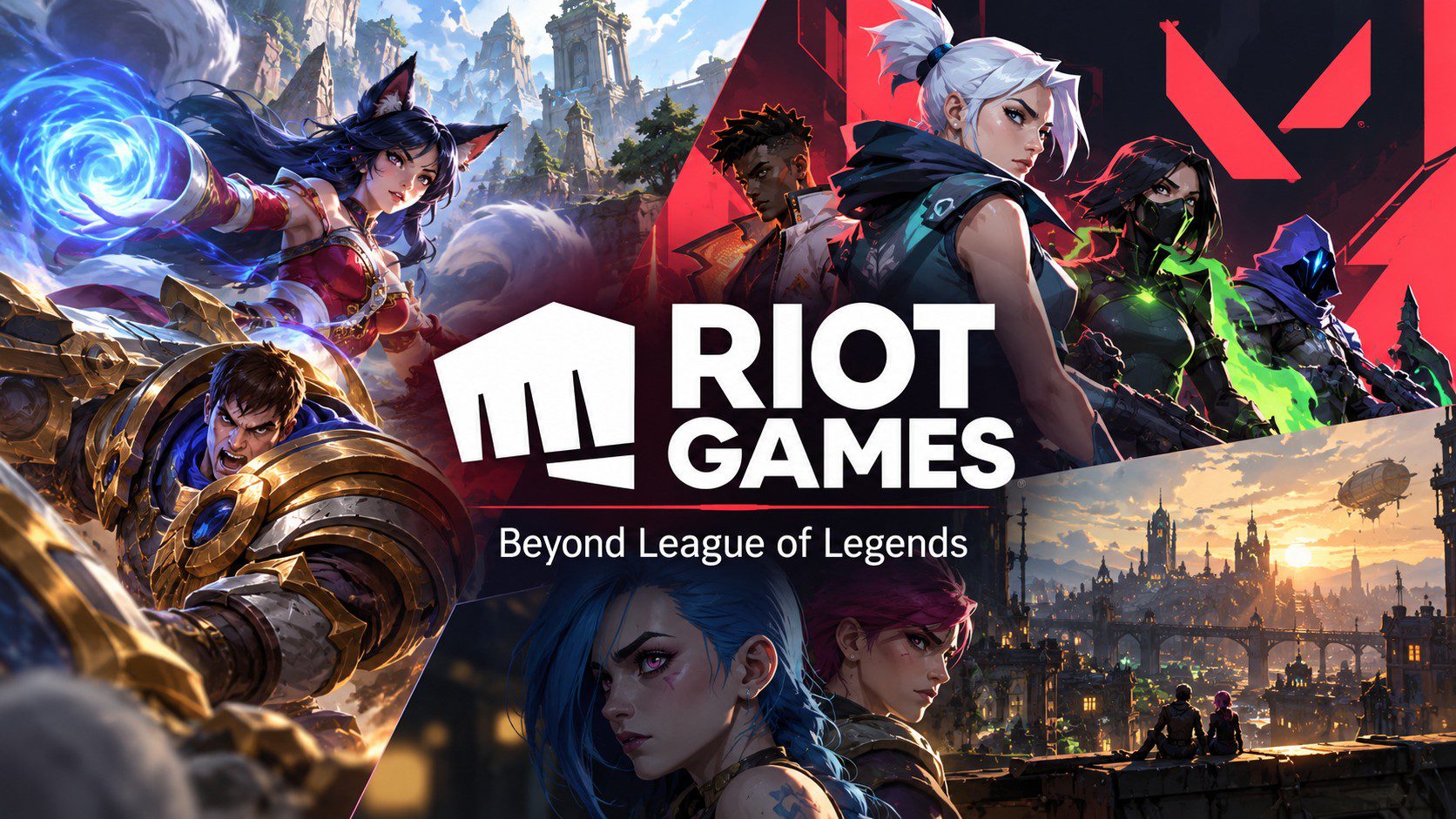
Riot Games turned one competitive game into a global entertainment business
Riot Games began with an idea that looked relatively modest: build a competitive game and keep improving it for the people who played it.
That approach eventually produced League of Legends, one of the most recognisable names in PC gaming. It also established a business model in which the relationship between a developer and its audience continues long after launch.
Today, Riot operates tactical shooters, strategy games, digital card games, international esports competitions and entertainment projects built around its fictional worlds.
However, that expansion has created challenges the original studio never faced.
Supporting a successful competitive game is one thing. Building several enduring games across different genres is considerably harder, even when the company already owns characters and worlds that millions recognise.
Riot’s history is therefore a story about both the possibilities and limitations of long-term game development.
Riot Games began with League of Legends
Brandon Beck and Marc Merrill founded Riot Games in Los Angeles in 2006.
The two had known each other through the University of Southern California and shared an interest in competitive gaming. Their ambition was to establish a company that would build games around the needs of dedicated players rather than treating launch as the end of development.
The result was League of Legends, released in 2009.
The multiplayer online battle arena places two teams against each other, with players selecting champions who possess different abilities and tactical responsibilities.
Its competitive structure proved capable of supporting years of development. New champions, balance adjustments, map changes and evolving strategies continually altered the experience without requiring a conventional sequel.
That gave Riot something valuable: a game that could remain relevant through constant reinvention.
League of Legends became more than a single game
League’s longevity changed the scale of Riot’s ambitions.
The game provided a growing cast of champions and an expanding fictional setting known as Runeterra. These elements offered opportunities beyond the original multiplayer format.
Characters who began as playable champions could become the foundation for other games, stories and entertainment projects.
However, Riot’s early success also depended on its willingness to adjust the competitive experience.
A champion who becomes too powerful can affect an entire match. Changes to equipment or objectives can alter established strategies, while new players need ways to understand an increasingly complicated game.
Riot built much of its identity around managing that continuous development process.
Riot Games made esports part of the experience
Competitive gaming became another major part of Riot’s business.
League of Legends developed a professional esports structure with regional competitions and an annual World Championship.
The tournament provides a destination for leading teams while giving ordinary players another way to engage with the game.
Professional matches also create stories beyond the software itself.
Teams develop rivalries. Players establish reputations. Major victories become moments that fans remember long after the game has changed.
Riot recognised that esports could help turn a competitive game into an ongoing spectator experience.
The relationship works in both directions. Professional competition attracts attention to the game, while a large player community supports the competitive scene.
VALORANT took Riot into tactical shooters
Riot expanded into a different competitive genre with VALORANT, released in June 2020.
Rather than reproducing the structure of League, the studio developed a five-versus-five tactical first-person shooter built around precise gunplay and specialised Agents.
Each Agent provides abilities that can reveal enemies, restrict movement, obstruct vision or support teammates.
However, those abilities do not replace the importance of positioning and shooting accuracy.
The result gave Riot another competitive game with its own identity.
VALORANT also demonstrated that the company could operate a major esports ecosystem outside the world of Runeterra.
TechnologyBlog’s dedicated VALORANT profile explores how the game’s Agent abilities, tactical objectives and team coordination work together.
Riot Games expanded into strategy and card games
Riot’s portfolio continued growing through games that approached competition differently.
Teamfight Tactics brought the company’s characters into the autobattler genre. Players build teams from a changing selection of units, manage resources and adapt their strategies across rounds.
Legends of Runeterra explored the same fictional universe through digital card gameplay. Its later emphasis on Path of Champions demonstrated how Riot could develop a more PvE-focused experience within a competitive card-game foundation.
League of Legends: Wild Rift adapted the MOBA experience for mobile platforms with controls and systems designed for shorter sessions.
These games allowed Riot to reach players with different interests.
Someone who enjoys Runeterra’s characters may not necessarily want to play a demanding PC MOBA. A strategy game or card game offers another way to engage with that world.
Runeterra became a world that could support different experiences
The shared fictional setting became one of Riot’s strongest assets.
Runeterra contains regions, characters and conflicts that extend beyond individual matches.
This gives developers a foundation for different types of gameplay without requiring every project to establish a completely new universe.
However, shared characters are not enough on their own.
A strategy game needs satisfying strategic decisions. A fighting game needs responsive combat, while a card game must give players reasons to experiment with different decks.
The setting can attract attention, but the mechanics determine whether people continue playing.
That distinction would become especially important for Riot in 2026.
Arcane brought Riot Games into television
Riot’s expansion moved beyond games with Arcane, the animated series developed with Fortiche and released through Netflix.
The series drew on the world of League of Legends, particularly characters associated with Piltover and Zaun.
Rather than simply reproducing the game’s competitive action, Arcane used those characters to tell a dramatic story about relationships, ambition, power and conflict.
That approach allowed audiences unfamiliar with League’s mechanics to engage with its world.
It also demonstrated how a game developer could expand an existing intellectual property into entertainment without requiring viewers to understand the original game.
For Riot, Arcane represented a significant step towards becoming a broader entertainment company.
Music became another part of Riot’s identity
Riot has also developed a distinctive relationship with music.
Virtual groups and musical projects connected to its games include K/DA, True Damage and HEARTSTEEL.
These projects give the company ways to reach audiences through performances, videos and original songs rather than gameplay alone.
Music also plays an important role in major esports events.
World Championship anthems help establish the atmosphere surrounding tournaments, while performances can turn competitive finals into larger entertainment productions.
In October 2026, Riot released the True Damage track Know My Name as the anthem for Worlds 2026.
The project illustrates how the company now connects games, music and esports within the same entertainment ecosystem.
Riot Games built a second major esport around VALORANT
VALORANT’s success gave Riot another opportunity to develop international competition.
The VALORANT Champions Tour provides a structure for professional teams to compete across regions and international events.
Unlike League’s established MOBA competition, VALORANT operates within the tactical shooter genre.
That requires different approaches to competitive balance, map design, spectator information and professional strategy.
The company’s 2026 schedule includes VALORANT Champions Shanghai, taking place from 24 September to 18 October.
For Riot, operating multiple major esports properties demonstrates how much the business has changed since the original League launch.
It is no longer responsible for a single competitive community.
Riot expanded into fighting games with 2XKO
One of Riot’s more ambitious expansions was 2XKO, a two-versus-two tag-team fighting game featuring characters associated with League of Legends and Arcane.
The project attempted to bring Riot’s approach to ongoing game support into a genre with an established competitive community.
Players could fight individually or coordinate with a partner, creating a different form of teamwork from Riot’s other competitive games.
The studio also planned to support existing fighting-game tournaments rather than immediately reproduce the large professional league structures used by League and VALORANT.
That approach recognised an important difference.
The fighting-game community already had its own competitive traditions, tournament organisers and events.
Riot wanted to participate in that ecosystem rather than replace it.
2XKO showed the limits of expanding an established universe
Despite Riot’s ambitions, 2XKO struggled to establish sustainable long-term engagement.
In February 2026, Riot announced that it was reducing the game’s development team after player engagement failed to reach the level needed to support the original team size.
The company continued working on improvements and supporting the competitive community.
However, the situation became more serious later in the year.
On 20 August 2026, Riot confirmed that active development would end in December.
The company explained that player retention, engagement and revenue had not produced a sustainable path forward.
This was an important admission from a developer whose reputation rests heavily on long-term support.
Riot Games will keep 2XKO playable after development ends
Riot’s August announcement distinguished between ending active development and shutting the game down.
The company said 2XKO would remain playable online after December 2026, with servers continuing to operate.
It also committed to completing remaining content and improvements during the final months of active development.
Riot announced plans to unlock champions, make adjustments to cosmetic access and refund qualifying purchases.
The decision reflects the difficulty of operating a live-service game.
A passionate community does not necessarily provide enough engagement to sustain a large development team.
Even an established publisher must eventually decide whether continued investment is commercially viable.
Riftbound brought Riot into physical card games
Riot’s expansion has not been limited to digital products.
Riftbound takes characters and settings associated with Runeterra into a physical trading card game.
That creates another form of engagement.
Players can collect cards, construct decks and compete face-to-face rather than through an online client.
The format also introduces challenges Riot’s digital games do not face in the same way.
Physical products require manufacturing, distribution, retail availability and organised play support.
For a company that began with one PC game, moving into tabletop gaming represents another substantial expansion of its business.
Riot Games operates a global development organisation
Riot’s current company profile describes an organisation with more than 4,500 employees across over 20 offices.
Its headquarters remain in Los Angeles, but its operations extend internationally.
That scale allows the company to support several games, regional publishing operations and esports competitions simultaneously.
It also creates organisational challenges.
Different games require different development expertise. International communities have different needs, while long-running products demand continuous technical maintenance.
The company must balance established games with new projects without assuming that every expansion will succeed.
The player-first philosophy faces practical tests
Riot describes its guiding philosophy as putting players first.
That principle appears throughout its public company material.
However, maintaining player trust involves more than stating a value.
Players expect fair competition, meaningful updates, stable services and clear communication about changes.
They also expect the company to respond when systems or business decisions affect their experience.
Riot’s handling of 2XKO demonstrates how difficult those responsibilities can become.
The company has promised continued server availability and refunds for qualifying purchases, but the end of active development remains disappointing for players who expected a longer future.
A developer’s relationship with its audience is tested most clearly when plans change.
Riot Games faces a different challenge in 2026
Riot no longer needs to prove that it can build a successful competitive game.
League of Legends established that reputation, while VALORANT demonstrated that the company could expand into another major genre.
The challenge now is deciding where to invest.
Established games need continued support.
Esports competitions require planning and resources.
Entertainment projects create opportunities beyond gameplay.
New games carry development costs and uncertain audiences.
The decision to end 2XKO development illustrates the limits of expansion, even for a company with Riot’s resources and recognisable characters.
Success in one genre does not automatically transfer to another.
Why Riot Games still matters in 2026
Riot Games helped demonstrate that a competitive game could become the foundation of a long-running entertainment business.
League of Legends established the company’s approach to continuous development. VALORANT extended its competitive ambitions into tactical shooters, while Teamfight Tactics, Wild Rift and Legends of Runeterra explored different ways to engage players.
Esports, music, animation and physical card games expanded that identity further.
However, Riot’s story is not one of uninterrupted success.
The difficult decisions surrounding 2XKO show that even a popular fictional universe cannot guarantee the long-term future of every project.
That may be the company’s most important lesson in 2026.
Building a successful game is difficult.
Keeping players engaged for years is harder.
And deciding which games can support that commitment has become one of Riot’s defining responsibilities.
