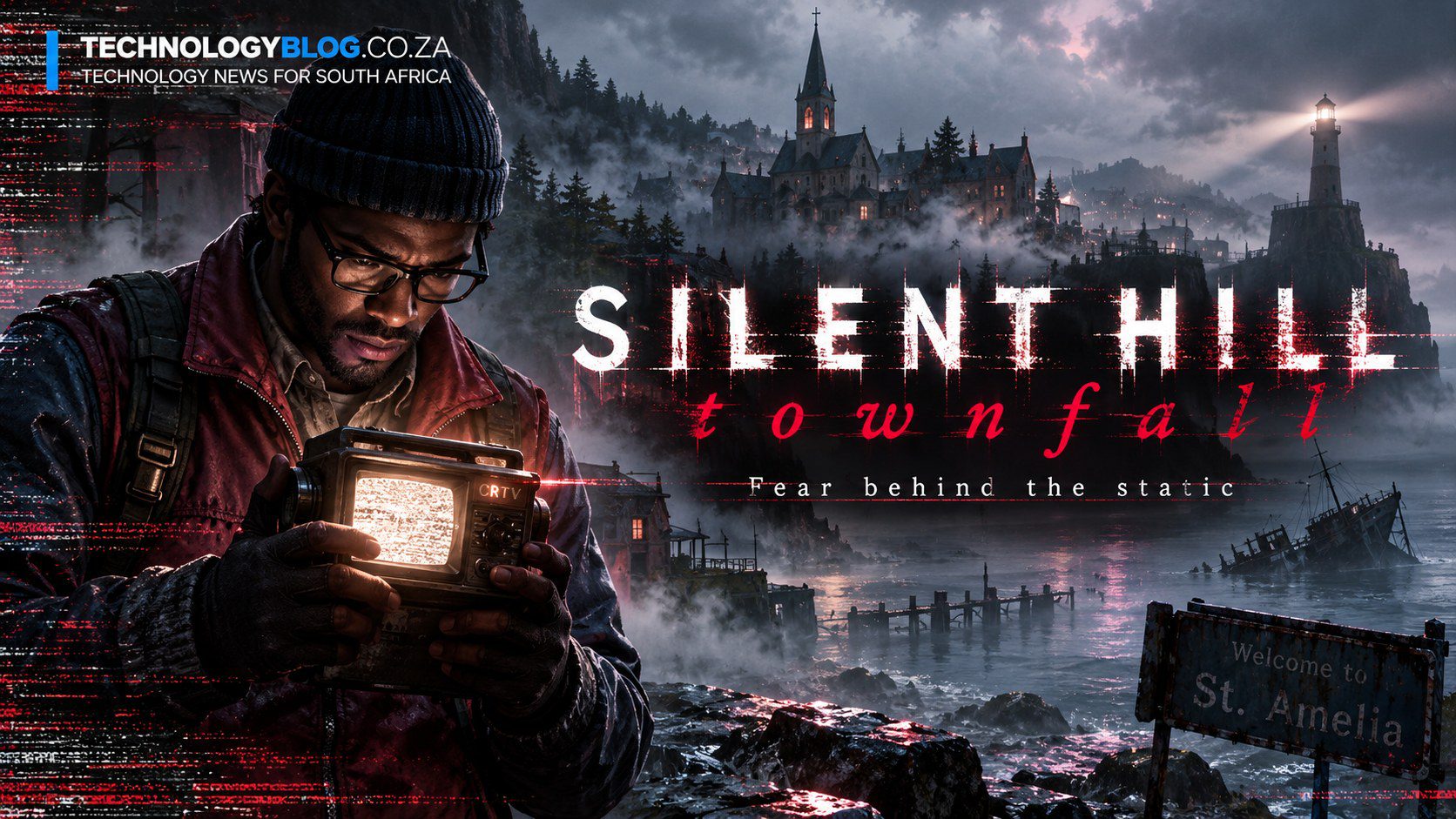
SILENT HILL: Townfall takes psychological horror to an isolated Scottish island
SILENT HILL: Townfall has arrived, and this time the fog has rolled across a remote Scottish island.
Developed by Screen Burn and co-published by KONAMI and Annapurna Interactive, Townfall launched on 24 September 2026 for PlayStation 5 and PC.
It is a full-length, self-contained entry in the Silent Hill series, but it does not simply repeat the familiar formula.
The setting has changed.
The perspective has changed.
Its protagonist has his own history to confront.
Even one of its most important tools is unusual: a pocket CRT television that picks up unstable signals.
Townfall has a distinctive identity.
However, its first Steam reception shows that not everyone is convinced by the execution.
SILENT HILL: Townfall leaves America behind
Townfall takes place in Scotland in 1996.
More specifically, the story centres on St. Amelia, an isolated island community surrounded by cold water and heavy fog.
That immediately gives the game a different identity.
Silent Hill has always used isolation effectively.
Fog hides what lies ahead.
Empty streets create uncertainty.
Ordinary buildings become threatening because players cannot tell what might be waiting inside.
Townfall takes those ideas and moves them into an isolated Scottish environment.
There is nowhere obvious to escape.
Simon Ordell has unfinished business on St. Amelia
The protagonist is Simon Ordell.
He is called back to St. Amelia to “put things right”.
That phrase immediately suggests history.
Simon is not arriving as an outsider who accidentally discovers something terrible.
He has a connection to this place.
He has a connection to its people.
Something happened here.
As Simon travels deeper into the apparently abandoned town, pieces of that past begin returning.
Townfall builds its horror around discovering what those fragments mean.
The town is empty, but it is not dead
St. Amelia initially appears deserted.
That does not make it safe.
The fog conceals the environment.
Buildings stand silent.
The town seems caught between abandonment and something considerably more disturbing.
This is familiar territory for Silent Hill as a concept, but Scotland changes the texture.
An island already creates physical separation from the outside world.
Fog makes that isolation stronger.
Then the game begins revealing why Simon was brought back.
Townfall is played entirely in first person
One of the biggest mechanical differences is perspective.
SILENT HILL: Townfall is experienced entirely in first person.
That brings players physically closer to the environment.
A narrow corridor fills the screen.
A dark doorway becomes harder to ignore.
Something moving in the fog feels closer.
The perspective also makes the CRTV more immediate because Simon physically carries and uses the device while exploring.
For a psychological horror game, that proximity can be extremely effective.
The CRTV is much more than a visual gimmick
One of Townfall’s most distinctive ideas is its pocket television.
The device is called the CRTV.
Simon can use it to tune into unstable signals.
That makes static part of the game’s mechanics rather than simply part of its visual identity.
The television can help reveal information hidden inside St. Amelia.
However, tuning into strange signals in a Silent Hill game is unlikely to provide comfort.
The CRTV becomes another way for the environment to communicate with Simon.
What it communicates may be considerably more disturbing than silence.
Static has always belonged in Silent Hill
The CRTV also feels appropriate for the wider franchise.
Radio static has long been associated with Silent Hill.
Earlier games used noise as a warning.
Players could hear danger before they could see it.
Townfall takes the concept in another direction.
Instead of carrying a simple radio, Simon has a screen.
That allows sound and image to become part of the mystery.
The technology is old.
The signals are unstable.
The information coming through cannot necessarily be trusted.
For a game set in 1996, the analogue technology also fits naturally into the world.
Simon cannot simply fight everything
Townfall includes combat.
However, the game is not built around giving Simon unlimited firepower.
His weapons and tools are limited.
Evasion therefore matters.
Players need to decide when confronting a threat makes sense and when survival means getting away.
That distinction is important for horror.
A monster becomes less frightening when the player knows every encounter can be solved by emptying enough ammunition into it.
Limited resources change the calculation.
Sometimes the correct response is not to fight.
Combat can still become explosive
Avoiding danger does not mean Townfall is passive.
Screen Burn describes its combat as frenetic.
That creates a useful contrast.
Exploration can be slow.
The player listens.
The CRTV produces something strange.
Fog obscures the path.
Then an encounter can suddenly become violent.
Horror often depends on controlling rhythm.
Long periods of uncertainty make sudden confrontation more effective.
Townfall appears deliberately structured around that tension.
Puzzles uncover the story
Narrative-driven puzzles form another major part of the experience.
These are not simply obstacles placed between Simon and the next room.
They are connected to what happened on St. Amelia.
Solving them helps expose the island’s history.
That gives exploration a narrative purpose.
Players are not only looking for the route forward.
They are trying to understand why Simon came back and what he needs to confront.
The answer appears to be buried beneath several layers of memory and guilt.
Townfall is a self-contained Silent Hill story
KONAMI describes Townfall as a full-length, self-contained psychological horror game.
That is important for new players.
Someone does not necessarily need to complete every previous Silent Hill game before starting Townfall.
The game has its own protagonist.
It has its own location.
It has its own mystery.
It is still part of Silent Hill, but its story has been designed to stand on its own.
That gives Screen Burn freedom to explore different ideas without requiring an enormous amount of franchise knowledge.
Silent Hill no longer needs one location
The wider series has increasingly demonstrated that the name Silent Hill can represent more than one American town.
Townfall takes that idea to Scotland.
The important elements become psychological rather than purely geographical.
Isolation matters.
Guilt matters.
Memory matters.
Personal history matters.
Reality can become unreliable.
The environment reflects something about the people trapped inside it.
Those ideas can travel.
St. Amelia is evidence of that.
1996 is an important part of the atmosphere
Setting the game in 1996 does more than justify the CRTV.
It changes what Simon has available.
There is no smartphone providing a constant connection to the outside world.
Information travels differently.
Analogue technology becomes useful.
Old televisions and unstable signals feel normal enough to belong in the period while remaining strange enough to become unsettling.
The era also gives Screen Burn a particular visual language.
Townfall can feel familiar without looking contemporary.
That distance helps create unease.
Jovan Adepo plays Simon
Townfall’s cast gives the characters another layer.
Jovan Adepo portrays Simon Ordell.
Kezia Burrows plays Zoe.
Terry O’Quinn plays Richard.
Their relationships sit at the centre of the mystery surrounding St. Amelia.
This matters because psychological horror depends heavily on character.
Monsters can create immediate fear.
The people involved give that fear meaning.
Townfall’s central question is not simply what happened to the island.
It is what Simon has to do with it.
Screen Burn brings its own history to the project
The developer was previously known as No Code.
The Scottish studio built its reputation around narrative-driven games such as Stories Untold and Observation.
That background makes Townfall an interesting fit.
Screen Burn already has experience with unusual interfaces, environmental storytelling and technology becoming part of how a narrative is delivered.
A pocket television that receives unstable signals therefore does not feel like a random addition.
It fits the studio’s existing interest in making the interface itself part of the story.
Stories Untold provides useful context
Stories Untold used old computers, equipment and interfaces as part of its horror.
Players interacted with machines rather than simply walking through conventional environments.
The interface became part of the tension.
That history is relevant to Townfall.
The CRTV continues the idea that technology can become part of the player’s relationship with the horror.
The device is not merely displayed on screen.
Players interact with it.
They search for signals.
The object becomes part of how information is discovered.
Observation pushed the studio further
Observation placed players in another unusual perspective.
Instead of controlling a conventional human protagonist, players interacted with a space station through an artificial intelligence.
Again, interfaces mattered.
Cameras mattered.
Technology shaped what the player could perceive.
Townfall is mechanically different, but the design lineage is visible.
Screen Burn appears comfortable asking players to interact with a world through unusual devices.
That experience gives the CRTV concept a strong foundation.
Annapurna Interactive remains involved
Annapurna Interactive co-publishes SILENT HILL: Townfall alongside KONAMI.
The partnership is notable because Townfall combines a major established horror franchise with a comparatively distinctive independent development studio.
KONAMI provides the Silent Hill property.
Screen Burn provides its own approach to narrative horror.
Annapurna brings another publishing partner into the project.
The result is not designed to replace other modern Silent Hill games.
It occupies its own space within the revival of the series.
Silent Hill has expanded rapidly again
The franchise looks very different from where it stood several years ago.
Multiple projects have brought Silent Hill back into active development.
Townfall is part of that broader strategy.
Rather than relying entirely on one studio or one interpretation, KONAMI has allowed different developers to approach the series in different ways.
That creates risk.
Not every interpretation will appeal to every fan.
However, it also prevents Silent Hill from becoming locked into one formula.
Townfall demonstrates how far that approach can stretch.
The early Steam response is Mixed
The first major warning sign comes from Steam.
When TechnologyBlog checked the store on 25 September, SILENT HILL: Townfall had a Mixed user-review rating.
Around 67% of more than 1,100 reviews were positive in the latest Steam snapshot.
That number has already moved since early access and launch.
Earlier snapshots were considerably more positive.
This is why launch-day review percentages need context.
The audience is growing rapidly.
More people are reaching later sections.
Technical problems and design complaints can also emerge as playtime increases.
The current rating should therefore be treated as an evolving launch response rather than a permanent verdict.
Townfall peaked above 8,000 concurrent Steam players
SteamDB recorded an all-time peak of 8,360 concurrent Steam players on 24 September.
Its latest snapshot showed roughly 4,000 players in-game.
Those numbers need careful interpretation.
They represent simultaneous Steam players.
They are not total sales.
They are not unique players.
They do not include PlayStation 5 or Epic Games Store players.
For a single-player horror game, concurrency is primarily useful as an indicator of launch interest.
It does not determine whether the game can remain playable in the future.
Townfall reached Steam’s top sellers
SteamDB also placed Townfall among Steam’s current top sellers in its latest snapshot.
That provides additional context for the launch.
The player count may not resemble a huge multiplayer blockbuster, but Townfall is a narrative-focused horror game.
Its audience will behave differently.
Players can complete it and move on.
There is no multiplayer population that needs to remain online for the game to function.
For this type of release, user reception and longer-term sales are more meaningful than permanent concurrency.
PC players are reporting enough concerns to watch closely
The Mixed Steam reception deserves attention.
A game’s concept can be strong while its PC version still causes frustration.
TechnologyBlog has not independently benchmarked Townfall, so we will not present specific performance problems as universal fact.
However, the changing Steam reception means PC players should check current user feedback and patch information before buying.
Launch conditions can change quickly.
A performance patch can alter the picture.
So can driver updates and configuration discoveries.
The important thing is not to freeze the launch-day situation permanently.
Townfall uses Unreal Engine
SteamDB identifies Unreal Engine among the technologies used by Townfall.
The PC version also includes technologies associated with AMD FSR and NVIDIA DLSS.
That provides players with modern scaling options, although the existence of those technologies does not automatically guarantee good performance.
Actual performance depends on hardware, settings and the game’s implementation.
TechnologyBlog has not independently tested the PC build.
Therefore, benchmark conclusions should wait for direct testing or reliable measured data.
Steam Deck support should be checked carefully
Steam’s current compatibility information should be checked before purchasing specifically for Steam Deck.
Compatibility status can change after patches or Valve testing.
A game launching on Steam does not automatically mean it provides a good handheld experience.
That is especially relevant to a visually demanding modern horror game.
Players intending to use a handheld should check the current Steam compatibility status immediately before buying.
Townfall has 36 Steam achievements
For players who enjoy completing horror games thoroughly, the Steam release includes 36 achievements.
The game also supports Steam Cloud and Family Sharing.
Full controller support is available for Xbox and PlayStation controllers.
Steam notes that the developers recommend using a controller.
Townfall remains a single-player experience.
There is no online multiplayer requirement shaping the core game.
Multiple endings encourage another look
Townfall also includes multiple endings according to its Steam information.
That fits the psychological mystery at the centre of the story.
A game built around buried history and personal responsibility benefits from giving player actions or discoveries additional significance.
Multiple endings can also encourage players to revisit St. Amelia.
A second playthrough changes the experience.
Players know more.
An apparently insignificant detail may suddenly matter.
A line of dialogue can take on another meaning.
In psychological horror, knowledge changes fear.
Townfall does not need to imitate Silent Hill 2
One of the biggest dangers facing any new Silent Hill game is comparison with the series’ most celebrated entries.
Townfall benefits from moving elsewhere.
It has another protagonist.
Another country.
Another period.
Another perspective.
Another developer.
The game can use Silent Hill’s psychological foundations without recreating James Sunderland’s journey.
That is healthier for the series.
A franchise built around psychological horror should be capable of telling more than one kind of psychological story.
St. Amelia gives Silent Hill a new kind of isolation
The island setting may ultimately be Townfall’s strongest idea.
Silent Hill has always understood that horror becomes more effective when escape feels uncertain.
An island makes that physical.
Fog makes it visual.
Simon’s past makes it psychological.
The CRTV makes it technological.
Those elements reinforce one another.
St. Amelia is not frightening simply because monsters may exist there.
It is frightening because Simon has returned for a reason.
The town knows something.
The signals know something.
Eventually, the player has to know it too.
Is SILENT HILL: Townfall worth playing?
TechnologyBlog has not completed an independent review of SILENT HILL: Townfall, so this article is not a scored recommendation.
What we can establish is that Townfall has a clear identity.
Screen Burn has not simply reproduced another Silent Hill game in first person.
The Scottish setting changes the atmosphere.
Simon has a personal connection to St. Amelia.
The CRTV gives exploration an unusual mechanic.
Combat and evasion create different responses to danger.
Narrative puzzles connect progression to the mystery.
The early Steam response, however, is Mixed.
That makes the opening patches and evolving player feedback important.
SILENT HILL: Townfall finds horror in the static
SILENT HILL: Townfall understands one of the series’ most useful ideas.
What you cannot clearly understand is often more frightening than what you can see.
St. Amelia disappears into fog.
Simon remembers fragments.
The town looks abandoned but refuses to stay quiet.
A small television pulls unstable signals out of the static.
Something happened here.
Simon came back because of it.
Screen Burn has taken Silent Hill away from its familiar geography without abandoning its psychological foundations.
The result is a game about a different town, another damaged protagonist and another buried truth.
This time, the truth may be waiting somewhere between the signals.


