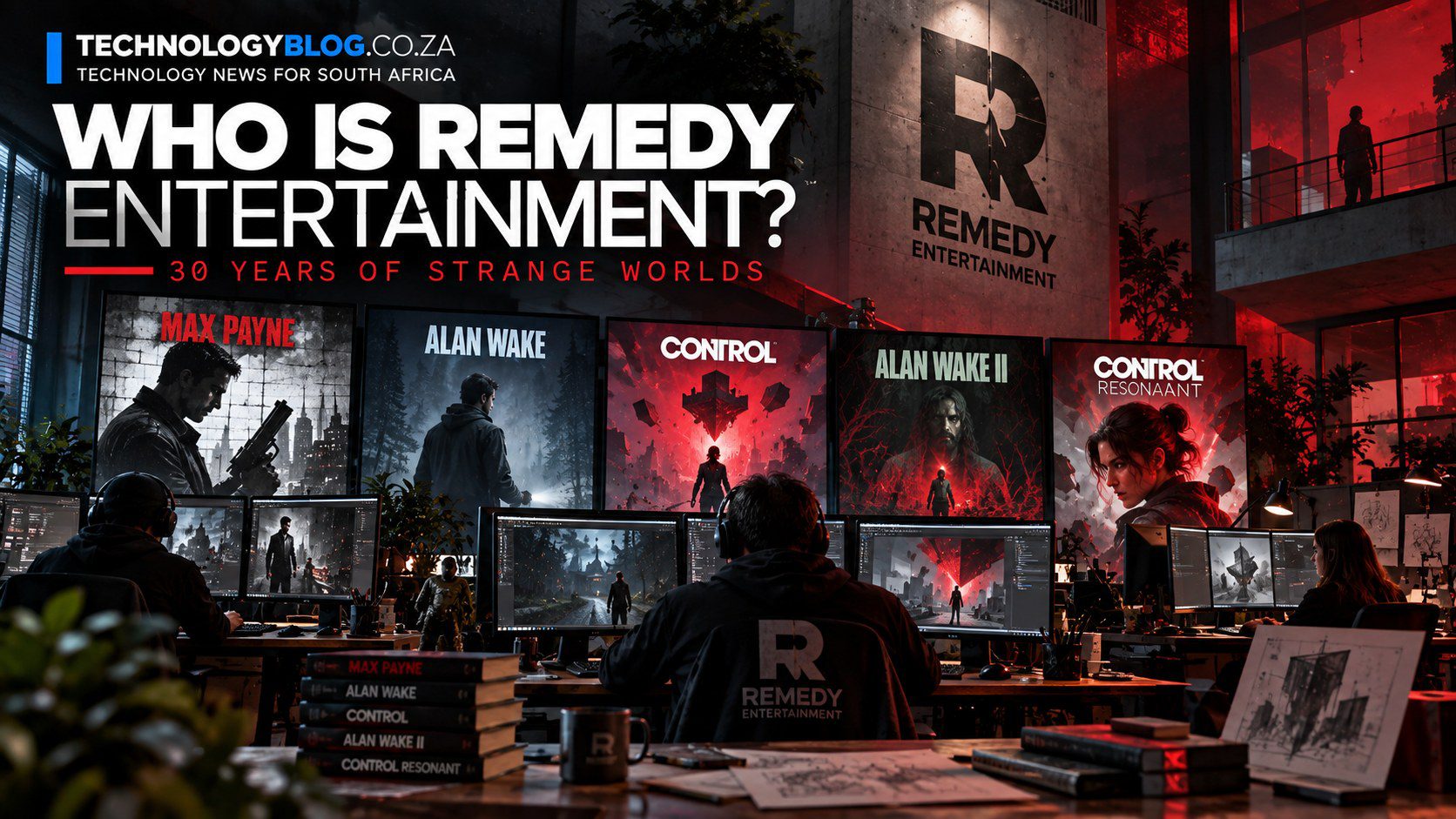
Who is Remedy Entertainment? The studio behind CONTROL Resonant, Alan Wake and Max Payne
Remedy Entertainment has spent more than 30 years making games that rarely feel like anyone else’s.
A detective dives sideways through the air while time slows around him.
A writer discovers that his own words are changing reality.
A woman enters an apparently ordinary government building and finds something impossible inside.
Now Dylan Faden is walking through a Manhattan where gravity itself can no longer be trusted.
Those games span different genres, publishers and generations of hardware.
Yet Max Payne, Alan Wake, Control and CONTROL Resonant share something recognisable.
They feel like Remedy games.
That identity has helped a Finnish developer founded in 1995 grow into a studio capable of producing major PC and console games while continuing to experiment with how games tell stories.
Remedy Entertainment began in a basement
The story starts in Espoo, Finland.
Remedy Entertainment was founded in August 1995 and emerged from Finland’s demoscene.
The early operation was considerably less glamorous than the modern studio.
Remedy’s own anniversary history remembers its beginnings in one of its founders’ basements.
That small group could hardly have known what would follow.
Three decades later, Remedy would employ hundreds of people from dozens of countries.
Before any of that could happen, however, it needed to make its first game.
Death Rally came first
Remedy’s first commercial game was Death Rally.
Released in 1996, the top-down vehicular combat game mixed racing with weapons and destruction.
It was very different from the cinematic third-person action games that would later define the studio.
However, Death Rally gave the young developer something essential.
It had shipped a game.
The project also began a relationship with publishers and industry figures that would help Remedy move towards something considerably more ambitious.
That next project changed the studio permanently.
Max Payne put Remedy Entertainment on the international map
Max Payne arrived in 2001.
The game combined third-person shooting with a dark crime story and a mechanic that became inseparable from its identity: bullet time.
Players could slow the action while Max continued aiming.
Gunfights became cinematic sequences.
Max could dive through doorways while bullets moved around him.
The mechanic was not simply visual spectacle.
It changed how players approached combat.
Max Payne helped establish Remedy as a developer capable of combining storytelling, technology and action in unusual ways.
Max Payne developed Remedy’s cinematic identity
The game’s storytelling was equally important.
Instead of relying only on conventional cutscenes, Max Payne used graphic-novel panels.
The internal narration leaned heavily into noir.
The city became oppressive.
Max himself was damaged, cynical and memorable.
Those techniques were partly practical responses to development limitations.
However, they also helped establish something that would become central to Remedy.
Constraints could become style.
The studio did not need to imitate film exactly.
It could borrow from cinema, television, comics and literature while still building something specifically designed for games.
Sam Lake became closely associated with Remedy
Any discussion of Remedy eventually reaches Sam Lake.
Lake joined the company during its early years and became one of the creative figures most closely associated with its games.
He wrote Max Payne and even provided the character’s face in the original game.
Over the following decades, Lake became increasingly visible as a writer, creative director and public face of Remedy.
His involvement connects several eras of the company.
Max Payne, Alan Wake and the modern Remedy Connected Universe may look very different, but they share creative DNA.
Lake’s work is one part of that continuity.
Remedy did not keep Max Payne forever
Success did not mean Remedy retained every property it created.
The Max Payne intellectual property eventually became part of Rockstar Games owner Take-Two Interactive.
Remedy nevertheless returned to develop Max Payne 2: The Fall of Max Payne.
After that, the studio moved towards another original idea.
That transition would become familiar.
Remedy creates worlds that players strongly associate with the studio, even when business arrangements around ownership and publishing differ.
Its next major protagonist was not a police detective.
He was a writer.
Alan Wake took Remedy somewhere stranger
Alan Wake arrived in 2010.
Its protagonist was a bestselling novelist suffering from writer’s block.
A trip to Bright Falls becomes something far more disturbing when his wife disappears.
Alan discovers pages from a manuscript he does not remember writing.
Worse, the events described on those pages begin happening around him.
The premise allowed Remedy to explore the relationship between fiction and reality.
Light became part of combat.
Darkness became both an enemy and a narrative idea.
Television, literature and episodic storytelling shaped the presentation.
The studio’s identity was changing again.
Bright Falls became more than a location
Alan Wake’s fictional town provided Remedy with another opportunity to build a world full of mysteries.
Players could follow the main story.
They could also pay attention to radio broadcasts, television programmes, manuscript pages and environmental details.
That layering became increasingly important to Remedy’s storytelling.
Not every piece of information needed to be placed directly in front of the player.
Some could sit at the edges.
Players willing to investigate could discover more.
Years later, that approach would become central to Control.
Quantum Break experimented with television and games
Before Control, Remedy created Quantum Break with Microsoft.
The project pushed the studio’s interest in combining different forms of entertainment further than ever.
Quantum Break mixed gameplay with live-action television episodes.
Player decisions could influence parts of the live-action material.
The concept was ambitious.
It also demonstrated Remedy’s willingness to experiment even when an idea carried significant risk.
Time manipulation became central to both gameplay and story.
Once again, a supernatural concept affected how players actually controlled the game.
That relationship between narrative ideas and mechanics would become even stronger in Control.
Control gave Remedy a new foundation
Control launched in 2019.
The setting was the Oldest House, headquarters of the Federal Bureau of Control.
From outside, the building appeared almost ordinary.
Inside, normal architectural rules stopped applying.
Rooms shifted.
Impossible spaces appeared.
Objects carried supernatural properties.
Hostile forces invaded.
At the centre of everything was Jesse Faden.
She entered the Oldest House looking for her brother Dylan and eventually became Director of the Bureau.
Control made the strange feel bureaucratic
One of Control’s smartest ideas was the Federal Bureau of Control itself.
The supernatural was terrifying.
The Bureau treated it as paperwork.
Impossible objects received classifications.
Incidents generated reports.
Employees followed procedures.
Departments existed to study things that should not exist.
That contrast created much of the game’s personality.
Control could be unsettling and funny at almost the same moment.
A possessed object might represent a dangerous supernatural phenomenon.
Somewhere nearby would be a memo explaining the correct administrative procedure for dealing with it.
Few games approached paranormal fiction in quite the same way.
The Oldest House became one of Remedy’s best environments
The Oldest House allowed Remedy to combine brutalist architecture with impossible geometry.
Concrete corridors could suddenly open into enormous spaces.
Rooms changed.
Entire sectors felt disconnected from normal reality.
The building became more than a backdrop.
It was part of the mystery.
Exploration also rewarded curiosity.
Documents, recordings and hidden areas revealed more about the Bureau and the events it investigated.
That density helped Control build a devoted audience.
It also gave Remedy something even more valuable.
A universe capable of expanding.
Alan Wake and Control became connected
Players gradually realised that Remedy’s games were no longer entirely separate.
The connections became explicit through Control and its AWE expansion.
Alan Wake’s world and the Federal Bureau of Control could exist within a shared mythology.
Remedy eventually formalised this idea as the Remedy Connected Universe.
That changed how players looked at earlier details.
A strange reference might no longer be an isolated Easter egg.
It could matter later.
The studio had spent years building unusual worlds.
Now some of those worlds could interact.
Alan Wake 2 demonstrated how far Remedy had evolved
Alan Wake 2 arrived in 2023.
Thirteen years had passed since the original game.
Rather than simply recreate what worked in 2010, Remedy changed the structure.
The sequel introduced FBI agent Saga Anderson as another playable protagonist.
Players moved between Saga’s investigation and Alan’s increasingly unstable reality.
The game leaned further into survival horror.
Live action blended with rendered scenes.
Music became part of storytelling.
The result demonstrated a studio increasingly comfortable combining different media inside a game.
Remedy’s live-action experimentation never disappeared
The studio’s fascination with live action stretches across several projects.
Quantum Break made it an obvious part of the experience.
Control used live-action material in stranger ways.
Alan Wake 2 pushed the technique further.
The effect can be deliberately disorienting.
A rendered character becomes a live actor.
A game sequence changes into something resembling television.
Music and choreography suddenly interrupt conventional gameplay.
For another studio, those shifts could feel inconsistent.
For Remedy, inconsistency can be the point.
Its stories often concern realities colliding with one another.
The presentation does the same.
Northlight gives Remedy its own technology
Behind these games is Remedy’s proprietary Northlight technology.
The company develops its own game engine and tools rather than depending entirely on a commercially available third-party engine.
That gives Remedy direct control over technology important to its games.
Lighting matters.
Character rendering matters.
Destruction matters.
Cinematic presentation matters.
Large, strange environments matter.
An internal engine can be developed around those priorities.
It also represents a substantial investment.
Building games is difficult.
Building the technology used to build those games adds another challenge.
Northlight evolved alongside Remedy’s games
A proprietary engine is not static.
Each new project creates additional requirements.
Quantum Break pushed cinematic presentation and environmental destruction.
Control demanded complicated environments, physics and supernatural effects.
Alan Wake 2 placed enormous emphasis on lighting, character detail and transitions between different realities.
CONTROL Resonant expands into much larger spaces.
Northlight has therefore evolved alongside the kinds of games Remedy wants to create.
The engine is not merely a logo displayed before a game starts.
It is part of the studio’s development strategy.
Remedy became a public company
The company itself changed as its projects became larger.
Remedy listed its shares in Finland and today trades on Nasdaq Helsinki under the ticker REMEDY.
That makes Remedy different from a privately owned independent studio.
It has shareholders.
It publishes financial reports.
Its development pipeline and commercial performance receive public scrutiny.
At the same time, Remedy continues to describe itself through the games and worlds it creates.
Balancing creative ambition with the realities of running a publicly listed game company has become another part of its story.
Remedy grew into a multinational team
The basement developer of 1995 no longer exists in that form.
At the end of 2025, Remedy employed 387 game-industry professionals from 38 countries.
Its headquarters remain in Espoo.
The company also operates an office in Stockholm, which opened in 2022.
That scale allows Remedy to work across multiple projects.
However, growth creates challenges of its own.
A larger studio requires more coordination.
Games become more expensive.
Production pipelines become more complicated.
Expectations increase.
The company that made Death Rally and the company making modern Remedy games share history, but they operate at very different scales.
Remedy regained full control of the Control franchise
One of Remedy’s most important recent business moves came in 2024.
The company acquired the full rights to the Control franchise from 505 Games.
That included Control and the projects then known as Condor and Control 2.
The transaction gave Remedy control over publishing, distribution and future commercial decisions for the franchise.
That matters because Control had become one of Remedy’s most important properties.
Owning the franchise gives the studio more control over what happens next.
The consequences of that decision are now visible.
FBC: Firebreak tried something very different
Condor eventually became FBC: Firebreak.
Instead of another single-player adventure, Firebreak moved into cooperative multiplayer.
Players became members of an FBC response unit dealing with supernatural crises inside the Oldest House.
The shift demonstrated another side of Remedy’s expansion strategy.
A shared universe does not require every game to use the same structure.
Control could be a single-player action game.
Firebreak could be cooperative multiplayer.
Another project could approach the universe differently again.
That flexibility is useful if Remedy wants its properties to grow beyond individual sequels.
CONTROL Resonant represents a major new step
CONTROL Resonant arrived on 24 September 2026.
The sequel puts Dylan Faden in the lead.
Jesse remains central to the story, but she is missing when Dylan’s journey begins.
The location has changed too.
Instead of remaining inside the Oldest House, the paranormal crisis has spread across Manhattan.
Reality is breaking.
Gravity can change direction.
Large areas invite exploration.
Dylan uses supernatural abilities alongside the Aberrant, a shapeshifting melee weapon.
Remedy describes Resonant as an action-adventure RPG and its most expansive game to date.
Remedy is publishing CONTROL Resonant itself
CONTROL Resonant also represents an important change behind the scenes.
Remedy is both developer and publisher.
Annapurna Pictures is co-financing and co-producing the project through a strategic partnership with the studio.
That arrangement gives Remedy a larger role in bringing one of its own major games to market.
It fits the broader strategy behind reacquiring the Control rights.
The company is not simply trying to create successful games.
It wants greater control over the franchises it creates.
CONTROL Resonant takes the studio outside the Oldest House
The scale of Resonant also reflects Remedy’s growth.
Control worked brilliantly inside a dense and deliberately confusing building.
Resonant moves into large Manhattan zones.
Optional discoveries sit away from the direct story path.
Gravity Anomalies change how players navigate.
The environment itself can become physically impossible.
It is a bigger canvas.
That creates risk.
A larger game needs enough meaningful content to justify its size.
However, it also gives Remedy an opportunity to apply its unusual design language to something far beyond office corridors.
Remedy still has a connection to Max Payne
The Max Payne story is not finished either.
Remedy has been working on remakes of Max Payne and Max Payne 2 in partnership with Rockstar Games.
The arrangement brings the original developer back to games that played a major role in establishing its reputation.
That creates an unusual circle.
Modern Remedy is dramatically larger and technologically more advanced than the company that made Max Payne in 2001.
Yet it is returning to that material with decades of additional experience.
For long-time players, the project connects the earliest internationally recognised Remedy era with the current one.
Thirty years changed almost everything
Remedy celebrated its 30th anniversary in 2025.
Consider the distance between the two ends of that timeline.
Death Rally was a top-down combat racer.
Max Payne created cinematic gunfights.
Alan Wake turned writing and light into central ideas.
Quantum Break mixed a game with live-action television.
Control created a paranormal government agency inside an impossible building.
Alan Wake 2 pushed further into survival horror and mixed-media storytelling.
FBC: Firebreak experimented with cooperative multiplayer.
CONTROL Resonant takes an action RPG into a warped Manhattan.
The genres changed.
The technology changed.
The size of the company changed.
The fascination with strange stories did not.
Remedy Entertainment builds around mysteries
A recurring element connects much of the studio’s work.
Remedy rarely explains everything immediately.
Players receive fragments.
Documents provide clues.
Characters may be unreliable.
Television programmes reveal something unexpected.
A song might contain information.
An apparently insignificant object can become important.
Sometimes the answer creates another question.
That approach asks players to participate in the mystery rather than simply watch it unfold.
The community then continues the process outside the game.
People compare theories.
They inspect scenes.
They connect events across different titles.
That engagement gives Remedy’s worlds unusually long lives.
The studio also understands memorable characters
Strange worlds need people to anchor them.
Max Payne gave players a broken detective.
Alan Wake gave them a writer trapped inside increasingly impossible fiction.
Jesse Faden entered the Oldest House determined to find her brother.
Saga Anderson investigated murders while reality changed around her.
Dylan Faden now carries his own complicated history into Resonant.
These characters are rarely conventional power fantasies.
They are confused.
Damaged.
Sometimes unreliable.
Often trapped inside situations they barely understand.
That vulnerability helps the supernatural elements feel more threatening.
Music has become part of Remedy’s storytelling
Music also occupies an unusually important position in Remedy games.
It is not always background decoration.
Songs can become part of the fiction.
Performances can become major story moments.
The fictional Old Gods of Asgard have crossed between Alan Wake and Control-related material.
Alan Wake 2 turned one musical sequence into one of the game’s most recognisable moments.
This willingness to use music as narrative material reinforces the studio’s mixed-media approach.
A Remedy story does not need to stay inside conventional dialogue and cutscenes.
The studio has learned to turn limitations into identity
That ability goes back to Max Payne.
Graphic-novel panels provided an economical storytelling method.
The limited resources of an early Finnish developer became part of the game’s style.
Modern Remedy has far more resources.
Yet the underlying mentality remains useful.
Technology should serve an idea.
Live action is used because it can create a particular feeling.
Brutalist architecture supports Control’s atmosphere.
Lighting becomes part of Alan Wake’s mechanics and themes.
Impossible geometry reinforces the supernatural nature of the FBC.
The best Remedy ideas tend to work at several levels simultaneously.
Not every Remedy experiment works equally well
A long career inevitably includes projects that connect differently with audiences.
Some experiments receive stronger responses than others.
New genres introduce new risks.
Multiplayer requires different expertise from cinematic single-player development.
Larger games create larger production challenges.
A publicly listed studio also cannot ignore commercial performance.
That context matters when discussing Remedy.
Its reputation for creativity does not make it immune to the realities of game development.
Experimentation creates the possibility of failure as well as success.
Independence does not mean working alone
Remedy has spent much of its history working with major partners.
Publishers and platform holders have included companies such as Microsoft, Epic Games Publishing, 505 Games and Rockstar Games.
The studio has also worked on external properties and partnership projects.
Those relationships helped finance increasingly ambitious games.
At the same time, Remedy has gradually increased ownership and control around some of its most important intellectual property.
The reacquisition of Control is the clearest example.
CONTROL Resonant being self-published by Remedy pushes that strategy further.
Remedy’s worlds can now support more than one game
This may be one of the biggest differences between early and modern Remedy.
Max Payne originally represented a game and then a sequel.
Modern Remedy increasingly thinks in terms of worlds.
Alan Wake connects to Control.
Control supports Firebreak.
CONTROL Resonant expands the FBC mythology.
Characters and ideas can move between projects.
That creates opportunities, but Remedy needs to preserve accessibility.
A new player should not need to study 30 years of games before understanding the next one.
CONTROL Resonant has therefore been designed as both a sequel and a possible new entry point.
That balance will become increasingly important as the connected universe grows.
Why Remedy Entertainment matters in 2026
Remedy Entertainment occupies an unusual position in modern game development.
It is large enough to produce ambitious AAA games.
It develops proprietary technology.
It employs hundreds of people.
Its shares trade publicly.
It works with major international partners.
Yet its games still carry a recognisable creative identity.
That is difficult to maintain as studios grow.
Large projects require hundreds of people and years of work.
Individual creative decisions pass through increasingly complex production pipelines.
Nevertheless, players can usually recognise a Remedy game.
CONTROL Resonant begins Remedy’s next chapter
The release of CONTROL Resonant gives the studio another major test.
Control is now fully owned by Remedy.
Resonant is being published by Remedy.
The game is larger.
Its structure is more open.
Its protagonist has changed.
Its combat places greater emphasis on melee.
Its setting has expanded from an impossible building into a distorted Manhattan.
All of those decisions increase the stakes.
They also represent what Remedy has spent three decades learning to do.
Take something familiar.
Distort it.
Build mechanics around the distortion.
Then place a damaged human being in the middle and see what happens.
From a Finnish basement to Manhattan
The scale of the journey is difficult to miss.
In 1995, Remedy Entertainment began in Espoo with roots in the Finnish demoscene and a workspace that included a founder’s basement.
Its first game was Death Rally.
Then came Max Payne.
Alan Wake followed.
Quantum Break experimented with the boundary between games and television.
Control built an entire mythology around a government agency trying to catalogue the impossible.
Alan Wake 2 connected realities even further.
Now CONTROL Resonant has taken that supernatural chaos into Manhattan.
The technology is different.
The budgets are different.
The company is different.
But after more than 30 years, Remedy still seems fascinated by the same question:
What happens when reality stops behaving the way we expect?
For Remedy Entertainment, that question has been enough to build an entire career.


