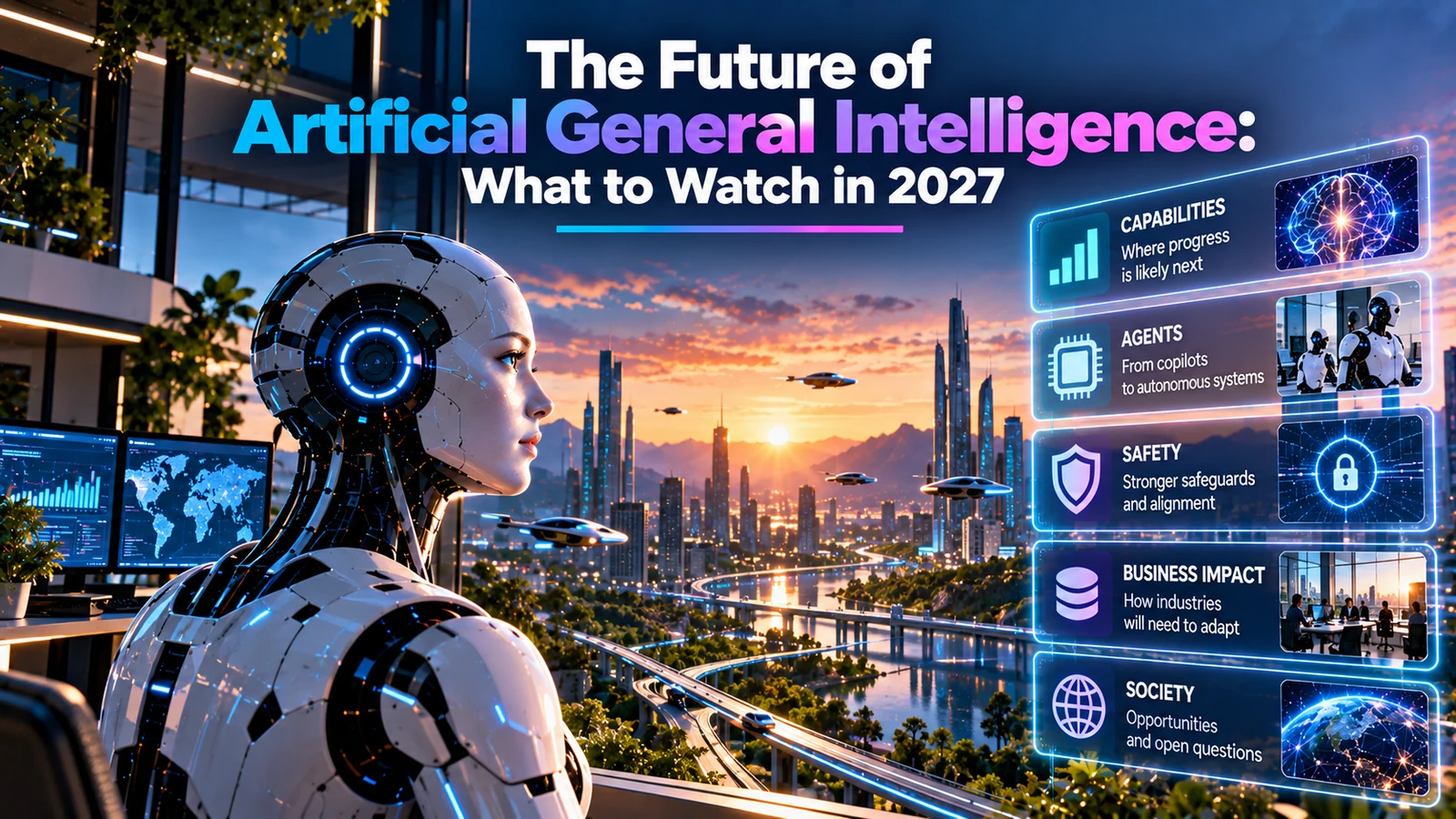
The Future of Artificial General Intelligence: What to Watch in 2027
Predicting the exact year of artificial general intelligence is not responsible journalism. The definition is contested, the research is moving quickly and experts disagree about which breakthroughs are still required. A useful 2027 outlook therefore needs measurable signals that could strengthen — or weaken — the case that more general systems are approaching.
The most important signals are not a new model name or a dramatic launch slogan. They are progress on unfamiliar-task adaptation, long-horizon reliability, automated AI research, robust generalisation and the safety thresholds frontier labs are already monitoring.
For the current baseline, start with our complete 2027 AGI guide and AGI progress in 2026.
Watch what comes after ARC-AGI-3’s September jump
ARC-AGI-3 launched with humans at 100% and frontier AI at 0.51%, but GPT-6 Astra reached 62.7% with the standard harness and 99.9% with a provider-adapter harness by September. That means the useful 2027 question is no longer simply whether systems can close the original benchmark gap.
Watch whether those gains transfer to new, less bounded environments without benchmark-specific engineering, whether performance remains strong under provider-neutral conditions, and what next-generation evaluations reveal. ARC Prize itself says saturation of ARC-AGI-3 is not proof of AGI.
Watch the length of tasks agents can complete reliably
METR’s time-horizon research provides a concrete trend line for software tasks. A continued increase would show that agents are becoming more capable of planning and recovering across extended work.
The key word is reliability. A system that occasionally completes a week-long-equivalent benchmark task is different from a system that can be trusted to do it repeatedly.
Watch AI systems doing AI research
Both Google DeepMind and Anthropic treat automated AI research as a frontier-risk domain. This is important because AI that accelerates AI development could shorten the time between capability generations.
In 2027, evidence that models can independently design experiments, improve training methods or contribute materially to model development would deserve close attention.
Watch continual learning
Current deployed models do not generally learn new permanent capabilities from ordinary user interaction in the way humans learn over a lifetime. More robust continual learning would strengthen the case for general intelligence.
It would also create new safety questions. A system that changes through experience can become harder to evaluate if its capabilities and behaviour are no longer fixed at deployment.
Watch the distinction between model and system
Future capability may come from systems built around models: memory, tool use, search, verification, planning loops and multiple specialised agents.
If a system behaves generally because of this architecture, the AGI debate will need to decide whether the label applies to the underlying model or to the complete deployed system.
Watch whether benchmarks become more ecological
Real intelligence operates under uncertainty, incomplete goals and changing environments. Expect more evaluations to move away from static exams toward tasks that require exploration, collaboration, tool use and recovery from failure.
That would make AGI evaluation harder but more meaningful.
Watch the safety frameworks, not only product announcements
DeepMind and Anthropic publish capability thresholds because dangerous capability can emerge before an AGI consensus. Changes to these frameworks can reveal what frontier labs are increasingly concerned about.
If a lab raises security requirements or reports a model approaching a critical threshold, that can be more informative than a consumer-facing feature launch.
Watch for clearer definitions from industry and academia
The AGI debate will remain noisy while organisations use incompatible definitions. A major step forward would be convergence around operational criteria or at least better disclosure of which definition a claim uses.
DeepMind’s level-based approach is one attempt to create shared language. Others may emerge in 2027.
Watch economic evidence carefully
If AI systems can handle a growing share of economically valuable work, companies and policymakers may treat that as practical AGI even if cognitive scientists remain unconvinced.
Employment data, firm adoption and task-level productivity studies will therefore become part of the AGI evidence base.
Watch cybersecurity and biological capability
Frontier safety research already tracks these domains. A major jump would raise governance pressure even if the system remained short of a broader AGI threshold.
TechnologyBlog’s coverage of OpenAI Astra’s cybersecurity assessment shows why domain capability can matter independently of the AGI label.
Watch how governments respond
South Africa is reworking its AI policy after the 2026 draft was withdrawn, while also calling for global guardrails. Internationally, governments are increasingly interested in frontier capability, compute, model evaluations and safety reporting.
In 2027, governance may become more capability-based and less dependent on whether a lab uses the word AGI.
Do not watch AGI countdown clocks too closely
Specific dates are seductive because they create certainty where there is none. A founder, researcher or forecaster may have a reasoned view, but a prediction is not an observation.
Dated forecasts should remain forecasts and be compared with measurable capability evidence.
What would materially change our view?
Several developments would justify a stronger claim that AGI is approaching: robust transfer beyond bounded benchmark environments, reliable completion of long multi-domain projects, efficient continual learning, strong results across independent cognitive evaluations, and material automated AI R&D that survives external scrutiny.
Even then, the definition question would remain. But the evidence would be substantially different from today’s.
What would weaken the near-term AGI case?
The near-term case weakens if gains on interactive benchmarks fail to transfer beyond their specific environments, long-horizon reliability plateaus, benchmark results depend heavily on proprietary scaffolding, or current architectures hit persistent reliability limits. Compute constraints, deployment resistance or stronger safety controls could also slow how quickly frontier capability reaches real-world use.
The responsible outlook therefore has to survive being wrong. If systems instead learn unfamiliar tasks efficiently and complete broad projects reliably with less human help, the evidence changes in the other direction. Scientific progress is not obliged to follow either the optimistic or pessimistic timeline.
Expect disagreement to increase if capabilities approach the threshold
Paradoxically, a more capable 2027 system may not settle the AGI debate. It could intensify it. Companies, researchers, economists and policymakers may each prefer definitions that reflect the outcomes they care about.
That makes transparent criteria essential. Readers should be able to see whether an AGI claim is based on economic substitution, benchmark breadth, autonomous learning, human-level cognition or some other standard.
The most useful 2027 question may be “what changed?”
Year-ahead coverage is strongest when it compares evidence rather than repeating forecasts. Did agents become more reliable on unfamiliar tasks? Did safety thresholds move? Did continual learning improve? Did businesses actually delegate broader functions?
Those questions create an auditable record of progress. They remain useful whether AGI arrives quickly, slowly or proves harder to define than the industry expects. The companion AGI capabilities guide sets out the evidence standard, while AGI Progress in 2026 preserves the baseline against which 2027 claims should be judged.