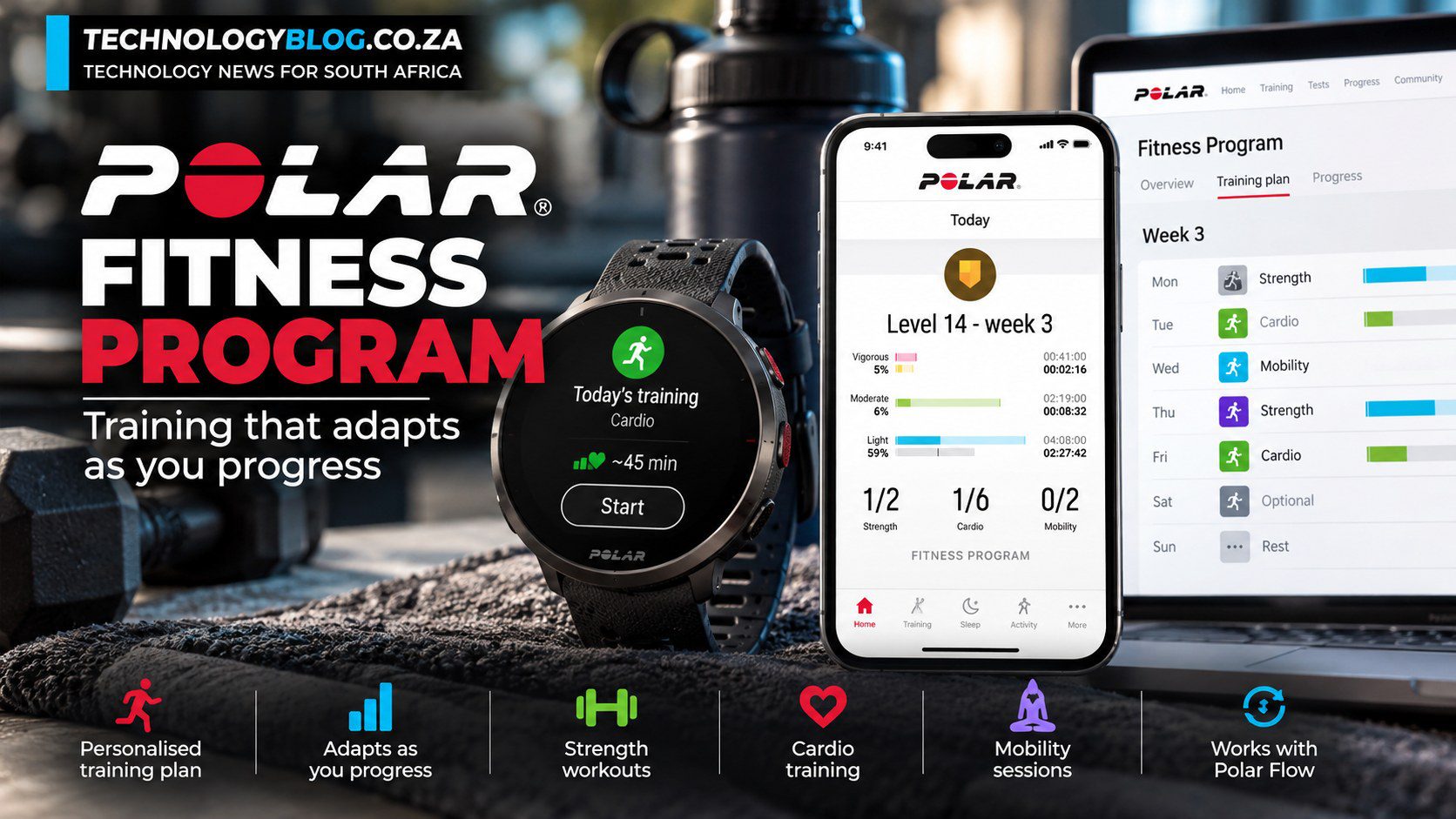
Polar Fitness Program turns wearable data into an adaptive training plan
The Polar Fitness Program takes the information collected by a Polar sports watch and tries to answer a practical question: what training should you do next?
Instead of simply recording another workout, the subscription service creates a personalised fitness plan through Polar Flow.
Polar builds that plan around the user’s current fitness, training history and recovery. It then adapts future training as those factors change.
That makes Fitness Program different from following a fixed workout calendar.
If training is going well, the plan can progress. However, when the available data suggests that the body needs more recovery, the programme can adjust the workload.
The goal is to turn wearable data into useful training guidance rather than simply adding more graphs to Polar Flow.
South African users are included in the programme’s supported markets. Readers can explore the service through the official Polar South Africa Fitness Program page.
Polar Fitness Program starts with a personal goal
The Polar Fitness Program begins by asking what the user wants to achieve.
Polar offers several goals rather than forcing everyone into the same training plan.
Users can focus on improving fitness, increasing strength or boosting mobility.
Alternatively, the programme can combine different training types for a more balanced approach.
This matters because “getting fit” can mean very different things.
Someone trying to improve cardiovascular fitness has different needs from a person who wants to become stronger or move more comfortably.
Therefore, the programme starts with the intended outcome before deciding how the training week should look.
Training plans cover more than running
Polar has long been associated with heart-rate training and endurance sports.
However, Fitness Program is not simply another running plan.
The service can include cardio, strength and mobility training.
As a result, a weekly plan can combine several types of exercise instead of repeatedly prescribing the same activity.
This also separates Fitness Program from Polar’s existing Running Program.
Running Program prepares users for specific running distances and events. Fitness Program, meanwhile, focuses on broader fitness goals and ongoing progression.
That makes it more relevant to someone who wants structured exercise without necessarily training for a race.
The plan adapts instead of staying fixed
Traditional training plans usually follow a predetermined calendar.
For example, week three may prescribe a particular workout regardless of how well the previous two weeks went.
An adaptive system can take a different approach.
Polar says Fitness Program updates the training plan according to progress, training history and recovery.
Therefore, the programme can respond to changes rather than assuming every week will unfold exactly as planned.
This is where the connection to a compatible Polar watch becomes important.
The watch is not only displaying workouts. It also provides information that helps the Polar ecosystem understand what the user has been doing.
Polar Flow connects the programme and the watch
Polar Flow sits at the centre of the experience.
The platform brings together training information, activity data and the Fitness Program itself.
Once the programme creates a workout, users can sync that training target to a compatible Polar watch.
The watch can then guide the session.
Afterwards, training data returns to Polar Flow and becomes part of the user’s wider training history.
This creates a feedback loop.
The programme recommends training, the watch records what happens, and Polar Flow uses the resulting information when presenting future guidance.
Recovery data changes the value of a training plan
A workout plan becomes more useful when it considers whether the person is ready to train.
Doing more exercise is not automatically better.
Training creates physical stress, while recovery allows the body to adapt to that stress.
Therefore, repeatedly increasing the workload without considering recovery can undermine the purpose of structured training.
Polar has spent years building recovery and training-load features into its sports-watch ecosystem.
Fitness Program uses that wider ecosystem to make its recommendations more personal.
Instead of treating every user with the same goal identically, the service can draw on the individual’s recorded activity and training history.
Nightly Recharge adds overnight recovery information
Compatible Polar watches can provide Nightly Recharge information.
The feature looks at how well the body recovered during the night.
Polar combines information about sleep with measurements related to the autonomic nervous system during the early part of sleep.
The resulting recovery information can help users understand whether the previous day’s demands carried into the night.
This does not turn a watch into a medical device.
Instead, it provides another source of fitness and recovery information inside the Polar ecosystem.
For an adaptive training service, that context can be more useful than simply knowing how many workouts someone completed.
Training Load Pro looks at the strain from exercise
Polar’s Training Load Pro examines the strain created by training.
The feature helps users see how recent exercise compares with their longer-term training level.
That distinction matters.
The same workout can represent a very different load for two people.
A demanding session for a beginner may be routine for an experienced athlete.
Likewise, a workout that normally feels manageable can become more demanding during a particularly heavy training week.
Training-load information gives Polar another way to put individual sessions into context.
Cardio Load Status provides a wider view
Polar also uses Cardio Load Status to compare recent training strain with the user’s longer-term tolerance.
This can help show whether training has increased, decreased or remained relatively stable.
For users, the value lies in context rather than chasing one number.
A single difficult workout does not define an entire training programme.
Instead, the pattern across days and weeks matters.
That longer view fits naturally with an adaptive programme because the system needs to understand both recent exercise and established training habits.
FitSpark and Fitness Program are not the same feature
Polar users may already know FitSpark.
FitSpark provides daily ready-made workout suggestions on compatible watches.
Those suggestions take factors such as training history and recovery into account.
Fitness Program serves a different purpose.
Rather than presenting individual daily suggestions, it creates a broader personalised programme around the user’s selected fitness goals.
The two ideas are related because both try to move beyond simple workout tracking.
However, users should not treat them as interchangeable names for the same feature.
A compatible Polar watch remains necessary
Fitness Program is not designed as a completely independent phone app.
Polar requires a compatible watch.
That requirement makes sense when considering how the service works.
The watch collects the training and activity information that helps build the user’s Polar profile. It also provides the most convenient way to follow scheduled workouts.
Therefore, Fitness Program sits inside a wider hardware-and-software ecosystem.
Someone without compatible Polar hardware cannot simply subscribe and expect the same experience through a phone alone.
Prospective subscribers should check Polar’s current compatibility information for their exact watch before signing up.
Heart-rate data remains central to Polar’s approach
Polar built much of its reputation around heart-rate monitoring.
That remains important when workouts use heart-rate zones to guide training intensity.
Instead of relying only on subjective descriptions such as “easy” or “hard”, heart-rate zones can provide a measurable intensity target.
However, wrist-based optical heart-rate monitoring is not the only option.
Polar also produces dedicated heart-rate sensors.
TechnologyBlog has previously covered the Polar H10, a chest-strap sensor designed for users who want dedicated heart-rate measurement during exercise.
The wider Polar ecosystem allows heart-rate information to play a role in both recording workouts and understanding training intensity.
The programme can guide strength workouts
Cardio training is only one part of Fitness Program.
Strength can also form part of the plan.
This broadens the programme beyond Polar’s traditional endurance-sport image.
A user may therefore receive structured strength sessions alongside other forms of training.
The exact programme depends on the selected goal and personal training plan.
Importantly, software cannot determine whether someone performs every movement with perfect technique.
Users still need to understand the exercises and train within their abilities.
A personalised digital plan provides structure, but it does not replace appropriate coaching when someone needs help with technique or injury-related limitations.
Mobility can form part of the weekly plan
Mobility training is another available focus.
This is useful because structured fitness programmes can easily become dominated by cardio and strength work.
However, movement quality and range of motion can also affect how people train.
Including mobility inside the same programme makes it easier to treat it as part of training rather than an optional extra.
Users can also choose a more balanced goal that combines several training areas.
Consequently, Fitness Program can serve people whose goal is general fitness rather than improvement in one narrow discipline.
Workout guidance moves onto the wrist
One advantage of using a sports watch is that the training plan does not need to remain on a phone.
Compatible workouts can move onto the Polar watch.
That allows users to follow training guidance during the session without repeatedly checking Polar Flow.
For heart-rate-based workouts, the watch can also show whether the user is training within the intended intensity.
This creates a more direct link between the programme and the actual exercise session.
The phone remains useful for reviewing the broader plan and analysing information afterwards.
During training, however, the watch becomes the more practical interface.
Progress matters more than isolated workouts
A training programme only becomes useful if users can understand whether they are moving towards their goal.
Polar Flow provides the wider view.
Instead of looking only at today’s exercise, users can examine training over time.
This is important because fitness rarely changes meaningfully after one workout.
Progress comes from repeated training followed by sufficient recovery.
An adaptive programme therefore needs to consider the pattern rather than reward individual sessions in isolation.
Polar’s advantage is that Fitness Program sits on top of an existing platform already designed to record those patterns.
Personalisation depends on good data
The quality of any adaptive fitness programme depends on the information it receives.
If someone rarely wears the watch, records workouts inconsistently or has limited recovery information, the system has less context to work with.
Therefore, users who want the full value of Fitness Program need to participate in the data collection that makes personalisation possible.
That does not mean every metric needs constant attention.
In fact, one attraction of an adaptive programme is that users should not need to interpret every graph manually.
However, the underlying data still needs to exist before software can use it.
Adaptive does not mean perfectly predictive
The word “adaptive” can create unrealistic expectations.
Fitness Program can respond to the information available within Polar’s ecosystem.
It cannot know everything happening in someone’s life.
Work stress, illness, nutrition, pain and many other factors can influence whether a workout is appropriate on a particular day.
Wearable data provides useful context, but it remains only part of the picture.
Therefore, users still need to apply judgement.
If someone feels unwell or experiences pain, a scheduled workout should not automatically take priority simply because it appears in an app.
The technology is there to support training decisions rather than remove human judgement from them.
Polar Fitness Program requires a subscription
The Polar Fitness Program is a paid subscription service.
That represents an important change from many traditional watch features that come with the hardware.
Users are not simply buying a compatible Polar watch and receiving unlimited access to Fitness Program automatically.
Instead, the programme forms part of Polar’s growing software and services ecosystem.
This creates a different value question.
Someone who mainly wants activity tracking and basic workout recording may not need an ongoing adaptive programme.
A user who wants structured training without manually building weekly workouts may find the subscription more useful.
The value therefore depends heavily on how much the person actually uses the guidance.
The subscription model changes the relationship with the watch
Wearables increasingly combine hardware with ongoing software services.
Fitness Program illustrates that shift.
The watch provides sensors, workout guidance and data collection. Meanwhile, the subscription provides an evolving training service built around that information.
This can extend the usefulness of existing hardware because new value does not always require a new watch.
On the other hand, subscription services create an ongoing cost beyond the original hardware purchase.
Consumers therefore need to consider the complete ecosystem rather than evaluating the watch and service separately.
South Africa is officially supported
For South African Polar users, one important question has a clear answer.
Polar lists South Africa as a supported country for Fitness Program.
The company also provides a dedicated South African page for the service.
That means this is not simply an overseas Polar feature being discussed without local context.
However, compatibility still depends on the user’s Polar hardware and account setup.
Users should therefore confirm that their exact watch supports Fitness Program before subscribing.
Polar Fitness Program turns data into a decision
Modern sports watches collect an enormous amount of information.
Heart rate, workouts, activity, sleep, recovery and training load can quickly become another collection of numbers to interpret.
The Polar Fitness Program attempts to turn some of that information into a simpler outcome: a structured answer to what training comes next.
Users choose a goal, while Polar builds a plan around their fitness and training history.
As training continues, the programme can adapt rather than forcing the user through an unchanged calendar.
Cardio, strength and mobility can all form part of that process.
Meanwhile, compatible Polar watches bring workout guidance onto the wrist and feed new training information back into Polar Flow.
The subscription requirement means Fitness Program will not make sense for every Polar owner.
However, its broader idea is significant.
Wearables have spent years becoming better at measuring people.
Polar Fitness Program represents the next step: using those measurements to help decide what users should do with the information.


