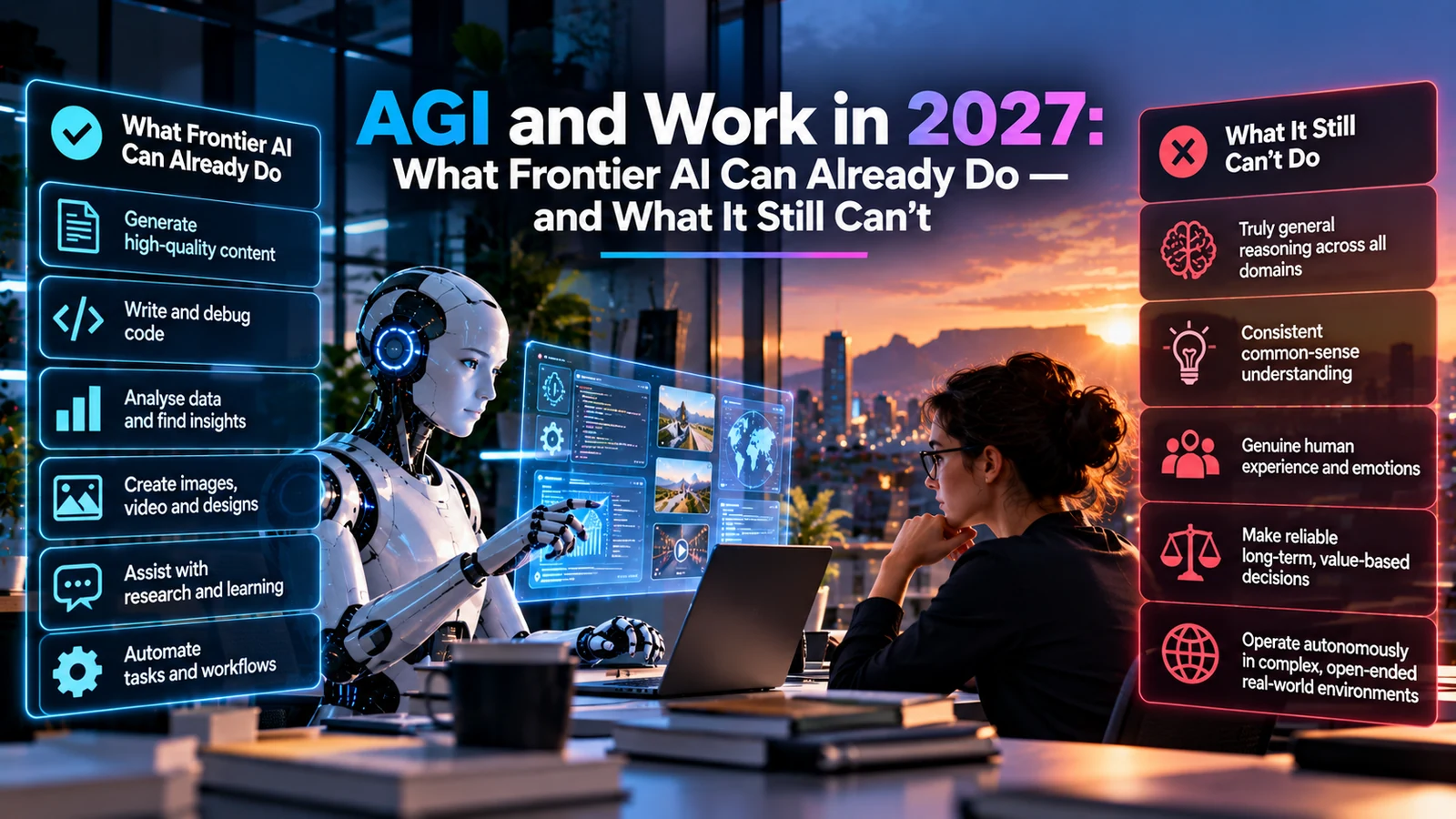
AGI and Work in 2027: What Frontier AI Can Already Do — and What It Still Can’t
The workplace is changing faster than the definition of AGI. Employees already use frontier AI to draft, code, research, analyse documents and complete parts of multi-step digital work. Those changes are economically significant, but they should not be mistaken for companies deploying an agreed form of artificial general intelligence.
The practical workplace question is therefore twofold: what can current AI already change, and what additional capabilities would a genuine AGI need before work could be delegated at a fundamentally different level?
For the definition behind that distinction, read our complete AGI guide.
Current AI already reduces the cost of some cognitive tasks
Writing, summarisation, code generation, data transformation and research assistance are established use cases. Employees can often produce a first draft faster, interrogate a document conversationally or automate part of a software workflow.
That matters economically even without AGI. A technology does not need to match a human across every domain before it changes how a specific role is performed.
The task is not the job
Jobs combine many kinds of work. A manager might analyse numbers, resolve conflict, interpret incomplete information, negotiate priorities and accept responsibility for a decision. Automating the spreadsheet analysis does not automate the managerial role.
This is one reason economic claims about AGI need care. OpenAI’s definition focuses on economically valuable work, but workplaces are built from tasks plus institutions, relationships and accountability.
Frontier AI is strongest when the work is legible
AI performs best when the goal can be stated, the inputs are available and success can be checked. Coding is attractive because software can often be tested. Document analysis is attractive because findings can be tied back to text. Structured research can require citations.
Work becomes harder when goals are ambiguous, feedback is delayed or success depends on social context that is not captured in the prompt or data.
Long projects expose current limitations
METR’s task-horizon measurements are useful here. Frontier agents are improving on increasingly difficult software tasks, but reliability drops as tasks become more complex and extended.
A human employee can notice that a project objective has changed, ask for clarification, preserve institutional knowledge and recover from a chain of failures. Current agents can do pieces of this, but not with the dependable generality implied by AGI.
AGI would change delegation, not just assistance
Today’s workplace AI is usually used as an assistant: the human sets the objective, provides context, checks the result and remains responsible. A genuinely general system could shift more work into delegation if it could understand new domains, plan over long periods and recover from uncertainty with less supervision.
That would be a qualitative change. The difference between “draft this report” and “take responsibility for producing the monthly reporting process” is not just a larger prompt.
Autonomy would need governance
More capable systems create a permission problem. If an AI can read email, change records, deploy code or approve transactions, a mistake can escape the chat window and become an organisational event.
Companies therefore need identity, audit logs, least-privilege access, approval gates and clear ownership long before AGI. Those controls are useful for current agents too.
TechnologyBlog’s AI in the Boardroom examines the governance question from the leadership side.
Skills may change before jobs disappear
A common mistake is treating automation as a binary prediction about whole occupations. In practice, tools first change the mix of skills inside a role. Employees who can frame problems, verify evidence and supervise automated workflows may become more valuable even if some manual production work declines.
AGI could accelerate that change, but current AI is already creating it.
Human judgement is not one capability
People often describe “judgement” as though it were a mysterious single skill. In workplaces it includes recognising missing context, understanding incentives, anticipating reactions, accepting accountability and balancing rules against exceptions.
An AGI claim relevant to work would need evidence across these dimensions, not only faster document production or better benchmark scores.
What should workers learn now?
The safest preparation is not to learn a hypothetical AGI interface. It is to learn how to work with current AI while preserving verification and responsibility.
- Break a job into tasks and identify which are safe to assist.
- Keep source evidence attached to important claims.
- Understand what data may enter an AI system.
- Test code and calculations.
- Use approval steps for consequential actions.
- Learn where current systems fail, not only where they impress.
South African workplaces face the same frontier with local constraints
South African organisations also need to consider POPIA, employment practices, data governance, skills gaps and unequal access to advanced digital tools. The national AI policy process is being reworked, while government has continued to call for ethical standards and international guardrails.
That means businesses should not wait for a final AGI definition before establishing responsible AI practices.
Do not confuse useful automation with general intelligence
The workplace impact of current AI is real, but calling those tools AGI adds confusion. A better approach is to describe the exact capability: document analysis, coding assistance, long-horizon agents, autonomous tool use or something else.
If AGI eventually arrives, the defining workplace change will be broader, more dependable delegation across unfamiliar tasks. Until then, the challenge is learning to use powerful but imperfect systems without pretending they are more general than the evidence shows. For organisational preparation, continue with AGI and Business; for the downside as capability rises, see AGI Benefits, Risks and Limitations.
How to evaluate AI productivity claims at work
Workplace studies should separate speed from value. A model may finish a task faster but create more review work, or it may enable a task that a team previously could not justify doing at all. METR has explicitly distinguished between substitution, uplift and the value created by new tasks, which is useful when evaluating current agents.
For an employer, the right metric is not “how many prompts did staff send?” It is whether the combined human-and-AI workflow produces better work, lower cost, faster turnaround or new capability without unacceptable risk. That measurement discipline will become even more important if systems become more general.


