The Future of Claude: What to Expect in 2027
Claude’s 2027 direction is visible, but Anthropic has not published a complete 2027 roadmap. Late-2026 products point toward longer agentic work, shared team agents, more connected applications, parallel Projects and stronger controls around high-capability models. Those are evidence-backed directions, not guaranteed launch commitments.
The useful job of a 2027 outlook is therefore to separate evidence from extrapolation. Cowork and Claude Code show where delegation is already happening; Projects and Claude Tag show how work is becoming persistent and collaborative; Fable/Mythos show that capability and access controls can diverge by user and use case.
For the current baseline, use our complete Claude AI guide and latest Claude features and updates.
1. Expect agentic work to become more central
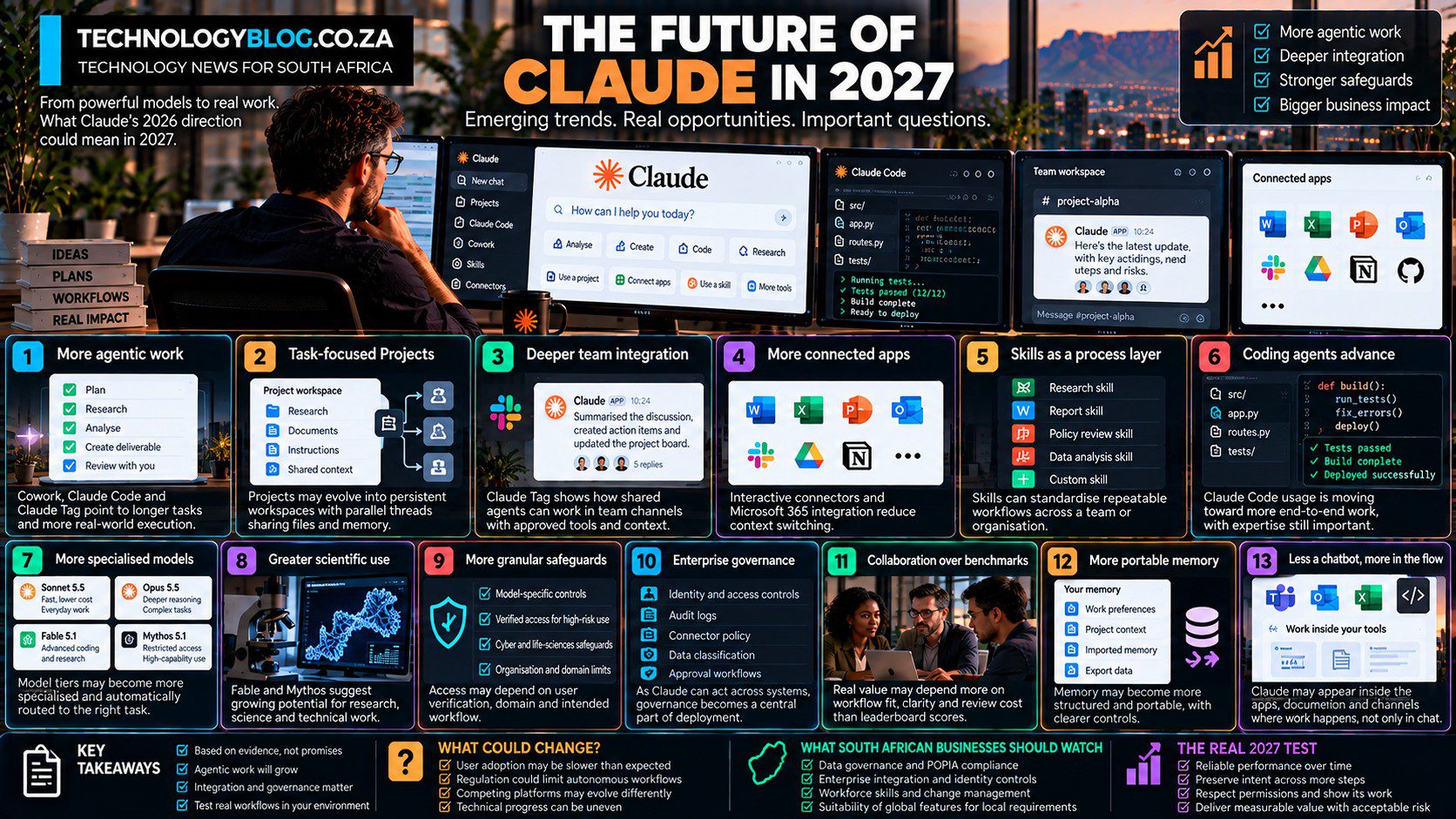
Cowork, Claude Code and Claude Tag all move the user experience from asking questions toward delegating work. In 2027, the important question will be how reliably Claude can complete longer jobs while preserving context, permissions and user intent.
This is an inference from 2026 product direction, not a confirmed roadmap.
2. Projects are likely to become more task-oriented
Anthropic’s current beta Projects model already points toward one project spawning parallel cloud threads that share files, repositories, instructions and memory.
If that direction continues, Projects may feel less like folders of chats and more like persistent workspaces where several pieces of a larger job run concurrently.
3. Claude may become more embedded in team communication
Claude Tag puts a shared agent inside Slack rather than keeping AI as a private employee tool. That design suggests a future in which teams delegate tasks to Claude in the same channels where human work is coordinated.
The governance challenge will be deciding which channels, tools and actions the shared agent can access.
4. Connected applications will matter more than the chat window
Connectors, interactive apps and Microsoft 365 integrations show Anthropic trying to reduce context switching. The user increasingly asks Claude to work where the data already lives.
In 2027, competition among AI assistants may depend as much on integration quality and permission design as on model benchmarks.
5. Skills could become an organisational process layer
Skills currently package instructions, scripts and resources for repeated work. For businesses, that can evolve into a library of approved AI processes maintained alongside policy and standard operating procedures.
The important issue will be lifecycle management: who owns a skill, who can change it and how changes are reviewed.
6. Coding agents will keep testing the boundary of delegation
Anthropic’s Claude Code research already shows users moving from debugging toward more end-to-end work. More capable models could extend that into longer implementation and maintenance tasks.
Expertise is unlikely to become irrelevant. As agents handle more execution, architecture, requirements and verification may become more important human roles.
7. Claude’s model lineup may become more specialised
Anthropic’s late-2026 lineup already differentiates Sonnet, Opus, Fable and Mythos models around speed, cost, complexity and advanced research capability.
The 2027 trend may be toward routing tasks to the right level automatically rather than users obsessing over one “best” model. That is a directional inference, not a confirmed feature.
8. Scientific and research workflows could become more prominent
Anthropic positioned Fable and Mythos 5.1 partly around advanced knowledge work and research, and September 2026 announcements highlighted scientific applications.
If these capabilities continue to improve, Claude may be used more deeply in hypothesis generation, literature synthesis and technical research. Verification and domain controls will become more important at the same time.
9. Safety controls are likely to become more granular
Sonnet 5.5 launched with cyber safeguards associated with more capable models, and Anthropic already operates verification programmes for legitimate cybersecurity and life-sciences users.
That suggests future Claude access may depend increasingly on user verification, domain, model capability and intended workflow rather than one universal set of limits.
10. Enterprise AI governance will become more operational
As Claude can read, write and act across more systems, enterprises will need stronger audit logs, identity controls, connector policy, retention settings and incident response.
Governance will move from “may employees use AI?” to “which agent may perform which action on which data under whose approval?”
11. Collaboration quality may matter more than raw benchmark leadership
Anthropic increasingly describes Claude as a collaborator, and external testers in model announcements often comment on judgement, clarity and workflow fit rather than only benchmark scores.
For real knowledge work, the cost of review and steering can matter as much as the model’s peak capability.
What could change this outlook?
The direction could shift if users resist broader agent permissions, governance costs outweigh productivity gains, regulation limits autonomous workflows or competing architectures prove better suited to enterprise work. Technical progress can also be uneven: a stronger model does not automatically make every agentic workflow reliable.
Do not confuse a likely direction with a promised feature
The strongest future-of-Claude coverage should separate three categories:
- Confirmed: Anthropic has announced or released it.
- Directional: current products make the trend visible.
- Speculative: possible, but not supported strongly enough to present as expected.
This outlook remains in the directional category. It follows evidence from longer-task execution, Claude Code, Claude Tag, Projects, Skills, connectors and model safeguards.
What South African organisations should watch
The practical questions are data governance, POPIA, workforce skills, enterprise integration and whether global product changes are suitable for local organisational requirements.
Businesses should avoid building policy around model names. Capability-based controls will age better as Claude’s lineup changes.
The most important 2027 test is reliability over time
Longer tasks make impressive demos easy and dependable systems difficult. The useful evidence in 2027 will be whether Claude can preserve intent across more steps, recover from a wrong turn, respect permissions and show the user enough of its work to support meaningful review.
For the risks that accompany that trajectory, see Claude: Benefits, Risks and Limitations. For competitive context, see Claude vs the Leading Alternatives.
12. Memory may become more portable and more structured
Anthropic already lets users import and export memory and keeps project-specific context separate from general chat memory. That suggests personalisation is becoming a managed data layer rather than an invisible side effect of conversation.
If this continues, users may expect more explicit control over which workspaces remember which facts and how memory moves between assistants. The 2027 implication is better continuity, but also more need for transparent controls.
13. Claude may become less visibly “a chatbot”
Interactive connectors, Office add-ins, Claude Tag and Cowork all reduce the importance of the main chat window. Claude increasingly appears inside the task, document, channel or application where work is happening.
If that trend continues, people may use Claude frequently without thinking of every interaction as a separate chatbot session. That would make product integration and trust more important competitive factors.
How this outlook should be judged
Agent adoption could still slow if error recovery remains poor, and Anthropic could reorganise the model family in a way that makes today’s Sonnet/Opus/Fable split less important. A useful forecast should be willing to lose: confirmed launches belong in the dated update record, while this outlook remains valuable only for as long as its reasoning matches the evidence.


