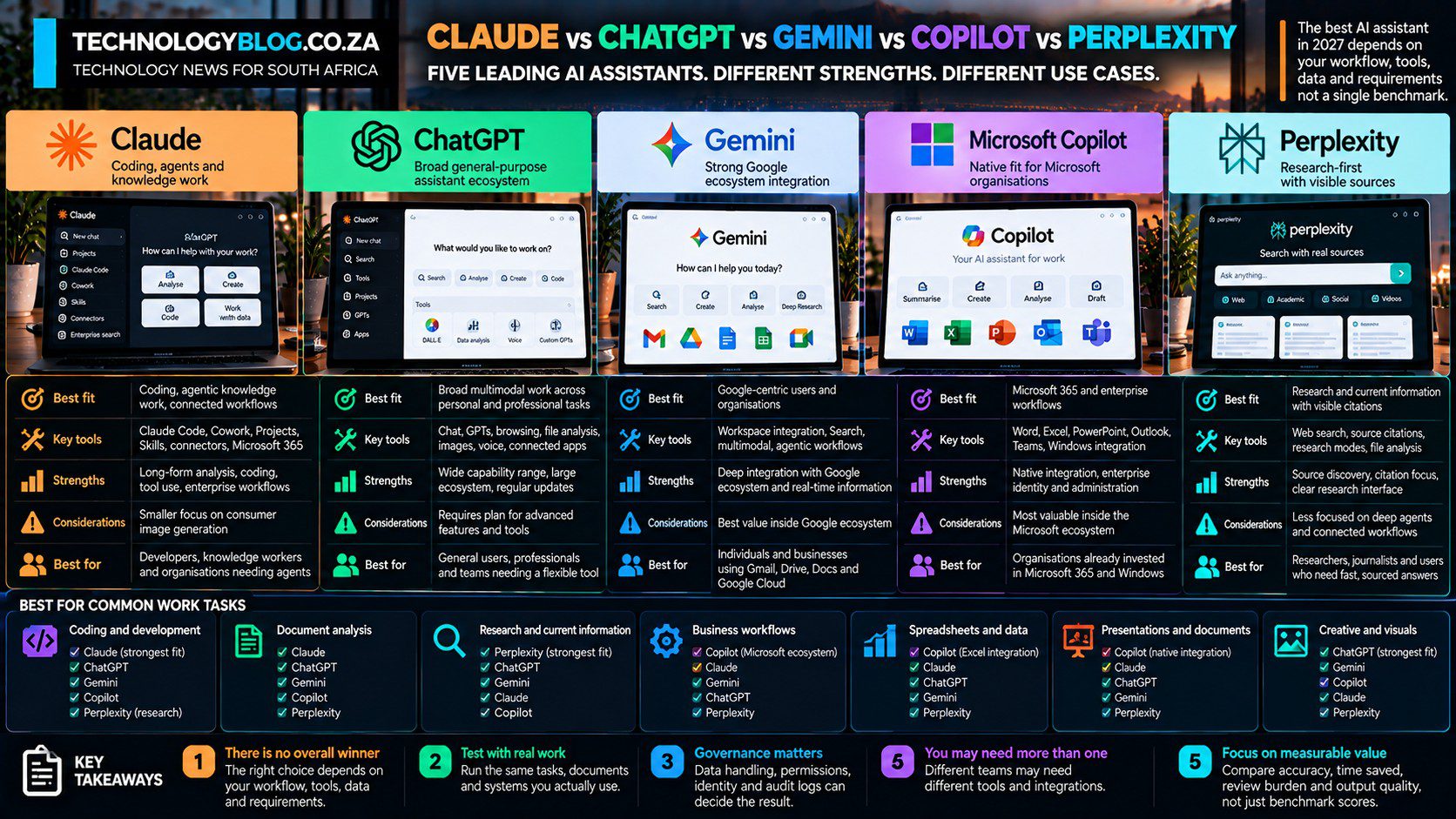
Claude vs the Leading Alternatives in 2027
Claude, ChatGPT, Gemini, Microsoft Copilot and Perplexity now overlap enough that a one-prompt showdown tells buyers very little. All can support writing, research and knowledge work in some form. The more revealing comparison is where each product sits, which sources and tools it can reach, how it is administered and how much review the real workflow requires.
That makes this a fit comparison rather than a league table. The relevant result depends on the account type, integrations and real workload being tested, and those product surfaces change too quickly for a permanent overall winner.
For the Claude side of the comparison, start with our complete Claude AI guide.
Claude: strong coding and agentic knowledge work
Anthropic’s 2026 strategy emphasises coding, long-horizon knowledge work, tools and agents. Claude Code, Cowork, Skills, Projects, connectors and Microsoft 365 integrations are central to that direction.
Sonnet 5.5 is positioned as a fast, lower-cost model for everyday work and coding, while Opus 5.5 is aimed at more complex work requiring deeper judgement.
ChatGPT: broad general-purpose assistant ecosystem
ChatGPT combines conversational AI with file analysis, web search, images, voice, connected apps and longer task workflows. Its strength is breadth across consumer and professional use.
TechnologyBlog’s ChatGPT guide covers that platform in more depth.
Gemini: strong Google ecosystem integration
Gemini benefits from Google’s position across Search, Workspace, Android and cloud services. For users already working in Gmail, Docs, Drive and Google’s broader ecosystem, integration can be a decisive factor.
TechnologyBlog’s Gemini coverage tracks Google’s move from assistant toward more agentic workflows.
Microsoft Copilot: native fit for Microsoft organisations
Copilot’s advantage is its connection to Microsoft 365, Windows and enterprise identity. Organisations deeply invested in Microsoft may value native administration and workflow integration more than small model-quality differences.
Claude itself is increasingly present inside the Microsoft ecosystem, including Microsoft Foundry and some Copilot experiences, which makes the comparison less clean than a simple vendor-versus-vendor table.
Perplexity: research-first positioning
Perplexity remains strongly associated with web-first research and visible citations. For users whose primary job is finding current information quickly, that interface may feel more purpose-built than a general work assistant.
As other assistants improve their own research modes, the distinction is increasingly about workflow design rather than whether web search exists at all.
Which is better for coding?
Claude has made coding a core product identity through Claude Code and increasingly agentic Sonnet and Opus models. Anthropic’s own research also provides unusually detailed data on how Claude Code is used.
ChatGPT and Gemini also have strong coding and agent capabilities. A serious comparison should use the same repository, task and review standard rather than relying on vendor benchmarks alone.
Which is better for long documents?
Claude is often attractive for long-context knowledge work and Projects. But context-window size alone should not determine the choice. Retrieval quality, source traceability, instruction following and output accuracy matter too.
Test with the actual documents your team handles.
Which is better for business workflows?
The answer depends heavily on existing systems. Microsoft-heavy organisations may prefer Copilot integration. Google Workspace users may favour Gemini. Teams needing Claude Code, Cowork and Claude’s connector ecosystem may prefer Claude.
Enterprise governance can decide the result before model quality does. Identity, audit logs, retention, encryption, permissions and procurement all matter.
Which is better for research?
Research quality depends on source retrieval and verification. Perplexity is explicitly research-first, while ChatGPT, Claude and Gemini increasingly offer web research and connected data.
The strongest tool is the one that makes it easiest to inspect primary evidence and distinguish sourced facts from model inference.
Which is better for creative or visual work?
Claude’s strength is less centred on consumer image generation than some competitors. Users whose main requirement is image creation may prefer an ecosystem with more mature built-in visual generation.
Claude can still help plan visual work, analyse images, create documents and work with connected design tools.
Comparison table
| Product | Strongest fit | Important evaluation question |
|---|---|---|
| Claude | Coding, agentic knowledge work, connected enterprise workflows | How well do Code, Cowork and connectors fit your process? |
| ChatGPT | Broad general-purpose multimodal work | Do you need one assistant spanning many personal and work tasks? |
| Gemini | Google-centric users and organisations | How much value comes from Google ecosystem integration? |
| Microsoft Copilot | Microsoft 365 and enterprise workflows | How important are native Microsoft controls and surfaces? |
| Perplexity | Web-first research | Is source discovery your primary workflow? |
Do not buy from benchmarks alone
Benchmarks are useful but narrow. Vendor evaluation methods differ, and performance can change with prompts, tools, effort settings and scaffolding.
Build an internal evaluation using real tasks: one document analysis, one research job, one spreadsheet, one coding task and one connected workflow. Score accuracy, source quality, edit time, reliability and governance fit.
Do you need more than one assistant?
Possibly. A development team may use Claude Code while another department uses Microsoft Copilot. A journalist may combine a research-first tool with a stronger document-analysis assistant.
The downside is tool sprawl: more data surfaces, more subscriptions and inconsistent policies. Organisations should standardise where possible without forcing every job into one product.
Run the same real task through the products you would actually buy
Choose based on the work you actually do, not a generic winner. Claude is strongest when its coding, long-form analysis, agentic workflows and connected work surfaces match the task. Another assistant can be a better choice when a different ecosystem is more important.
TechnologyBlog already compares the broader market in ChatGPT Alternatives. For Claude’s specific tools, see Best Claude Tools and Use Cases; for the current Anthropic release baseline, see Claude Latest Features and Updates.
Privacy and administration can outweigh model preference
For an individual, the choice may be mainly about capability and interface. For a company, data handling and administration can decide the result. Anthropic says commercial Claude data is not used for training by default, while enterprise features include audit logs, identity management and retention controls. Other providers have their own commercial commitments and administrative models.
A procurement team should therefore compare the exact plans it would deploy, not consumer free tiers. The question is not only what the assistant can answer, but who can administer it, what it can access and how its actions are recorded.
Model access and product access are separate questions
Another complication is that the same underlying model can appear in more than one ecosystem. Claude models are available through Anthropic’s own products and through major cloud platforms, and Anthropic has also integrated Claude into parts of Microsoft’s ecosystem.
That means an organisation may choose Claude capability without standardising on the Claude app for every employee. The architecture of the deployment can be as important as the model brand.


