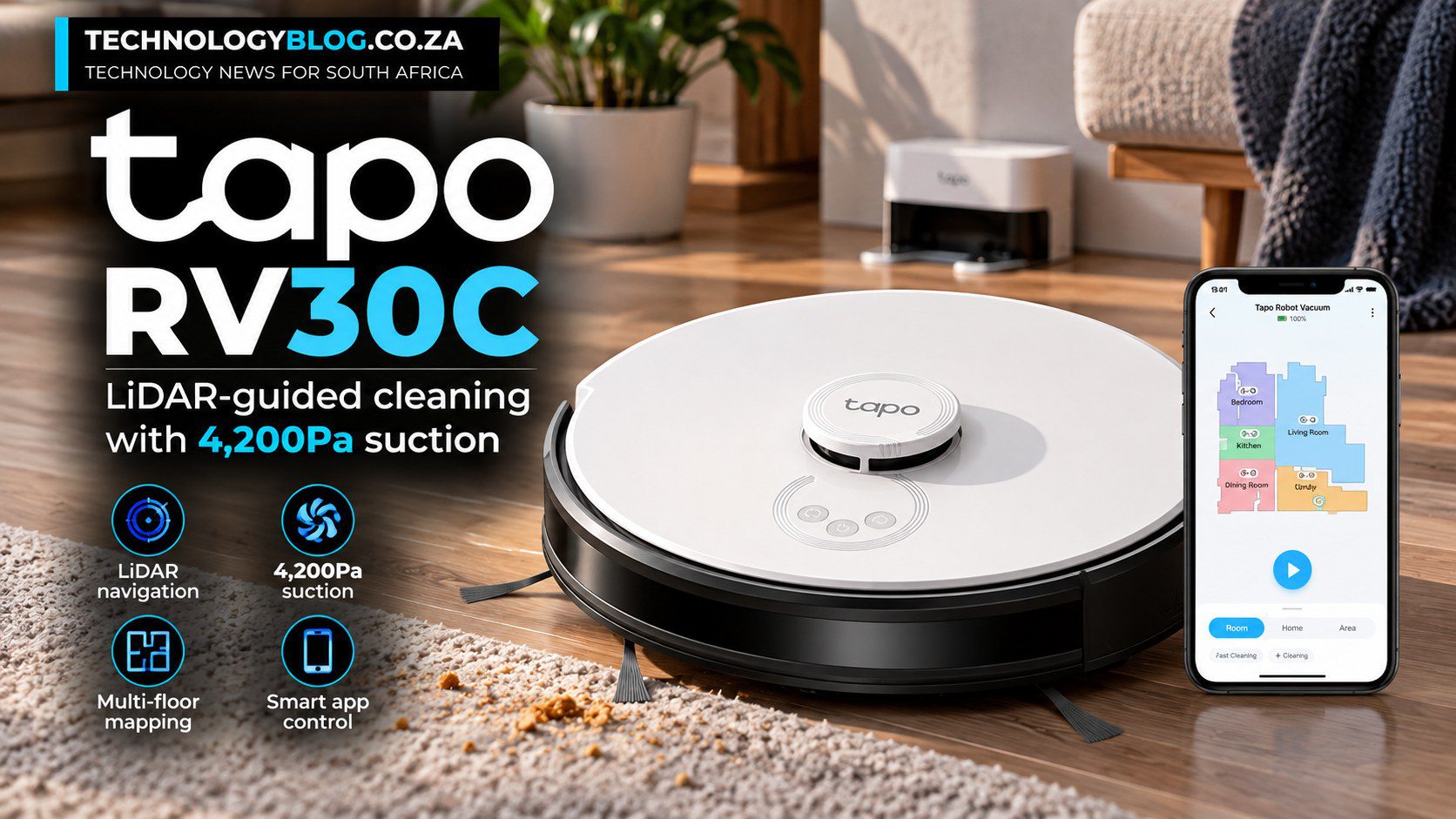
Tapo RV30C focuses on smarter vacuuming without the mop
The Tapo RV30C takes a relatively focused approach to automated floor cleaning. It vacuums, maps the home and lets owners control where and when it cleans, but it does not include a wet-mopping system.
Instead, TP-Link gives the robot 4,200Pa maximum suction, LiDAR and gyro navigation, an 800ml dustbin and a 3,200mAh battery.
That combination makes the RV30C interesting for households that primarily want automated vacuuming rather than a more complicated vacuum-and-mop system.
TP-Link South Africa officially lists the model in its current robot-vacuum range. Readers can find the complete technical information on the official TP-Link South Africa Tapo RV30C product page.
Tapo RV30C uses 4,200Pa maximum suction
The Tapo RV30C provides four suction settings: Quiet, Standard, Turbo and Max.
At its highest setting, TP-Link specifies maximum suction of 4,200Pa.
However, a suction figure does not tell the complete cleaning story.
Brush design, airflow, floor type, debris and the route taken through a room can all affect real-world results.
Therefore, TechnologyBlog would treat 4,200Pa as a manufacturer specification rather than proof that the RV30C cleans better than another robot with a different suction figure.
TP-Link also includes Carpet Boost.
When the robot encounters carpet, it can automatically increase suction. As a result, owners do not need to change the power setting manually whenever the floor surface changes.
LiDAR and gyro navigation plan the cleaning route
Navigation plays an equally important role in the RV30C.
TP-Link combines LiDAR with a gyroscope to map the home and track the robot’s position.
LiDAR measures the surrounding environment using laser light. Consequently, the robot can build a map without depending on normal room lighting.
TP-Link specifically states that the RV30C can navigate accurately in the dark.
That matters because owners may schedule cleaning overnight or while rooms have their lights switched off.
The robot can also track its position in real time rather than simply moving until it encounters an obstacle.
Tapo RV30C can create a map in about eight minutes
TP-Link says its dual navigation system can map a home in approximately eight minutes.
That figure comes from the company’s internal testing, so actual mapping time will depend on the size and complexity of the home.
Furniture placement also matters.
Nevertheless, quick initial mapping has a practical advantage.
The robot can learn the layout before owners begin creating detailed room schedules, no-go zones and targeted cleaning areas.
Once the map exists, the app becomes considerably more useful than a simple remote Start button.
Multi-floor maps suit larger homes
The Tapo RV30C can store multiple maps.
TP-Link describes the system as 3+1 multi-floor local-stored maps.
Therefore, owners do not need to overwrite the main map every time the robot moves between different levels of a home.
Multi-floor mapping does not mean the robot can climb stairs.
Someone still needs to move it physically between floors.
Instead, the feature allows the RV30C to recognise different mapped areas once it reaches them.
Virtual walls keep the robot away from selected areas
Not every part of a home should necessarily be accessible to a robot vacuum.
Loose cables, children’s play areas, pet bowls or a room currently in use can all create reasons to keep the robot away.
The Tapo app therefore allows owners to create virtual walls and no-go zones.
These software boundaries reduce the need to place physical barriers around an area.
They also make the robot’s map more useful over time.
For example, an owner can exclude a particular area without preventing the RV30C from cleaning the rest of the room.
Room and zone cleaning target specific messes
Whole-home cleaning is only one option.
Owners can also select individual rooms or mark specific zones that need attention.
That can prove useful after a meal when only the kitchen or dining area needs cleaning.
Likewise, a small section near an entrance may collect more dirt than the rest of the home.
Instead of sending the robot through every room, the app can direct it towards the relevant area.
This targeted approach can save time and battery power when a complete cleaning run is unnecessary.
Cleaning schedules can change by room
The Tapo app also supports scheduled cleaning.
Owners can create routines around when particular rooms normally need attention.
For instance, the kitchen could receive a cleaning run after meals. Meanwhile, the whole home could follow a different schedule when nobody is around.
TP-Link also allows users to customise cleaning modes for individual rooms.
Therefore, the RV30C can apply different settings across the mapped home rather than treating every area identically.
An 800ml dustbin reduces emptying frequency
One of the more practical RV30C specifications is its 800ml onboard dustbin.
Robot vacuums often have relatively small bins because the entire machine needs to remain compact.
TP-Link says the RV30C’s bin provides twice the capacity of its smaller reference design.
The company also advertises up to 14 days without emptying.
However, that figure requires context.
A home with several shedding pets may fill the bin much faster than a small apartment with little daily debris.
Cleaning frequency also changes how quickly the container fills.
Therefore, the 14-day figure should be treated as a manufacturer estimate rather than a guaranteed emptying interval.
The 800ml physical capacity is the more useful specification.
The Tapo RV30C does not need an auto-empty station
The larger onboard bin also helps explain the RV30C’s simpler charging setup.
Unlike robot cleaners that transfer dirt into a large disposable bag inside an auto-empty station, the RV30C stores collected debris inside the robot.
Owners therefore need to empty the bin manually.
That means less station automation, but it also avoids the larger docking hardware and dust bags associated with many self-emptying systems.
The best approach depends on what the household values.
Some owners will prefer a station that handles more maintenance automatically. Others may prefer a simpler charging dock and a larger washable onboard bin.
HEPA filtration targets fine particles
TP-Link lists an H11 HEPA filter for the RV30C.
The company says its filtration system captures 99.9% of allergens as small as 0.3 microns.
That percentage is a manufacturer claim and should remain attributed to TP-Link.
Filters also need maintenance to remain effective.
The RV30C package includes two HEPA filters, while TP-Link provides cleaning and replacement guidance through its support platform.
For households concerned about fine dust, filtration can matter almost as much as the robot’s suction figure.
A floating suction mouth follows the floor
TP-Link uses what it calls a floating suction mouth.
The design aims to keep the intake close to the floor as the robot moves across different surfaces.
That matters because suction power is only useful if airflow reaches the debris.
Large gaps between the intake and floor can reduce the effectiveness of that airflow.
Meanwhile, the main brush is detachable.
Hair and fibres will inevitably wrap around rotating cleaning parts over time, so easy access can make routine maintenance less frustrating.
Tapo RV30C can cross obstacles up to 20mm
Robot vacuums rarely operate across completely flat homes.
Door thresholds and transitions between flooring can interrupt the route.
TP-Link specifies a maximum barrier-crossing height of 20mm for the RV30C.
That does not guarantee that it will cross every 20mm obstacle.
Shape, angle and surface material can also influence whether the wheels can climb over something.
Still, the specification provides a useful guide when assessing whether the robot can move between rooms without assistance.
Anti-drop protection helps around stairs
Stairs present a different problem.
The RV30C includes anti-drop protection to detect dangerous floor edges.
This allows the robot to work on an upper level without intentionally driving down a staircase.
However, sensors should not encourage careless setup.
Owners should still keep the sensors clean and follow TP-Link’s placement guidance.
Unusual surfaces and environmental conditions can affect sensor behaviour on automated equipment.
A 3,200mAh battery targets long cleaning runs
TP-Link equips the RV30C with a 3,200mAh battery.
The company claims up to three hours of continuous cleaning.
Importantly, TP-Link bases that figure on internal testing in Quiet mode with a fully charged battery.
Actual runtime can therefore fall when the robot uses stronger suction settings or frequently activates Carpet Boost.
Floor layout, obstacles and battery condition will also influence real-world results.
The three-hour figure is best understood as a maximum manufacturer test result rather than a guaranteed runtime for every cleaning session.
Recharge and resume helps with larger homes
Battery capacity becomes less restrictive because the RV30C supports Recharge and Resume.
When the battery becomes low, the robot can return to its charging dock automatically.
After charging, it can continue from where it stopped.
Consequently, a cleaning job does not necessarily fail simply because the battery cannot cover the entire mapped area in one session.
This feature becomes particularly useful in larger homes.
However, completing the job will naturally take longer if the robot needs an intermediate charging stop.
Quiet mode drops to a claimed 53dB
Noise changes according to the selected suction mode.
TP-Link specifies 53dB in Quiet mode and 60dB in Standard mode.
The 53dB figure comes from the manufacturer’s internal testing.
Therefore, it should not be treated as a universal noise measurement across every surface and operating condition.
Nevertheless, adjustable suction gives owners some control over the trade-off between cleaning power and noise.
A quieter setting may make sense for routine dust collection while people are home.
Max mode may suit situations where stronger suction matters more than sound.
Voice control works with Alexa and Google Home
The RV30C integrates with Amazon Alexa and Google Home.
This allows owners to start supported cleaning actions through voice commands.
Voice control is convenient, although it is not central to cleaning performance.
The Tapo app remains more important because it handles mapping, zones, schedules and other detailed controls.
Still, asking a smart speaker to start the vacuum can be useful when someone’s hands are occupied.
Real-time voice reports explain what the robot is doing
The robot can also provide spoken status reports.
These messages help explain what is happening without requiring the owner to check the app.
For example, voice feedback can make errors or changes in operating state easier to understand.
This is a small feature, but it can make the robot easier to live with.
Automated appliances are more useful when owners can quickly understand why they have stopped or what they need next.
Child and Pet Lock prevents accidental starts
The Child and Pet Lock addresses another everyday problem.
Physical controls on a robot vacuum sit close to floor level.
That makes them easy for children or pets to activate accidentally.
TP-Link allows owners to disable the physical start button through this feature.
As a result, an accidental press should not send the robot into an unexpected cleaning run.
The Tapo app requires 2.4GHz Wi-Fi
TP-Link specifies IEEE 802.11 b/g/n Wi-Fi on the 2.4GHz band.
Bluetooth 4.2 is also present, although TP-Link says it is used only during setup.
The 2.4GHz requirement is worth knowing before installation.
Many modern routers provide both 2.4GHz and 5GHz networks, but smart-home devices often continue to use 2.4GHz because of its range and compatibility advantages.
Owners therefore need a suitable 2.4GHz network for the connected features.
OTA updates allow the software to change
TP-Link supports over-the-air firmware updates through the Tapo app.
This allows the company to update compatible software after purchase.
Connected appliances increasingly depend on this type of support.
Mapping behaviour, app integration and other software-controlled functions can potentially evolve without replacing the physical robot.
However, long-term connected functionality also depends on continued software and service support.
That applies to almost every modern smart-home appliance.
The Tapo RV30C is vacuum-only
One specification deserves particular emphasis: the Tapo RV30C does not wet mop.
TP-Link’s South African specification explicitly lists wet mopping as No.
This matters because the company also sells a product called the Tapo RV30C Mop.
The names are extremely similar.
The RV30C Mop combines vacuuming with three-level electronic mopping and includes a water tank. The standard RV30C covered here does not.
Therefore, buyers should check the full model name before purchasing.
For some households, the absence of mopping may actually simplify ownership.
There is no water tank to fill, mop pad to wash or wet-cleaning system to maintain.
For others, however, a combined vacuum-and-mop robot will make more sense.
Tapo RV30C specifications
| Specification | Tapo RV30C |
|---|---|
| Product type | Robot vacuum |
| Wet mopping | No |
| Maximum suction | 4,200Pa |
| Suction modes | Quiet, Standard, Turbo, Max |
| Carpet Boost | Yes |
| Navigation | LiDAR + gyroscope |
| High-precision mapping | Yes |
| Quick mapping claim | Approx. 8 minutes |
| Multi-floor maps | 3+1 locally stored maps |
| Virtual walls | Yes |
| No-go zones | Yes |
| Zone cleaning | Yes |
| Scheduled cleaning | Yes |
| Real-time tracking | Yes |
| Dustbin | 800ml |
| Filter | H11 HEPA |
| Battery | 3,200mAh |
| Claimed maximum runtime | Up to 3 hours in specified test conditions |
| Recharge and Resume | Yes |
| Barrier crossing | Up to 20mm |
| Anti-drop protection | Yes |
| Quiet-mode noise | 53dB manufacturer figure |
| Standard-mode noise | 60dB |
| Wi-Fi | 2.4GHz 802.11 b/g/n |
| Bluetooth | Bluetooth 4.2 for setup |
| Amazon Alexa | Yes |
| Google Home | Yes |
| Child & Pet Lock | Yes |
| OTA firmware updates | Yes |
| Dimensions | 342.6 × 342.2 × 95mm |
| Maximum working power | 45W |
| Official South African product page | Yes |
TP-Link’s South African electrical specification needs clarification
There is one unusual detail on TP-Link South Africa’s specification page.
The page currently lists a rated input voltage of 120V AC at 60Hz.
That specification does not match South Africa’s normal 230V/50Hz household electricity supply.
The same value also appears on TP-Link’s US product page, which raises the possibility that the South African web specification inherited a regional value rather than documenting the local charging adapter.
TechnologyBlog could not confirm a separate local adapter specification from TP-Link’s published South African material.
Therefore, we would not use the 120V/60Hz figure to describe the local product’s actual mains requirement without further confirmation from TP-Link.
Buyers should use the supplied local charging equipment and verify its electrical rating rather than substitute an overseas adapter.
Tapo RV30C is officially listed for South Africa
The Tapo RV30C appears on TP-Link South Africa’s current robot-vacuum catalogue.
That gives the product a stronger local basis than smart-home hardware found only on overseas TP-Link sites.
The South African support portal also provides the RV30C V1 datasheet, setup material, firmware information and manuals, including documentation for the Asia-Pacific, Middle East and Africa region.
However, an official product listing does not necessarily prove current stock at every retailer.
TechnologyBlog has therefore confirmed the local product listing without making a claim about immediate retail availability.
A large dustbin changes the RV30C’s approach
The Tapo RV30C sits in an interesting part of the robot-vacuum market.
It does not offer an elaborate self-emptying station.
Nor does it wash mop pads, refill water or attempt to maintain a wet-cleaning system.
Instead, TP-Link puts the emphasis on navigation, vacuuming and a larger onboard bin.
The 800ml container reduces how often owners may need to empty the robot. Meanwhile, LiDAR and gyro navigation provide the mapping needed for targeted rooms, zones and schedules.
Carpet Boost adds automatic suction adjustment, while Recharge and Resume helps the robot deal with larger cleaning areas.
The result is a simpler form of automation.
Owners still need to empty the bin and maintain the brush and filter. However, they avoid some of the additional consumables and maintenance associated with more complicated docking stations and mopping systems.
For households that mainly want floors vacuumed on a predictable schedule, that simplicity may be exactly the point of the Tapo RV30C.


Pingback: Roborock F25 Gen 2: F25 RT Gen 2 specs, runtime and what changed - Technology Blog