The Future of Artificial Intelligence in 2027: What We Can Predict — and What We Can’t
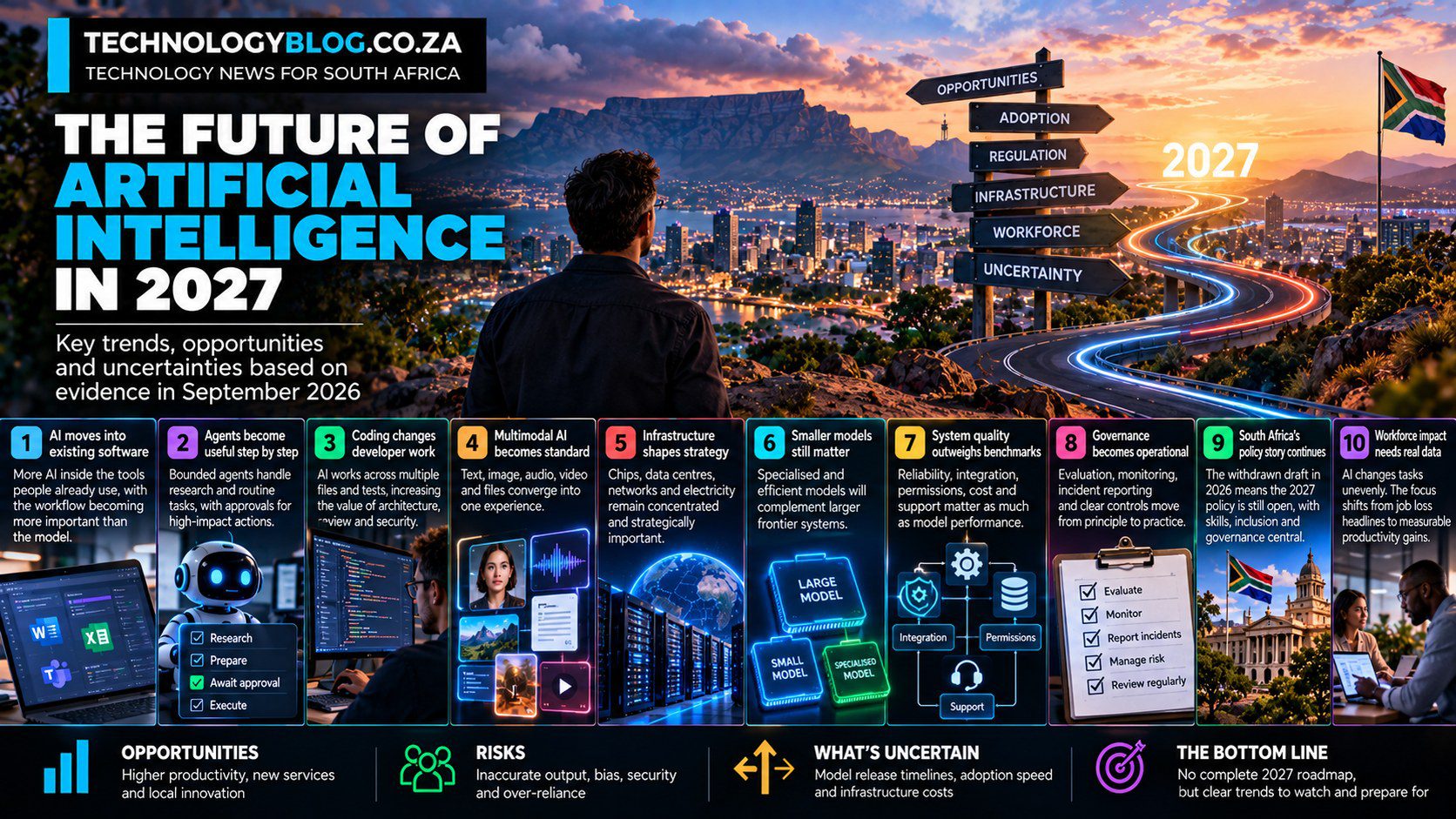
The most important fact about the future of artificial intelligence in 2027 is that there is no complete 2027 roadmap.
Technology companies have not announced every model they will release, governments have not finalised every rule, and important variables — from agent reliability to infrastructure economics and workplace adoption — can still move in several directions. Any confident release calendar written now would be speculation dressed as reporting.
What we do have is evidence. The 2026 Stanford AI Index, current product direction and South Africa’s policy debate show where pressure is building. That supports an outlook — not a promise.
AI is likely to feel less like a destination
One of the clearest shifts is that AI is moving into the software where work already happens.
Instead of visiting a dedicated chatbot for every task, users increasingly encounter AI inside documents, coding environments, search, creative tools and business systems.
If that direction continues, the model will become less visible while the workflow becomes more important.
Agents could become useful before they become fully autonomous
The popular image of an agent is software that takes a goal and completes everything alone.
A more realistic 2027 path is bounded delegation: an agent researches, prepares or performs low-risk steps and then asks for approval before consequential actions.
That model fits the current technical reality better because reliability remains imperfect. Useful autonomy does not require unlimited autonomy.
Coding agents could change the unit of developer work
AI coding has already moved beyond autocomplete.
Systems increasingly work across multiple files, tests and repository context. In 2027, developers may delegate larger bounded jobs while spending more time on architecture, review, security and integration.
This does not make engineering less important. It moves the bottleneck from typing code toward deciding what should be built and whether the generated changes are correct.
Multimodal interfaces should become less fragmented
Text, image, audio, video and file capabilities are converging.
The likely result is not a separate “multimodal mode” but ordinary workflows where a user speaks, shows, uploads and asks without switching conceptual tools.
The governance consequence is that more types of sensitive information can enter the same system.
AI infrastructure may shape national strategy more visibly
Advanced AI is built on physical systems: accelerators, data centres, high-speed networks and electricity.
The 2026 AI Index shows how concentrated that infrastructure remains. Countries may have broad access to AI services without equivalent control over the compute used to build them.
For South Africa, the opportunity is not necessarily to reproduce every frontier model. It is to build skills, local datasets, infrastructure and applications that create leverage in areas where the country has real needs and expertise.
Smaller specialised models should survive the frontier race
Not every workflow benefits from the largest available model.
A smaller system can be cheaper, faster, easier to host and easier to constrain. Specialist models can be tuned around a domain or device.
That means the future of AI is unlikely to collapse into one universal model. Organisations will assemble systems from different capabilities according to task, cost, latency and governance.
The competitive battleground may move from model quality to system quality
If the leading models continue to cluster more closely on general evaluations, product design becomes more important.
Reliability, retrieval, permissions, integrations, latency, support and auditability can decide which system works inside an organisation even when another model performs slightly better on a public benchmark.
In enterprise AI, the wrapper is becoming part of the intelligence.
AI governance should become more operational
Broad principles such as fairness, transparency and accountability are necessary but difficult to implement without concrete processes.
The next stage is operational: evaluation sets, incident reporting, permission boundaries, audit logs, data policies and periodic model review.
NIST’s AI RMF work and the OECD’s 2026 due-diligence guidance both point in that direction.
South Africa’s 2027 policy story remains genuinely open
The draft national AI policy was withdrawn in 2026 after fictitious references were discovered. Government committed to reworking it with expert input.
It would be irresponsible to predict the exact final policy text. What can be said is that credibility, ethical use, skills, inclusion and governance will remain central because government has continued to raise those themes publicly, including at the United Nations.
The policy reset also creates an opportunity to build a framework that is more evidence-led than the withdrawn draft.
Workforce impact should become easier to measure
The broad question “Will AI take jobs?” is too blunt to be useful.
AI changes tasks unevenly. Drafting, search, coding, analysis and customer-service work can be partly automated or accelerated while other parts of the same job remain human.
In 2027, better evidence should emerge around which workflows produce genuine productivity gains and which simply redistribute effort into review and correction.
AI literacy may outlast prompt engineering as a skill
Prompt techniques change with products. Judgement is more durable.
People need to know how to define a task, recognise unsupported output, protect data, verify a source and decide when the model should stop.
Those skills remain useful even when the interface changes completely.
What should not be presented as fact
No specific 2027 model name, launch date, fixed capability or price should be treated as confirmed without a primary announcement.
Scenario work is useful because the future is uncertain. It becomes misleading when analysis is written with the certainty of a release note.
For developments that are already observable, use Artificial Intelligence Trends 2027. For the South African policy and adoption picture, see the 2027 AI cornerstone.
The most defensible forecast is organisational
Whatever models arrive, organisations will still need people who can frame the work, control access, evaluate the result and take responsibility for decisions.
Better AI may remove manual steps. It does not remove the need for governance. If anything, systems that can take more actions make boundaries and accountability more valuable.
What would make this outlook materially wrong?
Agent adoption could slow if failure recovery remains poor, infrastructure costs could constrain frontier deployment, and organisations could retreat from broad integrations if security or governance problems outweigh the productivity gain. The opposite is also possible if models become more efficient and bounded agents prove reliable enough for routine work.
Those uncertainties are why this page should remain an outlook rather than a disguised release calendar.


