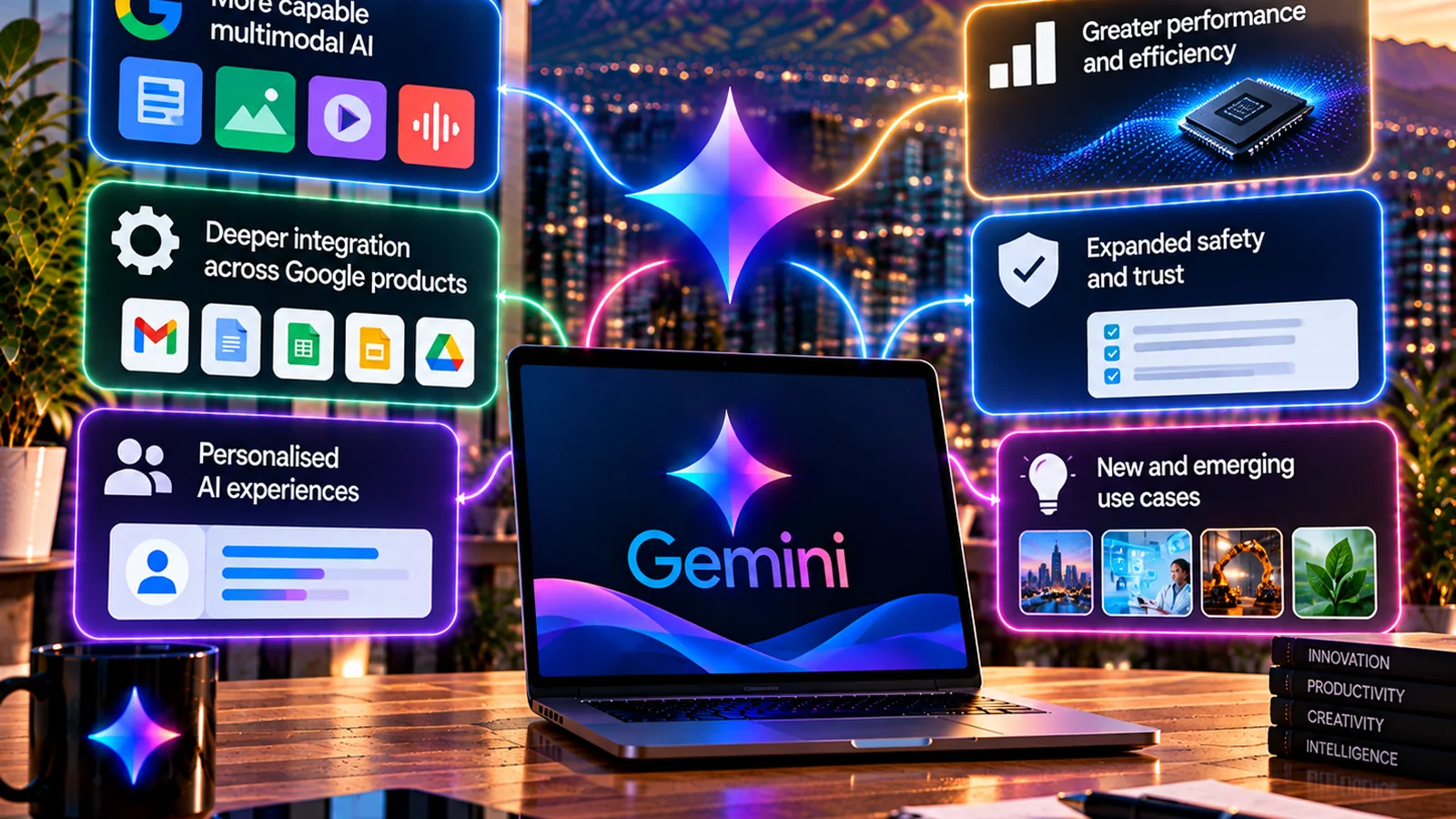
Google Gemini Latest Features and Updates: September 2026
September 2026 turned Gemini into a moving target for anyone trying to describe the product accurately. Google released Gemini 3.8 Flash, new Live models, a Windows desktop app, text-to-speech models, more agentic Workspace capabilities and, on 30 September, reusable skills for personal Gemini accounts.
The releases point in the same direction: Gemini is moving closer to the operating system, deeper into Workspace and further from a model that only returns text. The new consumer skills launch also makes repeatable instructions part of ordinary Gemini chat. For the stable product map, use TechnologyBlog’s Google Gemini 2027 complete guide.
Gemini 3.8 Flash launched on 2 September
Google introduced Gemini 3.8 Flash on 2 September 2026, describing it as its most intelligent Flash model and positioning it for software engineering, agentic work and difficult multi-step reasoning.
The developer documentation lists support for text, images, video, audio and PDF input, a 1,048,576-token input limit, code execution, file search, function calling, search grounding and computer use in preview. The significance is not a single benchmark: Google’s fast model line is being designed for longer and more operationally complex tasks.
Gemini 3.8 Live reached developers on 15 September
Google released Gemini 3.8 Live and 3.8 Live Extended Thinking through the Gemini API and Google AI Studio on 15 September, then published a broader model overview later that week. The models are designed for real-time dialogue with stronger reasoning and visual context, including the ability to manage tools in the background while conversation continues.
This pushes voice beyond dictation or conversational novelty. Live interaction is becoming another interface for agentic work.
The Gemini Windows app arrived on 10 September
Google’s Gemini Apps release notes added a Windows app for Windows 10 or later. The app can be opened with Alt + Space and brings chat, image creation, Deep Research and supported Google-app connections into a desktop workspace.
Google had already introduced a native Mac app earlier in 2026. The Windows launch makes the desktop strategy much broader.
Workspace became more agentic on 9 September
Google’s Workspace team announced cross-app capabilities that let Gemini gather context from selected files, emails and chat threads and create formatted Docs, structured Sheets or Slides under user direction.
This is one of the most important product changes because it shifts Gemini from suggesting content inside one app toward orchestrating work across several apps.
Gemini 3.8 text-to-speech arrived on 23 September
Google introduced Gemini 3.8 Flash TTS and Flash-Lite TTS as more expressive speech-generation models for character voices and directed dialogue. The models are aimed at Google AI Studio, the Gemini API, Gemini Enterprise and products such as Google Vids.
That broadens Gemini’s multimodal role from understanding audio to generating more controllable speech.
Gemini 3.8 Live with Live Avatar followed on 24 September
Google then introduced Gemini 3.8 Live with Live Avatar for enterprise use, combining its live dialogue system with low-latency streaming video and a generated visual persona. Google describes the feature as able to listen, see and speak with real-time expressions and lip-sync.
This is a developer and enterprise-facing release rather than evidence that every Gemini app user suddenly received an on-screen avatar. The distinction between a model capability, an enterprise product and a consumer feature should remain explicit.
Consumer Gemini skills launched on 30 September
Google announced reusable skills for Gemini on 30 September. Skills let users package repeatable instructions and invoke them inside a normal chat instead of opening a separate custom assistant.
Google’s current help documentation says skills are available to individuals aged 18 or older signed in to personal Google accounts. Gems are still scheduled to be removed and automatically converted beginning in November 2026 for personal accounts, with later Workspace transitions in 2027.
Workspace skills arrived on 16 September
Google separately announced skills for Workspace on 16 September. In that environment, skills are reusable prompts that can package a team’s rules, templates and reference files so Gemini can apply the same operating instructions to recurring work.
This is related to, but not identical with, the consumer transition away from Gems. For businesses, the more important idea is standardisation: a workflow that once lived in one employee’s prompt history can increasingly be turned into shared instructions that need owners, testing and change control.
Gems will still transition automatically
Consumer skills are already available, but Google’s support documentation still sets the automatic Gem-to-skill transition for November 2026 on personal accounts, March 2027 for Workspace business, enterprise and non-profit accounts, and June 2027 for education accounts.
Skills are reusable instructions that can be invoked in chat and, in some cases, automatically applied when relevant. The change matters because users building repeatable workflows should avoid treating the current Gem interface as permanent.
Deep Research continues to expand
Google’s Deep Research experience can combine Google Search with selected sources such as Gmail, Drive, uploaded files and NotebookLM notebooks where supported. The product now sits closer to a research agent than a simple long-form answer generator.
For journalists and analysts, the source layer matters more than the report length. Open the evidence and separate primary documentation from generated synthesis.
Privacy guidance was updated in September
The Gemini Apps Privacy Hub was updated on 24 September 2026. It explains the data Gemini can collect from prompts, uploads, connected apps, devices, Live sessions and other sources, as well as activity-retention controls.
The document also explicitly warns users to supervise browsing and tasks because Gemini can make mistakes, including when actions involve third parties.
What the September updates say about Google’s direction
The pattern is more important than any one release. Gemini is becoming a desktop assistant, a Workspace orchestrator, a research agent, a real-time voice interface and a developer platform for increasingly autonomous systems.
That means the central product question is shifting from “how good is the answer?” to “what context can Gemini access, what action can it take, and where does the human approve the result?”
The September releases sit on different Gemini surfaces
Gemini 3.8 Flash is a developer model, the Windows app is a consumer desktop surface, Workspace skills belong to Google’s productivity environment, and Live Avatar is aimed at enterprise experiences. Grouping them under one Gemini label is useful only if those boundaries stay explicit. A model announcement does not automatically describe the consumer app, and an enterprise capability should not be presented as though it appeared for every personal account.
Announcement date is not the same as availability
Google often separates an announcement, the start of a rollout and general availability. Platform, subscription, region and administrator settings can also affect access. The dates above record when Google documented each change; they do not prove that every Gemini account received it immediately.
That distinction is particularly important in a fast-moving update tracker. Confirmed later changes should be added with their own dates rather than backdated into September. For more stable material, use Gemini Explained; for capability selection, use Best Gemini Tools and Use Cases.


