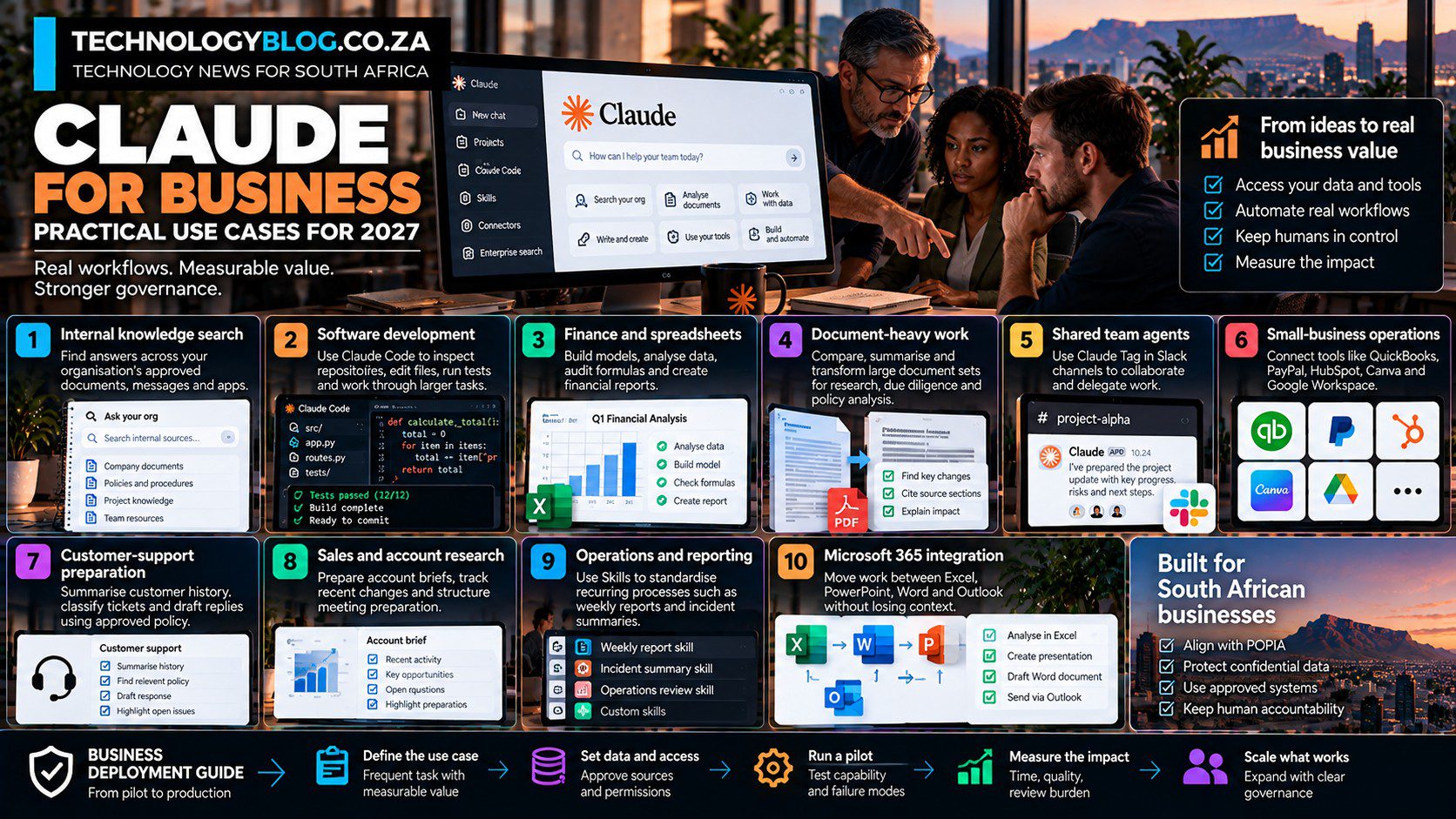
Claude for Business: Use Cases and Examples
For a business, Claude becomes more consequential the moment it can touch the systems where work happens. Cowork, Claude Code, Microsoft 365 integration, connectors and shared agents push the assistant closer to files, messages, code and operational tools. That can remove real friction, but it also turns identity, permissions and approval into part of the business case.
The shortage is not use cases. It is evidence that a particular workflow is worth giving real organisational context. A useful pilot should expose failure modes as clearly as it demonstrates capability, so the company knows where Claude should stop, ask or hand the work back to a person.
For the broader product context, see our complete Claude AI guide.
1. Internal knowledge search
Organisations often lose time because information is scattered across documents, messages and systems. Anthropic’s enterprise-search capability creates a dedicated knowledge project connected to approved organisational sources.
This can reduce search friction, but it works only if permissions and source quality are maintained. AI cannot fix a knowledge base full of stale policy.
2. Software development
Claude Code is one of Anthropic’s most mature enterprise use cases. It can inspect repositories, implement changes, run tests and help teams work through larger software tasks.
The business case is strongest when coding outcomes are verifiable. Tests, code review and deployment checks provide concrete ways to judge whether the agent’s work is correct.
3. Finance and spreadsheet work
Anthropic has invested heavily in financial-services workflows. Claude can work in Excel, connect to approved financial data, build models, audit formulas, prepare sensitivity analyses and help move results into Word or PowerPoint.
In 2026 Anthropic also introduced ready-to-run finance agent templates for work such as pitchbooks, KYC screening and month-end close.
4. Document-heavy professional services
Claude is well suited to comparing, summarising and transforming large document sets. Professional-services firms can use it for due-diligence support, policy analysis, research synthesis and document preparation.
PwC and KPMG both announced broad Claude deployments in 2026, showing the direction of enterprise adoption. Vendor announcements are not independent proof of ROI, but they demonstrate that the product is moving into core professional workflows rather than remaining a side chat tool.
5. Shared team agents
Claude Tag brings Claude into Slack channels. Team members can tag the assistant, give it access to selected context and delegate work in a shared thread.
This changes the interaction model from one employee plus one assistant to a collaborative agent visible to the team. Shared visibility can improve handoffs but also requires clear permissions and accountability.
6. Small-business operations
Anthropic’s Claude for Small Business package connects Claude with tools such as QuickBooks, PayPal, HubSpot, Canva, DocuSign, Google Workspace and Microsoft 365. Anthropic describes workflows such as invoice chasing, lead triage, contract review and month-end preparation.
The important design principle is approval: Anthropic says business owners approve before actions such as sending, posting or paying occur.
7. Customer-support preparation
Claude can help summarise customer history, draft replies, classify tickets and find relevant policy. It can also work with connected support systems where approved.
Businesses should avoid letting a general model invent refund rules or commitments. The answer should come from controlled policy sources.
8. Sales and account research
Claude can prepare account briefs from approved CRM data, public sources and internal documents. It can summarise recent changes, identify open questions and structure meeting preparation.
Again, the distinction between source fact and model inference should remain visible.
9. Operations and recurring reporting
Skills are useful for standardising recurring work. A company can create a skill for a weekly operating review, incident summary or customer-health report.
The workflow becomes easier to maintain because the process logic sits in a reusable package instead of living only in an employee’s personal prompt history.
10. Cross-application knowledge work
Claude’s Microsoft 365 direction matters because business work rarely stays in one file. A financial analysis may begin in Excel, move into PowerPoint and then become a Word memo or Outlook message.
Reducing those transitions can create more value than simply making the model slightly better at text generation.
Business governance needs to match agent capability
As Claude gains the ability to read, write and act across systems, organisations should define which actions can run automatically and which require approval.
Least-privilege access, audit logs, identity management, connector controls and incident response become central. Enterprise features such as audit logs, SCIM and retention controls exist because agentic AI is partly an access-control problem.
Commercial data handling is different from consumer use
Anthropic says it does not train models on data submitted through commercial products such as Team, Enterprise and the API by default unless the customer opts into a development programme.
The organisation remains responsible for deciding what employees may submit, how data is classified and which connected systems Claude may access.
South African businesses need their own policy layer
POPIA, confidentiality obligations, labour practices and sector rules still apply. A vendor’s privacy controls do not replace the company’s legal responsibilities.
A useful internal policy should classify approved data, prohibited data, permitted connectors, review standards and escalation paths.
How to choose the first business use case
Start where three conditions overlap: the task occurs frequently, the output can be checked and the data can be handled safely.
That usually favours research support, document transformation, coding, internal knowledge search and structured reporting before high-impact automated decisions.
Measure the business case honestly
Track total turnaround time, review burden, error rate and whether the workflow enables useful work that previously would not have been done.
Anthropic’s Economic Index research suggests Claude is used heavily for work, but adoption patterns differ by country and income. Businesses should therefore test their own workflows instead of assuming global case studies transfer directly.
The deployment boundary matters more than the demo
Claude is becoming a workflow platform rather than only a chatbot. That increases its potential value and its governance requirements at the same time.
For employee-level productivity, see Claude for Work. For the downside and safeguards, read Claude: Benefits, Risks and Limitations. Businesses choosing between platforms can continue to Claude vs the Leading Alternatives.
Use pilot design to expose failure modes
A business pilot should not measure only successful demonstrations. It should deliberately include difficult cases, incomplete inputs and permission boundaries. Record where Claude asks for help, where it invents an answer and where the human reviewer has to intervene.
Those failure cases are part of the business case. A workflow is production-ready only when the organisation understands not just its average result but how it fails under realistic conditions.


