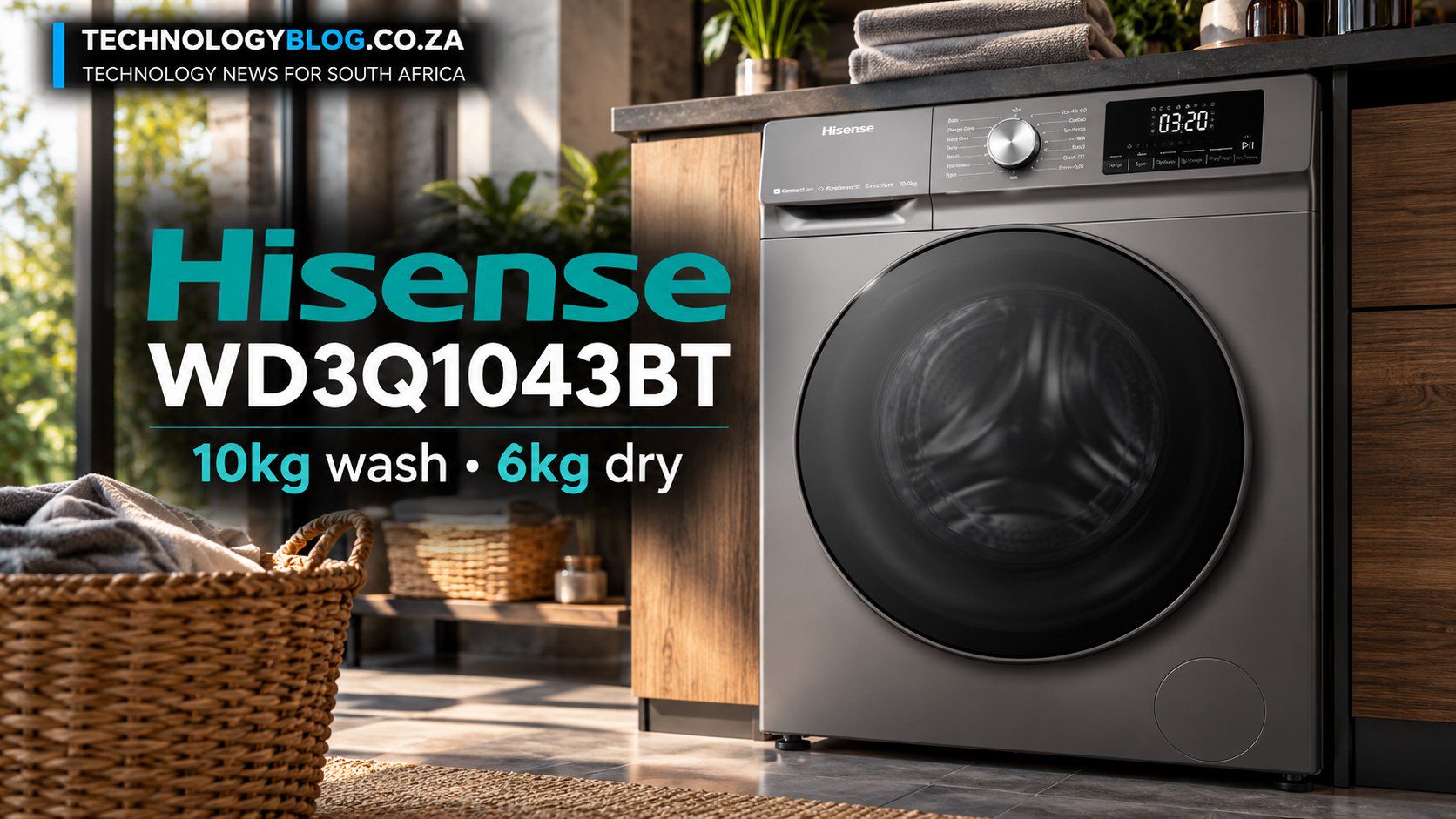
Hisense WD3Q1043BT combines 10kg washing and 6kg drying in one machine
The Hisense WD3Q1043BT combines two large laundry appliances into one freestanding machine.
Its drum can handle up to 10kg for washing and 6kg for drying, while a maximum 1400rpm spin speed helps remove water before the drying stage begins.
Hisense also equipped the washer-dryer with Jet Wash, Pure Steam, Pause & Add, load detection, Wi-Fi connectivity and 15 programmes.
There is an important qualification in 2026, though.
The WD3Q1043BT is no longer a current Hisense model. Hisense South Africa now lists it as discontinued, while keeping the product page available to support existing owners.
That changes how the machine should be viewed.
It is no longer primarily a new-product story. Instead, it is useful context for people who already own one, encounter remaining stock or consider buying a used unit.
The Hisense WD3Q1043BT washes 10kg but dries 6kg
The Hisense WD3Q1043BT has a maximum washing capacity of 10kg and drying capacity of 6kg.
That difference is important.
A full 10kg washing load cannot simply remain in the machine and then be dried as a full load if it exceeds the 6kg drying limit.
Users washing larger loads may therefore need to remove part of the laundry before drying.
This is common to many combination washer-dryers, but it remains one of the most important specifications to understand before using one.
The advantage is space.
A household gets both washing and drying functionality from a single 595mm-wide freestanding appliance rather than needing room for two separate machines.
The maximum spin speed reaches 1400rpm
Hisense specifies a maximum spin speed of 1400rpm.
Users can also select lower speeds including 400, 600, 800, 1000 and 1200rpm.
Spin speed matters because the washing machine is mechanically removing water from clothing before drying begins.
A higher spin speed can leave less moisture for the drying process to remove, although the correct speed still depends on the fabric and selected programme.
Delicate garments should not simply be subjected to maximum spin because the machine can reach 1400rpm.
The programme and garment-care instructions remain more important than chasing the highest number.
Jet Wash uses targeted water jets
Hisense includes Jet Wash on the WD3Q1043BT.
The company describes the system as using high-pressure water jets to clean laundry more quickly and efficiently.
For this model, the important point is that Jet Wash forms part of the washing system rather than being another programme name.
TechnologyBlog has not independently tested the WD3Q1043BT, so we cannot confirm Hisense’s claims about faster washing or compare its cleaning performance with a conventional wash system.
Nevertheless, Jet Wash is one of the principal features Hisense associated with this machine.
Pure Steam adds another way to treat laundry
The WD3Q1043BT also includes Pure Steam functionality.
Steam Refresh is listed among its programmes, while Hisense describes the feature as helping reduce creases.
Steam can be useful when clothing needs refreshing without treating the job exactly like a conventional full wash.
However, steam should not be interpreted as a universal replacement for washing.
The correct treatment still depends on the garment, level of soiling and care instructions.
TechnologyBlog has also not independently tested Hisense’s crease-reduction claim on this model.
Pause & Add deals with forgotten laundry
One of the more practical features is Pause & Add.
Almost everyone has started a washing cycle and then noticed a forgotten sock, shirt or towel.
Pause & Add is designed to provide an opportunity to add an item after the cycle has started when operating conditions allow it.
There are obvious safety limitations.
A front-loading washing machine cannot simply unlock its door whenever requested. Water level, temperature and the stage of the programme can determine whether opening the door is safe.
The feature therefore provides flexibility rather than an unconditional override of the door lock.
Wi-Fi brings remote control to the washer-dryer
The WD3Q1043BT includes Wi-Fi and remote-control functionality.
Hisense associates the machine with its ConnectLife smart platform.
That can allow a connected appliance to become part of a broader smart-home environment rather than requiring every interaction to take place at the control panel.
However, Hisense South Africa’s current product page contains an obvious documentation error.
Its generic Smart Connectivity description says users can control and monitor their “fridge”, adjust temperatures and manage fridge settings.
Those statements clearly do not describe the WD3Q1043BT washer-dryer.
TechnologyBlog has therefore not repeated those erroneous functions as washer-dryer capabilities.
The model specification itself confirms Wi-Fi and remote control. Any specific ConnectLife function should be checked against the app and current Hisense support documentation.
Load Detection adds automation inside the machine
Hisense lists Load Detection among the WD3Q1043BT’s features.
A washer already needs to make several decisions during a cycle.
Load information can help the appliance adapt its operation rather than treating every drum as though it contains exactly the same quantity of laundry.
However, Hisense’s South African specification does not provide enough model-specific technical detail to justify claims about exactly how much water, time or electricity Load Detection saves.
Those outcomes should therefore not be invented.
The confirmed point is simply that load detection forms part of the machine’s feature set.
There are 15 programmes
Hisense specifies 15 programmes for the WD3Q1043BT.
The documented options include Cotton, Synthetics, Mix, Wool, Quick 15, Rinse+Spin, Spin, Shirts and Cotton Colour.
There is also Allergy Care, Drum Clean, Steam Refresh and a 60-minute Wash & Dry programme.
Dry Only provides another useful option.
That means owners are not forced to run a washing programme simply because they want to use the drying function.
The programme selection reflects the machine’s dual role.
Some cycles concentrate on washing, others on garment care, while drying functionality can operate separately.
Quick 15 targets small, fast washing jobs
The Quick 15 programme addresses situations where a full-length washing cycle may be unnecessary.
Short cycles can be useful for lightly soiled clothing or small loads that need a quick wash.
However, the existence of a 15-minute programme should not be interpreted as meaning every 10kg load can be thoroughly washed in 15 minutes.
Quick programmes normally involve restrictions around load size and suitable laundry.
Owners should follow the model’s programme guidance rather than selecting the shortest cycle regardless of what is inside the drum.
A 60-minute programme combines washing and drying
Hisense also lists a 60′ Wash & Dry programme.
This is one of the features that highlights the convenience argument for a combination machine.
Instead of moving laundry from a washer into a separate tumble dryer, a suitable load can remain inside one appliance while it moves through both processes.
Again, the programme should not be confused with the machine’s maximum capacities.
A rapid combined cycle will have its own operating conditions and load limitations.
The manual should determine what can safely and effectively be used with that programme.
Dry Level and Time Dry provide more control
Drying is not limited to one automatic setting.
Hisense lists both Dry Level and Time Dry controls.
These give users different ways to approach the drying stage.
A drying-level setting lets the appliance work towards a selected result, while timed drying is useful when a specific additional drying period is required.
The appropriate option depends on the fabrics and the condition of the load.
As with any tumble-drying process, garment-care labels remain important.
Not every item suitable for machine washing should automatically be tumble dried.
Drum Clean helps maintain the appliance
The WD3Q1043BT includes a Drum Clean programme.
This is an important feature on a machine that routinely handles water, detergent, fibres and residue.
The inside of a washing machine needs maintenance even though its job is cleaning other things.
A dedicated maintenance cycle provides a defined process for cleaning the drum according to Hisense’s instructions.
Owners should still maintain other areas such as seals, detergent compartments and filters where required.
A Drum Clean programme does not make the entire appliance maintenance-free.
The Pearl Drum is made from stainless steel
Hisense identifies a Pearl Drum among the machine’s features.
The specification lists the tub and drum materials as plastic and stainless steel respectively.
The stainless-steel drum is the surface directly interacting with laundry during washing and spinning.
Drum design can influence how fabric moves through the machine, although TechnologyBlog has not independently assessed Hisense’s Pearl Drum against alternative drum designs.
Therefore, it is best treated as a documented construction feature rather than evidence of superior garment care.
The inverter motor targets vibration, noise and efficiency
Hisense uses an inverter motor in the WD3Q1043BT.
The manufacturer associates this motor with reduced vibration, lower noise and reduced energy consumption.
Those are manufacturer claims rather than TechnologyBlog test results.
The underlying reason inverter motor technology is useful is its ability to control motor operation electronically rather than relying on simpler fixed-speed behaviour.
That can help a washing machine manage different stages of a programme more precisely.
However, the actual noise and electricity use of the WD3Q1043BT would need controlled testing before TechnologyBlog could quantify those advantages.
Balance and foam monitoring add protection
Hisense includes several less visible systems that matter during operation.
There is an anti-foam sensor, electronic spin-speed management and balance control.
Balance management is particularly relevant at high spin speeds.
A wet load that gathers heavily on one side of the drum can create substantial vibration.
The machine therefore needs to manage how it reaches high-speed spinning.
Foam management tackles another issue.
Excessive detergent can produce too much foam, potentially affecting washing and rinsing behaviour.
These systems operate in the background, but they contribute to the practical functioning of the appliance.
The WD3Q1043BT uses a large front door
Hisense lists a large door design among its user-comfort features.
That makes sense for a machine capable of accepting a 10kg washing load.
Bulky laundry can become awkward to push through a narrow opening even when the drum itself has sufficient capacity.
A larger opening can make loading and unloading easier, particularly with bedding and towels.
The physical door still requires clearance in front of the machine.
That needs to be considered when installing the appliance in a narrow laundry or kitchen area.
Titanium Silver gives it a darker appliance finish
The WD3Q1043BT uses a Titanium Silver cabinet.
That distinguishes it visually from the conventional white finish associated with many laundry appliances.
The controls use an LED display accompanied by six push buttons.
This is not an appliance built around a large touchscreen.
The physical controls and display provide direct access to the machine’s programmes and settings, while Wi-Fi adds the connected layer.
It needs standard South African electrical supply
Hisense specifies a 220–240V, 50Hz supply.
That aligns with South African household electricity.
The specified water-pressure range is 0.1 to 1MPa.
Installation therefore involves more than simply finding a 595mm-wide gap.
The appliance needs an appropriate electrical outlet, water supply, drainage connection and enough space for hoses and ventilation according to Hisense’s installation instructions.
Because the machine also dries laundry, installation guidance should be followed rather than treating it exactly like a basic washing machine.
The machine weighs 70kg
The WD3Q1043BT measures 595 × 610 × 845mm and has a net weight of 70kg.
Those dimensions place it within the familiar footprint of a large freestanding front-loader, but the depth needs attention.
Cabinet depth does not necessarily represent the complete installation space required once hoses, the door and surrounding clearance are considered.
The 70kg weight also means moving it is not a trivial job.
Correct levelling matters because an unstable washing machine can become particularly noticeable when a heavy wet load reaches high spin speeds.
The energy labels need historical context
Hisense’s specification lists Energy Efficiency Class A for washing and A for wash-and-dry under EU Regulation 2019/2014.
Those figures are part of the product’s documented specification.
However, consumers should be cautious about comparing historical energy labels directly with unrelated appliances carrying labels under different standards, test procedures or regional schemes.
An A classification is meaningful within the standard under which it was measured.
It does not automatically prove that the WD3Q1043BT uses less electricity than every newer washer-dryer.
TechnologyBlog would need comparable test data before making that claim.
The WD3Q1043BT is now a discontinued model
This is the biggest difference between discussing the WD3Q1043BT now and covering it when it was current.
Hisense South Africa marks the product as discontinued.
The manufacturer has retained its page because customers continue to own and use the machine.
That is useful.
Specifications, manuals and support information remain relevant long after a home appliance disappears from the current catalogue.
It also means shoppers need to understand what they are buying if they encounter one.
Remaining retail stock, clearance units and second-hand machines should not be confused with a current-generation Hisense launch.
Warranty status can also depend on when and where a particular unit was purchased.
Hisense WD3Q1043BT specifications
| Specification | Hisense WD3Q1043BT |
|---|---|
| Product type | Freestanding washer-dryer |
| Washing capacity | 10kg |
| Drying capacity | 6kg |
| Maximum spin speed | 1400rpm |
| Selectable spin speeds | 400/600/800/1000/1200/1400rpm |
| Maximum temperature option | 95°C |
| Programmes | 15 |
| Jet Wash | Yes |
| Pure Steam | Yes |
| Steam Refresh | Yes |
| Pause & Add | Yes |
| Wi-Fi | Yes |
| Remote control | Yes |
| ConnectLife | Listed by Hisense |
| Load Detection | Yes |
| Quick 15 | Yes |
| 60′ Wash & Dry | Yes |
| Dry Only | Yes |
| Dry Level | Yes |
| Time Dry | Yes |
| Allergy Care | Yes |
| Drum Clean | Yes |
| Child Lock | Yes |
| Delay End | Yes |
| Memory Backup | Yes |
| Inverter motor | Yes |
| Drum | Stainless steel |
| Display | LED |
| Cabinet colour | Titanium Silver |
| Supply | 220–240V / 50Hz |
| Water pressure | 0.1–1MPa |
| Dimensions | 595 × 610 × 845mm |
| Net weight | 70kg |
| Current status | Discontinued |
The WD3Q1043BT still shows why washer-dryers appeal
The Hisense WD3Q1043BT is no longer part of Hisense South Africa’s current product range, but its design illustrates why combination washer-dryers remain attractive.
A 10kg washer and 6kg dryer occupy the footprint of one freestanding appliance.
Jet Wash, steam functions, Pause & Add and a 1400rpm spin speed expand the basic laundry capabilities. Wi-Fi and remote control add connectivity, while load detection and several safety systems operate behind the scenes.
There are compromises.
Drying capacity is lower than washing capacity, so a maximum washing load cannot automatically become a maximum drying load. Combination machines also need to perform two very different jobs inside one drum.
Most importantly, buyers considering this particular model now need to recognise its status.
The WD3Q1043BT is discontinued, not a new Hisense washer-dryer.
For existing owners, that makes Hisense’s decision to keep the specifications and manual online valuable.
For prospective buyers encountering remaining or second-hand stock, it makes checking condition, support and warranty status just as important as checking the feature list.


