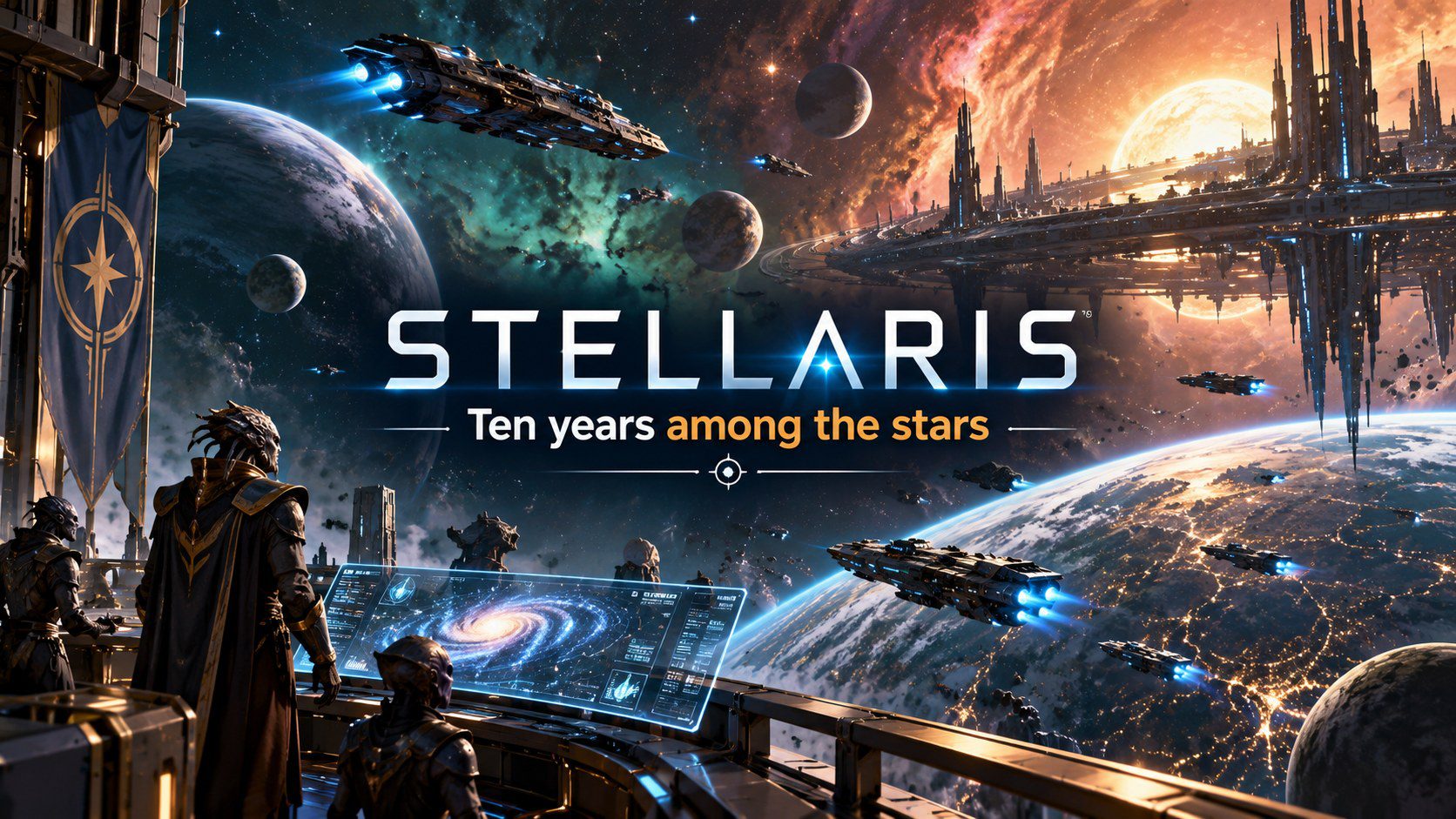
Stellaris turns exploring the unknown into running a galactic civilisation
Stellaris begins with an empty galaxy.
Not literally empty.
That would make for a considerably shorter game.
The problem is that you do not know what is out there.
Your civilisation has discovered interstellar travel. A science ship can finally leave the home system and survey the stars beyond it.
So you send one.
Another system appears.
There are planets.
Resources.
An anomaly.
Something strange is hiding on a moon.
Your scientists investigate.
Then you discover another system.
And another.
Eventually, one of your science ships finds something considerably more important.
Someone else.
Suddenly, the galaxy is no longer about discovering what exists beyond your borders.
It is about deciding what you are going to do about it.
Stellaris starts with exploration
The opening hours can feel surprisingly peaceful.
Science ships survey systems.
Scientists investigate anomalies.
Construction ships establish stations.
Potential colonies appear.
Resources gradually reveal themselves.
The map begins as an enormous collection of unexplored stars.
Every survey removes another piece of uncertainty.
Exploration is one of the game’s central systems, with anomalies and discoveries capable of producing stories, events and unexpected outcomes.
That uncertainty gives the early game its identity.
You know almost nothing.
So you explore.
Every new star makes the Stellaris galaxy smaller
Eventually, exploration becomes expansion.
Useful systems need to be claimed.
Resource stations increase production.
Habitable worlds offer opportunities for colonies.
Strategic locations become increasingly important.
Your civilisation begins spreading across the map.
At first, expansion can feel almost unlimited.
Then another empire appears.
The unexplored frontier suddenly has an owner.
Another civilisation has its own territory, values, economy, military and ambitions.
The galaxy starts developing borders.
First contact changes Stellaris completely
Meeting another civilisation introduces uncertainty of a different kind.
Are they friendly?
Hostile?
Stronger than you?
Weaker?
Would trade benefit both empires?
Could an alliance work?
Do they occupy systems you wanted?
Are their ethics compatible with yours?
Most importantly:
What do they think about you?
Procedurally generated species and empires can possess different traits, ideologies and characteristics. Diplomacy provides multiple ways for those civilisations to interact.
The unknown galaxy gradually becomes a political map.
Stellaris lets you define your civilisation
Before exploring the galaxy, players decide what kind of civilisation will enter it.
Species traits shape the population.
Ethics establish ideological foundations.
Governments and civics further define how the empire operates.
Origins can change where and how a civilisation begins.
Those decisions matter because Stellaris is not simply asking players to choose a flag.
It asks them to create a society.
That society might become diplomatic.
Militaristic.
Authoritarian.
Collective.
Spiritual.
Technological.
Organic.
Machine.
The possibilities have expanded enormously during ten years of development.
The empire you create determines how you approach the galaxy.
Then the galaxy determines whether those ideas survive contact with everyone else.
Stellaris colonies turn exploration into administration
Finding a habitable planet is exciting.
Colonising it creates work.
A colony needs population.
Infrastructure.
Jobs.
Housing.
Resources.
Development.
Eventually, what began as a distant planet becomes another important part of the empire.
Repeat that process several times and the player’s perspective changes.
You are no longer managing one homeworld.
You are managing an interstellar economy.
Resources produced in different places support fleets, research, construction and further expansion.
Exploration has become administration.
The Stellaris economy determines what your empire can do
Ambition is easy.
Paying for it is harder.
An empire needs resources.
Expansion requires infrastructure.
Research requires scientists and supporting economies.
Fleets require ships.
Ships need construction.
Military strength needs industrial capacity capable of replacing losses.
Population and jobs feed into the wider system.
A civilisation that wants to dominate the galaxy needs an economy capable of supporting that ambition.
Otherwise, the enormous fleet you planned remains exactly that.
A plan.
Stellaris technology constantly changes what is possible
Research provides another source of progression.
New technologies unlock buildings, weapons, ships and other capabilities.
However, technology is not simply a ladder with one obvious route to the top.
Research opportunities shape what becomes available.
Different empires can therefore develop in different directions.
Military technologies strengthen fleets.
Economic developments improve production.
Other discoveries unlock entirely new possibilities.
Over time, the civilisation that cautiously entered its first neighbouring star can become almost unrecognisable.
That transformation is central to Stellaris.
Diplomacy becomes unavoidable
You can ignore another empire.
It may not return the favour.
As more civilisations discover one another, the galaxy develops relationships.
Rivalries form.
Agreements emerge.
Borders create disputes.
Trade can create mutual interests.
Defensive relationships can discourage aggression.
Federations can bring several powers together.
Diplomacy matters because the galaxy eventually becomes too crowded for every civilisation to pretend it is alone.
The stars may be enormous.
Political space eventually becomes surprisingly small.
Stellaris warfare needs more than a large fleet
Sometimes diplomacy fails.
Then the fleets move.
Players can build and customise warships for interstellar combat.
Different weapons and technologies provide options when designing fleets, while military capability develops alongside the wider economy and research systems.
But building ships is only part of warfare.
They need replacing when destroyed.
Territory needs defending.
Shipyards matter.
Strategic systems matter.
The economy needs to support prolonged conflict.
A spectacular fleet is useful.
A civilisation capable of rebuilding it can be considerably more dangerous.
Wars reshape the Stellaris galaxy
Conflict has consequences beyond individual battles.
Systems can change hands.
Borders move.
Rivalries deepen.
Other empires react.
Allies become involved.
A war between two powers can affect neighbours that never fired a shot.
By this point, the galaxy is no longer the mysterious frontier from the beginning.
It has history.
Some of that history belongs to the player.
Some happened because other empires were pursuing their own objectives.
That gives each campaign its own emerging narrative.
Galactic politics goes beyond individual empires
As civilisations become increasingly interconnected, politics can operate above the level of individual relationships.
The Galactic Community allows participating empires to debate and vote on resolutions affecting the wider galaxy.
Federations create another form of cooperation.
Diplomatic influence therefore becomes another resource.
The empire with the largest fleet may be powerful.
That does not mean everybody has to agree with it.
Political influence, alliances and relationships can matter alongside military strength.
Stellaris changes as the campaign progresses
The changing scale is one of the most interesting parts of the game.
The beginning is about discovery.
The early empire is about expansion.
The middle game increasingly involves economics, diplomacy, strategic positioning and competition.
Eventually, established galactic powers dominate large sections of space.
Old rivalries have history behind them.
Alliances matter.
Major fleets exist.
Technology has advanced.
Then Stellaris can introduce another problem.
A crisis.
Stellaris crises can make old enemies useful
A powerful threat can change the meaning of galactic politics.
The empire you spent decades opposing may suddenly have fleets you desperately need.
Old diplomatic calculations can become irrelevant when survival is at stake.
The game has expanded its crisis systems significantly over the years.
For example, 2024’s The Machine Age introduced another endgame crisis alongside a player crisis path and major additions for machine and cybernetic societies.
Other expansions have continued exploring ways players can transform their own civilisation into something the rest of the galaxy may have reason to fear.
The question can eventually stop being:
How do I defeat my rival?
It becomes:
Does the galaxy survive?
Ten years changed Stellaris enormously
Stellaris released on 9 May 2016.
The version available in 2026 contains the results of a decade of expansions, free updates and system revisions.
Dozens of pieces of additional content have appeared, while the underlying game has repeatedly changed through free updates.
Discussing it as though it were still simply the game released in 2016 would therefore be misleading.
Core systems have evolved.
New empire types appeared.
Diplomatic options expanded.
Ascension developed.
New crises arrived.
Additional stories, species and mechanics became part of the wider experience.
Some older paid content has even moved directly into the base game.
Stellaris became larger for its tenth anniversary
Paradox used the game’s tenth anniversary to make a significant change.
On 11 May 2026, content from Utopia, Synthetic Dawn and the Humanoids Species Pack became part of the base game.
That brought major content previously sold separately into the standard experience.
Among those additions are Hive Mind empires and Gestalt Machine Intelligences.
The change matters because Utopia in particular had long occupied an important position in the expansion catalogue.
A new player starting in 2026 therefore receives a broader base experience than someone buying the game several years earlier.
Stellaris BioGenesis changed biological evolution
BioGenesis launched in May 2025.
Its focus is biological development.
The expansion overhauled genetic ascension, introduced biological ships, added new origins and created additional ways for players to manipulate life itself.
That demonstrates how far empire development can move beyond simply researching better weapons.
Your civilisation can change what it fundamentally is.
Stellaris expanded psionic development
Shadows of the Shroud approached transformation from another direction.
Rather than genetics, its focus is psionics.
The expansion substantially reworked the Psionic Ascension path and expanded interaction with the mysterious Shroud.
Players can develop relationships with Shroud Patrons while their choices influence their civilisation’s spiritual direction.
Once again, the late-game empire may bear little resemblance to the civilisation that originally sent its first science ship into the unknown.
Stellaris changed again in 2026
Paradox has not treated the tenth anniversary as the end of development.
Update 4.3 “Cetus” arrived in March 2026.
It focused on balancing the 4.x economy and military systems while improving performance and stability.
Then another major change arrived in June.
Stellaris Nomads changes how an empire expands
Most strategy games expect empires to control territory.
The Nomads expansion asks what happens if they do not.
Released on 15 June 2026, Nomads allows players to create empires that are not dependent on claiming conventional systems or colonising worlds.
Instead, a nomadic civilisation can travel through the galaxy aboard an upgradeable Arkship.
Trade routes and contracts provide alternative ways to gain resources and influence.
It is a striking addition because it challenges one of the assumptions present since the beginning.
Explore.
Claim territory.
Colonise.
Expand.
Nomads allows a civilisation to look at that sequence and choose another path.
Stellaris 4.4 Pegasus changed warfare too
Nomads arrived alongside free update 4.4 “Pegasus.”
Pegasus introduced the ability to join and leave wars already underway.
It also brought changes to jobs, a reworked Situation Log interface, performance improvements and bug fixes.
That matters beyond the individual features.
Ten years after release, Paradox Development Studio is still willing to alter fundamental parts of how Stellaris operates.
The galaxy has not stopped changing.
Stellaris mods can change the galaxy again
Official development is only part of the story.
Stellaris supports the Steam Workshop.
Mods can alter different parts of the experience, ranging from interface adjustments to substantially larger changes.
That gives players another way to reshape campaigns after learning the official systems.
It also suits a game built around variation.
The game already asks players to imagine different civilisations.
Modding gives the community additional tools to expand that imagination.
Every Stellaris campaign can tell another story
Procedural generation plays an important role in keeping the galaxy unpredictable.
Stars change.
Empires change.
Species change.
Anomalies appear in different places.
Relationships develop differently.
Wars produce different borders.
The civilisation you create can also completely change the direction of the campaign.
One game might become a story about peaceful exploration.
Another becomes a military expansion.
Another revolves around diplomacy.
Another becomes a technological race.
Another ends with everyone desperately trying to survive something considerably worse.
Stellaris provides systems.
The campaign turns those systems into stories.
Why Stellaris still works ten years later
Stellaris starts with one civilisation looking towards the stars.
Everything beyond the home system is unknown.
So you send a science ship.
It discovers another star.
Then another.
You find resources.
A habitable world.
An anomaly.
A potential colony.
Then you discover somebody else.
Exploration becomes diplomacy.
Expansion creates borders.
Borders create tension.
Tension creates alliances and wars.
Colonies create economies.
Economies build fleets.
Technology transforms societies.
Politics spreads across the galaxy.
Then something appears that makes those carefully constructed rivalries seem considerably less important.
The scale changes.
Your priorities change.
Your civilisation changes.
Ten years of development have changed Stellaris too.
The galaxy that players entered in 2016 has accumulated expansions, new systems, reworks and free updates that have made the current game considerably broader.
Yet the first question remains remarkably simple.
There is another star beyond your borders.
What will you find there?


