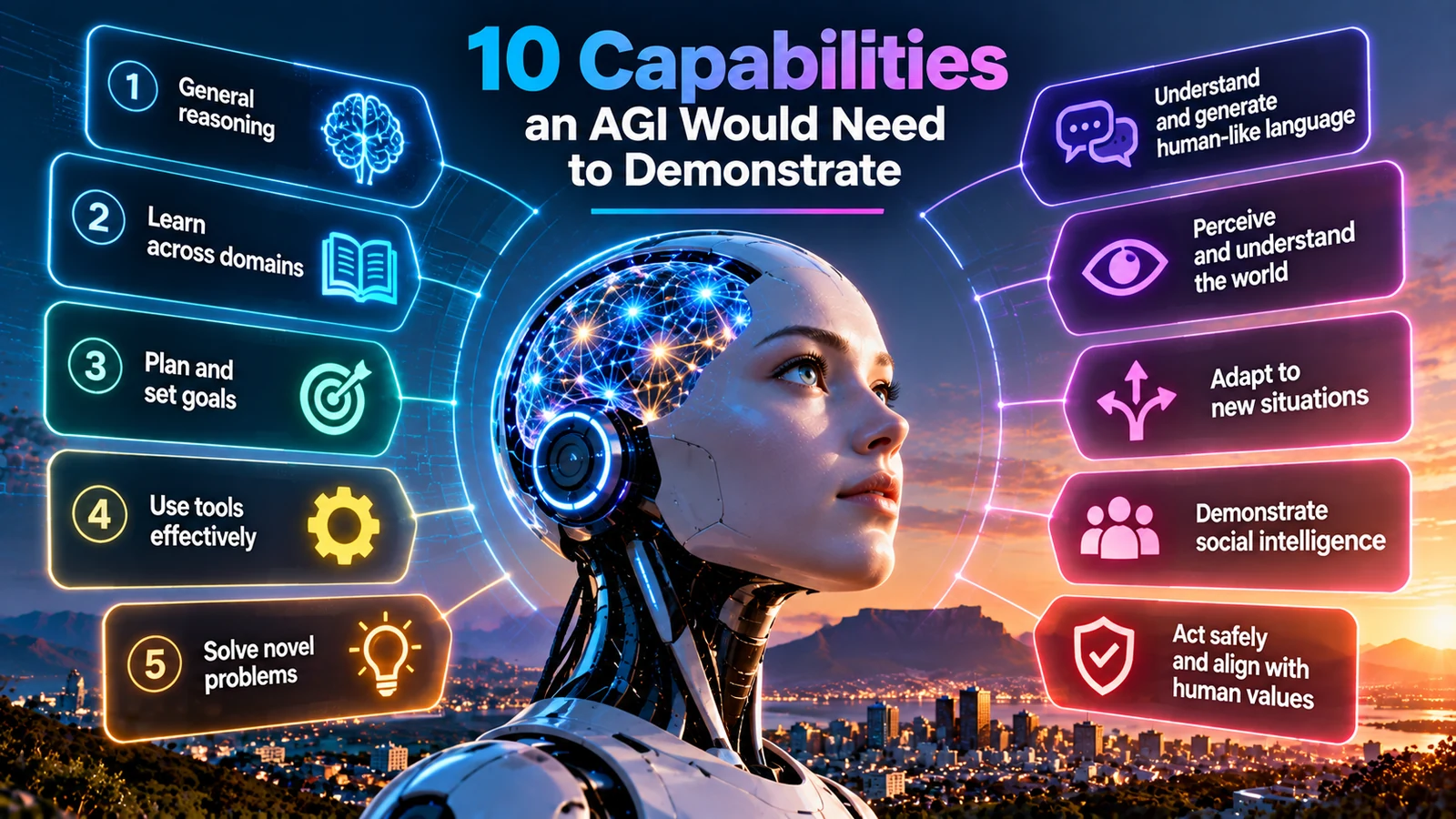
10 Capabilities an AGI Would Need to Demonstrate
If AGI cannot be settled by one benchmark, the next useful question is what a convincing system would have to demonstrate repeatedly. A leaderboard win or a long feature list is not enough. The evidence needs to show breadth, adaptation and reliability on problems the system was not specifically prepared to solve.
The following ten capabilities recur across AGI frameworks, evaluation programmes and frontier-safety research. None is a standalone AGI test; together they provide a more demanding way to examine the claim.
For the broader context, see our complete AGI guide.
1. Transfer knowledge across domains
Generality requires more than storing facts from many subjects. An AGI should be able to use a principle learned in one area to solve a structurally related problem somewhere else.
This kind of transfer is ordinary for humans. We use analogies, abstractions and prior experience to reduce the amount of learning required in a new domain.
2. Learn unfamiliar tasks efficiently
A system that needs a massive new training run for every unfamiliar task is not strongly general. AGI would need to acquire new skills from relatively limited instruction, demonstration or experience.
That does not mean it must learn exactly like a human. The important part is flexible adaptation rather than task-specific rebuilding.
3. Infer hidden rules from interaction
ARC-AGI-3 focuses directly on this capability. Agents enter environments without instructions, explicit goals or rules and must discover how actions affect the world.
The task resembles everyday intelligence: explore, form a hypothesis, test it, notice failure and revise the model.
4. Plan across long horizons
Short answers can hide weak planning. Longer tasks require a system to break a goal into steps, maintain state, manage dependencies and recover when something goes wrong.
METR’s task-horizon research measures one version of this challenge in software work. AGI would need robust planning across more than one domain.
5. Use tools without losing the objective
General intelligence in a digital environment would probably involve browsers, software, databases, code execution and communication tools. The system would need to choose tools appropriately and preserve the goal while switching between them.
Tool use also creates safety requirements because an error can turn into a real action.
6. Reason under uncertainty
Real problems rarely arrive with complete information. An AGI should know when evidence is weak, distinguish a hypothesis from a fact and seek more information when needed.
Confidently filling gaps is the opposite of general intelligence if the result is unreliable.
7. Self-correct after failure
An intelligent system should notice when its plan is not working and revise it. Current models can sometimes critique their own output, but self-correction remains inconsistent.
AGI would need this capability across unfamiliar tasks rather than only in carefully scaffolded agent loops.
8. Maintain useful memory and context
Long-term work depends on remembering decisions, constraints and lessons. A general system would need to retrieve the right information at the right time without being overwhelmed by irrelevant history.
Memory should support reasoning, not simply store more text.
9. Generalise safely when goals are ambiguous
A powerful system will sometimes receive incomplete instructions. It must avoid taking extreme actions merely because they maximise a literal objective.
This is where alignment and common-sense judgement become important. Google DeepMind and Anthropic both treat misalignment and autonomous harmful behaviour as frontier concerns.
10. Perform reliably across a broad task distribution
The final capability ties the others together. AGI cannot be defined by occasional flashes of brilliance. It needs dependable performance across many kinds of work, including tasks it has not seen in the same form before.
DeepMind’s levels framework captures this by considering both breadth and performance.
What is not on the list?
Consciousness is deliberately absent. Some people believe subjective awareness is necessary for human-like intelligence; others think it is irrelevant to functional AGI. Current AGI frameworks usually focus on observable capability because consciousness is much harder to measure.
A humanoid body is also not necessarily required. Embodiment may prove important for learning and common sense, but a digitally general system could still satisfy some AGI definitions.
Why one benchmark cannot cover all ten capabilities
Each test exposes a slice. ARC-AGI-3 stresses adaptation and exploration. METR stresses longer technical tasks. Traditional evaluations may test reasoning, coding, knowledge or maths.
A convincing AGI case would need strong performance across several independent forms of evaluation and in real-world settings.
Where current frontier AI appears strongest
Current systems are particularly strong at language, code, multimodal analysis and tool-assisted workflows. They can also show surprising reasoning and planning when tasks are well specified.
The weaker areas tend to include reliability across long tasks, unfamiliar environments, sustained autonomous learning and consistent calibration under uncertainty.
Why this list matters for readers
AGI debates can become abstract very quickly. A capability list gives readers a concrete way to evaluate claims.
When a company announces a breakthrough, ask which capability improved. Better coding does not automatically prove generality. Better tool use does not prove robust transfer. A benchmark record is meaningful, but it should be connected to the broader picture.
An AGI claim should survive an unusually demanding test
AGI is supposed to describe a major change in machine intelligence. If the term can be triggered by every impressive model release, it stops helping readers understand the technology.
A demanding, multi-capability standard keeps the debate tied to evidence instead of marketing.
How these capabilities interact
The ten capabilities are not independent checkboxes. Better memory can improve long-horizon planning. Tool use can expand what the system can accomplish, while self-correction can make tool use safer. Transfer learning can reduce the need for detailed instructions in unfamiliar tasks.
This interaction means an AGI assessment should examine the whole system. A model may look weak by itself but perform far better with retrieval, tools and verification loops. Conversely, an impressive agent may depend on extensive engineering that hides limitations in the underlying model.
What a serious demonstration would look like
A convincing demonstration would include tasks the developers could not anticipate individually, independent evaluation, repeat trials and transparent failure reporting. It would show not only successful outputs but how often the system failed and how much human help was required.
That evidence standard is intentionally demanding. If AGI is supposed to mark a historic change in machine capability, the claim should survive more scrutiny than an ordinary product launch. TechnologyBlog’s AGI measurement guide explains how current evaluations work, while Future of AGI: What to Watch in 2027 identifies the signals that would materially change the evidence.


