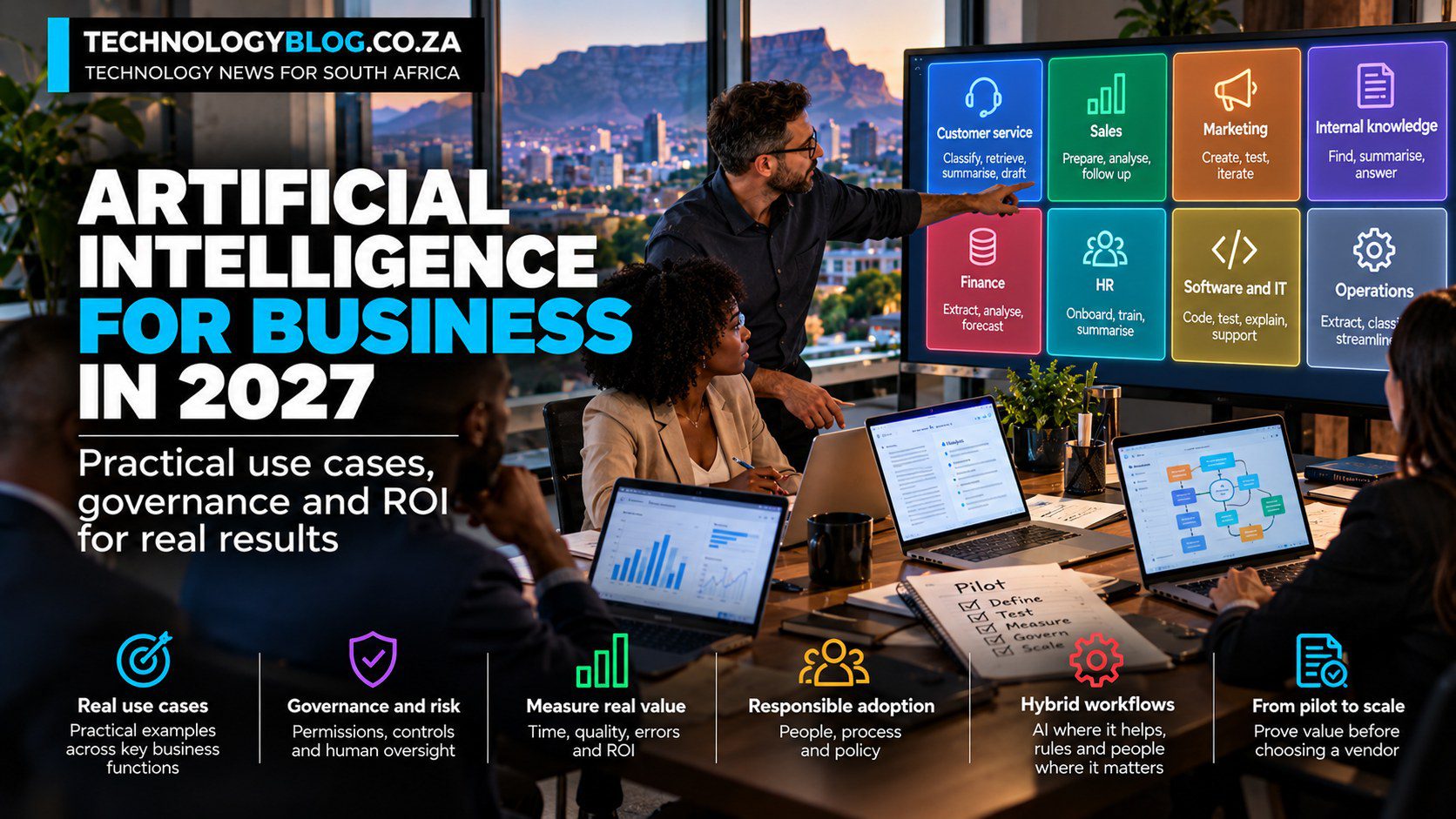
Artificial Intelligence for Business in 2027: From Pilot to Governed Workflow
Businesses are not short of places where AI could be used. They are short of evidence about which of those places deserve production access to real data and real processes.
Customer service, sales, marketing, finance, HR, software, operations and internal knowledge can all produce plausible pilots. The harder decision is which workflow can be measured, governed and stopped when it fails — and whether the result is better enough to justify the new complexity.
That decision becomes more important in 2027 as AI moves from standalone experimentation into connected workflows. The business case now has to include permissions, failure handling and human accountability alongside model capability.
Start where the organisation already understands the process
The safest first pilot is rarely the most ambitious one.
Choose a task that happens frequently, has a measurable baseline and produces an output that a person can check. Document extraction, internal research, support drafting and policy search are easier to evaluate than an autonomous system making consequential decisions.
A pilot should reveal failure modes, not merely prove that the AI can work under ideal conditions.
Customer service: use AI around the source of truth
AI can classify messages, retrieve approved information, summarise customer history and draft replies.
The architecture matters. Policy, refunds, warranties and account facts should come from controlled business systems or knowledge bases, not from a general model improvising an answer.
A strong workflow uses AI to prepare the response while deterministic systems and human advisers retain authority over commitments.
Sales: useful for preparation, risky as a mind reader
AI can organise public information about a prospect, summarise meeting notes and prepare follow-up questions.
It should not turn inference into fact. A generated statement about a customer’s “strategy” or “intent” needs evidence before a salesperson repeats it as though the customer said it.
Measure preparation time and source quality, not only the volume of briefs generated.
Marketing: speed is easy, differentiation is harder
Generative AI can produce campaign variants, drafts, concepts and image ideas quickly. That makes content volume an easy metric and a poor one.
The value comes from using real product knowledge, audience insight and brand judgement to produce material that performs better or reaches the market faster.
Publishing more generic copy because generation is cheap can reduce rather than increase the value of marketing.
Internal knowledge may be the most practical enterprise use
Large organisations often have answers locked inside documents, policies and project systems that employees struggle to search.
Permission-aware AI can give users a natural-language route into that knowledge. The important phrase is permission-aware. The assistant should not flatten access controls and expose material the user could not normally open.
Retrieval quality and identity integration can matter more here than the benchmark score of the underlying model.
Finance: explanation is not authority
AI can classify documents, extract invoice fields, explain variance and help draft narrative reporting.
Predictive models can also support forecasting and anomaly detection. Material financial numbers still need validated calculations and accountable approval.
The system can accelerate analysis without becoming the ledger.
HR is where governance needs to become stricter
AI can help with onboarding material, policy search, training and summarising anonymised feedback.
Hiring, disciplinary, remuneration and performance decisions carry different consequences. Historical data can encode bias, and a model can make opaque recommendations that look objective because they are automated.
High-impact people decisions require legal, fairness and human-review controls that routine content generation does not.
Software and IT: capability and security rise together
AI can generate tests, explain code, search technical knowledge and help summarise incidents.
As models become more capable, they can also perform more security-sensitive work. That means permissions, sandboxing and monitoring need to grow with the capability.
TechnologyBlog’s OpenAI Astra cybersecurity analysis shows why frontier technical capability should be treated as an access-control question as well as a productivity feature.
Operations: hybrid systems can be stronger than fully autonomous ones
Unstructured inputs are a natural place for AI. A model can read a document, classify an email or extract fields from an image.
Once that interpretation is complete, conventional software can enforce business rules. A human can handle exceptions.
This hybrid pattern limits the model’s responsibility to the part of the process where flexibility is actually useful.
What South Africa’s policy reset means for business
South Africa’s draft national AI policy was withdrawn in 2026 after fictitious references were found in the draft. Cabinet later approved the withdrawal so the policy could be reworked.
Businesses should not treat the withdrawn document as final national policy. They also should not interpret the absence of a final policy as an absence of responsibility. TechnologyBlog’s South African AI cornerstone tracks the policy reset and wider local context.
POPIA, contracts, sector requirements, employment law, consumer obligations and cybersecurity controls continue to matter. Internal governance can be built now.
A useful AI governance policy answers operational questions
- Which AI services are approved?
- What data may each service receive?
- Which use cases need human approval?
- Which actions can an agent take without confirmation?
- How are incidents reported?
- How are model changes re-evaluated?
- Who owns the final decision?
NIST’s AI Risk Management Framework and the OECD’s 2026 due-diligence guidance both support ongoing governance rather than a one-time deployment review.
ROI should include the cost of being wrong
Measure total process performance: time, quality, error rates, escalation, customer outcomes, model cost and review burden.
A system that generates thousands of outputs is not valuable simply because the number is large. A smaller deployment that removes a recurring bottleneck with a measurable quality improvement can be the stronger investment.
The 2027 business advantage is disciplined execution
AI capability is increasingly accessible. The differentiator is becoming the surrounding system: proprietary data, workflow design, integration, evaluation, permissions and the people who understand when to trust the result.
That makes AI less of a software-buying exercise and more of an operating-model question.
For employee-level workflows, read AI at Work. For the decision between AI and deterministic systems, see AI vs Traditional Automation.
Vendor selection should come after the pilot
Once a workflow has shown measurable value, procurement has a clearer job. The organisation can compare vendors against requirements that emerged from real work: identity integration, data controls, model choice, logging, export options, support and the ability to restrict permissions.
This also reduces the risk of buying around a benchmark or demo that has little to do with the intended deployment. AI products change quickly, so contracts and review processes should account for material changes in models, product terms and connected capabilities after launch.


