HPE’s $1.2bn Vultr order puts AMD Helios AI racks to the test
Hewlett Packard Enterprise’s $1.2 billion order from Vultr is a concrete customer commitment to AMD’s Helios rack-scale AI system, but it is not evidence that the racks have already entered service. HPE announced the order on 30 September 2026 for installations at Vultr data centres in the United States. In HPE’s 23 November earnings call, executives said Helios and an Oracle agreement would contribute to networking growth during fiscal 2027, with the year more weighted to the second half.
The order matters for two reasons. It gives HPE its first Helios customer order, and it ties a large AI compute purchase to HPE’s networking business after the Juniper Networks acquisition. The company is supplying a complete rack architecture that combines AMD accelerators, HPE switching, liquid cooling and deployment services. The system’s performance, however, will depend on delivery, software, power and operations as much as on the components listed in a press release.
What HPE and Vultr have actually agreed
HPE’s 30 September announcement describes a $1.2 billion order from Vultr for AMD Helios AI Rack by HPE systems, to be deployed at Vultr’s U.S. cloud data-centre locations. HPE called it the first order for its Helios system. The companies said the infrastructure is intended to meet service-provider and enterprise demand for model training and inference.
The release does not name the number of racks, a delivery calendar, the division of value between compute and networking, or how much capacity will be available to customers at each site. Those omissions matter: the $1.2 billion headline is a contract value, not a rack count or a public benchmark. A large order is a strong commercial signal, but by itself it does not establish how quickly the customer will receive the equipment or how much usable compute it will deliver.
Reuters reporting placed the order alongside HPE’s revised networking outlook at its September investor day. That wider context matters because HPE is not selling only GPU servers. It is also positioning its networking portfolio as part of the AI infrastructure package.
Inside the Helios rack
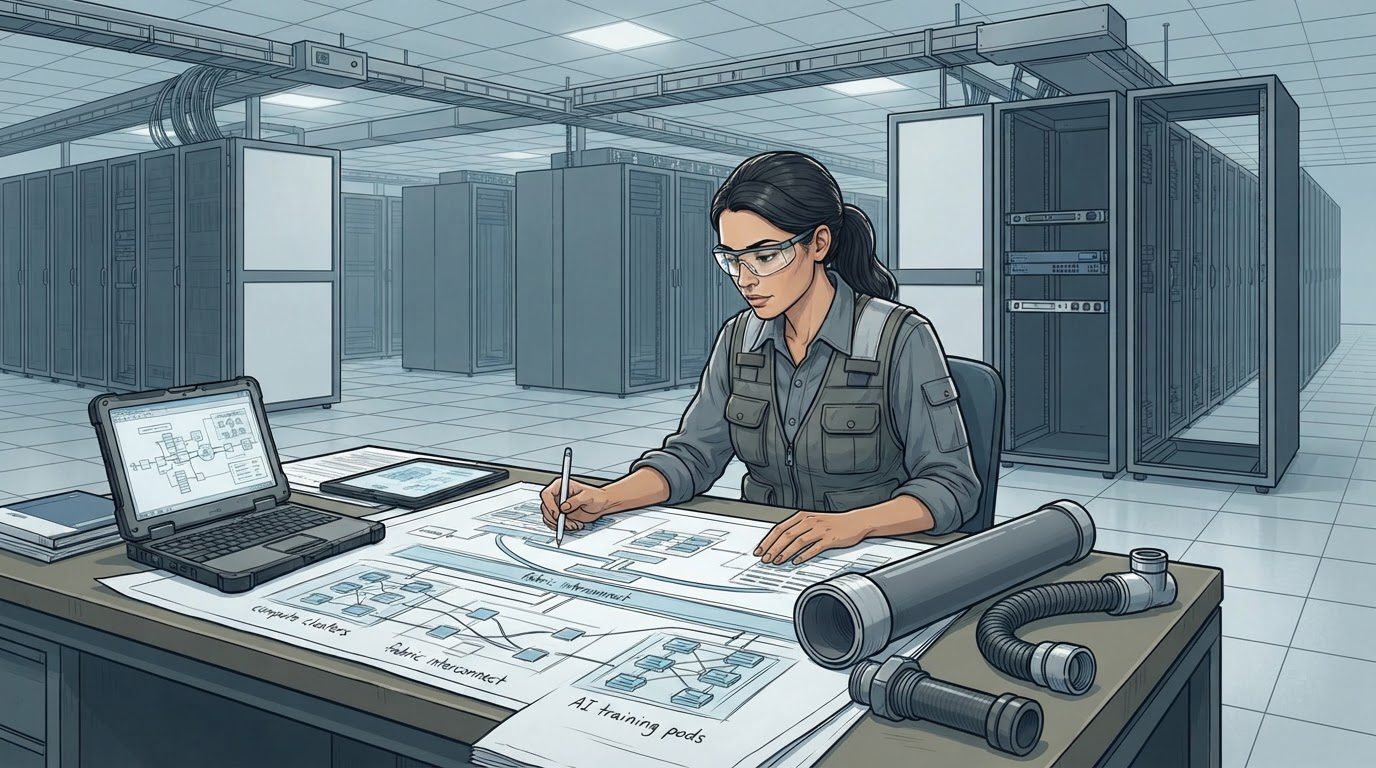
HPE says each rack combines 72 AMD Instinct MI455X GPUs with AMD EPYC “Venice” processors, AMD Pensando Vulcano AI networking, and AMD ROCm software. Six HPE Juniper Networking QFX5252 switch trays connect the GPUs inside the rack. HPE also describes direct liquid cooling and system deployment services as part of its delivery.
The switches are intended to serve the rack’s scale-up network: the high-bandwidth links between accelerators working together within the same system. That is different from scale-out networking, which connects separate servers or racks across a data centre. The design uses Ethernet for the in-rack fabric and supports UALink over Ethernet, or UALoE, according to HPE’s product announcement. The company describes this as an open, standards-based approach; buyers still need to test the actual hardware, software and workload combinations they intend to run.
For large AI jobs, keeping accelerators supplied with data can be as important as adding more processors. Training can require many GPUs to exchange gradients and model state; inference can require a cluster to respond quickly while serving many requests. The rack network is therefore part of the compute design, not an accessory added after the servers are chosen. HPE and AMD’s stated architecture should be assessed against the workload, model size, software stack and service-level targets of the intended customer.
Readers who want background on AMD’s wider product portfolio can see our AMD company profile. For a separate view of Ethernet switching and data-centre operations, our Arista Networks profile explains another supplier’s role in high-performance network fabrics. These are context pieces, not direct tests of the Vultr system.
Why HPE is selling the network with the compute
AI clusters put pressure on links inside a rack and between racks. HPE’s pitch is that it can combine compute, switching, cooling and services as one engineered system. The company’s June 2025 acquisition of Juniper Networks gave it a larger networking portfolio; Reuters reported that HPE used the September order to illustrate its broader AI-networking strategy. The company is therefore using Helios both to sell a complete system and to create demand for networking products and services around it.
HPE’s latest fiscal results give useful context without proving that the Vultr order has shipped. In results published on 23 November, HPE reported fourth-quarter Networking revenue of $3.1 billion, up 12.3% year over year, and Cloud & AI revenue of $11.3 billion, up 68.6%. In its 23 November earnings call, management said Helios and an Oracle agreement were expected to support networking growth through fiscal 2027 and described the year as more back-end loaded. Those are company results and guidance, not independent measurements of the Vultr deployment.
The order also reflects a market where customers may want alternatives to a single vendor’s accelerator and interconnect stack. AMD’s strategy emphasises an open system assembled with partners, while NVIDIA offers its own tightly integrated accelerator and networking technologies. Choosing between them involves more than comparing GPU names: operators need to measure software maturity, engineering support, model compatibility, system availability and total operating cost under their actual workloads.
The delivery question remains open
Neither HPE nor Vultr has publicly disclosed the rack count or a detailed delivery schedule for this order. Fierce Network’s deal analysis also notes that the companies have not disclosed those details. HPE’s November earnings call points to Helios contributions during fiscal 2027, but the timing of a contract announcement, equipment shipment, installation and customer availability are separate milestones. They should not be collapsed into a claim that Vultr is already serving workloads on Helios.
A November 2026 AMD and Arista technical paper said Helios had not yet been deployed in production at the time of publication. That statement provides a useful industry-wide caution about the platform’s maturity, but it does not identify the status of the specific HPE–Vultr order. The public evidence supports saying that the deal was announced and that HPE expected contributions in fiscal 2027; it does not support claiming a completed installation or customer performance results.
HPE also has to execute in a supply-constrained market. Its November call cited constraints in memory, NAND and other components and said demand remained ahead of revenue. Large rack orders must pass through manufacturing, integration, site preparation, power and cooling readiness, and customer acceptance. Any delay in one of those steps can move revenue and usable capacity even when demand and the contract are real.
What South African businesses should take from the deal
The named deployment locations are in the United States; HPE’s announcement does not identify a South African Helios site or a local launch. South African organisations should not infer local availability, pricing or service coverage from a U.S. order. A business assessing AI infrastructure locally would need to confirm where capacity is physically hosted, which data-handling terms apply, how latency affects its workloads, and what power and cooling arrangements support the service.
The wider lesson is that AI infrastructure procurement is becoming a systems decision. A buyer evaluating GPU capacity must consider the network fabric, storage, power delivery, cooling, software support and operational responsibility together. A rack can offer substantial theoretical compute while still being a poor fit if the customer cannot supply data fast enough, operate the software or manage the facility costs. These questions apply to South African enterprises even when the particular Vultr deployment remains overseas.
Signals to watch next
The next useful evidence will be practical rather than promotional: a confirmed shipment or installation timeline, the number of racks delivered, the cloud regions where Vultr makes capacity available, and the software options customers can use. Independent workload results would help buyers compare the platform with alternatives, provided they disclose model, precision, software version, power draw and test conditions.
Until those details emerge, the $1.2 billion order is best read as an important commercial and networking milestone for HPE, AMD and Vultr—not as proof of a live production cluster or a universal measure of AI performance. The architecture puts Ethernet scale-up networking at the centre of an AI rack, while the deployment schedule and customer results remain the evidence still to come.