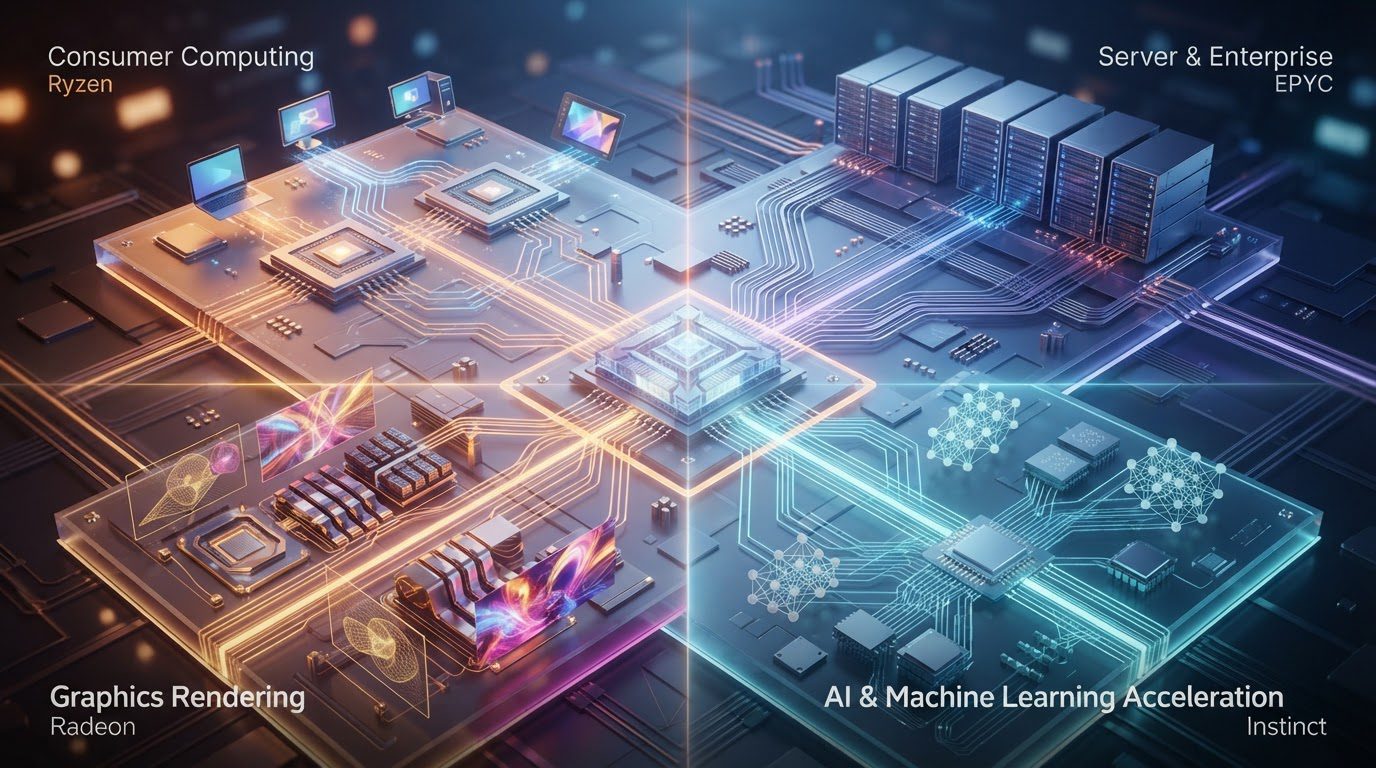
AMD: the different roles of Ryzen, EPYC, Radeon and Instinct
AMD develops processors, graphics, accelerators and adaptive computing products. The brand names identify different roles: Ryzen is associated with PCs, EPYC with servers, Radeon with graphics and Instinct with accelerated computing.
Understanding those distinctions is more useful than treating AMD as a single kind of chip. A laptop processor and a data-centre accelerator can belong to the same company while requiring entirely different hardware, software and purchasing decisions.
A semiconductor history beginning in 1969
AMD’s corporate overview dates its beginnings to 1969. Its anniversary account identifies Jerry Sanders and seven fellow co-founders.
The company’s later development broadened its scope. The Xilinx acquisition, completed in February 2022, added adaptive computing products and expertise.
That history helps explain why the current portfolio includes more than desktop CPUs and graphics cards. Products designed for embedded or configurable systems need a different explanation from a component selected for a gaming PC.
Processor families address different systems
Ryzen covers personal and business computing applications. EPYC targets servers, where platform features and deployment requirements differ from those of a desktop or notebook.
Even within one family, generation and configuration matter. A product name without its model does not establish core count, memory support, socket compatibility or the power characteristics of a finished system.
For a PC buyer, the surrounding design also matters. Cooling, memory, firmware and the manufacturer’s configuration contribute to the experience. A comparison between processors should therefore use the actual products and workload rather than assume that a family label guarantees a result.
Graphics and acceleration are related but distinct
Radeon graphics products serve visual and computing applications, while Instinct accelerators are directed towards demanding AI and high-performance computing workloads.
A graphics card capable of running a game is not automatically interchangeable with a data-centre accelerator. Software support, memory requirements and the intended deployment determine whether a device is suitable.
The same caution applies to an AI performance claim. Training a model and serving its outputs are different tasks, and a published result for one configuration cannot establish the speed of every application carrying the same broad label.
ROCm makes software compatibility part of the decision
AMD describes ROCm as an open software stack containing programming models, tools, compilers, libraries and runtimes for GPU computing.
That role is important because a processor alone does not run an application independently of its software environment. A team needs the supported combination of hardware, operating system, framework and stack version.
AMD’s documentation also distinguishes ROCm from CUDA. Porting tools can assist migration, but APIs and dependencies are not simply interchangeable. The effort depends on the actual application, and correctness still needs to be tested after changes.
Adaptive computing broadens the portfolio
FPGAs and adaptive system-on-chip products serve designs in which processing can be configured for a particular function. Their development workflow differs from installing an ordinary application on a PC.
This gives AMD another relationship with customers building systems rather than buying a finished consumer device. It also explains why a single generic paragraph about “gaming performance” cannot describe the whole company.
AMD’s portfolio connects several kinds of computing. A useful assessment starts with the role of the product, follows the relevant software and platform requirements, and only then compares measured results for the intended task.