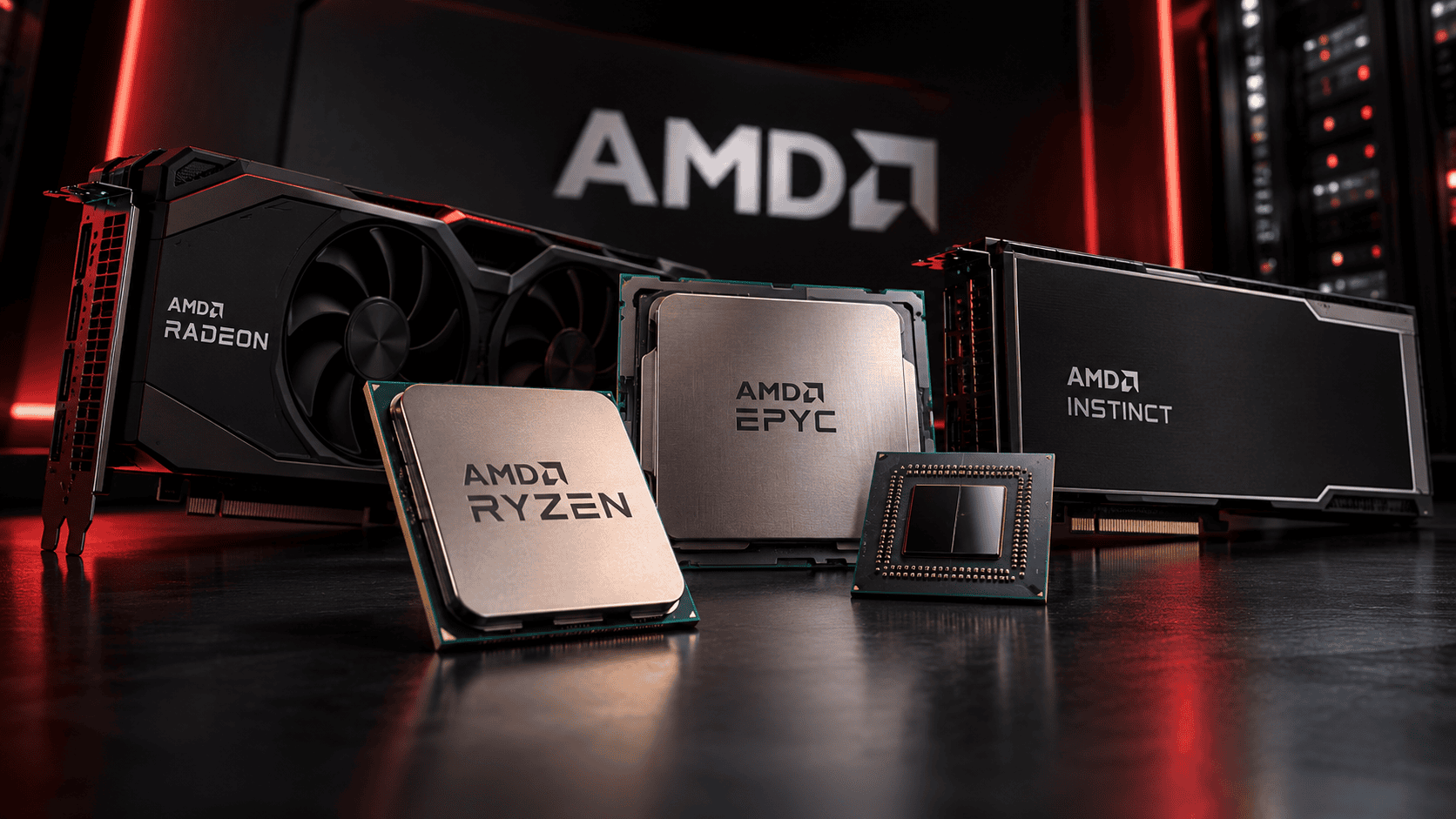
Company profile — AMD: history, ownership, strategy and current technology portfolio
AMD in 2026 competes across CPUs, data-centre accelerators, gaming and professional graphics, embedded systems and an increasingly important software stack, while remaining dependent on outside foundries for manufacturing.
The company has repeatedly reinvented where it competes
Advanced Micro Devices was founded in 1969 as a semiconductor company and spent decades competing in processors and related components. Its modern position was rebuilt around the Zen CPU architecture, which restored competitiveness in PCs and servers, while Radeon graphics and later the Xilinx acquisition broadened the product base.
That history matters because AMD does not control a captive operating system or device platform. It competes by making processors and accelerators attractive to PC makers, cloud providers, workstation vendors and developers that can choose rival hardware.
Public ownership and a fabless model shape the economics
AMD is a publicly traded US company with a dispersed shareholder base. It designs its major processors and GPUs but relies on external semiconductor foundries and packaging partners rather than owning the leading-edge fabrication plants itself.
The fabless model reduces the need to fund advanced fabs directly, but it makes capacity allocation and foundry execution critical dependencies. A strong design can still be limited by packaging, substrate or wafer availability, especially when several product families compete for the same advanced manufacturing capacity.
Ryzen and EPYC address different parts of the CPU market
Ryzen covers consumer and commercial PCs, while EPYC targets servers and cloud infrastructure. The same broad architecture strategy can therefore appear in a laptop and a data centre, but power, memory, I/O and reliability requirements are very different.
AMD’s CPU position is strongest when it can offer competitive performance without forcing customers into a proprietary software environment. The trade-off is that Intel, Arm suppliers and custom cloud processors can all attack parts of the same market from different directions.
Instinct and ROCm are central to the AI challenge
AMD’s Instinct accelerators compete for AI and high-performance computing workloads, while ROCm provides the software environment needed to make those accelerators usable with major frameworks. Hardware specifications matter, but developer support and library maturity can determine whether an accelerator is practical in production.
This is the hardest part of competing with NVIDIA. Customers may tolerate a hardware difference if the software path is easier, so AMD has to improve installation, documentation, framework support and performance tuning at the same time as it ships new silicon.
Radeon now spans gaming, workstations and AI-focused professional cards
Radeon RX serves gaming, Radeon PRO W7000 targets professional graphics and certified workstation workflows, and AMD’s newer Radeon AI PRO R9000 Series adds RDNA 4 options aimed at local AI and memory-intensive professional workloads. That newer family means W7000 should no longer be described as the whole current professional roadmap.
The distinction is important for buyers. W7000 remains relevant for CAD, media and existing certified workflows, while the newer AI PRO products emphasise large VRAM and AI development. A current portfolio view has to show both rather than treating one generation as a direct universal replacement for the other.
The Xilinx acquisition expanded AMD beyond PCs and servers
Acquiring Xilinx added adaptive computing, FPGA technology and a much larger embedded business. These products serve markets with long qualification and support cycles, including communications, industrial and specialised computing environments.
That diversity can smooth some consumer-market volatility, but it also increases the number of software stacks and customer requirements AMD must support. An embedded customer may care more about product longevity and deterministic behaviour than about headline benchmark leadership.
Consoles keep semi-custom silicon strategically relevant
AMD has supplied semi-custom processors used in major game consoles, combining CPU and GPU intellectual property in designs tailored to a customer’s platform. These contracts are different from selling retail processors because volumes, margins and design cycles are negotiated years in advance.
The work is strategically useful because it keeps AMD technology in large gaming ecosystems and can influence developer optimisation. It also shows the flexibility of a company that can sell standard chips, accelerators and custom designs from related intellectual property.
What to watch from AMD
The most important indicators are EPYC adoption, ROCm maturity, availability of Instinct systems, the evolution of Ryzen efficiency and how clearly AMD separates Radeon gaming, workstation and AI-professional roles. Product names alone are becoming less useful as the portfolio broadens.
AMD’s opportunity is to be the credible alternative across several compute markets without requiring one closed platform. Its risk is that competitors can use software ecosystems, manufacturing scale or custom silicon to make technically strong AMD hardware harder to adopt than a specification sheet suggests.
Chiplets and packaging are core parts of AMD’s design strategy
AMD has used chiplet architectures to combine smaller pieces of silicon rather than building every large processor as one monolithic die. That can improve manufacturing flexibility and let the company mix process technologies, memory interfaces and I/O in ways tailored to a product.
Advanced packaging then becomes strategically important because the benefit depends on how quickly those chiplets communicate and how reliably the package can be manufactured at scale. Packaging capacity is therefore part of the semiconductor supply chain, not a secondary assembly detail.
Platform partners decide how much AMD technology reaches customers
AMD rarely sells a complete PC or server itself. OEMs, motherboard vendors, cloud providers and workstation manufacturers choose cooling, memory, firmware and system configurations that determine how the chip behaves in practice.
That means an excellent processor can still appear in a poor system, while strong platform design can amplify AMD’s advantages. Buyers should separate the capability of the silicon from the quality of the laptop, server or workstation built around it.
Professional software certification remains a separate market from gaming performance
Radeon PRO cards are sold into workflows where certified drivers and predictable behaviour can be more important than the fastest benchmark. AMD therefore has to support application vendors and workstation OEMs over product lifecycles that are often longer than consumer GPU cycles.
This is why the coexistence of W7000 and newer AI PRO products matters. Different professional users may prioritise CAD certification, display outputs, memory size or local AI rather than moving to the newest architecture for its own sake.
