AMD Ryzen AI 300: Zen 5, RDNA 3.5 and XDNA 2 specifications explained
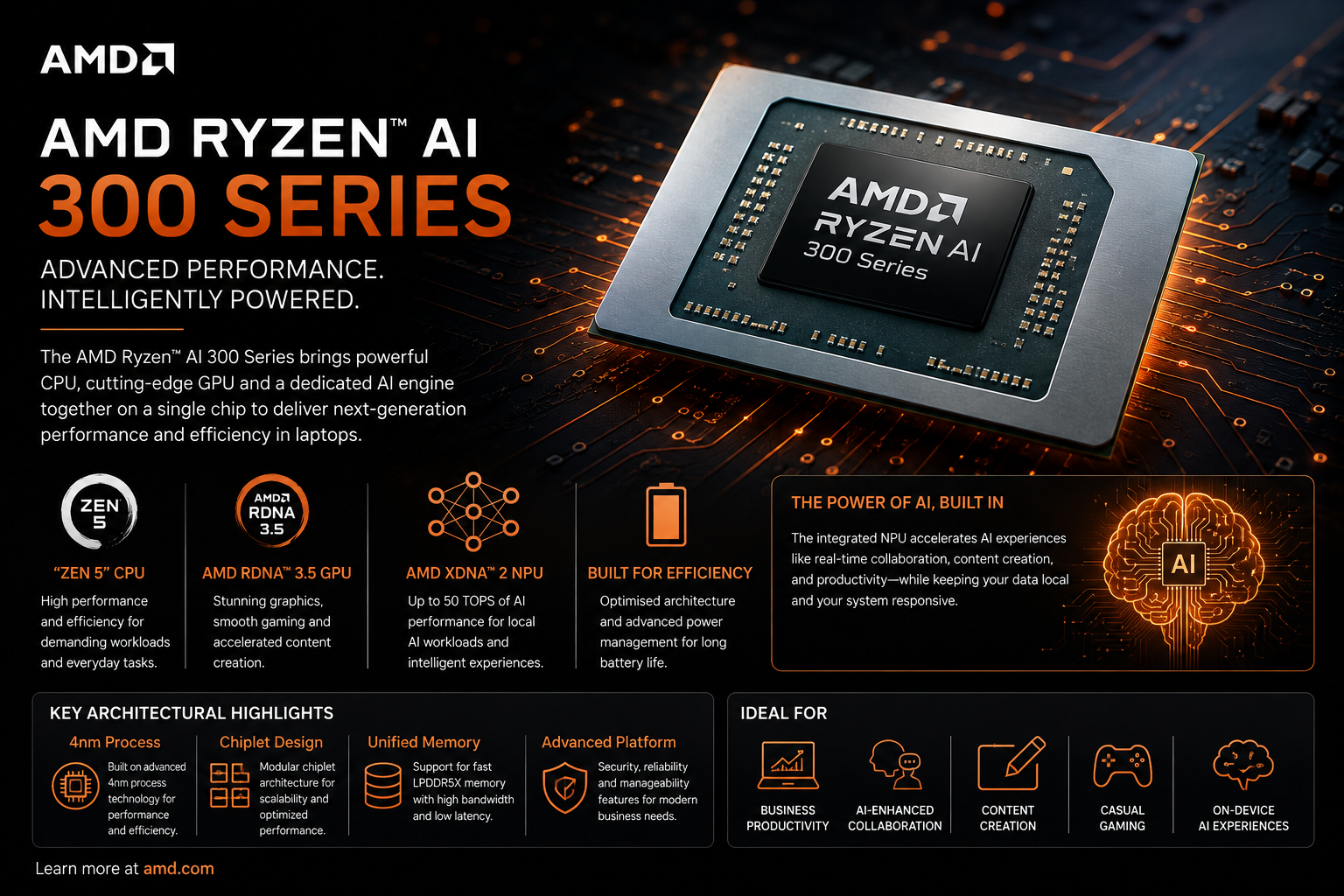
AMD’s Ryzen AI 300 Series is a family of processors built around three different types of compute hardware: Zen 5 and Zen 5c CPU cores, Radeon graphics based on RDNA 3.5, and an XDNA 2 neural processing unit for AI workloads.
AMD’s original Ryzen AI 300 launch materials confirm the combination of Zen 5 CPU cores, RDNA 3.5 Radeon 800M graphics and an XDNA 2 NPU rated at up to 50 TOPS. Those figures are manufacturer specifications rather than independent Technology Blog benchmark results.
The combination was significant when AMD introduced the family because its XDNA 2 NPU delivers up to 55 TOPS on the Ryzen AI 9 HX 375 and up to 50 TOPS on most other Ryzen AI 300 processors. That exceeds Microsoft’s 40-TOPS NPU requirement for many Copilot+ PC features.
The 300 Series is no longer AMD’s newest Ryzen AI generation. AMD announced the Ryzen AI 400 Series at CES 2026, increasing maximum NPU performance to 60 TOPS while retaining Zen 5, RDNA 3.5 and second-generation XDNA 2 technology. Ryzen AI 300 therefore now sits as the preceding generation rather than AMD’s latest AI PC platform.
TechnologyBlog.co.za has not independently benchmarked the Ryzen AI 300 Series. This article focuses on its verified architecture and specifications rather than making performance or battery-life conclusions.
What is AMD Ryzen AI 300 Series?
Ryzen AI 300 is primarily an integrated processor platform for AI-capable PCs.
Rather than relying only on conventional CPU cores, AMD places a CPU, integrated GPU and dedicated NPU on the processor. Different workloads can then use whichever engine suits them best.
At a basic level:
- CPU: handles general-purpose applications, operating-system tasks and latency-sensitive processing.
- GPU: handles graphics and highly parallel computing.
- NPU: accelerates supported machine-learning and AI inference workloads with an emphasis on power efficiency.
An application does not automatically split itself equally across all three.
Software developers, operating-system components and AI frameworks determine which processor is used for a particular task. Some AI applications may run predominantly on the NPU, others on the Radeon GPU, and some still use the CPU.
Cloud-based AI can also perform most of its processing on remote servers instead of the laptop itself.
Ryzen AI 300 introduced a new naming system
AMD unveiled the first Ryzen AI 300 processors at Computex 2024.
The company described them as its third generation of Ryzen processors with dedicated AI acceleration. Earlier Ryzen 7040 “Phoenix” processors introduced AMD’s first XDNA NPU, while the Ryzen 8040 “Hawk Point” generation increased NPU performance before Ryzen AI 300 moved to XDNA 2.
AMD also changed its naming scheme.
Instead of continuing the previous four-digit mobile Ryzen naming format, it introduced names such as:
Ryzen AI 9 HX 370
The “300” identifies the processor generation rather than the number of CPU cores or NPU performance.
AMD subsequently expanded the family beyond its original high-end Ryzen AI 9 models with Ryzen AI 7 and Ryzen AI 5 processors.
Strix Point and Krackan Point both sit inside the 300 Series
Ryzen AI 300 is not based on only one physical processor design.
The higher-end models use AMD’s Strix Point design. These include the Ryzen AI 9 HX 375, Ryzen AI 9 HX 370 and Ryzen AI 9 365.
Later Ryzen AI 7 and Ryzen AI 5 processors use the smaller Krackan Point design. AMD currently lists the Ryzen AI 7 350, Ryzen AI 7 345, Ryzen AI 5 340 and Ryzen AI 5 330 within this group.
Both designs combine Zen 5 and Zen 5c CPU cores with RDNA 3.5 graphics and an XDNA 2 NPU.
The number of CPU cores, GPU compute units, cache and PCIe lanes differs according to the model.
Ryzen AI 300 Series specifications
| Processor | CPU cores / threads | Core configuration | Max boost | Integrated graphics | GPU CUs | NPU |
|---|---|---|---|---|---|---|
| Ryzen AI 9 HX 375 | 12 / 24 | 4 Zen 5 + 8 Zen 5c | 5.1GHz | Radeon 890M | 16 | Up to 55 TOPS |
| Ryzen AI 9 HX 370 | 12 / 24 | 4 Zen 5 + 8 Zen 5c | 5.1GHz | Radeon 890M | 16 | Up to 50 TOPS |
| Ryzen AI 9 365 | 10 / 20 | 4 Zen 5 + 6 Zen 5c | 5.0GHz | Radeon 880M | 12 | Up to 50 TOPS |
| Ryzen AI 7 350 | 8 / 16 | 4 Zen 5 + 4 Zen 5c | 5.0GHz | Radeon 860M | 8 | Up to 50 TOPS |
| Ryzen AI 7 345 | 6 / 12 | 2 Zen 5 + 4 Zen 5c | 4.6GHz | Radeon 840M | 4 | Up to 50 TOPS |
| Ryzen AI 5 340 | 6 / 12 | 3 Zen 5 + 3 Zen 5c | 4.8GHz | Radeon 840M | 4 | Up to 50 TOPS |
| Ryzen AI 5 330 | 4 / 8 | 1 Zen 5 + 3 Zen 5c | 4.5GHz | Radeon 820M | 2 | Up to 50 TOPS |
AMD lists a default TDP of 28W for these processors. Most can be configured between 15W and 54W, while the Ryzen AI 5 330 has a narrower 15W to 28W configurable range.
This configurable power range is important.
Two laptops using the same Ryzen AI processor can perform differently because manufacturers determine cooling, sustained power limits, memory configuration and firmware behaviour.
A processor name alone therefore does not establish complete laptop performance.
Zen 5 provides the general-purpose CPU architecture
The CPU side of Ryzen AI 300 uses AMD’s Zen 5 architecture.
AMD designed Zen 5 as the successor to Zen 4 and claimed an average 16% improvement in instructions per clock across its selected workloads. That percentage is an AMD architectural comparison rather than a guarantee of 16% faster performance in every application.
Ryzen AI 300 also supports simultaneous multithreading.
That is why the 12-core Ryzen AI 9 HX 370 can process up to 24 threads, while the eight-core Ryzen AI 7 350 supports 16.
Zen 5 additionally supports instructions including AVX2 and AVX-512 on current Ryzen AI 300 specifications.
Zen 5c is not simply an AMD equivalent of an Intel E-core
One of the more interesting design choices is AMD’s combination of standard Zen 5 cores and smaller Zen 5c cores.
Zen 5c is a density-optimised implementation of the same broad Zen 5 architecture.
The smaller cores operate at lower maximum clock speeds and occupy less silicon area. This allows AMD to fit more CPU cores alongside the relatively large GPU and NPU portions of the processor.
This should not be confused with an architecture where the two core groups support fundamentally different instruction sets.
Both Zen 5 and Zen 5c support simultaneous multithreading and the same main CPU features. The difference centres more on physical density and operating frequency.
For example, AMD lists the Ryzen AI 9 HX 370 with four Zen 5 cores and eight Zen 5c cores.
Its standard Zen 5 cores can boost as high as 5.1GHz, while AMD lists a maximum Zen 5c frequency of 3.3GHz.
RDNA 3.5 powers the integrated Radeon 800M graphics
The second major processor block is AMD’s integrated RDNA 3.5 GPU.
AMD uses this architecture for the Radeon 800M graphics inside Ryzen AI 300.
The flagship Radeon 890M contains 16 graphics compute units and operates at up to 2.9GHz in the Ryzen AI 9 HX 370 and HX 375. The Radeon 880M drops to 12 compute units, while the Radeon 860M uses eight.
Lower models reduce the GPU further.
The Radeon 840M inside the Ryzen AI 5 340 and Ryzen AI 7 345 has four compute units, while the Ryzen AI 5 330’s Radeon 820M has two.
That means the words Ryzen AI 300 do not tell buyers much about gaming or GPU performance on their own.
A Radeon 890M and Radeon 820M belong to the same processor family but have dramatically different hardware resources.
The Radeon 890M is a substantial integrated GPU
The Radeon 890M was one of Strix Point’s most important features when the platform launched.
Moving to 16 RDNA 3.5 compute units increased the amount of integrated graphics hardware over earlier premium AMD mobile processors. Independent architectural analysis also highlighted the greater GPU allocation inside Strix Point compared with earlier designs.
That makes high-end Ryzen AI 300 laptops potentially useful where buyers want stronger integrated graphics without adding a discrete GPU.
However, an integrated GPU still shares system memory and the processor’s wider thermal and power budget.
Laptop cooling and memory bandwidth therefore remain important to real performance.
TechnologyBlog.co.za has not independently benchmarked the Radeon 890M.
XDNA 2 is the dedicated AI processor
The feature that gives Ryzen AI 300 its name is the XDNA 2 NPU.
An NPU, or neural processing unit, is specialised hardware designed to accelerate neural-network calculations.
AMD’s XDNA architecture uses a spatial dataflow design formed from arrays of AI Engine tiles. Each tile includes vector and scalar processing resources along with local instruction and data memory.
Rather than repeatedly moving all data through conventional CPU cache structures, the architecture tries to keep AI data close to the processing hardware and route it through the tile array.
The goal is high AI throughput at lower power than using a general-purpose CPU for the same supported workload.
XDNA 2 increased the tile count to 32
The original XDNA implementation used 20 AI Engine tiles and provided 10 TOPS in AMD’s first Ryzen AI generation.
XDNA 2 expands that design to 32 AI Engine tiles and adds architectural changes including greater local memory and more processing capability per tile. AMD rates the implementation in Ryzen AI 300 at up to 50 TOPS, or 55 TOPS in the HX 375.
AMD originally described XDNA 2 as providing up to five times the AI compute capacity of its first Ryzen AI implementation and up to twice the projected generative-AI power efficiency of Ryzen 8040’s NPU. These are AMD architectural claims rather than independent battery measurements.
What does 50 TOPS actually mean?
TOPS means trillions of operations per second.
It is useful as a broad indication of theoretical AI processing throughput, but it should not be treated like a universal benchmark score.
A Ryzen AI 300 NPU rated at 50 TOPS does not automatically complete every AI task twice as fast as a 25-TOPS processor.
Performance depends on factors including:
- AI model
- numerical data type
- software optimisation
- memory requirements
- NPU utilisation
- driver and runtime support
- whether part of the workload runs on the CPU or GPU
AMD itself describes TOPS as a peak measurement under an optimal scenario and notes that actual AI performance can vary by system configuration, software and model.
The distinction is particularly important when comparing NPU TOPS with overall platform TOPS.
For example, AMD rates the Ryzen AI 9 HX 375 NPU at up to 55 TOPS but lists up to 85 overall TOPS when other compute resources are included.
Microsoft’s Copilot+ requirement applies to NPU capability, not simply a manufacturer adding CPU, GPU and NPU numbers together.
Why the 40-TOPS figure matters for Copilot+ PCs
Microsoft requires an NPU capable of more than 40 TOPS for many Copilot+ PC features.
Microsoft specifically identifies Ryzen AI 300 as one of the processor families capable of powering Copilot+ PCs.
That allows compatible laptops to use supported Windows AI features that can run locally on the NPU.
However, buying a processor with a 50-TOPS NPU does not mean every Microsoft AI service operates locally.
Copilot itself can still rely heavily on cloud services, while individual Windows features have their own hardware, software and regional requirements.
“Copilot+ PC” is therefore a platform qualification rather than a promise that a laptop runs all generative AI without an internet connection.
Block FP16 is an important XDNA 2 feature
AMD also introduced support for Block FP16 with XDNA 2.
AI models frequently use lower-precision numerical formats because they require less memory and computational work. The trade-off can be reduced numerical precision.
AMD designed its block floating-point approach to provide higher effective precision while retaining much of the efficiency associated with lower-precision inference. AMD initially positioned XDNA 2 as capable of delivering its 50-TOPS performance with both INT8 and Block FP16 workloads.
In practical use, this only matters when software and AI models are designed to use the feature.
A specification appearing in the NPU does not automatically accelerate every generative-AI application.
AMD has since demonstrated supported Stable Diffusion workloads running on Ryzen AI 300 NPUs with its Block FP16 implementation.
Local AI can reduce reliance on the cloud
The NPU’s main purpose is to run suitable AI inference locally and efficiently.
Examples can include:
- background effects for video calls
- image and video processing
- speech processing
- local AI assistants
- supported generative-AI workloads
- computer-vision processing
- Windows AI features
Local execution can offer advantages in latency and can reduce the amount of data that needs to leave the computer.
It can also continue working without an active connection if the application and model are genuinely stored and executed locally.
That does not mean every Ryzen AI application is private by default.
Applications can still send prompts, files or other information to cloud services even when the computer contains an NPU. Users and businesses should check how each individual application processes data.
Memory support reaches LPDDR5X-8000
Current Ryzen AI 300 processors support DDR5 and LPDDR5X memory.
AMD lists up to DDR5-5600 and LPDDR5X-8000 on its current specifications for the Ryzen AI 9 HX 370, HX 375, Ryzen AI 9 365 and lower Krackan Point processors.
AMD lists maximum memory capacity of up to 256GB at processor level.
That does not mean consumers can upgrade every Ryzen AI 300 laptop to 256GB.
Many thin-and-light notebooks use soldered LPDDR5X memory, and laptop manufacturers can set substantially lower maximum capacities.
Buyers should therefore check the laptop specification rather than treating the CPU’s memory-controller limit as a guaranteed upgrade path.
PCIe 4.0 remains the platform interface
Ryzen AI 300 uses PCI Express 4.0 rather than PCIe 5.0.
Strix Point models such as the Ryzen AI 9 HX 370 provide 16 native usable PCIe lanes. Some lower Krackan Point parts, including the Ryzen AI 7 345 and Ryzen AI 5 330, provide 14.
The decision is not necessarily a major limitation in an ultraportable laptop.
PCIe 4.0 SSDs already provide substantial storage bandwidth, while PCIe 5.0 can increase power and thermal demands.
Still, the specification is worth noting when comparing platforms purely on connectivity generation.
USB4 is integrated
Ryzen AI 300 also provides native USB4 connectivity.
AMD lists two 40Gbps USB4 interfaces across the current processor family, alongside additional USB 3.2 and USB 2.0 connections.
The ports a user actually receives depend on the laptop manufacturer.
A processor supporting two USB4 controllers does not mean every notebook must expose two USB4 Type-C ports.
Manufacturers determine chassis ports, routing, charging support and display outputs.
Ryzen AI 300 and Ryzen AI PRO 300 are different families
Businesses should distinguish Ryzen AI 300 from Ryzen AI PRO 300.
The PRO versions use the same broad Zen 5, RDNA 3.5 and XDNA 2 foundations but add AMD PRO technologies intended for managed commercial PCs.
AMD lists capabilities including additional security and manageability features on the PRO processors. Current PRO models include the Ryzen AI 9 HX PRO 375, HX PRO 370, Ryzen AI 7 PRO 360, AI 7 PRO 350 and AI 5 PRO 340.
For a company buying a large managed laptop fleet, the distinction may matter more than a small difference in raw processor frequency.
Consumer Ryzen AI 300 should therefore not automatically be treated as equivalent to a Ryzen AI PRO 300 system for enterprise deployment.
Ryzen AI 400 has now succeeded the 300 Series
AMD used CES 2026 to announce the Ryzen AI 400 and Ryzen AI PRO 400 families.
These newer processors retain Zen 5 CPU cores, Radeon 800M graphics and second-generation XDNA 2 NPUs but raise peak NPU performance to 60 TOPS and add faster memory support and other platform refinements.
That changes the buying context for Ryzen AI 300.
A 300 Series laptop can still meet Copilot+ requirements and provide capable CPU, graphics and AI hardware. However, buyers purchasing a new premium system in 2026 should check whether an equivalent Ryzen AI 400 configuration is available.
Processor generation should also not override the rest of the laptop.
A well-designed Ryzen AI 300 notebook with a better display, more RAM, larger battery or stronger cooling can be more useful to a particular buyer than a weaker overall system carrying a newer processor.
Ryzen AI 300 hardware is available in South Africa
Ryzen AI 300-based computers have reached the South African market through major PC manufacturers.
ASUS South Africa, for example, lists the Zenbook S 16 with up to the Ryzen AI 9 HX 370, 32GB of LPDDR5X memory and a 3K OLED display.
ASUS also lists the ExpertCenter PN54 mini PC with the Ryzen AI 7 350 and its 50-TOPS XDNA 2 NPU.
This confirms that Ryzen AI 300 is not merely a specification available in overseas systems.
Exact configurations and availability still vary by manufacturer and retailer.
For broader context, our Vivobook 16 M1607 coverage shows how Ryzen AI appears in a mainstream laptop, our Ryzen 9000 guide explains AMD’s desktop implementation of Zen 5, and our AMD history traces the wider architecture and product strategy behind the Ryzen family.
Who is Ryzen AI 300 for?
The higher-end Ryzen AI 9 models make the most sense for buyers who need a combination of strong CPU performance and substantial integrated graphics.
The Radeon 890M in the HX 370 and HX 375 is particularly relevant to thin laptops that do not contain discrete graphics.
The Ryzen AI 9 365 lowers CPU and GPU resources slightly while retaining a 50-TOPS NPU.
Ryzen AI 7 models move further into mainstream territory. The Ryzen AI 7 350 still retains an eight-core, 16-thread CPU and 50-TOPS NPU but reduces the integrated GPU to a Radeon 860M.
Ryzen AI 5 models are aimed at less demanding systems. The Ryzen AI 5 330 in particular drops to four CPU cores and Radeon 820M graphics while retaining its 50-TOPS NPU.
That last point shows why NPU performance should not be used to judge the complete processor.
A Ryzen AI 5 330 and Ryzen AI 9 HX 370 can both advertise 50 NPU TOPS while differing substantially in CPU and graphics capability.
What buyers should check before choosing a Ryzen AI 300 PC
The complete laptop matters more than the Ryzen AI logo.
Start with the exact processor because GPU resources range from two Radeon compute units to 16.
Then check memory capacity and whether it is upgradeable. Many premium Ryzen AI systems use soldered LPDDR5X.
Cooling is also important. Most Ryzen AI 300 models have a wide configurable power range, allowing different manufacturers to tune the same processor for thinner or higher-performance systems.
Battery capacity, display technology, SSD size, USB4 implementation and Wi-Fi hardware also vary independently of the processor.
Finally, buyers interested specifically in AI should first identify the software they plan to use.
A 50- or 55-TOPS NPU is useful only when the operating system or application can actually send a compatible workload to it.
Ryzen AI 300’s most important contribution was therefore not simply placing “AI” in the processor name. It brought Zen 5 CPU cores, substantially stronger RDNA 3.5 integrated graphics and an XDNA 2 NPU capable of meeting Copilot+ requirements into one mobile platform.
In 2026, it remains capable technology, but buyers should now compare it directly with AMD’s newer Ryzen AI 400 systems before choosing a new PC.


