Hisense H06AFBS2S3 combines a visible basket with 10 air-fryer presets
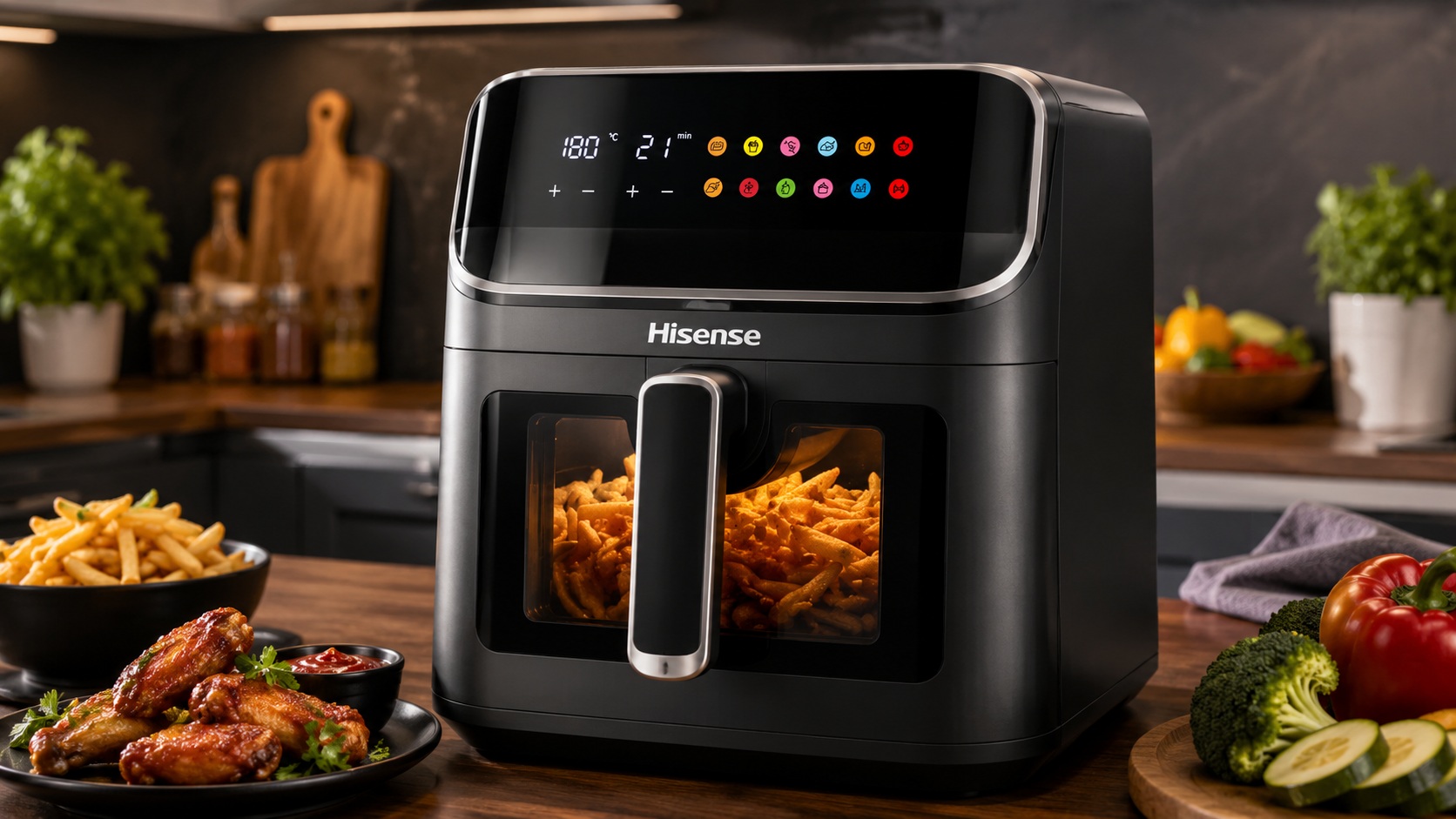
The Hisense H06AFBS2S3 is a digital air fryer built around 360-degree hot-air circulation, a visible cooking basket, colourful touch controls and 10 preset menus.
Hisense South Africa markets the appliance as an 8L Air Fryer and gives it a 24-month warranty. However, supporting specification material for the exact H06AFBS2S3 model lists a 6.7-litre net capacity and 1,350W power rating.
That discrepancy is worth knowing before buying, especially because capacity often determines which air fryer best suits a household.
Hisense H06AFBS2S3 uses 360-degree hot-air circulation
Hisense uses 360-degree hot-air circulation as the core cooking technology in the H06AFBS2S3.
The system circulates heated air around the food instead of submerging it in oil. Hisense positions the technology as a way to create crisp results with little or no added oil.
That is how most basket-style air fryers work.
A heating element warms the air while a fan moves it rapidly around the cooking chamber. The resulting airflow heats the food from several directions and helps dry its surface.
The process can create a crisp exterior, although it will not reproduce every characteristic of deep-fat frying.
The visible basket is genuinely useful
One of the Hisense H06AFBS2S3’s more practical features is the viewing window built into the basket.
The window lets users check browning and cooking progress without repeatedly pulling the basket out.
That matters because opening an air fryer interrupts the hot-air environment and releases heat.
A visible cooking area can therefore make it easier to judge whether food needs a few more minutes without disturbing the cooking process as often.
Hisense highlights the Visible Basket as one of the model’s main features on its South African page.
Ten presets simplify common cooking jobs
The H06AFBS2S3 includes 10 preset menus.
Hisense describes these as pre-programmed settings for common dishes and cooking tasks.
Presets can simplify operation because users do not need to manually select a temperature and cooking time for every meal.
They should still be treated as starting points.
Food size, quantity, starting temperature and how crowded the basket becomes can all affect cooking time.
Someone filling the basket with frozen chips may need different results from someone cooking a smaller portion of fresh vegetables, even when both use a preset.
Colourful touch controls replace traditional knobs
Hisense uses a colourful touch panel for the H06AFBS2S3.
The digital interface provides access to temperature, time and the 10 presets from the front of the appliance.
That gives the air fryer a cleaner appearance than models with several physical knobs.
The usability question is whether the touch panel remains responsive when someone’s hands are damp or greasy during cooking.
TechnologyBlog has not tested the appliance, so that would need a hands-on review.
The capacity figure needs explanation
This is the biggest specification issue with the H06AFBS2S3.
Hisense South Africa repeatedly identifies the model as an 8L Air Fryer.
However, South African appliance distributor Atlas lists the exact same model as having a 6.7-litre net capacity. Its specification material also lists a 1,350W power rating and 10 cooking menus.
Other international listings for H06AFBS2S3 likewise specify 6.7 litres.
The most likely explanation is a difference between marketed or gross capacity and usable net capacity, but Hisense South Africa’s page does not explain that distinction.
Until Hisense confirms it, TechnologyBlog should describe the unit as marketed locally as 8L, with supporting specifications showing 6.7L net capacity.
That is more useful than silently choosing one figure.
A larger basket can reduce batch cooking
Whether the usable figure is 6.7 or 8 litres, the H06AFBS2S3 sits towards the larger end of conventional single-basket air fryers.
More space can help when cooking for several people.
A larger basket may allow users to spread food across a broader surface rather than packing everything tightly together.
That can matter because air fryers need airflow around the food.
Overcrowding can reduce browning and lead to less even cooking.
More capacity does not automatically mean every meal should fill the basket completely.
The removable tray should simplify cleaning
Supporting South African specification material lists a removable baking tray among the H06AFBS2S3’s main features.
Removable cooking surfaces generally make cleaning easier because users can take food-contact components out of the main appliance.
Air fryers still need regular cleaning.
Grease and crumbs can accumulate underneath the tray and around the basket, particularly when cooking fatty foods.
Users should follow Hisense’s manual for cleaning instructions rather than immersing the electrical body of the air fryer in water.
1,350W is the most consistently published power figure
Hisense South Africa’s public product summary does not expose a detailed power specification in the searchable page content.
However, supporting product material for the exact H06AFBS2S3 model repeatedly lists 1,350W. This includes South African distributor information and international listings using 220–240V supplies.
That figure makes sense for a countertop air fryer of this size, but TechnologyBlog should identify it as a supporting specification rather than pretend Hisense South Africa’s current page clearly publishes it.
For South African households with backup power, 1,350W also matters.
The air fryer may draw less power than some full-size ovens, but it still creates a significant electrical load while its heating element operates.
An air fryer can make sense on backup power, within limits
A 1,350W air fryer could potentially run from a suitably sized inverter and battery system.
That does not mean every backup system will support it.
A small 1kW inverter will obviously fall short. Even on a larger inverter, refrigerators, televisions, computers and other appliances may already consume part of the available output.
Battery energy also matters.
Air fryers generally run for shorter periods than full-size ovens, which can make them attractive when power is limited. However, frequent or extended cooking can still consume a noticeable amount of stored energy.
Users should check the inverter’s output rating and battery capacity before cooking during an outage.
Hisense H06AFBS2S3 specifications
| Specification | Hisense H06AFBS2S3 |
|---|---|
| Product type | Digital basket air fryer |
| South African marketed capacity | 8 litres |
| Supporting net-capacity specification | 6.7 litres |
| Power | 1,350W* |
| Air circulation | 360-degree hot air |
| Visible basket | Yes |
| Touch controls | Yes |
| Preset menus | 10 |
| Removable baking tray | Yes* |
| Finish | Black* |
| Voltage | 220–240V* |
| Frequency | 50/60Hz* |
| South African warranty | 24 months |
*These specifications come from supporting South African and international documentation for exact model H06AFBS2S3 rather than Hisense South Africa’s shortened web specification.
Hisense’s product page has some obvious content errors
There is another reason to treat the current online information carefully.
Hisense South Africa’s H06AFBS2S3 page describes the Basket feature as helping stop items from getting “lost at the bottom of the freezer”. It also describes the Touch Control feature using wording intended for a hob.
Those descriptions clearly appear to come from generic or incorrectly mapped website content.
The actual product images and headline features still identify the H06AFBS2S3 as an air fryer, but the errors make independent specification checking worthwhile.
This is precisely why product pages should not always be copied directly into articles without verification.
Air frying uses less oil, but “healthy” needs context
Hisense describes air frying as a way to achieve fried-style results with little or no oil.
That is a reasonable description of the cooking method.
Using less added oil than deep frying can reduce the amount of cooking fat involved in preparing certain foods.
However, an air fryer does not automatically make every meal healthy.
The nutritional value still depends on what goes into the basket, portion size and the rest of the diet.
A frozen highly processed food remains the same underlying food even when prepared without deep frying.
The 24-month warranty adds local support
Hisense South Africa lists a 24-month warranty for the H06AFBS2S3.
That is useful because this is a locally listed appliance rather than an import-only model.
Buyers should retain proof of purchase and check the current Hisense warranty terms when making a claim.
Warranty coverage does not necessarily include damage from misuse, incorrect electrical supply or normal wear.
Who is the Hisense H06AFBS2S3 for?
The Hisense H06AFBS2S3 makes the most sense for households that want a reasonably large single-basket air fryer without moving to a dual-basket design or countertop oven.
The visible basket offers a useful way to monitor food without constantly opening the appliance.
Ten presets provide convenience, while 360-degree air circulation handles the basic air-frying job.
The only frustrating part is Hisense’s capacity documentation.
Calling the product an 8L air fryer while other specifications for the same model list 6.7L creates unnecessary confusion.
For most buyers, the precise litre figure matters less than whether the physical basket can handle the portions they regularly cook. However, manufacturers should still provide clear and consistent specifications.
Is the Hisense H06AFBS2S3 worth considering?
The Hisense H06AFBS2S3 offers the features most people actually use in a modern air fryer.
You get digital touch controls, 10 presets, 360-degree hot-air circulation and a window that lets you see how food is progressing.
Its larger basket should also make it easier to prepare family-sized portions without cooking everything in several small batches.
The 1,350W supporting power specification could make it less demanding than some larger countertop cooking appliances, although households using battery backup still need to account for its full electrical load.
The main criticism comes from the documentation rather than the product itself.
Hisense South Africa calls it an 8L model, while supporting specifications consistently identify 6.7 litres of net capacity.
Until Hisense clarifies that difference, buyers should treat 8 litres as the marketed capacity rather than assuming it represents 8 litres of usable basket space.