Yale Smart Safe adds app control and tamper alerts to secure home storage
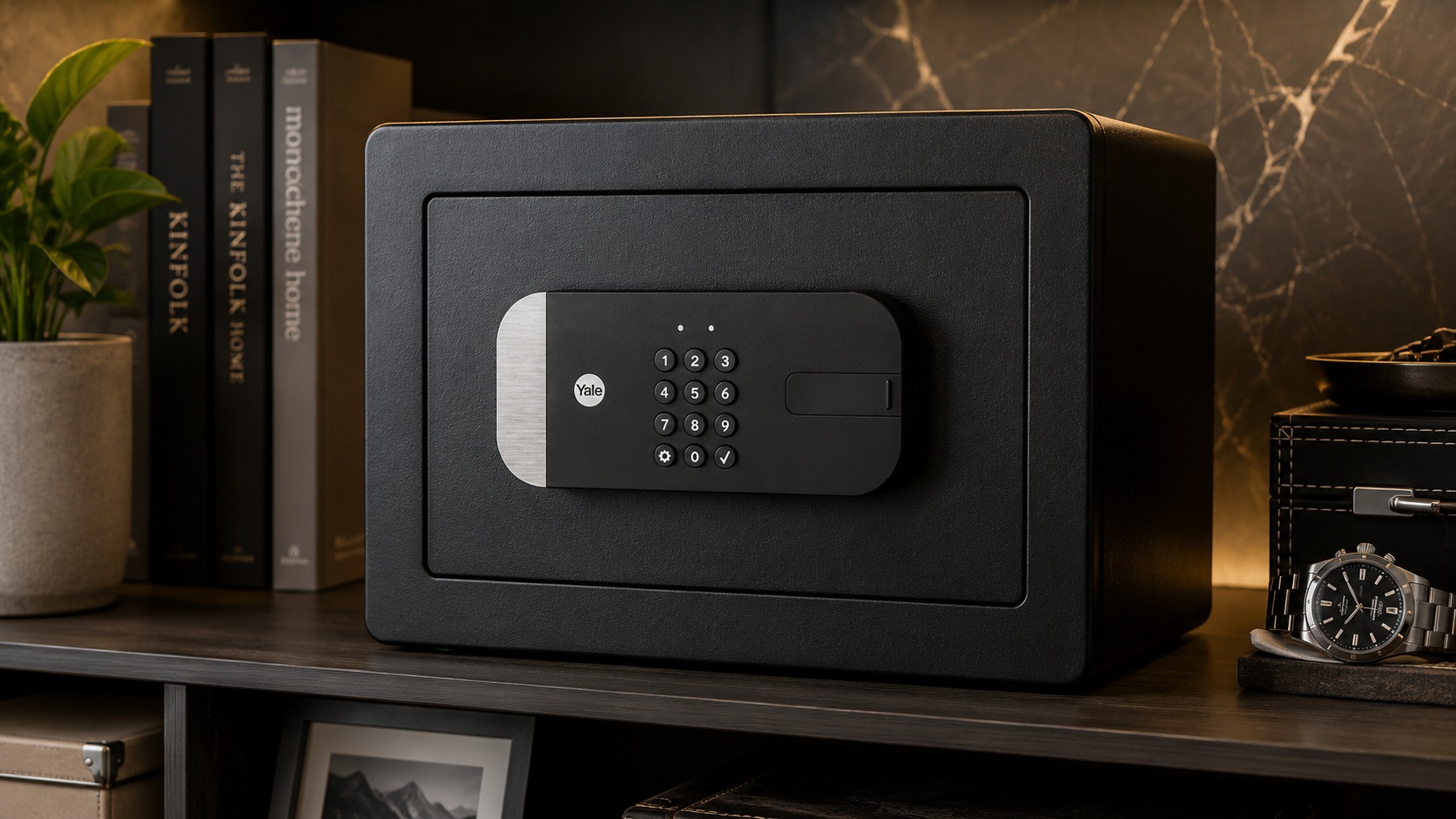
The Yale Smart Safe YSS/250/EB1 combines traditional locked storage with smartphone access, PIN codes and activity monitoring.
Its 20.5-litre interior provides space for documents, jewellery and other smaller valuables, while two motorised anti-saw bolts and a laser-cut steel door handle the physical security side. Yale adds a keypad, physical override key and support for unlocking from an Apple Watch or smartphone.
For South African buyers, the main distinction is straightforward: basic smart functions work locally over Bluetooth, but full remote access requires an additional Yale Wi-Fi Bridge.
Yale Smart Safe offers several ways to unlock it
The Yale Smart Safe does not force owners to rely on one access method.
Users can unlock it using:
- A PIN code
- The Yale Home app
- An Apple Watch
- A physical override key
Yale supports up to 25 PIN codes, consisting of one master code and as many as 24 user codes.
That makes the safe useful in homes or small offices where several people may need controlled access.
Instead of sharing one PIN with everyone, owners can provide separate codes and remove access later when necessary.
Remote access needs a Wi-Fi Bridge
The Smart Safe connects directly to a nearby phone over Bluetooth for local app control.
Owners who want to unlock it remotely, monitor activity from elsewhere or receive remote alerts need a Yale Wi-Fi Bridge. Yale South Africa sells the safe both on its own and as a bundle with the bridge.
Once connected, the Yale Home app can let users:
- Unlock the safe
- Share access codes
- View access history
- Receive notifications
- Check battery status
- Manage supported smart-home integrations
Yale confirms these functions in its South African setup documentation.
The bridge requirement is worth knowing before purchase because the safe itself does not provide independent Wi-Fi connectivity.
Temporary access can replace handing over a key
One of the more useful connected features is guest access management.
Owners can create access for trusted people without giving them the physical override key. Yale allows temporary or ongoing access through the Yale Home app.
That could suit a household where a family member occasionally needs access to stored documents or a small business where several authorised people use the same safe.
The activity feed provides another layer of accountability by showing when access occurred.
A conventional safe can tell you whether the door is locked. A connected safe can also help show who accessed it and when.
Five failed attempts trigger a lockdown
Yale adds protection against repeated PIN guessing.
After five incorrect attempts, the Smart Safe sounds an alarm and enters a five-minute lockdown.
During that period, additional keypad attempts will not immediately reopen the safe.
The feature will not stop every physical attack, but it makes rapid electronic code guessing harder.
For households using individual PINs, it also adds another reason not to share the master code unnecessarily.
Two anti-saw bolts secure the door
The lock uses two motorised 20mm steel anti-saw bolts.
Yale pairs these with a precision laser-cut steel door designed to reduce gaps that could make prying attacks easier.
The safe itself remains compact rather than being a heavy certified vault.
That distinction matters when setting expectations.
Yale markets this as a secure home and office safe for personal valuables. Buyers needing independently certified burglary resistance, insurance grading or specialist commercial protection should compare it with safes carrying the appropriate certification for those requirements.
Mounting the safe matters
Yale supplies mounting hardware and allows owners to secure the Smart Safe to either a wall or floor.
That is more important than it may sound.
A small safe only provides useful protection if someone cannot simply pick it up and carry it away.
The YSS/250/EB1 weighs around 11.4kg to 12.1kg depending on the regional documentation, so permanent mounting should form part of a serious installation.
Owners should choose fixing hardware and a mounting surface appropriate to the construction of the building.
A 20.5-litre interior keeps the safe compact
Yale lists a 20.5-litre internal volume.
The current technical documentation gives external dimensions of approximately 250 × 350 × 300mm and internal dimensions of roughly 242 × 345 × 245mm.
This makes the Smart Safe suitable for smaller valuables rather than bulky equipment.
Typical uses could include passports, important documents, jewellery, backup drives and other personal items.
A removable shelf gives owners more flexibility when arranging the interior, while internal key hooks and lighting make smaller items easier to organise.
Four AA batteries power the locking system
The Smart Safe runs from four AA alkaline batteries.
Yale specifically recommends alkaline batteries and advises against rechargeable or lithium replacements for normal operation.
Battery status appears in the Yale Home app when the safe is connected.
A low-battery warning gives owners time to replace the cells before they run flat.
Still, Yale provides two backup methods if battery power becomes unavailable.
A 9V terminal provides emergency power
The exterior includes a 9V emergency power terminal.
If the internal AA batteries run flat, users can connect a 9V battery externally to power the electronics long enough to unlock the safe.
Yale also includes a physical override key.
Those fallback methods matter because a smart safe should not become permanently inaccessible simply because its batteries die or an app becomes unavailable.
Keeping the override key somewhere secure but outside the safe is therefore sensible.
Apple Watch support adds another access option
Yale South Africa lists Apple Watch compatibility.
Owners can use a supported watch to unlock the Smart Safe without taking out their phone.
This is primarily a convenience feature rather than a security upgrade.
The same principle applies to smartphone unlocking: digital access makes the safe easier to use, but physical security still depends on the safe’s construction, locking mechanism and installation.
Voice assistants are available with remote connectivity
Yale’s South African Smart Safe bundle supports integration with Amazon Alexa and Google Assistant when the required Wi-Fi Bridge is present.
Voice control adds convenience, but Yale protects relevant commands with additional verification such as a PIN.
That is appropriate for a safe.
Voice control should never make opening secured storage easier for an unauthorised person simply because they happen to be within speaking distance of a smart speaker.
Yale Smart Safe specifications
| Specification | Yale Smart Safe YSS/250/EB1 |
|---|---|
| Product type | Connected home/office safe |
| Capacity | 20.5 litres |
| Access | PIN, app, Apple Watch, physical key |
| PIN codes | Up to 25 |
| Locking bolts | 2 × 20mm motorised anti-saw bolts |
| Tamper response | Alarm + 5-minute lockdown |
| Lockdown trigger | 5 incorrect attempts |
| Bluetooth | Yes |
| Remote access | Yes, with Yale Wi-Fi Bridge |
| Activity history | Yes |
| Guest access | Yes |
| Emergency power | External 9V terminal |
| Main power | 4 × AA alkaline batteries |
| Internal light | Yes |
| Removable shelf | Yes |
| Key hooks | Yes |
| Wall mounting | Yes |
| Floor mounting | Yes |
| External dimensions | Approx. 250 × 350 × 300mm |
| Internal dimensions | Approx. 242 × 345 × 245mm |
| Capacity | 20.5L |
| Weight | Approx. 11.4–12.1kg |
| Fire certified | No |
| Waterproof certified | No |
Yale’s regional documentation shows a small discrepancy in the published weight, with some sources listing 11.4kg and another listing 12.1kg. The physical dimensions and 20.5-litre capacity remain consistent across current documentation.
It is not a fire safe
This is one of the most important limitations to understand.
Yale documentation states that the Smart Safe is not certified as fireproof or waterproof.
That means someone storing irreplaceable paper records purely for fire protection should consider a certified fire safe instead.
The Smart Safe targets protection against unauthorised access while adding digital convenience.
Fire resistance is a different requirement.
A safe can offer strong access control without automatically protecting its contents from prolonged exposure to high temperatures.
The physical key remains important
Smart features are convenient until a phone battery dies, a network connection fails or an app becomes unavailable.
Yale avoids making digital access the only option.
The physical key provides an independent method of opening the safe, while the external 9V connection addresses flat internal batteries.
Those fallback systems should form part of the owner’s setup plan.
Storing the override key inside the safe would defeat the purpose.
The Yale Smart Safe makes the most sense when access needs to be shared
The Yale Smart Safe offers more than simply unlocking a box from a phone.
Its strongest smart feature may be controlled access.
A household can give different people their own PIN codes. Temporary access can go to someone who only needs the safe occasionally, while the activity feed records access events.
That makes the product particularly interesting when more than one trusted person needs access but handing out physical keys would be inconvenient.
For someone who simply wants a secure place that only one person ever opens, a conventional electronic safe may offer everything required.
Is the Yale Smart Safe worth considering?
The Yale Smart Safe YSS/250/EB1 combines a familiar steel safe with useful connected controls.
Its 20.5-litre capacity provides enough room for smaller valuables, while the two 20mm locking bolts, tamper alarm and five-minute lockout deal with basic physical and electronic security.
The Yale Home app adds access history, guest management and smartphone control. Adding the Wi-Fi Bridge extends those functions beyond Bluetooth range.
Its limitations matter just as much.
This is not a certified fire or waterproof safe, and remote connectivity requires additional hardware.
For South African households that primarily want controlled access to documents, jewellery or other smaller valuables, the Smart Safe’s best feature is arguably not remote unlocking.
It is the ability to control who gets access, remove that access again, and keep a record of when the safe was opened.