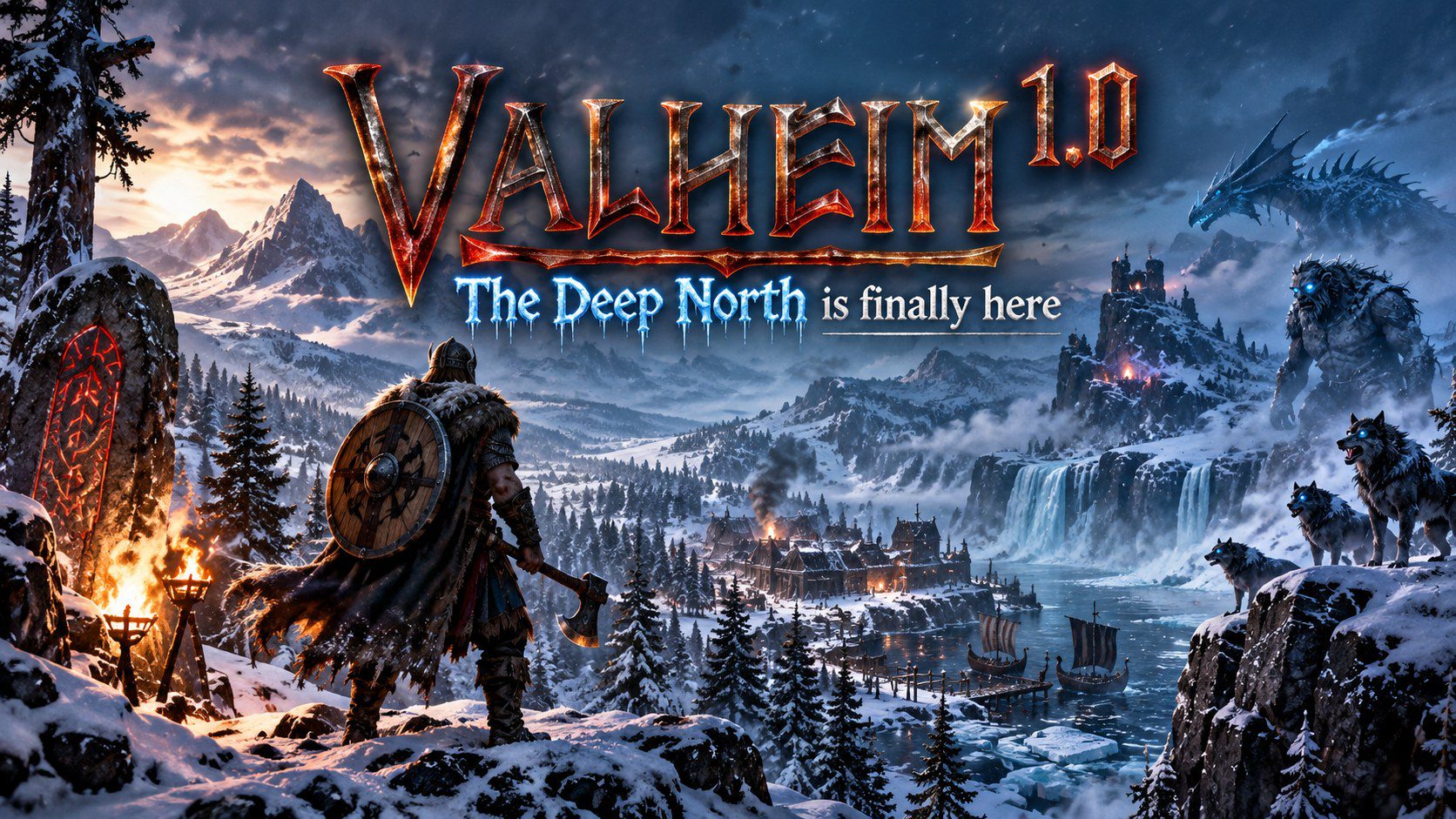
Valheim 1.0 brings hundreds of thousands of players back for the Deep North
Valheim 1.0 has finally arrived.
More than five years after Iron Gate released its Viking survival game through Steam Early Access, Valheim reached its full release on 9 September 2026.
The milestone would already be significant considering how long players have waited for the final biome.
What happened afterwards made it much bigger.
Hundreds of thousands of players returned.
During TechnologyBlog’s latest check, SteamDB ranked Valheim seventh among Steam games by daily active users. Around 252,000 Steam users were running the game simultaneously at the checked snapshot, while its 24-hour peak was approaching 259,000. SteamDB
That puts Valheim back among Steam’s largest active games.
The reason is easy to identify.
The Deep North is finally open.
Valheim 1.0 ends more than five years of Early Access
Valheim entered Steam Early Access on 2 February 2021.
Its full release arrived on 9 September 2026. Steam Store
That represents an Early Access journey lasting more than five and a half years.
For players who joined during the extraordinary launch period of 2021, the game has changed enormously during that time.
New biomes arrived.
Combat expanded.
Building grew.
Magic entered the game.
Enemies became more complicated.
The world became increasingly dangerous.
Now the progression finally has its last major biome.
The Deep North completes Valheim’s biome journey
The Deep North is the headline addition in Valheim 1.0.
Players have been able to see the frozen region at the edges of their worlds for years.
However, it was largely unfinished territory.
Version 1.0 changes that.
The Deep North is now a complete biome with its own enemies, resources, locations, equipment and progression.
It represents the final stage of the journey Iron Gate began when Valheim first entered Early Access.
Official Valheim 1.0 patch notes
Supporting image alt: Valheim 1.0 Deep North biome
Valheim 1.0 adds more than one new biome
Calling version 1.0 a Deep North update understates its scale.
Iron Gate added more than 40 new weapons.
There are four new armour sets.
Players can craft two additional capes and two trinkets.
More than ten new creatures inhabit the expanded world.
Builders received over 80 new construction pieces.
The update also contains more than 30 crafting materials and over 20 food items. Valheim
There are also new locations, music, events, mechanics and crafting-related structures.
In other words, 1.0 is not simply an Early Access label disappearing from the Steam page.
It substantially expands the game.
The Deep North changes the endgame
Valheim’s progression has always been closely tied to its biomes.
Players begin in relatively forgiving surroundings.
Then the world becomes progressively more hostile.
The Black Forest introduces new resources and threats.
The Swamp punishes poor preparation.
Mountains add environmental danger.
The Plains introduce another jump in enemy difficulty.
Mistlands changes visibility and eventually opens magical progression.
Ashlands turns the environment itself into a hostile battlefield.
The Deep North now sits at the end of that journey.
Players reaching it are expected to understand Valheim’s systems.
The game can therefore demand more from them.
New weapons expand the final stage of progression
More than 40 new weapons is a substantial addition.
Valheim has always used equipment progression to push players towards dangerous environments.
New materials allow new weapons.
New weapons make harder enemies manageable.
Those enemies then guard resources needed for the next stage.
The Deep North continues that loop at the end of the current progression path.
By the time players arrive, they have already crossed almost every environment Valheim can throw at them.
Now they have another arsenal to master.
Supporting image alt: Valheim 1.0 Deep North weapons and armour
Building received another enormous expansion
Combat is only half of Valheim.
For many players, building is equally important.
Version 1.0 adds more than 80 new buildable pieces. Valheim
That gives long-term builders another large collection of materials to experiment with.
Valheim’s structural building system has always been one of its strongest features because construction is not entirely cosmetic.
Support matters.
Foundations matter.
Height matters.
Material choice matters.
Smoke needs somewhere to escape.
A beautiful Viking hall can therefore also be an engineering problem.
More pieces mean more possibilities.
Achievements finally arrived with Valheim 1.0
One of the most obvious signs that Valheim had remained in Early Access was the absence of a conventional achievement system.
That changed with version 1.0.
Achievements are now part of Valheim. Valheim
However, there are some important conditions.
Statistics begin tracking from the 1.0 update.
Certain world modifiers can prevent achievements from unlocking.
Cheated items can also be identified by the game.
Existing players therefore do not necessarily receive every achievement retroactively simply because they completed equivalent tasks years ago.
Old Valheim saves still work
Long-term players do not have to abandon their worlds.
Iron Gate confirmed that existing saves remain compatible with version 1.0. Valheim
However, world generation creates an important limitation.
New biome content can generate properly in areas that players have not previously explored.
Already explored regions may not receive the full new generation.
Iron Gate therefore recommends starting again for the best overall experience.
That creates an interesting choice for veterans.
Continue a world containing hundreds of hours of work?
Or begin again and experience the entire progression as it exists in 1.0?
Starting again may be the better Valheim 1.0 experience
Restarting sounds painful when a player has enormous bases, upgraded equipment and established portals.
However, Valheim’s progression is part of the game.
Beginning with almost nothing is not merely an obstacle between the player and the Deep North.
It is the journey.
Players rediscover their first shelter.
They hunt their first deer.
They establish a proper base.
They defeat bosses.
They build ships.
They cross oceans.
Eventually, they become powerful enough to challenge environments that would have killed them instantly at the beginning.
Starting again lets players experience how that entire progression has changed during more than five years of development.
Valheim still understands the importance of preparation
One reason Valheim has survived for so long is that preparation matters.
Food does not simply prevent starvation.
Different foods influence health and stamina.
Rest matters.
Equipment matters.
Resistance matters.
The right weapons matter.
A badly prepared expedition can end quickly.
This creates a rhythm unlike survival games that constantly force players to manage hunger bars simply to stay alive.
Valheim instead uses preparation to determine what players are capable of doing.
Food is effectively part of the character build
There are no conventional character classes.
Food helps create them temporarily.
A player focusing heavily on health can prepare for dangerous melee combat.
Another can prioritise stamina.
Magic eventually creates additional considerations.
Therefore, deciding what to eat before leaving a base becomes part of preparing a build.
Version 1.0 adds more than 20 food items, expanding those decisions again. Valheim
That system remains one of Valheim’s cleverest approaches to survival mechanics.
Death remains expensive enough to matter
Valheim is not a permadeath game by default.
Death still hurts.
Players can lose skill progress and leave equipment behind at the place they died.
Recovering that equipment can become an adventure by itself.
A difficult expedition may therefore turn into a rescue mission.
If the death occurred in a dangerous biome, reaching the corpse may require backup equipment, food and another journey.
Sometimes players die during the recovery.
Then the problem becomes considerably worse.
Those moments produce stories.
Sailing remains one of Valheim’s defining experiences
Few things capture Valheim better than leaving land behind in a boat.
The world is procedurally generated.
Players therefore cannot simply memorise one universal map.
They need to explore.
Sailing makes that exploration feel significant.
A distant shoreline may contain the biome you need.
It may contain a dangerous enemy.
It may offer the perfect place for another base.
Or the journey may end with a sea creature turning everything into chaos.
The uncertainty makes travel meaningful.
Portals never completely remove distance
Valheim eventually allows players to establish portal networks.
That dramatically reduces travel time.
However, exploration still matters because players first need to reach those locations.
Certain resources and progression systems also create logistical challenges that prevent every expedition from becoming trivial.
As a result, the world remains large even after players become established.
Travel changes.
It does not disappear.
Valheim works because its world feels like somewhere to live
The game is not constantly hostile.
That matters.
Players can return from an expedition, repair equipment and cook food.
They can improve their base.
They can farm.
They can organise storage.
They can build something purely because it looks good.
Then they leave again.
That contrast between safety and danger gives the world rhythm.
Without the quiet periods, the dangerous expeditions would become exhausting.
Without danger, the base would not feel safe.
Valheim’s building community became part of its identity
Iron Gate regularly highlights community builds.
That makes sense because players have transformed Valheim’s construction systems into something far beyond basic shelters.
There are castles.
Villages.
Ports.
Bridges.
Temples.
Fortresses.
Entire settlements.
The game provides structural rules and building pieces.
Players provide imagination.
Version 1.0’s 80-plus additional pieces give that community another substantial toolkit. Valheim
Supporting image alt: Valheim 1.0 Viking base building
Valheim can be played alone
The game’s multiplayer reputation sometimes hides an important fact.
Valheim supports solo play.
A single player can explore the world, build bases and progress through the bosses.
The experience changes considerably.
Resource gathering takes longer.
Combat leaves less room for mistakes.
Dangerous expeditions require more preparation.
However, solo play can also make exploration more atmospheric.
There is nobody coming to rescue you.
Every success belongs entirely to you.
Co-op transforms the experience
Valheim supports groups of up to ten players. Valheim
That changes everything.
Players can divide responsibilities.
One person builds.
Another gathers resources.
Someone cooks.
Someone disappears for two hours and returns with a boat full of material nobody knew they needed.
Combat becomes cooperative.
Boss fights become social events.
Disasters become shared stories.
Valheim is therefore one of those games where co-op does not merely add more players.
It changes the personality of the experience.
Valheim 1.0 has full crossplay
The 1.0 launch expanded the platform list significantly.
Valheim is now available across Windows, Linux, Mac, Xbox One, Xbox Series X|S, PlayStation 5 and Nintendo Switch 2. Valheim
More importantly, Iron Gate supports crossplay between the platforms.
That dramatically expands the potential co-op community.
Friends no longer necessarily need to own the same gaming platform to explore Valheim together.
For a game built heavily around cooperative adventures, that is a major improvement.
PlayStation 5 and Switch 2 arrived with version 1.0
PlayStation 5 and Nintendo Switch 2 joined Valheim with the full release. Valheim
That represents another important transition.
For years, Valheim’s console presence centred on Xbox.
The 1.0 launch therefore did more than complete the game’s content roadmap.
It broadened the audience at exactly the moment Iron Gate was asking players to return.
The enormous activity around launch needs to be viewed in that context.
This was both a major content update and a substantial platform expansion.
Valheim 1.0 sent Steam activity soaring
The most dramatic evidence of renewed interest is visible on Steam.
During TechnologyBlog’s latest check, SteamDB showed roughly 252,000 concurrent Steam players.
Its 24-hour peak was approximately 259,000.
SteamDB also ranked Valheim seventh by daily active users at the checked snapshot. SteamDB
Those are extraordinary numbers for a game that first entered public Early Access in February 2021.
They also demonstrate the scale of the 1.0 resurgence.
Valheim has not broken its original Steam record
There is an important distinction.
The current resurgence has not surpassed Valheim’s extraordinary original Steam peak.
SteamDB records an all-time peak of 502,387 concurrent players, reached on 21 February 2021. SteamDB
That happened only weeks after the Early Access launch.
The original Valheim phenomenon was enormous.
However, reaching more than half of that historic concurrent record again more than five years later is still significant.
Very few survival games can produce that kind of return.
Steam reviews remain overwhelmingly positive
Valheim’s long-term reception remains extremely strong.
At the latest Steam check, 94% of more than 263,000 English-language reviews were positive, giving the game a Very Positive rating.
Recent reviews were also Very Positive, with approximately 82% positive across more than 11,000 reviews in the previous 30 days. Steam Store
The difference between recent and lifetime ratings is worth noting.
The 1.0 launch has introduced a huge wave of returning and new players, alongside technical issues Iron Gate has been addressing through rapid patches.
Even with that increased scrutiny, the recent rating remains Very Positive.
More than half a million Steam reviews show Valheim’s scale
SteamDB’s broader review dataset is even larger.
At the latest check, it listed more than 550,000 total reviews, with its calculated rating around 92.9%. SteamDB
Review counts are not player counts.
They should never be treated as such.
However, they demonstrate the enormous accumulated footprint Valheim has built since 2021.
This is no longer simply a successful indie survival game.
It is one of the genre’s defining modern releases.
Valheim 1.0 has needed several rapid patches
The full launch has not been flawless.
Iron Gate released multiple hotfixes and patches during September.
Patch 1.0.14 addressed keybindings, accessibility, server issues, crashes and Deep North problems. Valheim
Patch 1.0.15 addressed terrain duplication and performance problems. Valheim
Then patch 1.0.16 arrived on 25 September.
It fixed cases where Deep North terrain modifications could revert after unloading, excessive enemy spawning and several achievement problems. Valheim
That rapid patch cadence shows Iron Gate is actively responding to the 1.0 launch.
Crossplay has remained a priority during patching
Multi-platform updates create another complication.
A patch may take longer to reach one platform than another.
Iron Gate has repeatedly emphasised that crossplay remains functional while individual platform updates move through their respective release processes. Valheim
That is particularly important now that Valheim supports such a broad platform list.
A fragmented player base would undermine one of the major benefits of the 1.0 release.
So far, Iron Gate has clearly treated crossplay compatibility as a priority.
Mods require more caution after Valheim 1.0
PC players using mods need to be careful.
Iron Gate does not provide official mod support.
The studio warned that mods may require time to become compatible with version 1.0. Valheim
There is also no official Steam Workshop integration.
Therefore, heavily modified installations should not be assumed to work immediately after a major update.
Players should check individual mod compatibility before loading important worlds.
Backing up saves is also sensible whenever a heavily modified game receives a major version change.
Valheim 1.0 for South African players
Valheim 1.0 is particularly flexible for South African players because it does not depend on public matchmaking.
The game works solo.
Friends can host cooperative sessions.
Dedicated servers are another option.
Crossplay also means groups can now include players across PC, Xbox, PlayStation 5 and Nintendo Switch 2. Valheim
Network performance will still depend on where the host or server is located, alongside routing and each player’s connection.
There is therefore no responsible universal South African ping figure for Valheim.
However, the ability to choose how and where a group plays gives South African players more control than games built entirely around fixed regional matchmaking.
Valheim’s relatively small download remains unusual
Modern games regularly require enormous downloads.
Valheim does not.
Iron Gate estimated the 1.0 download at around 4.3 GiB on most platforms, with some platform-specific differences. Valheim
That is remarkably compact for a game containing procedurally generated worlds, multiple biomes, extensive building systems, multiplayer and years of accumulated content.
For South African players managing storage or bandwidth, that is a practical advantage.
Valheim is finally a complete journey
For years, recommending Valheim came with a qualification.
It was excellent.
But it was unfinished.
Major biomes were still missing.
Progression eventually reached the edge of what Iron Gate had completed.
Version 1.0 changes that relationship.
The Deep North provides the final major biome.
Achievements have arrived.
The platform rollout has expanded.
Crossplay connects the player base.
Valheim is no longer asking players to imagine what the completed journey might eventually become.
They can play it.
Iron Gate is not promising another giant expansion
That does not mean Valheim development has ended.
Iron Gate says it will continue improving the game through bug fixes and quality-of-life updates.
However, the studio has deliberately avoided promising further major content.
Its official 1.0 FAQ says it is too early to say whether additional content will arrive after release. Valheim
That is an important distinction.
Players should not assume another biome is already planned.
For now, version 1.0 represents the completed progression Iron Gate committed to building.
Why Valheim still works in 2026
Valheim’s success was never based on one extraordinary feature.
Instead, several systems reinforce each other.
Exploration provides resources.
Resources create equipment.
Equipment opens new biomes.
Biomes create new threats.
Threats make preparation important.
Preparation makes bases useful.
Bases encourage building.
Building gives players somewhere worth returning to.
Then a boat opens another horizon and the cycle begins again.
Co-op adds another layer because all those systems become shared.
That loop remains compelling even after players understand how Valheim works.
Is Valheim worth returning to for version 1.0?
TechnologyBlog has not conducted a fresh scored review of Valheim 1.0, so this is not a purchase recommendation.
However, players who left during Early Access now have substantially more game waiting for them.
The Deep North completes the biome progression.
Version 1.0 adds dozens of weapons, new armour, creatures, food, crafting materials and building pieces.
Achievements have arrived.
PlayStation 5 and Switch 2 players can now join.
Crossplay connects every supported platform. Valheim
The huge Steam resurgence also means returning players are certainly not returning alone.
Valheim 1.0 finally finishes the journey that began in 2021
Valheim was never supposed to become as enormous as it did.
A small Swedish studio released an Early Access Viking survival game in February 2021.
Within weeks, more than half a million Steam users were playing simultaneously.
Then came the difficult part.
Iron Gate had to finish it.
That took more than five years.
The game expanded through new systems and biomes while players built extraordinary worlds of their own.
Now the Deep North is open.
Valheim has reached 1.0.
And hundreds of thousands of Steam players have returned to see how the journey ends.
For a game that spent five and a half years carrying an Early Access label, there may be no better measure of what Iron Gate achieved.
