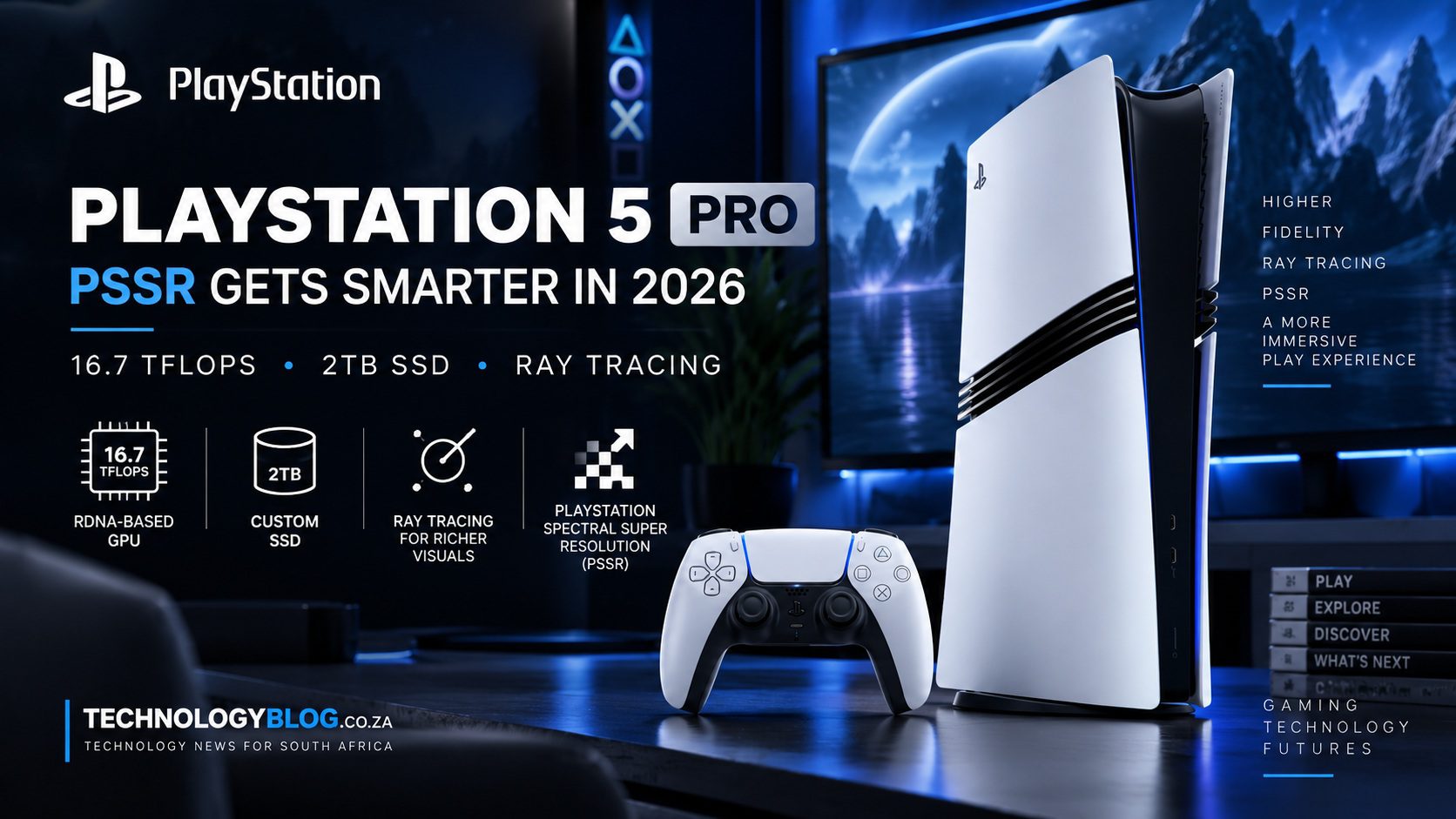
PS5 Pro’s upgraded PSSR gives Sony’s mid-generation console a second graphics act
PlayStation 5 Pro is Sony Interactive Entertainment’s higher-performance PS5 console. Its main focus is graphics quality, ray tracing and AI-assisted image reconstruction rather than a new CPU generation.
Sony’s current safety specifications list an eight-core, 16-thread AMD Zen 2 CPU, a 16.7TFLOPS RDNA-based GPU, 16GB GDDR6 plus 2GB DDR5 and a 2TB custom SSD.
TechnologyBlog.co.za has not performed a fresh laboratory comparison of the 2026 PSSR update. Improvements differ by title and developer implementation.
PSSR reconstructs a sharper image from a lower internal render
PlayStation Spectral Super Resolution uses machine-learning-based reconstruction to produce higher-resolution output while allowing the game to render internally at a lower resolution.
That can free GPU resources for higher frame rates, ray tracing or more complex visual settings.
Reconstruction quality depends on motion, input resolution and game integration, which is why results can differ between titles.
Sony upgraded PSSR in 2026
Sony announced a newer PSSR implementation in February 2026 and has been rolling it into supported PS5 Pro games.
The console now includes an ‘Enhance PSSR Image Quality’ option for compatible titles that originally used the first PSSR generation.
This demonstrates an advantage of dedicated machine-learning reconstruction: the algorithm can improve even when the hardware remains unchanged.
2TB storage and Wi-Fi 7 are practical upgrades
The console includes 2TB of built-in custom SSD storage and retains an M.2 expansion slot.
Wi-Fi 7 support can improve local wireless throughput and latency with compatible routers, although internet gaming quality still depends on the wider connection.
The optional optical disc drive is separate, so physical-game owners should account for that hardware requirement.
TechnologyBlog has already covered the console’s core design
For a broader breakdown of the original hardware and buying considerations, see TechnologyBlog.co.za’s existing PlayStation 5 Pro overview.
This article focuses on the console’s current 2026 specification and the evolution of PSSR rather than repeating the original launch story.
Who is PS5 Pro for now?
The strongest audience remains players with capable 4K displays who value higher visual settings, ray tracing and smoother performance in enhanced games.
Players satisfied with the standard PS5 or using displays that cannot expose the visual differences have less reason to upgrade solely for the Pro badge.
PlayStation 5 Pro specifications
| Specification | Details |
|---|---|
| CPU | AMD Zen 2, 8 cores / 16 threads |
| GPU | AMD RDNA-based, 16.7TFLOPS |
| Main memory | 16GB GDDR6 |
| Additional memory | 2GB DDR5 |
| Storage | 2TB custom SSD |
| AI reconstruction | PlayStation Spectral Super Resolution |
| Wireless | Wi-Fi 7 compatible |
| PS4 compatibility | More than 8,500 PS4 titles supported according to Sony |
| Disc drive | Optional accessory |
Real-world performance is a system property
The same processor, storage device, battery chemistry or radio can behave differently depending on firmware, cooling and workload. Short benchmarks can favour burst performance, while long tasks expose thermal limits. Wireless results depend on the network. Camera results depend on processing and conditions. For that reason, manufacturer specifications are useful boundaries, not substitutes for independent testing. TechnologyBlog.co.za has not treated those published numbers as a performance review.
The ecosystem can matter as much as the hardware
Ports, accessories, repair options, software updates, cloud services and compatibility all affect the useful life of a device. A product that looks strong on launch day can become frustrating if replacement parts are scarce or a required accessory is proprietary. Conversely, mature software and broad peripheral support can make modest-looking hardware much easier to live with. That surrounding ecosystem belongs in the buying decision.
What to verify before buying
Players should consider their 4K/120Hz display, existing PS5 library, storage needs and the number of enhanced games they care about before upgrading. Buyers should also check the exact regional configuration because storage, memory, radios, displays or included accessories can differ between markets. Retail listings often shorten model names, so the model code is the safer reference where available.
What South African users should consider
South African gamers should also factor broadband download sizes, power resilience and local accessory availability into a console that increasingly depends on large digital updates. Electricity, network quality, repair logistics and importer support can all change the practical ownership experience. That context does not make a global specification less relevant; it changes which parts of the specification deserve the most weight.
Who gets the most value
The best customer for PlayStation 5 Pro is the person or team that can use its distinctive capabilities repeatedly. Premium features are easiest to justify when they remove a recurring bottleneck, improve a professional workflow or meaningfully extend useful life. If those features are only impressive on paper, a simpler product can be the more rational choice without being technically superior.
A specification only matters inside the complete product
Sony’s upgraded PS5 console that uses a stronger GPU, advanced ray tracing and PlayStation Spectral Super Resolution to improve selected games. PS5 Pro is a mid-generation performance upgrade: its value depends on the display and on whether a particular game includes a meaningful Pro enhancement. A good buying decision starts by asking how the specification changes the user’s actual workflow rather than whether it is the largest number on a comparison sheet. PSSR and ray tracing can improve image quality, but results vary by title and patch, and not every game benefits equally. This is especially important for premium hardware because compromises often move from raw performance into heat, battery, acoustics, dimensions or upgradeability.
Five questions worth asking before committing
Before adopting PlayStation 5 Pro, write down the problem it is meant to solve, the metric that will show improvement, the systems or people it depends on, the failure mode that would hurt most, and the support path when something goes wrong. Players should consider their 4K/120Hz display, existing PS5 library, storage needs and the number of enhanced games they care about before upgrading. That exercise prevents a technically impressive product from becoming a solution in search of a problem. It also creates a baseline for later review: if the expected outcome does not improve, the organisation can change configuration, training or even the product choice instead of defending the original purchase.
The procurement checklist is shorter than the feature list
Before committing, define the job this product must perform and the constraint it is supposed to remove. Then verify compatibility, support lifecycle, security updates, failure recovery, integration effort, skills required and the exact regional or model-specific configuration. For business technology, add identity, audit logging, data location and exit strategy. For hardware, add power, cooling, serviceability and spare availability. For online services, add account recovery, privacy controls and local terms. This checklist sounds less exciting than a launch presentation, but it is usually where a technically impressive product proves whether it belongs in a real environment. A product that fits the workflow and support model will generally deliver more value than one selected because it wins a single headline specification.
