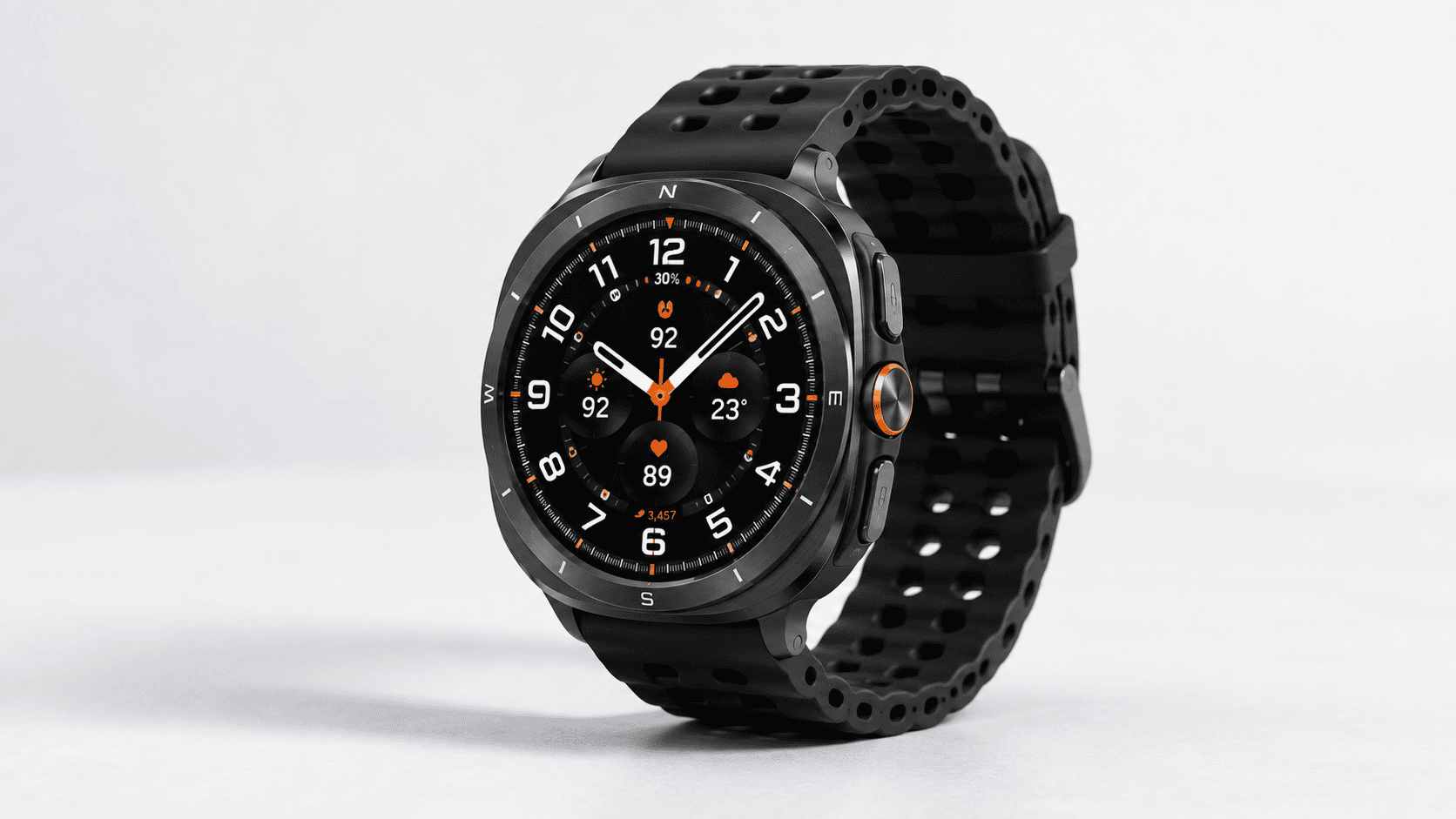
Samsung Galaxy Watch Ultra2 brings an 800mAh battery and 5,000-nit display to outdoor users
Samsung has pushed its premium smartwatch further towards endurance sport and outdoor use with the Galaxy Watch Ultra2. The 47mm watch combines a titanium case, 800mAh battery and a Super AMOLED display rated for up to 5,000 nits of peak brightness.
The Watch Ultra2 also introduces Qualcomm’s Snapdragon Wear Elite platform to Samsung’s Ultra line. Samsung pairs it with dual-frequency GPS, 64GB of storage and dedicated features for trail running and diving.
Durability remains central to the design. Samsung lists 10 ATM water resistance, IP69K protection, MIL-STD-810H testing and EN 13319 certification for depth-measuring equipment used by divers.
Samsung currently lists the Galaxy Watch Ultra2 on its South African website in Titanium Silver. The company has also included the watch in its latest local Galaxy product rollout.
TechnologyBlog.co.za has not tested the Galaxy Watch Ultra2. This article therefore covers its verified specifications and features rather than making conclusions about GPS accuracy, health tracking or real-world battery endurance.
The 800mAh battery is Samsung’s largest Galaxy Watch battery
Samsung equips the Galaxy Watch Ultra2 with an 800mAh battery. That represents a 35% capacity increase over the previous Ultra generation.
Samsung’s South African product page rates the watch for up to 80 hours with the Always On Display disabled. That figure drops to up to 60 hours with the Always On Display enabled.
Those figures come from Samsung’s controlled testing. GPS use, LTE connectivity, screen brightness and workout tracking can all change actual endurance.
The larger battery should matter most to users who spend extended periods away from a charger. Long trail runs, hikes and outdoor events can place considerably greater demands on a watch than basic notification use.
Samsung also supports faster wireless charging through its high-frequency WPC-based charging system.
TechnologyBlog.co.za has not measured charging speed or battery life independently.
The display can reach a claimed 5,000 nits
The Watch Ultra2 uses a 1.52-inch Super AMOLED display with a resolution of 498 × 498 pixels. Sapphire Crystal protects the screen.
Samsung rates localised peak brightness at up to 5,000 nits under strong ambient light. The company described this as a first for a globally released smartwatch when it announced the device in July 2026.
That figure does not represent constant full-screen brightness. Samsung notes that actual output depends on temperature, environment and usage conditions.
High brightness has a practical purpose on an outdoor watch. Runners, cyclists and hikers need to read information quickly without shielding the display from direct sunlight.
TechnologyBlog.co.za has not tested outdoor visibility.
Samsung reduces thickness despite the bigger battery
The Galaxy Watch Ultra2 measures 47.4 × 47.1 × 10.7mm and weighs 61.5g without its strap.
Samsung says internal redesign work reduced thickness by 12% compared with the previous Ultra generation. It achieved that while increasing battery capacity.
The 47mm body still makes this a large watch. Buyers with smaller wrists should consider the case dimensions before ordering.
Samsung also offers lighter and softer straps to make extended wear more comfortable. The available Ultra band families include Marine, PeakForm and Trail options.
Comfort matters for health tracking because many features depend on users keeping the watch on during both daytime activity and sleep.
Titanium remains central to the Ultra design
Samsung retains a shock-resistant titanium casing for the Galaxy Watch Ultra2. The watch comes in Titanium Silver and Titanium Gray, although availability can vary by market.
The design maintains Samsung’s distinctive cushion-shaped Ultra body with a circular display inside it.
Sapphire Crystal covers the display, providing a harder surface than conventional smartwatch glass. The case also carries several environmental and durability ratings.
These specifications indicate Samsung’s intended use case, but no certification makes a smartwatch impossible to damage.
Users should still follow Samsung’s care requirements when exposing the device to salt water, high temperatures or extreme environments.
IP69K goes beyond ordinary splash protection
Samsung gives the Watch Ultra2 an IP69K rating as well as 10 ATM water resistance.
IP69K includes resistance testing against high-pressure and high-temperature water jets. Samsung separately lists IP6X dust resistance under laboratory conditions.
Samsung also states that the watch has 100-metre water resistance under ISO 22810 testing. However, water resistance can decline over time through normal use.
After exposure to seawater, Samsung advises users to rinse the watch in fresh water and dry it.
These distinctions matter because water-resistance ratings describe specific laboratory tests. They do not provide unlimited protection under every diving or high-pressure environment.
EN 13319 certification adds proper diving features
The Galaxy Watch Ultra2 carries EN 13319 certification. This standard applies to instruments that measure water depth using environmental pressure and track dive time under defined conditions.
The watch can automatically display information including depth, dive time and water temperature when the appropriate feature is enabled.
Samsung is also developing additional diving functions with diving-equipment company Mares. The Ultra2 Diving app is expected later in 2026 and will add features such as ascent and descent speed tracking and safe dive limits.
Samsung says these Mares-developed functions will remain exclusive to Galaxy Watch Ultra2 among Wear OS smartwatches for two years after launch.
Prospective divers should still understand the difference between smartwatch functions and specialist dive equipment. Users need to follow Samsung’s operating instructions and recognised diving safety practices.
Trail Run tracks elevation and terrain
Samsung has developed Trail Run specifically for the Galaxy Watch Ultra2.
The mode tracks elevation, climbing progress and terrain impact. Samsung designed the information to help runners adjust their pace and understand how changing terrain affects effort.
Trail running places different demands on an athlete compared with running on a flat road. Elevation and surface changes can influence pace significantly, so simple kilometres-per-minute figures tell only part of the story.
The feature requires the Samsung Health app and a compatible Android phone. A Samsung Account is also required.
TechnologyBlog.co.za has not compared its trail metrics against professional running or GPS equipment.
Nutrition Alert can suggest when to hydrate
Samsung has also expanded its Sweat Loss feature with Nutrition Alert.
The watch estimates sweat loss relative to body weight during supported activities. It can then provide guidance around when and how much the user should hydrate.
This could prove useful during long events where hydration requirements change with temperature, effort and duration.
However, smartwatch estimates should not replace medical or professional sports advice. Individual hydration needs vary substantially.
Samsung also limits Nutrition Alert to selected exercise types, and users need to enable the feature in the exercise settings.
Snapdragon Wear Elite handles processing and GPS
The Galaxy Watch Ultra2 uses Qualcomm’s Snapdragon Wear Elite platform, identified in Samsung’s specifications as the SDW6100. It uses a five-core processor built on a 3nm process.
Samsung pairs the chipset with 2GB of memory and 64GB of storage. The South African product page lists about 49.3GB of available user storage after system files.
The watch also supports L1 and L5 dual-frequency GPS.
Dual-frequency positioning can help a compatible device handle difficult environments such as city streets surrounded by tall buildings. It can also improve tracking where reflected satellite signals create additional errors.
Real-world GPS performance still depends on the environment and software implementation. TechnologyBlog.co.za has not independently compared its positioning accuracy.
LTE allows the watch to connect away from a phone
Connectivity includes LTE, Bluetooth 6.0, dual-band Wi-Fi, NFC and dual-frequency GPS.
LTE can allow supported watch functions to continue when the paired smartphone is not nearby. Mobile-network functionality still depends on carrier support and an appropriate wearable service.
NFC supports compatible contactless functions, while Wi-Fi provides another network option when LTE or Bluetooth is unnecessary.
Users should confirm local operator support before buying the watch primarily for standalone mobile connectivity.
Samsung Health adds new cardiovascular and recovery insights
Outdoor sport only forms part of the Watch Ultra2 story.
Samsung also introduces several health features through Samsung Health and One UI 9 Watch. These include Vitals, Heart Health Score, Daily Cardio Load, Fitness Index and Hearing monitoring.
Vitals establishes a personal baseline during sleep and can alert the user to significant changes.
Heart Health Score simplifies several cardiovascular measurements into a single score with lifestyle guidance. Samsung states clearly that the feature does not diagnose or treat medical conditions.
Daily Cardio Load looks at workout volume and estimated recovery needs. Samsung recommends 28 days of continuous wear for optimal accuracy, although the feature can begin working with less historical data.
Fitness Index combines information such as body composition, VO2 Max, activity records and steps to provide a broader view of fitness.
These features aim to turn continuous sensor data into simpler information. They should not replace professional healthcare.
The BioActive Sensor handles several measurements
Samsung’s BioActive Sensor combines optical bio-signal sensing, electrical heart signals and bioelectrical impedance analysis.
The watch also contains a temperature sensor, accelerometer, barometer, gyroscope, geomagnetic sensor and light sensor.
Together, these sensors support features ranging from workouts and body composition to sleep and environmental measurements.
Sensor availability does not mean every health feature works in every country. Regulatory approval and software support can differ between regions.
South African users should confirm whether a specific medical-style function is locally available before buying the watch for that reason.
Sleep Apnea support carries important restrictions
Samsung includes its Sleep Apnea feature among the Watch Ultra2’s health capabilities in supported markets. The function analyses sleep data for signs associated with moderate to severe sleep apnoea.
Samsung explicitly states that the feature does not replace diagnosis or treatment by a healthcare professional.
It requires a compatible Galaxy smartphone and specific sleep data. Samsung also restricts use to adults and advises people who already have a sleep-apnoea diagnosis not to use the feature as a diagnostic tool.
Availability varies by country.
TechnologyBlog.co.za does not treat smartwatch health alerts as medical diagnoses.
Wear OS 7 and One UI 9 Watch handle software
The Galaxy Watch Ultra2 runs Wear OS 7 powered by Samsung with One UI 9 Watch.
That gives the device access to Samsung’s health ecosystem alongside supported Wear OS applications.
The watch requires an Android phone running Android 13 or later with more than 1.5GB of memory for activation. The phone also needs Google Mobile Services.
This means the Watch Ultra2 is not intended as a universal smartwatch for every smartphone ecosystem.
Users should confirm compatibility before buying, particularly if they use an older Android device.
Galaxy Watch Ultra2 specifications
| Specification | Samsung Galaxy Watch Ultra2 |
|---|---|
| Case size | 47mm |
| Case material | Titanium |
| Display | 1.52-inch Super AMOLED |
| Resolution | 498 × 498 |
| Display protection | Sapphire Crystal |
| Peak brightness | Up to 5,000 nits |
| Processor | Snapdragon Wear Elite / SDW6100 |
| CPU | Penta-core, 3nm |
| Memory | 2GB |
| Storage | 64GB |
| Battery | 800mAh |
| Rated battery life | Up to 80 hours with AOD off |
| AOD battery rating | Up to 60 hours |
| Charging | High-frequency WPC wireless charging |
| GPS | L1 + L5 dual-frequency |
| Cellular | LTE |
| Bluetooth | Bluetooth 6.0 |
| Wi-Fi | 2.4GHz and 5GHz |
| NFC | Yes |
| Water resistance | 10 ATM |
| Ingress protection | IP69K / IP6X |
| Diving standard | EN 13319 |
| Durability testing | MIL-STD-810H |
| Operating system | Wear OS 7 |
| Interface | One UI 9 Watch |
| Dimensions | 47.4 × 47.1 × 10.7mm |
| Weight | 61.5g |
| Colours | Titanium Silver and Titanium Gray |
Samsung’s South African product page and official launch documentation provide these specifications.
The watch is designed to work across sport and daily health
Samsung has not positioned the Watch Ultra2 only as a rugged sports instrument.
The large battery and outdoor ratings support longer activities, but Samsung also wants users to wear the device overnight and throughout ordinary daily life. Continuous wear provides more information for sleep, recovery and cardiovascular insights.
That creates a balancing act.
A 47mm titanium watch with a 61.5g body is more substantial than a lightweight everyday smartwatch. Samsung has reduced thickness and introduced softer bands, but wrist size and personal preference will still matter.
Users primarily interested in basic notifications and step counting may not need many of the Ultra2’s specialised outdoor functions.
Who should consider the Samsung Galaxy Watch Ultra2?
The Watch Ultra2 makes the strongest case for runners, hikers, endurance athletes and outdoor users who can make use of its larger battery and durability features.
Trail Run provides more specialised information than ordinary pace tracking. Dual-frequency GPS targets more accurate positioning, while Nutrition Alert adds hydration guidance during supported activities.
Divers gain another set of functions through EN 13319 certification and automatic depth tracking. Samsung’s planned Mares integration will expand that capability further.
The 5,000-nit display also targets conditions where visibility matters more than it does in ordinary indoor use.
For everyday users, the health features remain substantial. However, the 47mm case and outdoor-focused design may provide more hardware than they need.
Galaxy Watch Ultra2 is available in South Africa
Samsung currently lists the Galaxy Watch Ultra2 on its South African website and includes the model in its latest local Galaxy launch.
Samsung’s South African communications contain slightly different dates for the local rollout. Its broader Galaxy launch announcement says sales for the new device family began on 21 August, while a Watch Ultra2 FAQ references a 13 August launch date. The device is now commercially listed locally, so prospective buyers should focus on current channel availability rather than the earlier rollout timing.
The Galaxy Watch Ultra2 represents Samsung’s most specialised current wearable. Its 800mAh battery, 5,000-nit display and titanium construction provide the hardware foundation.
Trail Run, dual-frequency GPS and diving functions then give that hardware a clearer purpose.
The most important question is whether a user needs those specialised features. For people whose activity regularly moves beyond the gym and into trails, long-distance training or water sports, the Ultra2 offers considerably more than basic smartwatch notifications.


Pingback: Huawei Watch GT 7 brings up to 21-day battery life