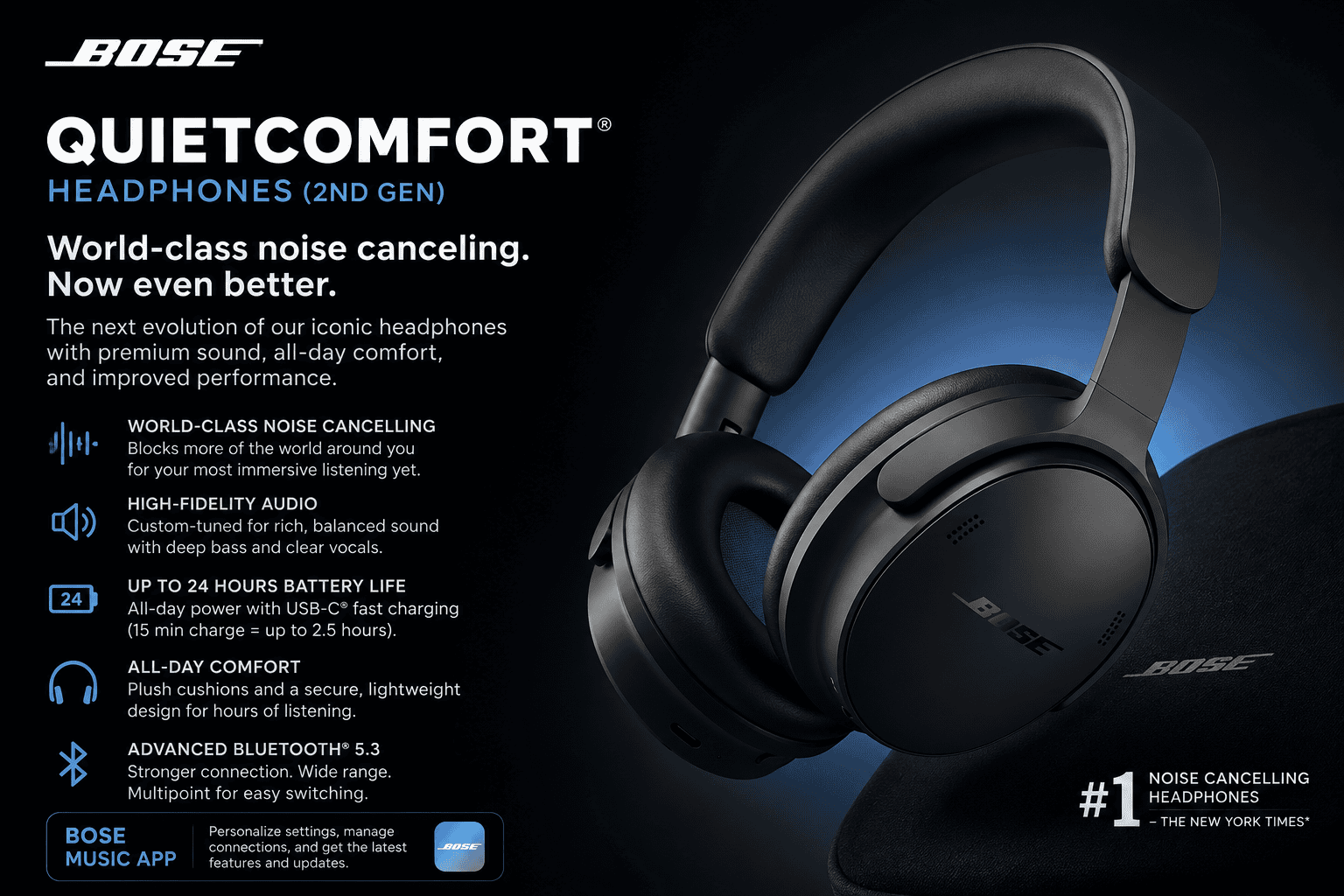
Bose QuietComfort Headphones (2nd Gen) add Immersive Audio and USB-C lossless playback
Bose has refreshed its mainstream QuietComfort headphones for 2026, adding Immersive Audio, improved active noise cancellation, USB-C audio and Bluetooth 5.4 while retaining the physical controls and folding over-ear design associated with the range.
The Bose QuietComfort Headphones (2nd Gen) were announced on 6 August 2026 and began shipping on 13 August. Bose launched them at US$359 in Black, White Smoke and three limited-edition colours: Eucalyptus Green, Dewdrop Mint and Rosewood Mauve. Regional pricing and colour availability can differ.
The second-generation model targets listeners who want full-size wireless noise-cancelling headphones for music, travel, calls and everyday use. One of its more meaningful upgrades is wired USB-C audio at up to 24-bit/48kHz, which gives users another option beyond Bluetooth.
TechnologyBlog.co.za has not tested the QuietComfort Headphones (2nd Gen). This article therefore examines their verified features and specifications rather than making conclusions about sound quality, comfort or noise-cancelling performance.
Immersive Audio moves into the regular QuietComfort range
Bose has brought its TrueSpatial Technology and Immersive Audio system to the standard QuietComfort headphones.
The system can spatialise conventional stereo content rather than requiring music that was specifically produced in a spatial-audio format. Bose provides three listening options called Still, Motion and Cinema.
Still mode attempts to anchor the virtual soundstage in a fixed position while the listener moves their head. Motion mode instead lets the soundstage follow head movement, which makes more sense while walking or travelling.
Cinema mode targets video and spoken content. Bose says it widens the presentation while placing dialogue more prominently towards the centre.
These modes add another listening option rather than replacing conventional stereo playback. Users can also switch Immersive Audio off when they do not need it.
USB-C now carries audio as well as power
The USB-C port represents one of the more practical upgrades.
Bose supports two-way USB-C audio, allowing the headphones to receive audio and transmit microphone audio through the same wired connection. This makes USB-C useful for music as well as voice calls and applications such as Microsoft Teams or Zoom.
Wired playback supports input at up to 24-bit/48kHz. Bose describes this as lossless input, although that specification applies specifically to the wired USB-C connection and should not be confused with lossless Bluetooth transmission.
The microphone signal can travel over USB-C at up to 24-bit/16kHz.
Bose also includes a USB-C-to-3.5mm cable for analogue sources. This is useful for equipment such as in-flight entertainment systems that still rely on a traditional headphone socket.
Users can continue listening even after the battery runs flat. The headphones then operate passively, although active noise cancellation and Bose’s Active EQ functions stop working without power.
QuietControl uses six microphones
Bose now refers to the noise-cancelling system as QuietControl.
The QuietComfort Headphones (2nd Gen) contain six microphones. Bose says it has changed the adaptive feedforward controls so the ANC system can better compensate when glasses, hair or headwear prevent the earcups from creating an ideal seal.
That is a manufacturer performance claim rather than a TechnologyBlog.co.za test result.
Aware Mode provides the opposite function by feeding environmental sound through the headphones. Bose has also updated its ActiveSense system, which can automatically introduce noise cancellation when it detects louder environmental sounds while Aware Mode is active.
Users who do not want electronic noise control can disable ANC entirely through the Bose app. This differs from Aware Mode because turning ANC off also stops the microphone arrays from recreating surrounding sound.
Custom modes allow different combinations of noise cancellation and environmental awareness to be stored for later use.
Bluetooth 5.4 supports two-device multipoint
Wireless connectivity moves to Bluetooth 5.4, and Bose includes multipoint connectivity.
The headphones can maintain connections to two devices simultaneously. For example, a notebook and smartphone can remain paired, allowing the headphones to move between computer audio and an incoming phone call without requiring a new pairing process.
When more than two devices have previously been paired, Bose says the headphones reconnect to the two most recently used devices after powering on.
Android users also receive Google Fast Pair support. Bose lists a wireless range of approximately 30 feet, or just over nine metres, although actual range will depend on the environment and connected hardware.
Physical buttons remain part of the design rather than Bose shifting all controls to touch surfaces.
Controls on the right earcup handle playback, volume and calls. A separate button on the left can change listening modes or trigger configured shortcuts, including the source device’s voice assistant or Spotify Tap.
Battery reaches a stated 24 hours
Bose rates the QuietComfort Headphones (2nd Gen) for up to 24 hours of playback under its test conditions.
Activating Immersive Audio reduces the stated figure to up to 18 hours. Bose also lists a full charging time of around three hours.
A 15-minute quick charge can provide up to 2.5 hours of playback.
The headphones can continue playing audio while charging over USB-C, which could prove useful at a desk when the battery runs low.
As with all manufacturer battery figures, actual endurance will vary according to listening level, connection type, processing features and other usage conditions.
Bose has redesigned the earcups and headband
The second generation receives a visual redesign rather than simply carrying the previous enclosure forward.
Bose has moved to more rounded, pill-shaped earcups and revised the adjustable headband sliders. The company also uses synthetic protein-leather material for the removable ear cushions.
The headphones weigh approximately 0.23kg, based on Bose’s listed 0.507lb product weight.
Their dimensions are roughly 18.5 × 23.1 × 4.7cm when Bose’s published measurements are converted to metric units. A folding design and supplied carrying case help make the full-size headphones easier to transport.
Bose has not moved this standard QuietComfort model into the more extensively metallic construction used elsewhere in its headphone family. The listed materials remain primarily plastic with protein-leather cushioning.
Bose QuietComfort Headphones (2nd Gen) specifications
| Specification | Bose QuietComfort Headphones (2nd Gen) |
|---|---|
| Headphone type | Over-ear, circumaural |
| Noise cancellation | Active, adjustable |
| Microphones | 6 |
| Immersive Audio | Yes |
| Immersive modes | Still, Motion, Cinema |
| Aware Mode | Yes |
| ActiveSense | Yes |
| ANC off mode | Yes |
| Bluetooth | Bluetooth 5.4 |
| Multipoint | Two simultaneous devices |
| Google Fast Pair | Yes |
| USB-C audio | Yes |
| Maximum wired USB-C input | 24-bit/48kHz |
| USB-C microphone output | Up to 24-bit/16kHz |
| Analogue input | Via supplied USB-C-to-3.5mm cable |
| Stated battery life | Up to 24 hours |
| Battery with Immersive Audio | Up to 18 hours |
| Charging time | About 3 hours |
| Quick charge | 15 minutes for up to 2.5 hours |
| Charging while listening | Yes |
| Bose app | Yes |
| Ear cushions | Removable |
| Weight | Approximately 0.23kg |
| Colours | Black, White Smoke, Eucalyptus Green, Dewdrop Mint, Rosewood Mauve |
Bose’s product documentation confirms that the headphones work with its mobile app for EQ adjustment, listening modes, Bluetooth device management, shortcut configuration and firmware updates.
What changed from the previous QuietComfort headphones?
The second generation keeps several fundamentals intact. Battery life remains rated at up to 24 hours, active noise cancellation remains central to the product, and Bose continues to use physical controls.
The more meaningful changes come from the surrounding features.
TrueSpatial Technology and Immersive Audio are now available on the regular QuietComfort model. Bose has also added USB-C audio, an ANC-off listening option, revised ActiveSense processing and changes to the microphone-based noise-cancelling system.
The redesigned enclosure is another visible difference, with new earcup shapes and a revised headband.
USB-C audio may prove particularly useful for people who work between mobile and desktop devices. It lets one cable handle charging, digital audio and microphone transmission rather than treating USB-C purely as a charging connector.
South African buyers should confirm the exact model number
South African listings for the new QuietComfort Headphones (2nd Gen) have started appearing.
However, buyers should check the model and SKU carefully. An iStore South Africa listing headed QuietComfort Headphones (2nd Gen) currently contains body copy and box-content information referring to the QuietComfort Ultra Headphones (2nd Gen). The Black listing identifies SKU BOS890101-0100, while the White model uses BOS890101-0200.
That inconsistency does not change Bose’s official specifications, but it does make checking the exact product before ordering worthwhile.
A broader upgrade than the name suggests
The QuietComfort Headphones (2nd Gen) do not abandon the formula of the previous model. Bose has instead added functions around it.
Immersive Audio broadens the listening modes, while USB-C audio makes the wired connection substantially more useful. Bluetooth 5.4, multipoint support, revised ActiveSense processing and the option to disable ANC provide further flexibility.
The most useful upgrade may ultimately depend on how the headphones will be used. Travellers may care more about QuietControl and the analogue cable, while desktop users may find two-way USB-C audio and simultaneous charging more important.
What cannot be established from specifications alone is whether the revised ANC, microphones and acoustic tuning deliver a meaningful real-world improvement. That requires independent listening and testing rather than Bose’s technical claims.


