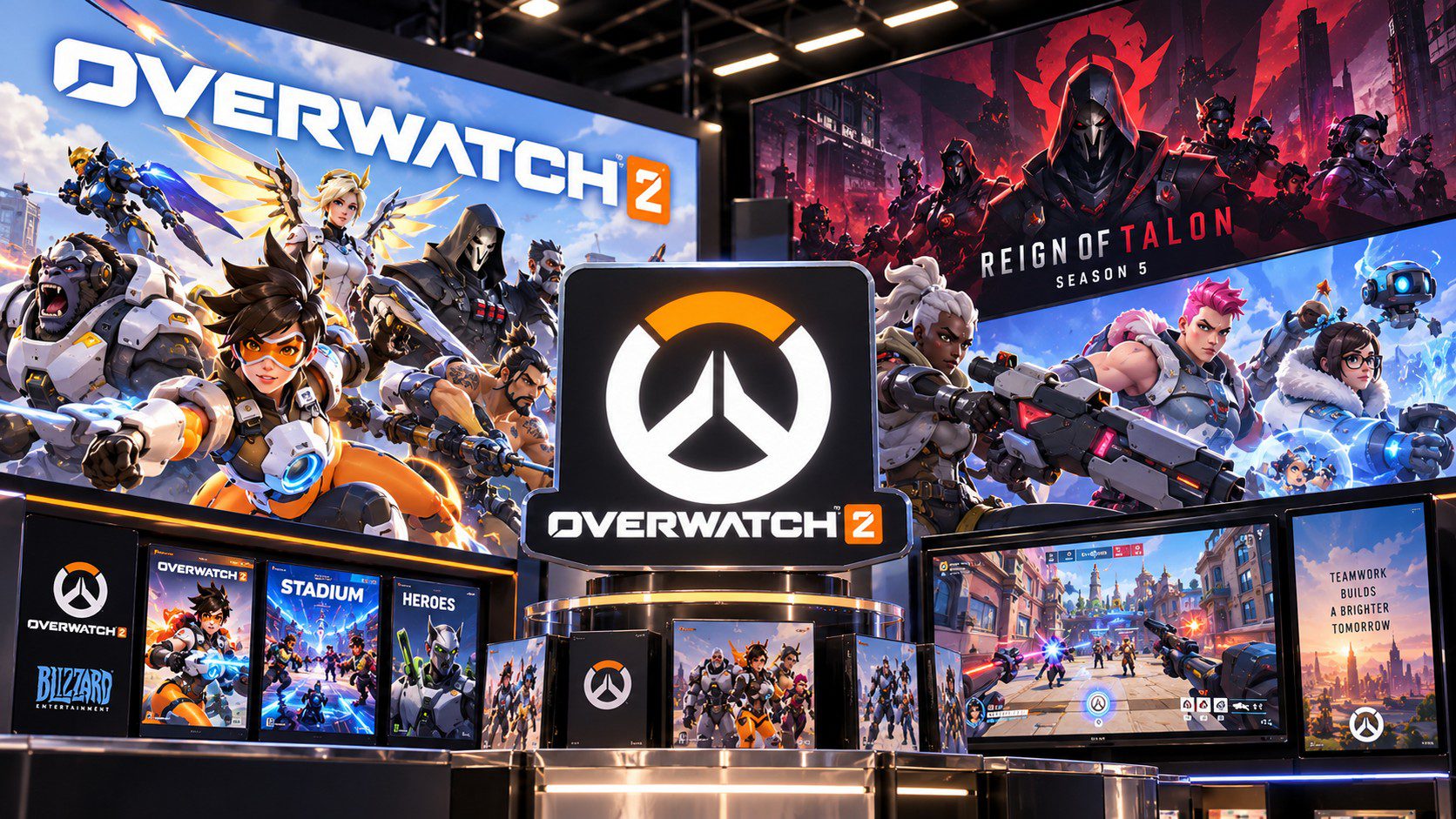
Overwatch is rebuilding its identity around heroes, teamwork and a living world
Overwatch has always been about more than shooting accurately. Its most memorable moments often happen when several players combine their abilities at exactly the right time.
A Tank creates an opening. A Support keeps the team alive, while a Damage hero uses that opportunity to eliminate an opponent. Within seconds, a seemingly lost fight can become a successful push towards the objective.
That cooperation helped establish Blizzard Entertainment’s hero shooter when it launched in 2016.
However, the years that followed brought major changes. The original six-player teams gave way to a five-versus-five structure, Overwatch 2 replaced the first game, and ambitious plans for cooperative story content were scaled back.
In 2026, Blizzard has made another significant change.
The game has returned to the simpler Overwatch name, introduced an interconnected annual storyline and expanded its roster with new heroes. At the same time, alternative modes such as Stadium are giving players different ways to approach familiar characters.
The challenge is no longer simply attracting attention to a successful shooter. It is making Overwatch feel like a coherent game and universe again.
Overwatch makes every hero part of the strategy
Overwatch is a team-based first-person shooter in which players select heroes with distinct weapons, movement abilities and combat roles.
Unlike shooters where every character begins with broadly similar equipment, hero selection changes how a player approaches almost every situation.
Reinhardt fights with a rocket hammer and protects teammates with a barrier. Tracer uses rapid movement and short-range attacks, while Mercy concentrates on healing and supporting allies.
These differences make team composition important.
A group with powerful offensive abilities may struggle without enough protection. A defensively strong team can also find itself unable to secure eliminations.
Winning requires players to understand not only their own hero, but how that hero contributes to the wider team.
Tanks create space rather than simply absorbing damage
Tank heroes are responsible for helping their teams establish and maintain advantageous positions.
They generally possess greater durability than other roles, but their value extends beyond surviving enemy attacks.
A Tank can force opponents away from an important route, protect vulnerable teammates or create an opportunity for the team to advance.
Winston, for example, can leap into contested positions and pressure enemies who prefer fighting from a distance.
D.Va provides mobility and defensive capabilities that allow her to contest threats across the battlefield.
The important decision is knowing when to engage.
A Tank who advances without support can quickly become isolated. One who refuses to contest space may leave teammates unable to reach the objective.
Effective Tank play requires awareness of both the enemy and the team behind them.
Damage heroes turn opportunities into eliminations
Damage heroes concentrate on applying pressure and defeating opponents.
However, their methods differ considerably.
Widowmaker rewards accurate long-range shooting, while Reaper is designed for dangerous close-range encounters. Genji uses mobility and precise timing to threaten vulnerable enemies.
Other Damage heroes can control particular routes or force opponents to reposition.
This variety gives teams several ways to approach the same objective.
A player may need to switch heroes when the opposing composition makes their preferred approach ineffective.
The strongest Damage player is not necessarily the person with the highest elimination count. Securing the right elimination at the right moment can be more valuable than repeatedly attacking a well-protected target.
Support heroes influence the outcome of every fight
Support heroes provide healing, utility and other abilities that help teammates survive and perform effectively.
However, the role is not limited to restoring health.
Ana can interrupt enemy plans with her abilities, while Lúcio helps teammates reposition through movement support.
Kiriko combines healing with mobility and protective utility.
Support players must constantly decide where their attention is needed.
Healing a teammate under pressure might preserve the team’s frontline. Using a defensive ability at the correct moment could prevent an enemy ultimate from deciding the fight.
Positioning also matters.
A Support who becomes isolated can leave the rest of the team without essential assistance.
Overwatch rewards Support players who understand the wider battle rather than concentrating on one health bar.
Objectives give Overwatch its structure
Most core Overwatch matches revolve around objectives rather than eliminations alone.
In Escort, one team attempts to move a payload through the map while the opposing team tries to stop it.
Hybrid combines an initial capture objective with payload movement. Control requires teams to contest a shared area, while Push centres on advancing a robot along a route.
Flashpoint and Clash introduce additional approaches to objective control.
These modes reward teamwork because defeating opponents does not automatically guarantee progress.
A team can win several individual encounters and still lose if it fails to contest the objective at the necessary moment.
Players must balance combat with positioning, timing and awareness of the match state.
Hero switching remains one of Overwatch’s defining mechanics
In core Overwatch modes, players can change heroes during a match, subject to the mode’s rules.
That flexibility allows teams to respond to difficult situations.
An opposing hero may dominate an open sightline. A different selection could provide the mobility or protection needed to challenge that position.
However, switching is not always the best solution.
Players also need to consider their familiarity with alternative heroes and the effect of a change on their team composition.
A well-coordinated group can sometimes overcome an unfavourable matchup through better positioning and timing.
Overwatch’s tactical depth comes partly from these decisions.
Players must continually evaluate whether the problem lies with their hero selection, execution or teamwork.
Ultimate abilities can transform a battle
Every hero has an ultimate ability capable of creating a significant advantage when used effectively.
Some ultimates deliver substantial damage, while others protect teammates or provide powerful utility.
However, activating an ultimate does not guarantee success.
An ability used too early may fail to influence the objective. Using several ultimates in a fight that is already won can leave the team vulnerable during the next engagement.
Coordinating abilities is therefore an important skill.
A team that understands when to commit resources can outperform opponents who use powerful abilities without a shared plan.
That creates some of Overwatch’s most dramatic moments.
A carefully timed combination can change the outcome of a match in seconds.
Overwatch’s visual identity makes heroes recognisable
Blizzard’s character design has always been central to the game’s appeal.
Heroes have distinctive silhouettes, weapons, voices and movement styles.
These differences serve a practical purpose.
Players need to recognise threats quickly during chaotic team fights. A clear character silhouette or familiar sound can help communicate what is happening without requiring players to examine every detail.
The game’s colourful presentation also distinguishes it from more realistic military shooters.
Maps range from futuristic urban environments to locations inspired by real-world cities and landmarks.
This visual variety helps establish Overwatch as a fictional world rather than merely a collection of competitive arenas.
The original Overwatch established the foundation in 2016
Blizzard released the original Overwatch in May 2016.
Its combination of distinctive heroes, accessible controls and team-based objectives quickly attracted attention.
The game also developed a strong identity through animated shorts, character biographies and other material exploring its fictional universe.
Players became interested in the characters beyond their gameplay abilities.
However, the live-service model created expectations for continued updates.
New heroes, maps and balance changes were essential to maintaining competitive interest.
As Blizzard began working towards a sequel, the pace and direction of development became an increasingly important concern for the community.
Overwatch 2 changed the game’s competitive structure
Overwatch 2 launched in October 2022 as a free-to-play successor to the original game.
One of its biggest changes was the move from six-versus-six teams to five-versus-five.
The standard Role Queue composition became one Tank, two Damage heroes and two Supports.
Reducing the number of Tanks changed the rhythm of combat.
Individual Tanks gained greater responsibility, while teams had fewer defensive resources available.
The transition also introduced new heroes, maps, modes and progression systems.
However, the sequel was controversial, particularly because the original Overwatch was replaced rather than maintained as a separate live game.
The cancelled PvE ambitions damaged confidence
Blizzard originally presented Overwatch 2 with ambitious plans for cooperative player-versus-environment content.
These plans included deeper progression systems and Hero Missions intended to expand the game’s story-driven possibilities.
In 2023, Blizzard announced that the original Hero Mission vision would not proceed.
The decision disappointed players who had expected a substantial cooperative experience to distinguish the sequel from its predecessor.
Blizzard subsequently released more limited story missions, but these did not fulfil the earlier ambitions.
That history remains relevant because it helps explain why the company’s promises surrounding future Overwatch content attract scrutiny.
A renewed focus on storytelling must be judged by what Blizzard actually delivers.
Stadium gives Overwatch a different competitive experience
Blizzard introduced Stadium in 2025 as a permanent alternative to the core Quick Play and Competitive modes.
Stadium combines five-versus-five team combat with round-based progression.
Players earn resources during matches and use them to purchase items or select powers that modify their heroes.
This creates a different relationship between hero selection and strategy.
A familiar character can develop new strengths depending on the upgrades selected.
Stadium also supports first-person and third-person perspectives, giving players more flexibility in how they approach combat.
Unlike core Overwatch, where hero switching is an important tactical tool, Stadium places greater emphasis on developing a selected hero through the match.
The result draws on ideas associated with multiplayer online battle arenas while retaining Overwatch’s combat identity.
Overwatch’s New MOBA-Inspired Mode
+1
Overwatch dropped the sequel number in 2026
In February 2026, Blizzard removed the numeral from Overwatch 2 and returned to the original Overwatch name.
The change accompanied a broader effort to redefine the game’s identity.
Rather than continuing to distinguish the current product primarily as a sequel, Blizzard began presenting it as an evolving platform with ongoing stories and major annual updates.
The company also introduced a new seasonal structure.
Season 1 began on 10 February, launching the first chapter of Reign of Talon.
Blizzard announced ten new heroes for 2026, with five arriving at the beginning of the storyline.
The approach represents one of the largest changes to Overwatch’s live-service direction since the launch of Overwatch 2.
Overwatch
Reign of Talon connects gameplay with storytelling
The Reign of Talon storyline follows the growing conflict involving Talon and the heroes opposing it.
Rather than treating each season as a largely separate collection of cosmetics and gameplay changes, Blizzard has organised the year around a connected narrative.
The story unfolds through cinematics, motion comics, events, character interactions and other material.
New heroes also contribute to the developing conflict.
This gives Blizzard opportunities to connect gameplay updates with the fictional world.
However, the approach creates a new expectation.
Players will want the narrative to progress meaningfully rather than functioning only as a theme for seasonal rewards.
Blizzard has described the storyline as having a defined beginning, middle and conclusion across the year’s seasons.
Overwatch
New heroes are changing the roster throughout 2026
Blizzard’s 2026 updates have introduced several characters tied to the developing storyline.
Season 2 added Sierra, a Damage hero connected to Watchpoint: Grand Mesa.
Season 3 introduced Shion, an Omnic Damage hero associated with the Hashimoto Clan.
Season 4 brought D.Mon into the Tank roster, expanding the game’s established MEKA Squad storyline.
These additions provide more than new combat abilities.
Each hero also introduces relationships, motivations and connections to existing characters.
That approach gives the growing roster a stronger narrative purpose while providing players with additional tactical options.
Overwatch
+2
Season 5 introduces Doctrine and major hero changes
Overwatch’s latest season, Reign of Talon — Season 5: A Grim Doctrine, launched on 6 October 2026.
The update introduces Doctrine, a Support hero whose abilities revolve around manipulating life force.
His character and abilities connect directly to the ongoing Talon storyline.
Season 5 also introduces substantial changes to established heroes.
Sombra has moved into the Support role, while Roadhog has received a rework intended to reduce the frustration associated with his Chain Hook and improve his ability to support teammates as a Tank.
These changes affect more than individual character balance.
They can alter team compositions, hero matchups and established strategies.
The October patch also includes adjustments to hit detection and other gameplay systems.
Overwatch
+1
Halloween brings Mystery Madness to Overwatch
Season 5 also introduces Mystery Madness: Graveyard Games, a Halloween-themed event.
The mode combines elements of Mystery Heroes, Junkenstein’s Lab and Stadium.
Players can complete event challenges, earn rewards and participate in a voting system that influences which characters appear in the limited-time experience.
The event demonstrates how Blizzard uses temporary modes to experiment with gameplay outside the standard competitive structure.
Such activities allow the developers to introduce unusual mechanics without permanently changing core matches.
For players, they also provide a different way to engage with familiar heroes.
Patch Notes
Battle Pass changes offer more flexibility
Season 5 introduces another important progression change.
Blizzard has updated the Battle Pass system to allow players to activate eligible current or previously released passes.
The change provides more flexibility in deciding which rewards to pursue, although availability and progression remain subject to the system’s rules.
This is significant for a game with years of seasonal cosmetic content.
Players who missed earlier rewards may have additional opportunities to work towards them.
However, Battle Pass systems still involve questions about pricing, progression requirements and the value of available rewards.
Their success depends on whether players consider the time and spending involved worthwhile.
Overwatch
Competitive Overwatch remains demanding
Overwatch’s competitive modes test individual skill and teamwork over repeated matches.
Players must understand their selected heroes, communicate effectively and respond to changing team compositions.
Mechanical ability matters, but it is only one part of successful play.
A team that manages its ultimates, maintains useful positions and coordinates engagements can overcome opponents with stronger individual aim.
Blizzard also maintains a professional esports ecosystem through the Overwatch Champions Series.
Competitive play remains important to the game’s identity, even as its seasonal storytelling and alternative modes expand.
The challenge is keeping the competitive environment understandable and rewarding as the roster grows.
Why Overwatch matters in 2026
Overwatch helped establish the hero shooter as a major competitive genre.
Its combination of distinctive characters, objective-based combat and coordinated abilities created a recognisable identity.
However, the game has also experienced difficult transitions.
The move to Overwatch 2 changed team composition and progression, while abandoned PvE ambitions damaged confidence in Blizzard’s direction.
The return to the Overwatch name in 2026 represents an attempt to move beyond those divisions.
New heroes, the Reign of Talon storyline, Stadium and continuing competitive updates suggest a renewed commitment to developing the game as a connected experience.
Whether that approach succeeds will depend on the quality and consistency of future updates.
For now, Overwatch’s greatest strength remains unchanged.
Its best moments happen when individual heroes stop fighting as separate characters and begin working as a team.


