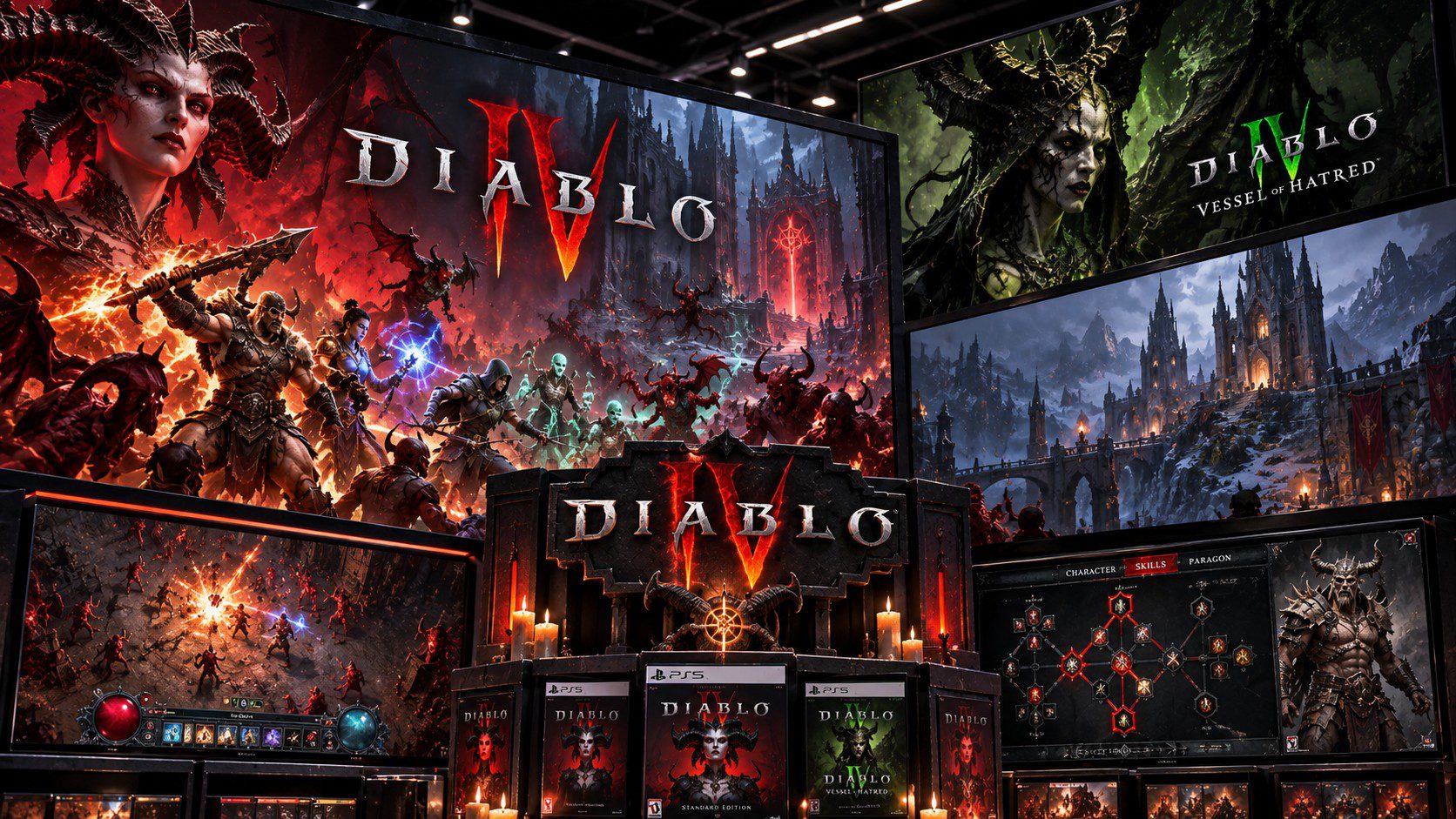
Diablo IV turns the hunt for power into an endless battle for Sanctuary
Diablo IV has a way of making one more dungeon seem like a reasonable idea, even when the previous one was supposed to be the last.
A powerful weapon might drop from the next boss. A rare item could transform an existing character build, while another Paragon upgrade might provide enough damage or defence to tackle a higher difficulty.
That anticipation is central to Blizzard Entertainment’s action role-playing game.
Diablo IV combines fast, ability-driven combat with character customisation, equipment progression and a dark fantasy world threatened by demons, cultists and ancient powers.
However, the experience has changed considerably since its 2023 launch.
Expansions have introduced new regions and classes, while seasonal updates have reworked progression and expanded the endgame. In 2026, Blizzard is celebrating 30 years of Diablo with content that revisits some of the franchise’s most recognisable enemies.
The result is a game where completing the story is only one part of a much longer journey.
Diablo IV returns players to a world consumed by conflict
Sanctuary is a world caught between the High Heavens and the Burning Hells.
Its inhabitants have spent generations suffering through conflicts involving angels, demons and powerful supernatural forces.
Diablo IV’s original campaign centres on Lilith, the daughter of Mephisto and one of Sanctuary’s creators.
Her return threatens an already troubled world, forcing players to confront cultists, monsters and competing interests as they investigate her intentions.
The story takes a darker approach than many conventional fantasy adventures.
Villages are devastated, religious institutions struggle with corruption, and even apparent allies can have questionable motives.
Rather than presenting Sanctuary as a heroic kingdom waiting to be saved, Diablo IV depicts a world where survival often requires difficult choices.
Combat makes every character build feel different
Diablo IV uses an isometric perspective, allowing players to move through environments while attacking enemies with weapons, spells and specialised abilities.
Combat can become extremely fast, particularly when a character’s equipment and skills begin working together.
However, different classes approach encounters in very different ways.
A Barbarian can charge into groups of enemies and fight at close range. A Sorcerer uses elemental magic to control the battlefield, while a Rogue can combine mobility with precise attacks.
The Necromancer can command undead servants or concentrate on direct damage and other dark abilities.
Druids can draw on nature magic and shapeshifting, creating builds centred on different forms and elemental powers.
The important distinction is that choosing a class does not determine every aspect of the character.
Players develop their own approach through skills, equipment and progression systems.
Diablo IV’s classes offer different approaches to power
The original game launched with five playable classes: Barbarian, Druid, Necromancer, Rogue and Sorcerer.
Vessel of Hatred subsequently introduced the Spiritborn, a class associated with the jungles of Nahantu and spiritual combat traditions.
Lord of Hatred expanded the roster again through the Paladin and Warlock.
The Paladin draws on holy power, while the Warlock channels darker forces.
Each class has its own mechanics, abilities and equipment considerations.
That variety gives players reasons to experiment with different characters.
Someone who enjoys a durable melee build may find a ranged spellcaster less comfortable. Another player might prefer a mobile character capable of rapidly moving between enemies.
Diablo IV’s class system allows those preferences to influence the entire experience.
Skill choices define how a character fights
Character progression begins with selecting skills and developing their interactions.
A build might concentrate on one primary damage ability, supported by defensive skills and effects that improve resource generation.
Another could rely on damage-over-time effects, summoned allies or abilities that trigger additional attacks.
These decisions influence which equipment becomes valuable.
An item that strengthens a particular skill may be extremely useful to one build while offering little benefit to another.
That creates a relationship between character development and loot.
Players are not simply looking for equipment with larger numbers.
They are searching for items that make their chosen abilities work more effectively together.
Loot is the foundation of Diablo IV’s progression
Equipment is central to the Diablo experience.
Weapons, armour, jewellery and other items provide statistics and effects that influence how characters perform.
Early in the game, replacing equipment is relatively straightforward.
A new weapon may offer a clear improvement, while additional armour helps a character survive dangerous encounters.
Later, the decisions become more complicated.
Players begin searching for specific affixes, unique effects and combinations that support their builds.
A rare item might enable a different approach to combat or provide an important defensive advantage.
The strongest equipment is not necessarily the piece with the highest visible damage value.
Its usefulness depends on the character using it.
Legendary and Unique items encourage experimentation
Legendary items provide special effects that can influence abilities or other gameplay systems.
These effects often become important when developing a particular build.
Unique items offer more specialised properties and can become central to particular strategies.
At the highest levels of progression, Mythic Unique equipment provides especially powerful possibilities.
However, obtaining a desirable item is only part of the process.
Players must consider how it interacts with the rest of their equipment, skills and Paragon selections.
A build that performs well with ordinary equipment may behave differently after acquiring a defining Unique.
This creates one of Diablo IV’s strongest incentives to keep playing.
The next useful item might not merely improve a character. It could change how that character fights.
Paragon progression adds depth beyond ordinary levelling
Once characters reach the appropriate progression stage, the Paragon system provides additional customisation.
Players develop their characters through boards containing different nodes and bonuses.
Glyphs provide further opportunities to strengthen particular attributes or playstyles.
These choices become increasingly important as players tackle difficult endgame activities.
A character may have the right equipment but still struggle because its Paragon configuration does not support the intended build.
Alternatively, adjusting progression choices can improve damage, survivability or other important characteristics.
The system rewards players who enjoy understanding how different mechanics interact.
However, it can also feel complicated to newcomers.
Diablo IV’s deeper progression systems require experimentation and, in some cases, careful planning.
Sanctuary’s open world encourages exploration
Unlike earlier Diablo games built primarily around connected acts and areas, Diablo IV features a large shared open world.
Players can travel between regions, discover settlements and encounter activities outside the main campaign.
The original game’s environments include fractured coastlines, deserts, mountains and swamps.
Each region has its own atmosphere, enemies and environmental details.
Exploration also reveals side quests, dungeons, strongholds and other activities.
Some provide additional background about Sanctuary, while others offer equipment, experience or useful progression rewards.
The world gives players opportunities to move away from the main storyline without abandoning character development.
Strongholds and dungeons provide different challenges
Strongholds are hostile locations that players can reclaim by completing particular objectives.
These activities often involve clearing enemies, confronting powerful opponents and restoring access to an area.
Dungeons provide more contained encounters.
Players move through hostile environments, defeat enemies and complete objectives before confronting a final challenge.
Although the activities share Diablo IV’s basic combat systems, they serve different purposes.
Strongholds help make the world feel responsive to the player’s actions.
Dungeons provide repeatable opportunities for combat, rewards and character progression.
As players become stronger, more demanding dungeon variants become increasingly important.
Nightmare Dungeons test the strength of a build
Nightmare Dungeons are a major part of Diablo IV’s endgame.
These modified dungeon experiences introduce additional difficulty and mechanics that require players to adapt.
A character capable of clearing ordinary enemies may struggle when facing more dangerous combinations of attacks and environmental hazards.
Survivability becomes particularly important.
Players must balance damage output against armour, resistances, defensive abilities and positioning.
The challenge is not simply defeating more enemies.
It is building a character that can perform consistently under increasing pressure.
Nightmare Dungeons also provide opportunities to develop progression systems and pursue rewards.
The Pit offers a direct measure of character power
The Pit is another important endgame activity.
Its tiered structure allows players to tackle increasingly demanding combat encounters.
Progress depends on defeating enemies efficiently and surviving the final challenge.
For players experimenting with character builds, The Pit provides a practical way to evaluate changes.
A new weapon, Paragon adjustment or defensive improvement may allow a character to complete a higher tier.
However, increasing difficulty can reveal weaknesses that were not obvious in easier content.
A build with impressive damage may struggle against powerful enemies if its defences are inadequate.
The Pit therefore encourages players to think about overall performance rather than damage alone.
Boss encounters give players specific goals
Diablo IV includes powerful bosses that provide difficult encounters and opportunities to pursue valuable equipment.
Some are connected to the campaign, while others form part of repeatable endgame activities.
Boss farming gives players a more focused objective than general exploration.
Instead of clearing random enemies, they can pursue encounters associated with particular rewards.
However, success depends on preparation.
Players need enough damage to complete the fight, but they must also understand attack patterns and defensive requirements.
At higher difficulties, simply possessing powerful equipment may not be sufficient.
Knowing when to attack, reposition or use defensive abilities becomes essential.
Difficulty progression changes how Diablo IV is played
Diablo IV allows players to move into increasingly demanding difficulty settings as their characters become stronger.
Higher difficulty levels make enemies more dangerous while providing opportunities for improved rewards.
This creates a progression cycle.
Players gather equipment, strengthen their builds and attempt harder content.
If they succeed, they can pursue further improvements.
If they struggle, they may need to reconsider their skills, equipment or defensive statistics.
The best difficulty is not necessarily the highest one a character can technically survive.
For farming, efficiency matters.
A player who clears slightly easier content quickly and consistently may make better progress than someone who spends excessive time struggling through a higher tier.
Seasons give Diablo IV a changing identity
Diablo IV uses seasonal updates to introduce new activities, mechanics and progression opportunities.
Seasonal characters participate in the current season’s systems, while Eternal Realm characters provide a more persistent alternative.
This structure allows Blizzard to experiment with different mechanics without permanently adding every seasonal feature to the base game.
However, it also means returning players may encounter substantial changes.
Equipment systems, class balance and progression activities can evolve between seasons.
A build that performed well several months earlier may require adjustments.
For some players, this constant change keeps Diablo IV interesting.
Others may prefer the stability of developing a long-term character on the Eternal Realm.
Both approaches offer different ways to engage with the game.
Vessel of Hatred expanded Diablo IV into Nahantu
Released in October 2024, Vessel of Hatred continued Diablo IV’s story following the events of the original campaign.
The expansion introduced Nahantu, a jungle region associated with new enemies, locations and challenges.
It also introduced the Spiritborn class.
The Spiritborn’s combat style draws on spiritual guardians and abilities that support different approaches to offence, defence and mobility.
The expansion broadened Diablo IV’s world while providing additional character-building possibilities.
It also continued the central conflict involving Mephisto, establishing important developments for the next major chapter.
Lord of Hatred brings the conflict to Skovos
Lord of Hatred represents another major expansion of Diablo IV.
The story takes players towards Skovos, an ancient island region connected to Sanctuary’s history.
Mephisto, the Lord of Hatred, remains central to the conflict.
The expansion also introduces the Paladin and Warlock classes, further increasing the available character-building options.
Additional dungeons, activities and endgame systems give players new reasons to develop their characters.
For returning players, the expansion represents more than a new story location.
New classes and progression opportunities can change how they approach the entire game.
diablo4.blizzard.com
Season of Hell’s Legacy celebrates Diablo’s 30th anniversary
Diablo’s 30th anniversary is a major theme of the current 2026 season.
Season of Hell’s Legacy began rolling out on 15 September, revisiting important characters and threats from the franchise’s history.
Deckard Cain returns as part of the seasonal narrative, while players confront echoes of the Prime Evils.
The season introduces Soul Splinters, which allow players to harness aspects of demonic power.
It also brings new rewards and additional progression opportunities.
For long-time Diablo players, the season connects the modern game to its earlier entries.
For newer players, it provides an introduction to some of the characters and conflicts that helped establish the series.
Blizzard News
Diablo IV continues changing beyond its expansions
Blizzard’s updates have not been limited to new story content.
The development team has repeatedly adjusted equipment progression, crafting, class balance and endgame activities.
These changes matter because Diablo IV depends heavily on how rewarding its progression feels.
If desirable items are too difficult to obtain, players may lose interest.
If powerful equipment becomes too common, the satisfaction of finding an upgrade can diminish.
Similarly, overly complicated crafting systems can make character development feel frustrating rather than rewarding.
Blizzard must continually balance accessibility, challenge and long-term progression.
That process is especially important for players who return at the beginning of each season.
Blizzard has announced more Diablo content beyond 2026
At BlizzCon 2026, Blizzard announced that Diablo V is planned for spring 2029.
The company also revealed an Amazon class pack planned for Diablo IV in 2027.
These announcements establish a longer-term direction for the franchise, but they should not be confused with content currently available in Diablo IV.
The Amazon class pack remains a future addition.
Diablo V is a separate game, not another Diablo IV expansion.
For the current game, Blizzard continues supporting seasonal content and character progression while preparing additional updates.
Blizzard News
Why Diablo IV remains compelling in 2026
Diablo IV is built around a deceptively simple idea: defeat enemies, collect equipment and become stronger.
However, that cycle becomes increasingly complex as players develop their characters.
Skills interact with equipment. Paragon choices influence performance, while harder activities reveal weaknesses that ordinary encounters may not expose.
The open world and campaign provide a dark fantasy setting, but the endgame gives players reasons to continue experimenting long after the main story ends.
Expansions such as Vessel of Hatred and Lord of Hatred have broadened the experience.
Meanwhile, the 30th-anniversary season connects Diablo IV to the franchise’s history.
Its lasting appeal depends on whether Blizzard can keep the relationship between challenge and reward satisfying.
For players who enjoy developing builds, pursuing rare equipment and testing their progress against increasingly difficult enemies, Sanctuary still offers plenty of reasons to return.
And there is always the possibility that the next boss will finally drop the item they have been looking for.


