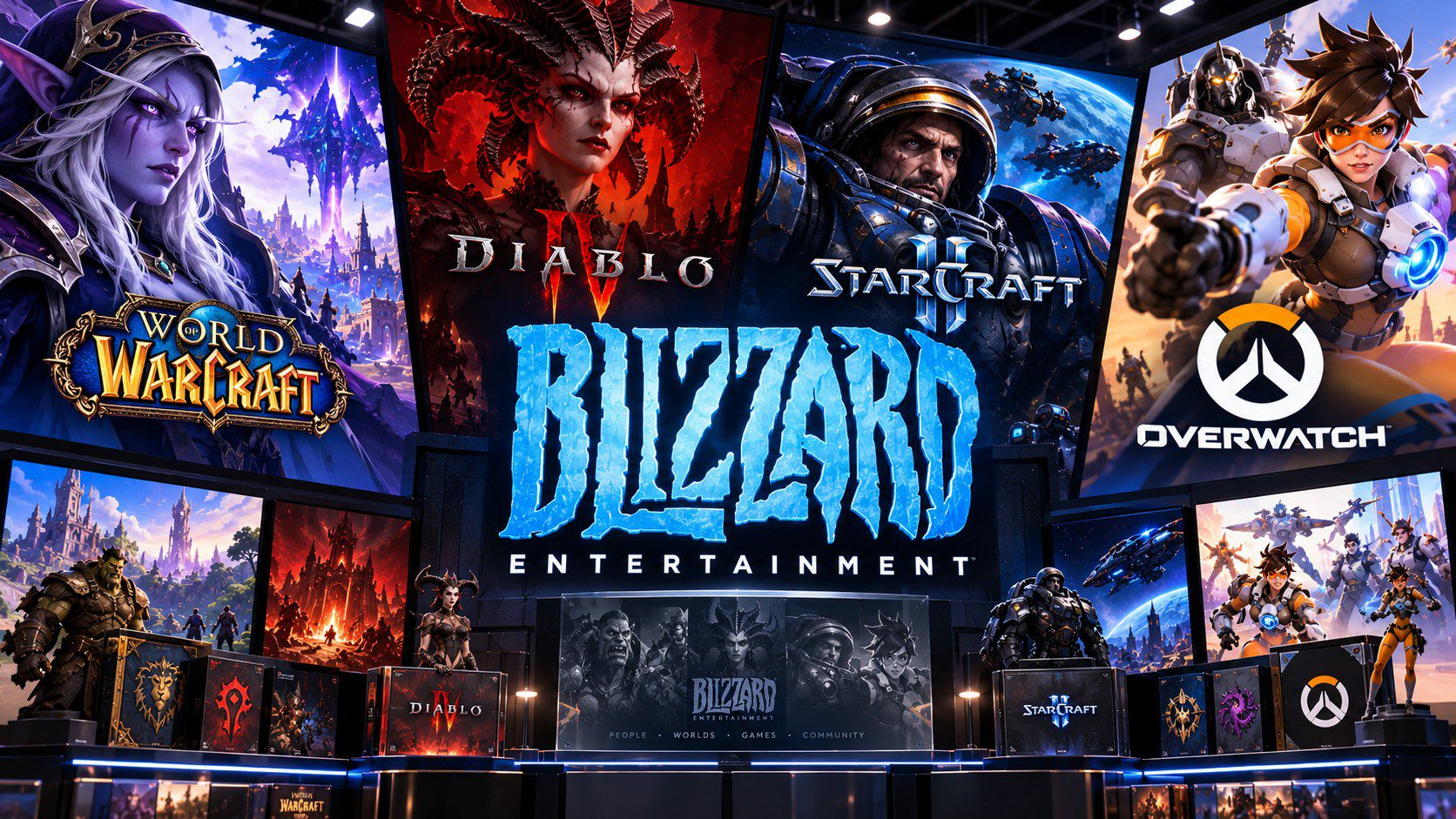
Blizzard Entertainment built worlds players never wanted to leave
Blizzard Entertainment has spent more than three decades creating games that players return to long after their original release dates.
For some, that relationship began with commanding armies in Warcraft. Others discovered Blizzard through the frantic hunt for equipment in Diablo, the competitive battles of StarCraft or the enormous shared world of World of Warcraft.
More recently, Hearthstone and Overwatch introduced the company to different audiences.
These games do not share one genre, but they reveal a consistent ambition. Blizzard has repeatedly tried to create worlds with enough depth, personality and replayability to support communities for years.
That approach helped establish its reputation as one of the most influential developers in PC gaming.
However, maintaining that reputation has become increasingly difficult. Changing player expectations, controversial development decisions, workplace disputes and corporate restructuring have all affected the company.
Now part of Microsoft Gaming, Blizzard enters the latter half of the 2020s with a substantial legacy and the challenge of deciding what comes next.
Blizzard Entertainment began as Silicon & Synapse
Blizzard’s history began in 1991 when Mike Morhaime, Allen Adham and Frank Pearce founded Silicon & Synapse.
The small California studio initially worked on games for other publishers, developing technical expertise while establishing its identity.
Early projects included The Lost Vikings, a puzzle-platform game built around three characters with different abilities, and Rock N Roll Racing, which combined racing with combat.
These games demonstrated the team’s interest in accessible mechanics supported by increasingly demanding challenges.
The company later adopted the Chaos Studios name before becoming Blizzard Entertainment in 1994.
That change coincided with the beginning of a new chapter.
Rather than remaining primarily a developer of smaller projects, Blizzard was preparing to establish franchises that would define its future.
Warcraft helped establish Blizzard’s strategy identity
Released in 1994, Warcraft: Orcs & Humans introduced players to a fantasy conflict between human and orc armies.
Its real-time strategy gameplay required players to gather resources, construct buildings and command units while responding to enemy attacks.
The game helped establish the foundation for one of Blizzard’s most important franchises.
Warcraft II: Tides of Darkness expanded the formula in 1995, introducing additional units, naval combat and a larger conflict.
However, the series became more ambitious with Warcraft III: Reign of Chaos in 2002.
Its heroes, storytelling and faction identities gave the fantasy world greater depth.
The game also supported custom maps, allowing players to experiment with experiences beyond the original campaign and competitive modes.
Those community creations became an important part of Warcraft’s wider influence.
Diablo made collecting equipment an adventure of its own
Blizzard’s influence extended into action role-playing games with Diablo, released in 1996.
Developed by Blizzard North, the game sent players beneath the town of Tristram to confront monsters, collect equipment and descend through increasingly dangerous environments.
Its atmosphere helped establish the franchise’s identity.
Dark environments, unsettling music and dangerous enemies created a sense of vulnerability, even as players became stronger.
However, Diablo’s lasting appeal depended on more than atmosphere.
Randomised equipment and character progression gave players reasons to return.
Diablo II, released in 2000, expanded those systems through additional classes, skills and equipment possibilities.
The franchise helped popularise a style of action RPG in which developing a character becomes as important as completing the story.
StarCraft became a competitive strategy landmark
Blizzard entered science-fiction strategy with StarCraft in 1998.
The game introduced three distinctive factions: Terran, Zerg and Protoss.
Each required different approaches to resource management, army composition and battlefield control.
That asymmetry became one of StarCraft’s defining strengths.
Players could not simply apply identical strategies to every faction.
They needed to understand their own strengths while anticipating the capabilities of their opponents.
The game became particularly influential in competitive gaming, especially in South Korea, where professional StarCraft competition developed a substantial following.
StarCraft II, released in 2010, continued the franchise through new campaigns, multiplayer systems and competitive events.
The series helped demonstrate that strategy games could support highly skilled spectator competition.
World of Warcraft changed the scale of online gaming
In 2004, Blizzard launched World of Warcraft.
The massively multiplayer online role-playing game transformed Azeroth into a persistent world where players could explore, complete quests, develop characters and participate in group activities.
Its appeal extended beyond conventional progression.
Players formed guilds, organised raids, traded equipment and developed friendships that continued outside the game.
For many, Azeroth became a familiar place rather than simply a collection of quests.
Blizzard supported that relationship through expansions that introduced new regions, stories, classes and gameplay systems.
However, the game’s longevity also created challenges.
New players needed ways to understand an increasingly complicated world, while experienced players expected fresh content without losing the elements they valued.
Maintaining both audiences became one of Blizzard’s most demanding responsibilities.
World of Warcraft continues expanding in 2026
More than two decades after its original launch, World of Warcraft remains a central Blizzard franchise.
Its 2026 expansion, Midnight, launched on 2 March.
The expansion continues the Worldsoul Saga and centres on the threat posed by Xal’atath and the forces of the Void.
Players return to important locations associated with Quel’Thalas while exploring new and reimagined areas.
The expansion also develops character progression, group content and housing systems.
For Blizzard, Midnight demonstrates the continuing challenge of operating a long-running MMORPG.
The studio must create meaningful new experiences while preserving the world and characters that players have followed for years.
Its official Midnight launch announcement provides details of the expansion and its initial content schedule.
Hearthstone brought Warcraft to card games
Blizzard entered digital collectible card games with Hearthstone in 2014.
The game uses characters, creatures and spells inspired by the Warcraft universe, but its mechanics differ substantially from the original strategy games.
Players construct decks and compete through turn-based matches.
The rules are relatively approachable, yet the interactions between cards can create complex strategic decisions.
Hearthstone also demonstrated Blizzard’s ability to reinterpret an established fictional world for a different audience.
Someone unfamiliar with real-time strategy or MMORPGs could still enjoy the characters and atmosphere through card gameplay.
Over time, the game expanded through additional modes, card sets and seasonal systems.
That development made Hearthstone another example of Blizzard’s preference for supporting games over long periods rather than treating release as the final milestone.
Heroes of the Storm brought Blizzard’s characters together
Heroes of the Storm launched in 2015 as Blizzard’s entry into the multiplayer online battle arena genre.
Its roster brought together characters from Warcraft, Diablo, StarCraft and other Blizzard properties.
The game emphasised team objectives, shared experience and maps with different strategic mechanics.
Rather than reproducing every convention of established MOBAs, Blizzard experimented with a more team-focused structure.
However, the game struggled to maintain the level of support originally envisioned.
In 2018, Blizzard announced a reduction in its esports and development commitments. In 2022, it moved the game into a more limited maintenance-oriented support model.
Heroes of the Storm remains an important example of a Blizzard project that did not achieve the long-term commercial position of its largest franchises.
It also demonstrates that recognisable characters cannot guarantee lasting success in every genre.
Overwatch established a new Blizzard universe
Blizzard released Overwatch in 2016, introducing a colourful team-based shooter built around heroes with distinctive abilities.
The game combined first-person combat with character roles and objective-based teamwork.
Its roster included Tanks, Damage heroes and Supports, each contributing differently to team strategy.
Overwatch also introduced a new fictional universe with its own characters, locations and conflicts.
Animated shorts and other storytelling material helped establish that world beyond individual matches.
However, the franchise later experienced a difficult transition.
Overwatch 2 introduced five-versus-five combat and a free-to-play model, while plans for ambitious cooperative PvE content were substantially reduced.
Those decisions affected player confidence and created questions about Blizzard’s long-term direction.
Overwatch returned to its original name in 2026
Blizzard made another significant change in February 2026 by returning to the simpler Overwatch name.
The relaunch introduced the Reign of Talon storyline and a broader approach to seasonal storytelling.
New heroes, events and gameplay changes now contribute to a connected narrative.
The game also continues developing alternative modes such as Stadium, which combines hero-based combat with upgrade systems and round-based strategy.
These changes represent an effort to reconnect Overwatch’s competitive gameplay with the fictional world that helped establish its identity.
TechnologyBlog’s dedicated Overwatch game profile explores its hero roles, gameplay systems and major 2026 developments.
For Blizzard, the franchise remains an important test of its ability to rebuild confidence while maintaining a competitive live-service game.
Diablo IV continues the studio’s action RPG legacy
Diablo IV launched in June 2023, returning players to Sanctuary through an open-world action RPG built around character progression, combat and equipment.
Its original campaign introduced Lilith as a central antagonist.
However, the game’s longer-term appeal depends heavily on its endgame activities.
Players develop builds, pursue rare equipment and challenge increasingly demanding enemies.
Expansions and seasonal updates have continued changing the experience.
Vessel of Hatred expanded the world through Nahantu and introduced the Spiritborn class.
Further development of the franchise demonstrates Blizzard’s continuing investment in the action RPG genre.
TechnologyBlog’s Diablo IV profile examines the game’s loot systems, character builds and endgame progression in greater detail.
Blizzard’s approach depends on long-term communities
Many Blizzard games share a particular design challenge.
They are built around experiences that players can continue enjoying for years.
That creates opportunities unavailable to games with fixed campaigns.
A new expansion can bring former players back to World of Warcraft. A balance update can change competitive strategies in Overwatch, while a new Diablo season can encourage players to experiment with different builds.
However, long-term development also creates expectations.
Players invest time in characters, communities and progression systems.
Major changes can therefore affect more than individual gameplay mechanics.
A redesign that attracts newcomers may frustrate experienced players who preferred an earlier system.
Blizzard’s reputation has often depended on how effectively it manages that tension.
Battle.net became part of Blizzard’s identity
Blizzard’s online infrastructure has also played an important role in its history.
Battle.net began as an online gaming service associated with the original Diablo era and subsequently expanded across the company’s portfolio.
Today, it provides account management, game access, social features and supporting services for Blizzard titles.
For players, the platform connects several franchises through a common ecosystem.
For Blizzard, it provides infrastructure for distribution, updates and online participation.
However, operating an online platform also creates responsibilities.
Security, account recovery, server reliability and communication become essential parts of the player experience.
A technically impressive game can still frustrate players when the services supporting it fail.
BlizzCon became a meeting place for Blizzard communities
BlizzCon has long provided an opportunity for Blizzard to bring its different communities together.
The event combines announcements, developer presentations, competitions and activities connected to its franchises.
For players, it offers a way to celebrate games they may have followed for years.
For Blizzard, it provides a platform for explaining development plans and presenting new projects.
However, major events also create expectations.
Announcements attract attention, but players ultimately judge whether the promised experiences arrive and meet expectations.
The history of cancelled or reduced projects demonstrates why that distinction matters.
BlizzCon can generate excitement, but the company’s credibility depends on what happens after the presentations end.
Blizzard’s cancelled projects reveal the difficulty of development
Blizzard has a history of cancelling projects that did not meet its expectations.
One notable example was Titan, an ambitious MMO project that was cancelled after years of development.
Elements of the team’s experience subsequently contributed to the development of Overwatch, although the resulting game was substantially different.
The studio has also faced criticism over announced features that did not materialise.
The reduction of Overwatch 2’s original PvE ambitions became particularly controversial because cooperative progression had been presented as an important part of the sequel.
These decisions illustrate a difficult reality.
Cancelling an unsuccessful project may be commercially sensible, but announcing ambitious plans creates expectations that can be difficult to reverse.
Blizzard’s challenge is communicating those changes clearly while retaining player trust.
Workplace controversies affected Blizzard’s reputation
Blizzard’s history also includes serious workplace controversies.
In 2021, California regulators brought legal action against Activision Blizzard over alleged workplace discrimination and related misconduct.
The case generated substantial public attention and criticism of the company’s workplace culture.
In December 2023, California’s Civil Rights Department announced a settlement concerning allegations of unequal pay and promotion opportunities affecting women.
The agreement, approved by a court in January 2024, provided approximately $54.9 million for relief and related costs, alongside commitments concerning employment practices.
The settlement resolved the specified legal claims without establishing every allegation originally made in the litigation.
The controversy remains important to Blizzard’s history because a company’s reputation depends on more than the games it produces.
Its treatment of employees, management practices and willingness to address workplace concerns also matter.
CRD
Microsoft acquired Activision Blizzard in 2023
Blizzard entered a new ownership structure when Microsoft completed its acquisition of Activision Blizzard on 13 October 2023.
The transaction brought Activision, Blizzard Entertainment and King into Microsoft’s gaming business.
However, these companies have different development histories and franchises.
Blizzard is associated with Warcraft, Diablo, StarCraft, Hearthstone and Overwatch.
Activision’s portfolio includes Call of Duty, while King is best known for mobile games such as Candy Crush.
The acquisition expanded Microsoft’s gaming operations across PC, console and mobile platforms.
It also placed Blizzard within a much larger corporate organisation.
Microsoft’s official acquisition announcement confirmed the completion of the transaction.
The Official Microsoft Blog
Johanna Faries took over Blizzard’s leadership in 2024
Blizzard appointed Johanna Faries as president in February 2024.
Her appointment followed a period of organisational change, including Microsoft’s acquisition and subsequent restructuring.
Faries previously held leadership responsibilities within Activision’s Call of Duty business.
Her arrival marked another stage in Blizzard’s efforts to establish a clearer direction under Microsoft Gaming.
However, leadership changes alone cannot resolve the challenges facing a long-established publisher.
The company’s performance depends on development teams, production decisions, workplace culture and the quality of the experiences delivered to players.
Blizzard’s own leadership announcement provides further background.
Blizzard News
Blizzard Entertainment faces competing priorities in 2026
Blizzard now supports several franchises with very different audiences.
World of Warcraft players expect meaningful expansions, group activities and a persistent world.
Diablo players focus on character progression, equipment and increasingly demanding challenges.
Overwatch requires competitive balance, new heroes and reliable multiplayer systems.
Hearthstone depends on a continuing supply of cards, modes and strategic possibilities.
Each game needs resources, but they do not all require the same approach.
The studio must also decide how much to invest in new intellectual property rather than relying exclusively on established franchises.
That decision is especially difficult for a publisher whose existing games have decades of history.
Why Blizzard Entertainment still matters
Blizzard Entertainment has influenced several major genres.
Warcraft and StarCraft helped define real-time strategy. Diablo shaped the action RPG, while World of Warcraft demonstrated the possibilities of persistent online worlds.
Hearthstone brought digital card games to a wider audience, and Overwatch introduced another distinctive approach to team-based shooters.
Those achievements established Blizzard’s reputation.
However, its future cannot depend entirely on that history.
The company must continue developing its games while addressing player expectations, workplace responsibilities and the commercial demands of operating within Microsoft Gaming.
In 2026, Blizzard remains responsible for some of gaming’s most recognisable worlds.
Its greatest challenge is ensuring those worlds continue offering meaningful experiences rather than relying on nostalgia alone.
The company built its reputation by creating places players wanted to return to.
Maintaining that relationship will determine the next chapter of Blizzard’s story.
