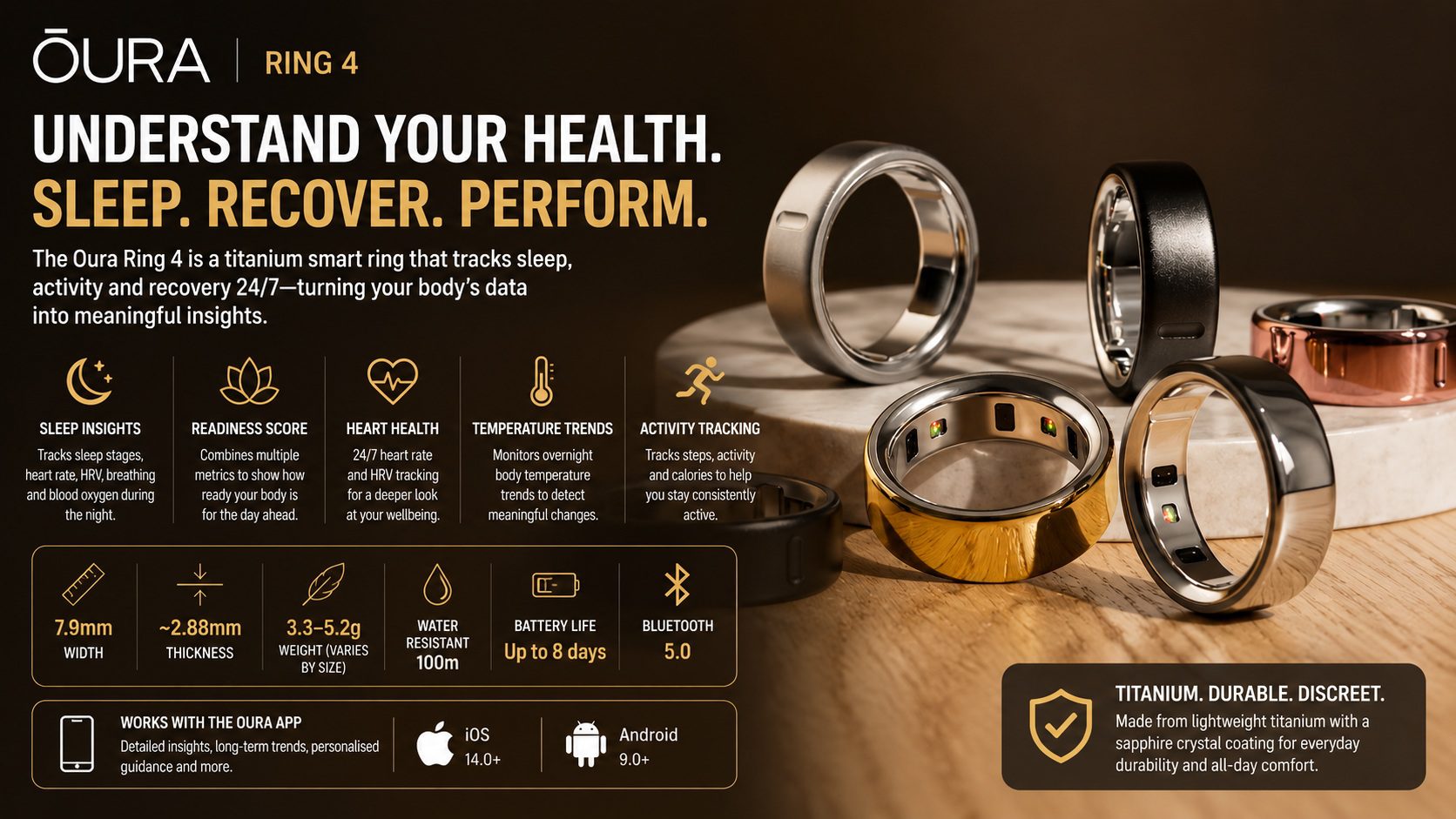
Oura Ring 4 remains a strong sleep and recovery tracker in 2026
The Oura Ring 4 takes a different approach to health tracking from a conventional smartwatch.
There is no screen, no stream of notifications and no large display strapped to the wrist. Instead, Oura places its sensors around a lightweight titanium ring designed to collect health and activity data throughout the day and night.
Its strongest areas remain sleep, recovery and long-term health trends rather than replacing a sports watch during detailed workouts.
That positioning still makes sense in 2026, even though Oura has since introduced the newer Ring 5.
Oura Ring 4 uses Smart Sensing around the finger
The Oura Ring 4 introduced Oura’s Smart Sensing platform.
Rather than relying on one fixed optical path, the system dynamically selects sensor pathways according to the wearer’s finger, skin and current conditions.
Oura says this allows the device to maintain more consistent readings while improving battery efficiency.
The sensing hardware includes red and infrared LEDs for blood-oxygen measurements during sleep. Green and infrared optical sensors track heart rate, heart-rate variability and respiration.
A digital temperature sensor monitors changes in temperature trends, while an accelerometer tracks movement and activity throughout the day.
The key distinction is that Oura does not ask the user to actively perform most measurements.
Once the ring is fitted correctly, much of the data collection happens in the background.
Recessed sensors improve the inner surface
Previous Oura generations used sensor bumps on the inside of the ring.
Ring 4 replaced those with recessed sensors inside a smoother titanium surface.
That change matters because a health ring needs close skin contact while remaining comfortable enough for continuous wear.
Oura Ring 4 measures 7.9mm wide and approximately 2.88mm thick.
Weight varies according to ring size, ranging from approximately 3.3g to 5.2g.
Those figures make it substantially less intrusive than most wrist-based fitness devices.
However, comfort remains personal.
Someone who dislikes wearing conventional jewellery may still find a smart ring noticeable, particularly when sleeping or gripping gym equipment.
Correct sizing matters more than with an ordinary ring
Fit affects both comfort and sensor accuracy.
Oura Ring 4 comes in sizes 4 through 15, but Oura warns that its sizes differ from normal jewellery sizing and from other generations of Oura Ring.
That means owners should use the correct Oura Ring 4 sizing kit rather than assuming their normal ring size will match.
The company uses whole sizes rather than half sizes.
Oura also recommends testing the sizer for long enough to account for normal changes in finger size throughout the day.
A ring that feels comfortable in the morning may become tighter in warmer conditions or after exercise.
This is particularly relevant in South Africa, where temperature changes can noticeably affect finger swelling during hotter weather.
The Oura Ring 4 focuses heavily on sleep
Sleep tracking remains one of Oura’s central features.
The Ring 4 measures data such as overnight heart rate, heart-rate variability, movement, breathing and temperature trends before translating that information into a Sleep Score.
The app also estimates sleep stages, including light, deep and REM sleep.
Rather than expecting users to interpret every individual metric, Oura combines the data into broader scores and trends.
This is one of the fundamental differences between Oura and a traditional sports watch.
The Ring 4 places greater emphasis on answering questions such as whether the user has recovered properly, whether sleep has been consistent and whether the body appears ready for another demanding day.
Readiness turns multiple measurements into one score
Oura’s Readiness Score attempts to provide a broader picture of recovery.
It considers several measurements rather than treating resting heart rate, sleep or activity as isolated numbers.
A user may therefore see reduced readiness after poor sleep, higher-than-usual resting heart rate or changes in temperature.
That does not make the score a medical diagnosis.
Instead, it acts as a wellness indicator based on patterns in the wearer’s own data.
The most useful approach is generally to watch changes over time rather than overreacting to one unusually low score.
Heart rate and HRV are tracked throughout the day
The Oura Ring 4 measures heart rate throughout the day and night.
It also tracks heart-rate variability, or HRV, which describes the variation in time between heartbeats.
Fitness and recovery platforms often use HRV as one of several indicators of physiological stress and recovery.
Oura combines those measurements with sleep and temperature trends rather than expecting users to interpret HRV in isolation.
This makes the Ring 4 useful for people interested in understanding recovery patterns without constantly checking a display.
However, athletes who need live pacing, GPS routes or detailed real-time training metrics may still prefer a dedicated sports watch.
Blood oxygen monitoring happens during sleep
Red and infrared LEDs allow the Ring 4 to measure blood-oxygen levels while the wearer sleeps.
Oura uses that information as part of its nighttime breathing analysis.
The app can highlight breathing disturbances and provide trends over time.
These readings should remain in the context of consumer wellness monitoring.
A smart ring is not a substitute for professional medical evaluation when someone has symptoms or concerns about breathing, heart health or sleep disorders.
Temperature tracking is about trends
The Ring 4 also measures changes in body temperature.
Rather than presenting itself as a conventional thermometer, Oura focuses on deviations from an individual baseline.
That can contribute to recovery insights, cycle tracking and general changes in physiological state.
The usefulness comes from repeated measurements.
One isolated temperature deviation tells far less than a consistent pattern collected over many nights.
This is where a ring intended for 24-hour wear gains an advantage over occasional manual measurements.
Oura Ring 4 tracks stress during the day
Oura’s software also includes Daytime Stress tracking.
The platform combines physiological information such as heart rate, HRV, movement and temperature trends to estimate periods of stress and recovery.
That can provide useful context for someone whose physical response to a busy day may not match how stressful they believed it felt.
At the same time, stress scores require sensible interpretation.
Exercise, excitement and other physiological changes can affect the same signals that wearable algorithms use to estimate stress.
The value therefore comes from trends and context rather than treating every stress reading as absolute.
Activity tracking is present but not the main attraction
The Oura Ring 4 also tracks movement and activity.
Automatic Activity Detection can identify a range of everyday activities, while the accelerometer provides data for steps and general movement.
Oura integrates activity into its broader health and recovery model.
However, it does not approach exercise in the same way as a dedicated Garmin, Polar or similar sports watch.
There is no display to show pace, distance or live training zones directly on the ring.
Oura therefore works best for someone who values passive tracking and recovery data more than continuous workout feedback.
Some users may choose to wear Oura alongside another fitness device rather than treating the two products as direct replacements.
Battery life typically ranges from five to eight days
Oura currently rates the Oura Ring 4 for approximately five to eight days of battery life.
Actual runtime varies according to ring size, settings, battery age, activity and enabled features.
Oura’s own battery testing used new rings and specific settings, including disabled blood-oxygen sensing during the test configuration.
Real-world battery life can therefore fall outside the headline figure.
Even so, several days between charges remain one of the advantages of a screenless wearable.
Oura says charging usually takes between 20 and 80 minutes, depending on the starting battery level.
The charger is specific to the ring size
The Ring 4 comes with a size-specific charging dock and USB-C cable.
That means a charger designed for one ring size should not automatically be assumed to fit another Ring 4.
The package includes:
| Included item | Oura Ring 4 |
|---|---|
| Oura Ring 4 | Yes |
| Size-specific charger | Yes |
| USB-C cable | Yes |
| Sizing kit | Depends on purchase route / sizing selection |
The dedicated charger is another reason to remember it when travelling.
A standard USB-C cable alone cannot charge the ring without the dock.
Water resistance reaches 100 metres
Oura rates Ring 4 for water resistance to 100 metres, or approximately 328 feet.
The company allows normal use while showering, swimming and in environments such as saunas.
However, Oura does not recommend scuba diving or prolonged submersion beyond its usage guidance.
A high water-resistance rating is particularly useful for a wearable designed around continuous tracking.
Removing the ring every time the user showers or swims would create gaps in data and undermine part of its purpose.
Oura Ring 4 uses titanium inside and out
The standard Oura Ring 4 uses titanium for both its inner and outer construction.
Different finishes use physical vapour deposition or diamond-like carbon coatings depending on the version.
Oura currently lists Ring 4 variants and finishes according to available inventory, while some colours have changed as the company’s product range has evolved.
Normal wear can still produce scratches.
Titanium may be durable, but a ring remains exposed to tables, gym equipment, weights and other hard surfaces throughout the day.
People doing heavy lifting may therefore prefer to remove it during certain exercises, both to protect the ring and for hand safety.
The Oura app does much of the heavy lifting
The physical ring collects the data, but the Oura app provides most of the interpretation.
It supports both iOS and Android and integrates with more than 40 external apps and services according to Oura’s current product information.
The software turns raw sensor measurements into Sleep, Activity and Readiness scores while also presenting trends for stress, cardiovascular metrics and other areas.
This is important when evaluating the product.
Oura Ring 4 is not simply a piece of hardware bought once and used independently.
The app and cloud-based analysis form an integral part of the experience.
Oura Membership is an ongoing part of ownership
The Oura Ring 4 requires an active Oura Membership to access the complete feature set.
New members currently receive one included month with a new ring purchase.
After that period, users need an active membership to retain access to Oura’s deeper analysis and personalised insights.
Without membership, the hardware becomes much less useful because many of the features that distinguish Oura live inside its software platform.
South African buyers should therefore think about the Ring 4 as a hardware-and-service product rather than only considering the cost of the ring itself.
TechnologyBlog is not including membership pricing because regional pricing can vary.
South Africa is now an officially supported Oura market
There has been an important improvement for South African buyers.
As of Oura’s 28 August 2026 supported-country information, South Africa is officially listed as a retailer-supported Oura market.
This means authorised retail partners handle local availability rather than South Africa being treated as a direct Oura shipping market.
That distinction matters for warranty support.
Oura says products bought through its official store or authorised retailers receive region-specific warranty support, while using products outside supported regions may create warranty complications.
South Africans should therefore favour authorised local sales channels rather than grey imports.
Discovery Vitality gives the Ring 4 an unusual South African connection
The South African story becomes more interesting through Discovery Vitality.
Oura currently states that qualifying Vitality members in South Africa can access Ring 4 benefits.
Depending on the eligible plan, those benefits can include a funded Oura Ring 4 with a period of Oura Membership, or a discount on selected Ring 4 configurations together with membership.
Eligibility and exact benefit structures depend on Discovery’s terms.
This connection gives Oura something many international wearables lack in South Africa: integration with an established local wellness programme.
Prospective users should still check their specific Vitality plan rather than assuming every member qualifies.
Not every Oura health feature is available in South Africa
There is another important regional caveat.
Oura states that some health features depend on regulatory approval or regional availability.
Its current feature-availability list shows that functions such as Glucose tracking, Health Panels and certain experimental health features remain limited to selected countries.
South African buyers should therefore not assume that every feature demonstrated on Oura’s global website or in international reviews will automatically appear in their local app.
Core Ring 4 features such as sleep, heart rate, HRV, activity, temperature and stress tracking remain the more relevant baseline.
Oura Ring 4 specifications
| Specification | Oura Ring 4 |
|---|---|
| Device type | Smart health ring |
| Material | Titanium inside and out |
| Width | 7.9mm |
| Thickness | Approx. 2.88mm |
| Weight | 3.3–5.2g depending on size |
| Sizes | 4–15 |
| Heart-rate tracking | Yes |
| HRV tracking | Yes |
| Blood oxygen | Yes, during sleep |
| Temperature sensor | Yes |
| Movement sensor | Accelerometer |
| Smart Sensing | Yes |
| Sleep tracking | Yes |
| Stress tracking | Yes |
| Activity detection | Yes |
| Battery life | Typically 5–8 days |
| Charging time | Typically 20–80 minutes |
| Water resistance | 100m |
| Bluetooth | Bluetooth Low Energy |
| Airplane mode | Yes |
| App | Oura App |
| Android support | Yes |
| iOS support | Yes |
| App integrations | 40+ |
| Membership | Required for full functionality |
| South Africa | Supported via authorised retailers |
| Discovery Vitality | Qualifying member benefit available |
Who is the Oura Ring 4 for?
The Oura Ring 4 makes the most sense for someone who wants health information without wearing a smartwatch around the clock.
Its small form factor works particularly well for sleep tracking because there is no display lighting up beside the bed and no large watch body pressing against the wrist.
Recovery-focused users may also appreciate having HRV, resting heart rate, temperature, sleep and activity combined into one system.
It becomes less compelling for people whose priority is live sports data.
Cyclists, runners and endurance athletes who regularly need maps, pace, power, lap information or real-time heart-rate zones will still get more direct information from a sports watch or cycling computer.
Oura can complement those products rather than replace them.
Is the Oura Ring 4 still worth considering in 2026?
The Oura Ring 4 is no longer Oura’s newest smart ring, but that does not automatically make it irrelevant.
Its Smart Sensing platform, titanium construction, smooth recessed sensors and five-to-eight-day battery claim still provide a strong foundation for passive health tracking.
Sleep and recovery remain the main attractions.
Unlike a smartwatch, the Ring 4 largely disappears into the background while collecting heart rate, HRV, movement, temperature and nighttime blood-oxygen information.
South African support has also improved significantly.
Oura now officially recognises South Africa as a retailer-supported market, while the Discovery Vitality partnership creates a locally relevant route into the ecosystem for qualifying members.
The biggest consideration remains Oura Membership.
Much of the product’s usefulness comes from the software interpreting the information collected by the ring. Buyers therefore need to consider the ongoing service alongside the hardware.
There is also now a newer Ring 5 to consider.
For someone buying without a special Ring 4 offer, comparing both generations makes sense. However, South Africans who qualify for a Discovery Vitality Ring 4 benefit may find the older model considerably more compelling.
That makes the Oura Ring 4 an unusual previous-generation wearable in 2026: newer hardware exists, but the combination of mature software, official South African support and local Vitality integration means it can still be highly relevant.


