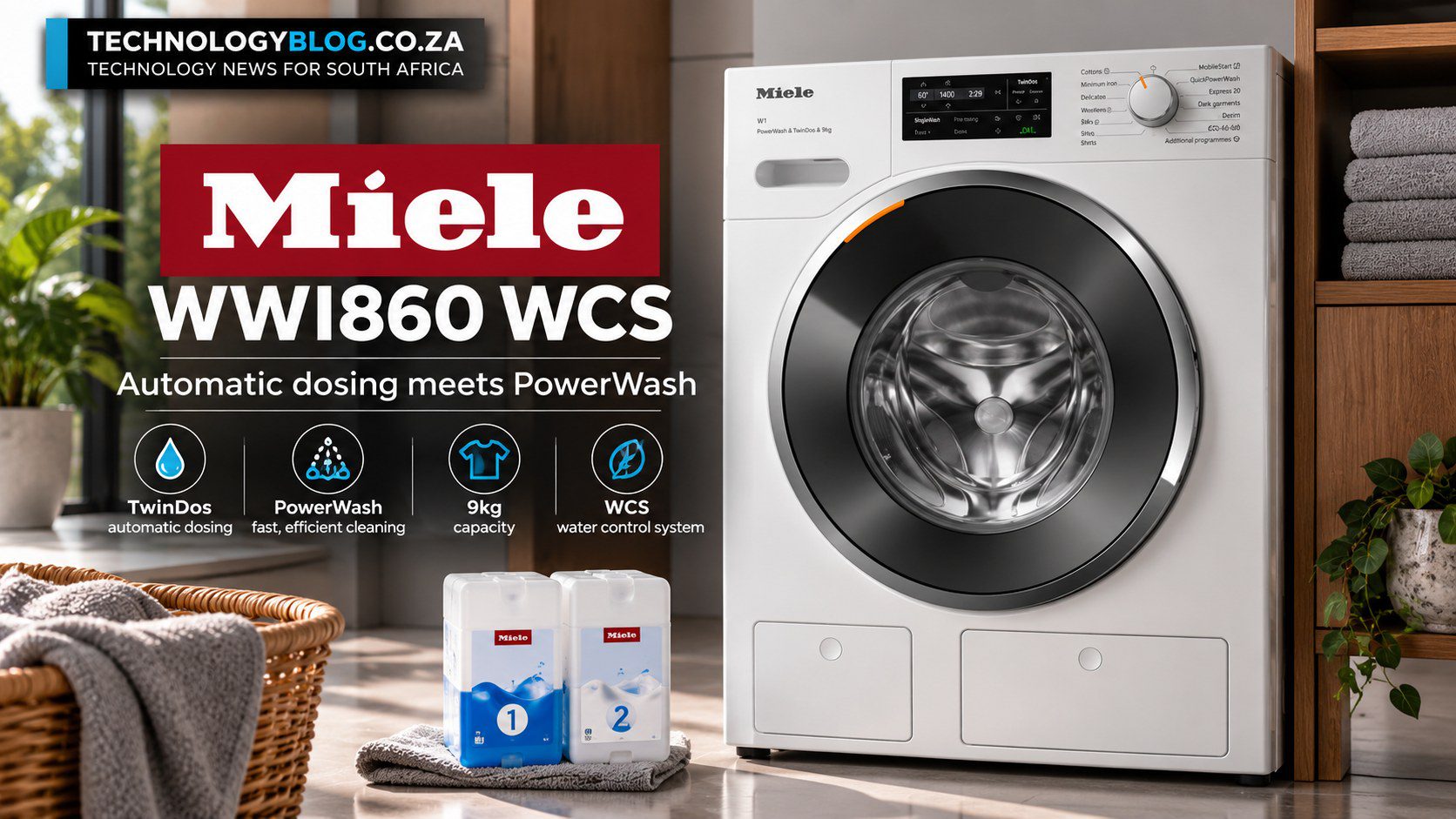
Miele WWI860 WCS automates more than just the wash cycle
The Miele WWI860 WCS is a 9kg front-loading washing machine that puts much of its technology into decisions people normally make before pressing Start.
How much detergent does the load need?
Is there enough laundry to justify a normal programme?
Can a smaller load be washed without unnecessarily using the resources associated with a larger one?
Miele approaches those questions with TwinDos automatic detergent dispensing, automatic load recognition and SingleWash. PowerWash tackles the washing process itself, while QuickPowerWash targets shorter cleaning when time matters. Miele
The machine also provides a 1600rpm maximum spin speed, Miele@home connectivity, AddLoad, CapDosing and a long list of specialised fabric programmes. Miele
The result is a washing machine where the headline story is less about capacity than automating the smaller decisions around each load.
The Miele WWI860 WCS handles up to 9kg
The Miele WWI860 WCS has a maximum washing capacity of 9kg.
That puts it in a useful size category for households that regularly handle substantial laundry without moving into the unusually large capacities offered by some machines.
Capacity still needs context.
Nine kilograms describes the maximum rated load under appropriate programme conditions. It does not mean every programme accepts 9kg of every fabric type.
Delicates, wool, silk and specialist programmes can have different load limits.
That distinction matters because the WWI860 WCS provides considerably more fabric-specific programming than a basic everyday washer.
A 1600rpm spin can remove more water before drying
Miele specifies a maximum spin speed of 1600rpm. Miele
That is relatively fast for a household front-loader.
Spinning does not dry clothing. Instead, centrifugal force removes water mechanically before laundry leaves the machine.
This can matter if clothing will subsequently go into a tumble dryer because less retained water means the dryer has less moisture to remove.
However, maximum speed is not appropriate for every fabric.
The selected programme and garment-care instructions should determine spin behaviour rather than automatically choosing the highest available number.
TwinDos automates detergent dispensing
TwinDos is one of the defining features of the WWI860 WCS.
Instead of requiring users to manually measure liquid detergent for every load, the system automatically dispenses detergent at appropriate stages of the programme.
Miele’s own UltraPhase system uses two detergent components. Miele
The practical idea is straightforward.
Detergent dosing is easy to get wrong.
Too little can compromise cleaning. Too much wastes detergent and can leave unnecessary residue while increasing the amount that needs to be rinsed away.
Automatic dosing attempts to make the amount more repeatable.
Miele claims TwinDos can reduce detergent use
Miele says precise TwinDos dispensing can save up to 30% detergent.
That figure needs attribution.
The company bases it on an Öko-Institut report dated 6 September 2013 concerning the potential savings from automatic TwinDos dispensing. Miele
TechnologyBlog has not independently measured detergent consumption on the WWI860 WCS.
Actual savings will also depend on what automatic dosing replaces.
Someone who routinely pours excessive detergent into a conventional machine may have greater opportunity to reduce consumption than someone who already measures every dose accurately.
The useful feature is therefore automatic dosing itself. The percentage saving remains a documented manufacturer claim.
PowerWash changes how detergent reaches the laundry
The WWI860 WCS also includes PowerWash.
Miele positions the technology around efficient cleaning, particularly when dealing with smaller loads. Miele
Rather than treating every load identically, PowerWash forms part of a system designed to make better use of water and detergent during the wash process.
That complements TwinDos.
TwinDos addresses how detergent is dispensed. PowerWash addresses how the washing process uses it.
TechnologyBlog has not physically tested the machine, so independent claims about superior stain removal or efficiency would require controlled testing.
QuickPowerWash targets a 49-minute cycle
One of the more immediately understandable features is QuickPowerWash.
Miele specifies very good cleaning performance in 49 minutes under the conditions covered by its cited test process. Miele
The important point is not that every possible load can be washed in 49 minutes.
Quick programmes have defined operating conditions and load requirements.
Instead, QuickPowerWash provides an option for situations where a compatible load needs a complete wash without committing to a much longer programme.
That can be more useful than an ultra-short refresh cycle that is suitable only for a handful of lightly worn garments.
SingleWash addresses small loads
Large-capacity washing machines create an interesting problem.
A 9kg drum is useful when there is plenty of laundry.
What happens when there is only one shirt or a very small load?
Running a machine as though the drum were full would undermine some of the benefit of buying an efficient appliance.
Miele’s SingleWash is designed specifically around smaller load sizes. The company says the option adjusts the use of electricity, water and time for small loads. Miele
That makes the WWI860 WCS more flexible.
A large drum does not necessarily mean owners need to wait until they have accumulated a large pile of washing.
TwinDos and SingleWash can work together
Miele also promotes the combination of TwinDos and SingleWash.
The company claims the combination can save up to 40% detergent and up to 60% energy and time under its specified comparison conditions. Miele
Again, those percentages require context.
Miele’s detergent comparison is against automatic dispensing without SingleWash. Its energy-and-time comparison refers to the Minimum iron 40°C programme against machines without PowerWash and SingleWash. Miele
Those are not universal household savings.
The underlying idea remains useful: detergent quantity and programme behaviour can be adjusted when the machine is handling substantially less than its full 9kg capacity.
Automatic load recognition adds another layer
The WWI860 WCS also includes automatic load recognition.
Miele says the system adjusts water and energy requirements according to the laundry load. Miele
This is another example of the machine concentrating on variable consumption rather than assuming every wash is identical.
A full drum and a small load do not require exactly the same treatment.
Automatic load recognition allows the machine to account for that difference without asking the user to estimate every requirement manually.
Actual household consumption will still depend on programme selection, temperature, load, options and usage patterns.
CapDosing targets specialised laundry
TwinDos is not the only detergent system.
The WWI860 WCS also supports CapDosing.
Miele offers portioned capsules intended for particular fabrics or treatment requirements. Miele
This provides another approach when a normal everyday detergent is not ideal for the load.
Specialised garments can require different detergents or fabric treatments.
CapDosing packages those treatments into predefined portions rather than requiring users to measure specialist products manually.
There is an obvious trade-off: capsules are consumables.
Convenience therefore needs to be considered alongside their ongoing cost and packaging.
AddLoad handles the forgotten sock
Miele includes AddLoad.
The feature allows individual items to be added or removed after a programme has started when operating conditions permit it. Miele
That solves a mundane but familiar problem.
A washing cycle begins, and then someone discovers a sock, shirt or towel that should have gone into the drum.
AddLoad provides a controlled way to deal with that situation without simply abandoning the programme.
Safety still comes first.
A front-loader cannot unlock its door under every possible temperature, water-level or programme condition.
Pre-ironing uses steam to reduce creasing
The WWI860 WCS includes Pre-ironing with steam.
Miele says the function can reduce the need for ironing by up to 50%. Miele
That is a manufacturer claim rather than an independent TechnologyBlog result.
The feature uses steam as part of the post-wash treatment to reduce creasing.
This does not mean every garment will emerge looking as though it has been pressed with an iron.
Fabric type, load size and how long clothing remains in the drum can all affect creasing.
Still, reducing wrinkles before laundry leaves the washer can make subsequent ironing easier.
The Honeycomb drum focuses on fabric care
Miele uses its Honeycomb drum inside the WWI860 WCS.
The company says its drum design allows fabrics to glide along the surface while reducing the risk of snagging and damage. Miele
Drum design matters because cleaning involves mechanical movement as well as detergent and water.
Clothing repeatedly moves against the drum throughout a programme.
A washing machine therefore needs enough movement to clean effectively without treating fabrics unnecessarily harshly.
TechnologyBlog has not conducted long-term fabric-wear testing, so Miele’s garment-protection claims should remain attributed.
Specialised programmes cover very different fabrics
The WWI860 WCS has programmes for considerably more than cotton and synthetics.
Miele documents dedicated options for woollens, silks, shirts, sportswear, outerwear, curtains, pillows, down-filled items and down duvets. Miele
There is also an Automatic Plus programme for mixed loads.
This variety matters because laundry is not one material.
A technical outdoor jacket needs different treatment from a cotton towel. Wool behaves differently from sportswear. Curtains introduce their own combination of dust and delicate material.
Dedicated programmes allow the machine to change its behaviour instead of asking users to approximate everything through manual temperature and spin selections.
Stains gets its own treatment option
Miele also provides a Stains option.
The company describes this as using specialised pre-wash treatment and an extended cycle for stubborn marks such as grass, mud and wine. Miele
That is useful because stain removal is not always about simply increasing temperature.
Different stains respond differently to water, detergent, time and mechanical action.
TechnologyBlog has not tested individual stain types on this machine, so we cannot independently confirm the results.
Nevertheless, the dedicated function gives owners another tool before resorting to manual pre-treatment.
Miele@home connects the washing machine
The WWI860 WCS supports Miele@home.
Miele says the washing machine can connect to a home network and be accessed through its app. Miele
The company also cautions that available digital functions can vary by model and country and that its digital offering may change over time. Miele
That qualification is important.
Connected-appliance features depend on more than the physical washing machine. They also rely on software, networking and services that can evolve during the much longer lifespan of a major household appliance.
For everyday use, the connected features supplement rather than replace the controls on the machine itself.
ComfortSensor keeps controls on the appliance
Miele equips the WWI860 WCS with its ComfortSensor interface. Miele
This means the machine does not rely on a smartphone for ordinary operation.
Users can select programmes and settings directly at the appliance.
That balance makes sense.
Remote information and app functionality can be useful, but loading a washing machine remains a physical task.
A good connected appliance therefore still needs straightforward local controls.
Consumption information makes efficiency more visible
The machine can also provide estimates and reports relating to water and energy consumption for programmes. Miele
That makes efficiency less abstract.
Instead of treating energy performance purely as a label attached to the machine at purchase, owners can gain more information about how programme choices affect consumption.
It can also make the consequences of routine decisions easier to understand.
Hotter or more intensive programmes may have different requirements from lighter everyday cycles.
Efficiency therefore depends partly on how the appliance is used.
The DuraLife motor uses an inverter drive
Miele identifies a DuraLife motor with inverter drive in the WWI860 WCS.
The company associates the design with low wear, noise and energy consumption. Miele
TechnologyBlog has not independently measured motor noise or long-term wear.
However, electronically controlled inverter motors are useful in washing machines because drum behaviour changes considerably throughout a programme.
Gentle tumbling, distribution and high-speed spinning require very different motor operation.
The motor therefore forms an important part of how precisely those stages can be controlled.
Water Control System monitors for leaks
The model designation includes WCS, referring to Miele’s Water Control System.
Miele says WCS monitors water intake and can detect leakage and water in the machine’s floor tray. Miele
Water protection deserves attention on any washing machine.
A machine is connected permanently or semi-permanently to a household water supply and repeatedly fills and drains throughout its life.
Monitoring the water system provides another layer of protection if something goes wrong.
It does not replace correct installation, hose inspection or normal maintenance.
Hygiene claims have specific test conditions
Miele makes strong hygiene claims for machines combining TwinDos and PowerWash.
The company says more than 99.99% of bacteria and 99.9% of viruses can be removed under specified intensive-cleaning conditions. Testing cited by Miele applies to the Cottons hygiene 60°C programme with the Hygiene plus Extra and was assessed by Albstadt-Sigmaringen University, with a gold label from the Institute for Integrative Hygiene and Virology. Miele
That context needs to stay attached to the percentages.
They are not claims that every programme, temperature or load automatically produces the same result.
Nor should a household washing machine be presented as a medical sterilisation device.
The figures describe performance under the manufacturer’s stated test conditions.
Miele’s 20-year statement is a test standard, not a warranty
Miele also promotes its W1 machines as tested for the equivalent of 20 years’ use.
That wording needs particular care.
Miele explains that during development it tests W1/W2 models and core components across 5,000 wash loads, calculated around five loads per week for 50 weeks per year over 20 years. Miele
The company explicitly states that this does not guarantee the durability of the final product. Miele
Therefore, TechnologyBlog should not shorten the statement to “lasts 20 years”.
Those are very different claims.
The correct interpretation is that Miele uses a long-duration development testing regime intended to simulate that level of usage.
South African availability is confirmed
Unlike appliances that appear only on overseas Miele sites, the WWI860 WCS is currently listed by Miele South Africa.
It appears in Miele’s current local washing-machine selection alongside other W1 models. Miele
That establishes its relevance to South African buyers without relying on grey-import listings.
TechnologyBlog has deliberately omitted its current local price.
The product’s features and capabilities remain the focus rather than a price that can change through promotions or catalogue updates.


