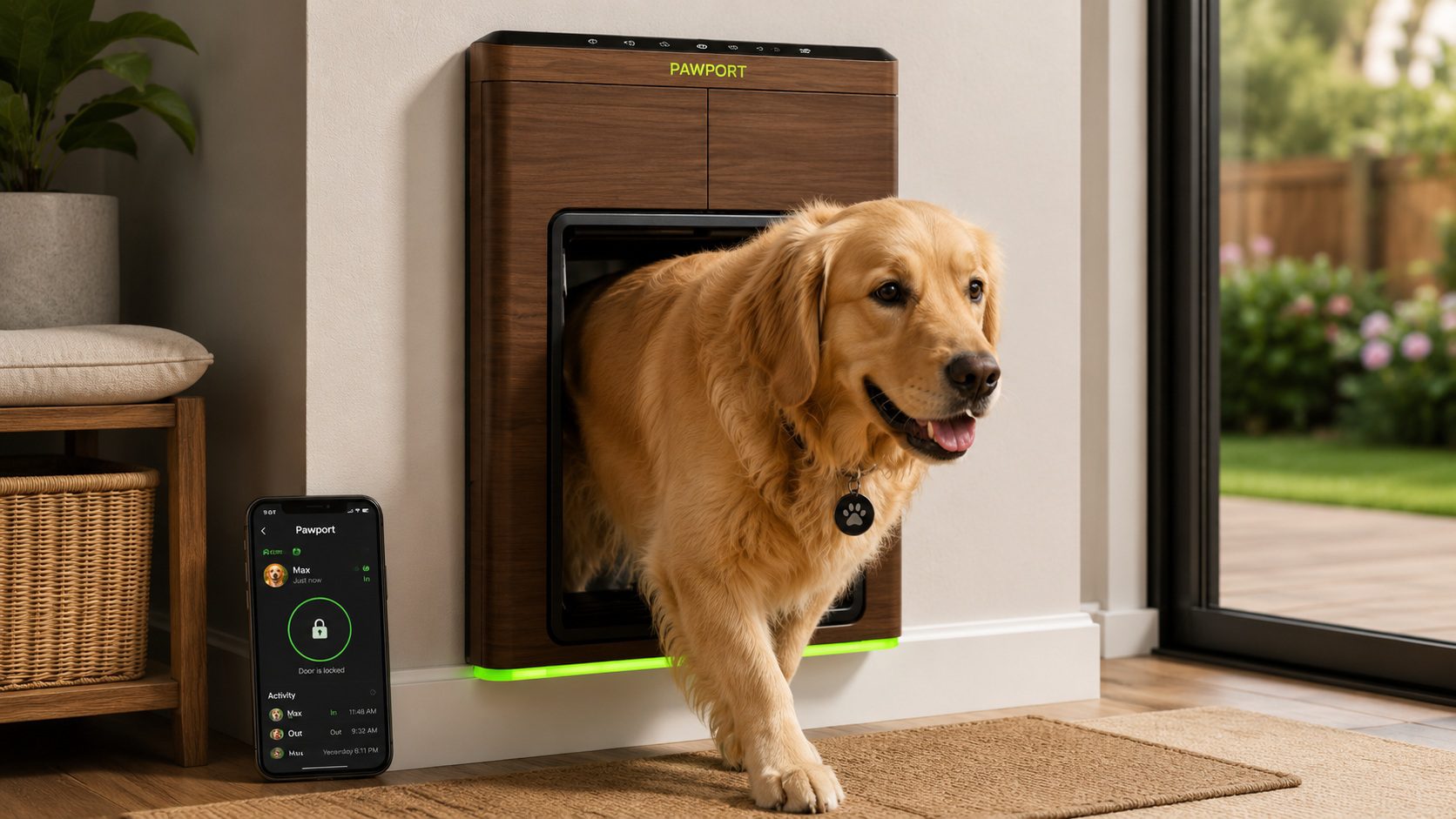
Pawport Smart Pet Door adds automatic access, schedules and dual deadbolts
The Pawport Smart Pet Door replaces the traditional free-swinging pet flap with a motorised door that opens automatically for recognised pets and locks again after they pass through.
A waterproof Smart Pet Tag worn on the collar identifies each animal. Owners can then use the Pawport app to create individual schedules, monitor activity and receive notifications when pets enter or leave.
Pawport also takes physical security more seriously than a typical plastic pet flap. The company uses steel and aircraft-grade aluminium, dual steel deadbolts and an integrated alarm.
Pawport Smart Pet Door recognises individual pets
The core of the Pawport Smart Pet Door is the Smart Pet Tag.
Each waterproof tag pairs with an individual pet. When the animal approaches, the door detects the tag, opens automatically and closes after the pet passes through.
That gives owners more control than a conventional pet flap that opens for any animal capable of pushing through it.
The app also lets users adjust the detection range, which can help determine how close a pet needs to be before the door reacts.
Pawport says the tag battery lasts more than a year, while its current support documentation gives a typical range of 12 to 18 months depending on use.
Each pet can have its own schedule
Multi-pet households gain another useful feature.
Pawport lets owners assign separate access schedules to individual animals. One pet could have unrestricted access during the day while another remains inside during certain hours.
That creates possibilities a normal pet door cannot provide.
Owners could, for example, prevent a dog from roaming outside overnight while still allowing another pet to follow a different routine.
The system can also restrict whether a pet may enter, leave or do both, depending on the configured access rules.
One-Way Entry helps prevent pets being locked outside
Schedules create one obvious problem: what happens if a pet is already outside when its curfew starts?
Pawport addresses that through One-Way Entry.
The system can prevent new exits while still allowing an animal that is already outside to come back in.
That is a small but important design decision.
A strict schedule without this exception could leave an animal stranded outside after the door locks.
Activity tracking shows when pets come and go
The Pawport app records pet-door activity.
Owners can see when an animal went outside, when it returned and how long it spent away from the house.
Notifications can also alert the owner when the door opens or closes, when locking status changes, when a scheduled event occurs or when the battery needs attention.
For pet owners who spend much of the day away from home, that gives the door a second job: it becomes a basic pet-activity monitor.
It should not be confused with GPS tracking, however.
The system knows when the pet passes through the door. It does not continuously track where the animal goes once outside.
Rain and lightning can trigger automatic lock behaviour
Pawport includes weather-based automation.
Owners can enable Rain Lock, which prevents pets from leaving when rain is detected. One-Way Entry still allows animals that are already outside to return.
A similar Lightning Lock can react when lightning is detected in the area.
These features depend on external weather information rather than the pet door physically sensing rain or lightning itself.
That distinction matters for South African users because weather-service availability and accuracy can vary by location.
The door can open to 90 or 120 degrees
Owners can choose between 90-degree and 120-degree opening angles through the Pawport app.
That gives more flexibility in tight installation areas.
A door mounted near furniture, a wall or another obstruction may not have room for the maximum opening angle.
Pawport also includes basic physical controls on the unit itself, so users do not need to reach for the phone every time they want to operate the door manually.
Dual deadbolts address a common pet-door security problem
Traditional pet flaps can create an obvious weak point in an exterior door or wall.
Pawport attempts to address that with two solid-steel deadbolts that lock into a high-strength steel frame.
The company also uses steel and aircraft-grade aluminium in the door construction.
Pawport markets the system heavily around security, but readers should distinguish manufacturer demonstrations from independent burglary certification.
The company’s own website even warns that although it demonstrates dramatic impact testing, the product is not designed as a ballistic barrier.
TechnologyBlog would therefore avoid describing the Smart Pet Door as burglar-proof.
An integrated alarm can react to forced opening
Pawport also includes an integrated alarm.
The company says the alarm sounds if something other than the owner or authorised pet opens the door, while the app can send an alert to the user’s phone.
Owners can additionally fit a compatible third-party alarm sensor to the rear of the door if they want to integrate the opening into an existing home alarm system.
That gives homeowners another option where the pet door forms part of a broader security setup.
Pinch protection matters on a motorised pet door
Adding a motor to a pet door introduces a new safety concern.
Pawport says its door opens and closes slowly and uses an anti-pinch design intended to avoid trapping or hurting a pet.
Owners can also disable the on-device controls so children cannot manually open the door from the control panel.
TechnologyBlog has not independently tested the safety system, so these remain manufacturer claims.
A hands-on review would need to test how the mechanism responds when something interrupts the door while closing.
The Pawport Smart Pet Door does not need Wi-Fi for basic pet access
One of the more useful design choices is that basic operation does not depend on Wi-Fi.
Pawport says the Smart Pet Door and Smart Pet Tag can continue working locally when the home’s internet connection fails.
Wi-Fi becomes necessary for remote app control and cloud-based functions.
That means a temporary internet outage should not automatically stop a recognised pet from using the door.
For South African households, that separation between local operation and cloud features is particularly useful.
Battery backup can keep the door working through a power cut
Pawport offers several power options.
The standard system can run from its included plug-in USB-C power supply. Owners can also use a concealed wired installation, rechargeable battery or solar accessory.
The optional internal battery becomes especially relevant during a power failure.
Pawport says a 6.4Ah battery pack targets around 24 hours of backup, while a larger 57.6Ah option can provide up to six weeks depending on usage.
Those are manufacturer estimates, and actual runtime will depend on how frequently the door operates and which connected functions remain active.
Still, backup power is a useful feature for South African households where electricity interruptions remain possible.
The battery can recharge over USB-C or solar
The optional rechargeable battery has several charging methods.
Users can charge it through:
- USB-C connected to mains power
- Pawport’s optional Charging Dock
- The optional Pawport Solar Panel
Battery status appears in the app and on the door’s control panel.
The Smart Pet Door itself does not require the battery if it remains connected to USB-C power or a concealed power kit.
That gives owners flexibility to treat the battery either as the main power source or simply as backup.
Three sizes cover pets up to roughly 91kg
Pawport currently offers Medium, Large and Extra Large Smart Pet Doors.
| Size | Door dimensions | Opening | Recommended pet size |
|---|---|---|---|
| Medium | 391 × 521mm | 337 × 413mm | Up to 45kg |
| Large | 391 × 622mm | 337 × 514mm | Up to 68kg |
| Extra Large | 391 × 724mm | 337 × 616mm | Up to 91kg |
Pawport publishes the original pet weight recommendations as 100lb, 150lb and 200lb respectively. The kilogram figures above are rounded metric equivalents for South African readers.
The recommended maximum shoulder heights range from approximately 711mm for Medium to 914mm for Extra Large.
Existing pet doors can be retrofitted
Pawport provides three main installation approaches.
The simplest is a retrofit over an existing pet door. Pawport says the mounting system can adjust over existing openings within its size limits without requiring an exact dimensional match.
For homes without an existing pet door, Pawport sells complete wall or door systems using its Tunnel & Frame hardware.
The company also provides documentation for installation into sliding glass doors.
Pawport says a basic retrofit does not require professional installation, while complete systems can involve more substantial work.
Hardwired installation should use a professional
Pawport’s warranty documentation specifically states that hardwired installations must be completed by a licensed professional and comply with local building codes and regulations.
That matters in South Africa.
A USB-powered retrofit is very different from routing permanent electrical wiring through a wall or door installation.
Anyone planning a concealed wired installation should therefore treat it as building and electrical work rather than a simple smart-home accessory installation.
Smart-home integration includes Alexa, Google and Siri
Pawport says the Smart Pet Door integrates with Amazon, Google and Siri-based smart-home environments.
The manufacturer does not provide enough detail on the supplied overview page to justify promising every possible automation or voice command.
TechnologyBlog would therefore describe it as supported integration rather than claiming specific functions without testing or checking the exact platform documentation.
The Pawport app remains the main control point for pet-specific schedules and tracking.
The decorative lighting is more than purely cosmetic
Pawport also puts controllable lighting into the door.
Users can change light settings and create schedules through the app.
This is one of the less essential smart features, but it may help the opening remain visible to a pet at night.
Owners can also switch the lights off completely if they prefer a less conspicuous installation.
Pawport Smart Pet Door specifications
| Specification | Pawport Smart Pet Door |
|---|---|
| Product type | Automatic smart pet door |
| Pet authentication | Paired Smart Pet Tag |
| Pet-specific schedules | Yes |
| Activity tracking | Yes |
| Notifications | Yes |
| One-Way Entry | Yes |
| Rain Lock | Yes |
| Lightning Lock | Yes |
| Door opening angles | 90° / 120° |
| Security | Dual steel deadbolts |
| Integrated alarm | Yes |
| Anti-pinch operation | Manufacturer claimed |
| Wi-Fi required for pet access | No |
| Wi-Fi required for remote app functions | Yes |
| Standard power | Plug-in USB-C |
| Optional battery | Yes |
| Concealed power | Optional |
| Solar charging | Optional |
| Battery backup | Available |
| Smart-home support | Amazon / Google / Siri |
| Sizes | Medium / Large / Extra Large |
| Largest opening | 337 × 616mm |
| Largest recommended pet | Approx. 91kg |
| Smart Pet Tag battery | About 12–18 months |
| Warranty | 1 year limited |
Specifications come from Pawport’s current product, support and installation documentation.
The one-year warranty is worldwide, but support can vary
Pawport gives the Smart Pet Door a one-year limited warranty against manufacturing defects under normal use.
The company states that the warranty is valid worldwide.
However, that wording needs context.
Pawport also says localised support may not exist in every region. International customers may receive a different return solution instead of prepaid shipping, and they may remain responsible for customs duties, taxes or import costs.
That matters for South African buyers considering an imported unit.
A worldwide warranty does not necessarily mean there is a local repair centre, installer or spare-parts network.
South African availability remains unclear
TechnologyBlog could not verify an official Pawport South African distributor or dedicated local store.
The company does acknowledge international customers in its warranty terms, but that does not establish normal retail availability or local installation support.
South African buyers should therefore confirm several points before importing:
- Whether Pawport ships the chosen system here
- Which power adaptor it supplies
- Import duties and logistics
- Local installation requirements
- Battery replacement availability
- Smart Pet Tag availability
- Warranty-return arrangements
The system’s USB-C power architecture reduces some electrical compatibility concerns compared with importing a mains-voltage appliance, but the supplied power adaptor still needs to suit local use.
The security question deserves realistic expectations
Pawport is clearly more substantial than a lightweight plastic pet flap.
Steel deadbolts, aluminium construction and alarms address several obvious vulnerabilities.
That does not mean homeowners should treat the Smart Pet Door as equivalent to a certified security door or burglar-resistant barrier.
The installation remains an opening through an exterior wall, door or glass panel.
Overall security therefore depends on the Pawport itself, the surrounding frame, the mounting method and the building structure around it.
For South African households that place a high priority on physical security, professional assessment of the complete installation would make sense.
Who is the Pawport Smart Pet Door for?
The Pawport Smart Pet Door makes the strongest case for households that already give pets independent outdoor access but want more control over when and how that happens.
Individual schedules provide a significant upgrade over an ordinary flap.
Activity tracking adds visibility while owners are away, and One-Way Entry solves the obvious problem of a curfew accidentally leaving a pet outside.
Battery backup and offline tag recognition also make the system less dependent on uninterrupted power and internet access.
The main trade-off is complexity.
A traditional pet flap contains almost nothing that can lose power, need a software update or require a replacement tag.
Pawport adds considerable intelligence, but that intelligence also means owners need to maintain batteries, connectivity and electronic components.
Is the Pawport Smart Pet Door worth considering?
The Pawport Smart Pet Door is one of the more ambitious attempts to rethink something that has barely changed for decades.
Instead of asking a pet to push through a flap, it recognises the animal, opens automatically and locks again afterwards.
Individual schedules, activity history, alerts and weather-based restrictions add useful control. Dual steel deadbolts and the integrated alarm address security, while optional battery backup helps maintain operation during an electricity failure.
For South African households, those features are interesting.
The unanswered question is local support.
Without a confirmed South African distribution and installer network, prospective buyers need to consider import logistics, spare tags, battery availability and warranty handling before committing.
The technology itself is compelling because it turns a passive hole in the door into controlled access for individual pets.
Whether it makes practical sense locally will depend as much on installation and support as on the app.


