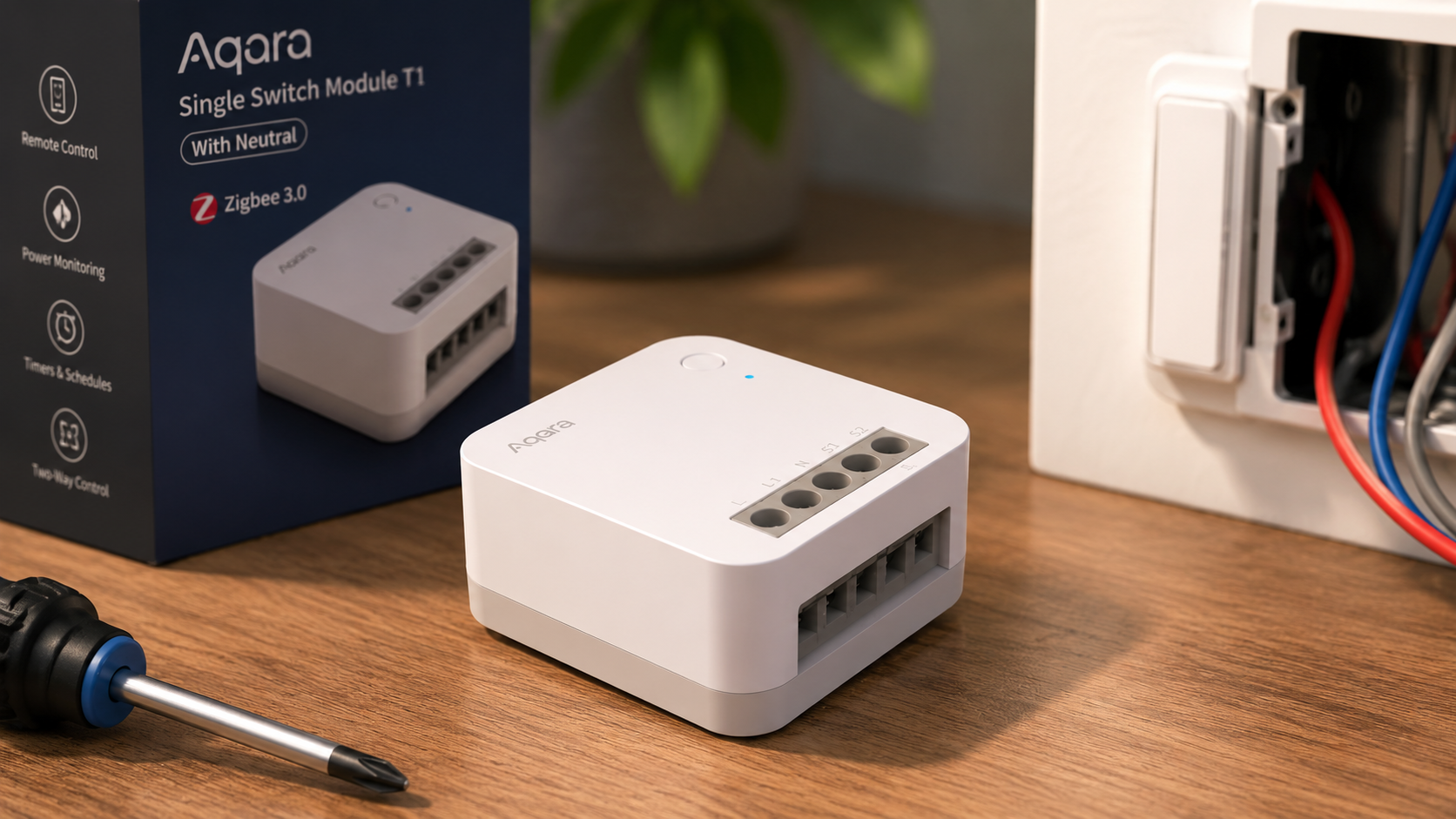
Aqara Single Switch Module T1 makes existing switches smart with Zigbee
The Aqara Single Switch Module T1 (With Neutral) takes a different approach to smart lighting. Instead of replacing a conventional wall switch with a visibly smart one, the compact relay installs behind the existing switch or socket and adds Zigbee 3.0 control.
That allows homeowners to retain their existing switch design while adding remote control, timers, automations, two-way switch support and power monitoring. Aqara also includes power-off memory and overload and overheat protection.
There is one important requirement in the product name: this version needs a neutral wire.
Aqara Single Switch Module T1 hides behind the existing switch
The T1 measures just 42.9 × 40 × 19.9mm and weighs around 30g. Aqara designed it to fit inside a compatible wall box, ceiling fitting or other suitable enclosure.
That makes it useful where homeowners want smart functionality without changing the appearance of their switches.
A conventional wall switch can remain the physical control point. The T1 sits behind it and handles the electrical switching.
Aqara describes it as a single-channel relay, so one module provides smart control for one switch circuit.
The approach can prove particularly useful in homes where replacing every wall plate with a smart switch would disrupt an existing design.
The With Neutral version needs both live and neutral
Aqara sells T1 modules in With Neutral and No Neutral configurations.
The distinction matters.
This model needs connections to both the live and neutral conductors. The No Neutral version can operate without a neutral connection.
Older homes do not necessarily have a neutral conductor available inside every light-switch box.
That means buyers should not order the With Neutral version simply because its additional features look useful.
The wiring needs checking first.
This is also one reason Aqara explicitly recommends professional installation. The module connects directly to mains electricity rather than operating as a low-voltage, plug-in smart-home accessory.
Power monitoring is an advantage of the neutral version
One significant advantage of choosing the Aqara Single Switch Module T1 With Neutral is power monitoring.
The Aqara Home system can record electricity consumption and produce usage information for the connected appliance.
That turns the module into more than an on/off controller.
For a lighting circuit, users can see how much electricity the connected lights consume. The same concept can apply when the T1 controls another compatible electrical load.
Energy data can also become part of an automation.
Aqara specifically shows power consumption as a possible trigger for smart-home routines.
For South African households increasingly paying attention to electricity consumption, that can make the With Neutral model more useful than simply adding remote switching.
Zigbee 3.0 handles smart-home communication
The T1 communicates using Zigbee 3.0 on the 2.4GHz band rather than connecting directly to the home’s Wi-Fi network.
Aqara lists IEEE 802.15.4 support and an indoor communication range of up to 30 metres under suitable conditions. Walls and other environmental factors can reduce the real-world range.
The module requires a compatible Zigbee 3.0 hub for its connected functions.
That hub becomes the bridge between the T1 and the broader smart-home system.
Users should therefore factor the hub into their setup if they do not already own compatible Aqara infrastructure.
Existing two-way switches can also become smart
Aqara includes two-way switch support.
That matters in homes where two physical switches control the same light, such as switches at opposite ends of a passage or at the top and bottom of a staircase.
Smart-home upgrades can become awkward when the existing wiring uses this type of arrangement.
The T1’s support allows compatible existing two-way switch installations to retain their physical controls while adding smart functionality.
The exact wiring configuration still needs professional assessment.
Timers can automate everyday appliances
Once connected through the Aqara ecosystem, the T1 supports timers and remote control.
Users could schedule a light to turn on at a chosen time or automatically switch something off after it has operated for a set period.
More useful automations become possible when the relay works with other Aqara sensors.
For example, Aqara shows a Motion Sensor triggering a light and a Door and Window Sensor activating a connected circuit when a door opens.
The module therefore provides the switching action while another smart-home device provides the trigger.
Power-off memory matters after an electricity outage
The Power Off Memory feature deserves particular attention in South Africa.
Aqara lets users configure how the connected device should behave after electricity returns following an outage.
That addresses an often-overlooked smart-home problem.
Imagine a light was switched on when the electricity failed. When power returns, homeowners may not necessarily want that light immediately switching back on.
Power-off memory lets the smart system control that behaviour rather than simply accepting whatever state the relay defaults to after power restoration.
The feature can also prove useful in homes with solar and battery systems where circuits move between available and unavailable power states.
Overheat and overload protection add safeguards
The With Neutral T1 includes overheat and overload protection.
That does not mean users can connect any appliance they choose.
Aqara’s current specification lists a maximum input current of 10A for a resistive load and warns against overloading the module. It also specifies a suitable upstream 10A over-current protection circuit breaker.
Load type matters as well.
Motors, transformers and other electrical equipment can behave differently from simple resistive loads.
An electrician should therefore assess the actual connected equipment rather than choosing a relay solely by comparing its headline wattage with an appliance label.
Aqara documentation has conflicting maximum-load figures
There is an important specification discrepancy worth highlighting.
Aqara’s current global specifications page lists the SSM-U01 at a maximum 2,500W resistive load.
However, Aqara’s main product page states 2,200W maximum resistive load for the With Neutral version.
An Aqara FAQ also references a 2,200W maximum.
TechnologyBlog would therefore not recommend designing an installation around the higher 2,500W figure without confirming the rating of the exact unit supplied.
The consistent limit across the current documentation is 10A maximum resistive current.
An electrician should follow the rating printed on the actual product and its supplied documentation.
Aqara Single Switch Module T1 specifications
| Specification | Aqara Single Switch Module T1 With Neutral |
|---|---|
| Model | SSM-U01 |
| Product type | Single-channel smart relay |
| Neutral required | Yes |
| Wireless connection | Zigbee 3.0 |
| Wireless standard | IEEE 802.15.4 |
| Frequency | 2.4GHz |
| Input | 100–250V AC, 50/60Hz |
| Maximum current | 10A resistive |
| Maximum load | Aqara documentation differs: 2,200W–2,500W resistive |
| Power monitoring | Yes |
| Two-way switch support | Yes |
| Power-off memory | Yes |
| Timers | Yes |
| Remote control | Yes |
| Overheat protection | Yes |
| Overload protection | Yes |
| Dimensions | 42.9 × 40 × 19.9mm |
| Net weight | 30g |
| Operating temperature | 0°C to 35°C |
| Operating humidity | 5–95% RH, non-condensing |
| Indoor use | Yes |
| Hub required | Compatible Zigbee 3.0 hub |
Specifications come from Aqara’s current global documentation.
The 35°C operating limit deserves attention in South Africa
One specification that could easily get overlooked is the operating-temperature range.
Aqara specifies 0°C to 35°C for the SSM-U01.
That matters because the module normally sits inside an enclosed wall box.
Internal temperatures can differ from the room temperature, particularly when the connected load generates heat or the wall receives substantial sun exposure.
South African buyers should therefore avoid assuming that a small hidden relay can operate under any environmental conditions simply because it sits indoors.
Correct loading, installation space and ventilation around electrical equipment all matter.
It can make more than lights smart
Although lighting provides the obvious use case, Aqara also positions the T1 for other compatible electrical circuits.
Its documentation references switches, wall sockets, ceiling fans and other suitable devices.
That flexibility creates interesting possibilities.
A conventional outlet could gain scheduling and energy monitoring. A compatible fan could become part of an automation triggered by another Aqara sensor.
However, the electrical characteristics of the load need checking first.
A device fitting physically behind a switch does not automatically mean it can safely control whatever that switch operates.
Matter support depends on the Aqara hub
The T1 itself uses Zigbee rather than connecting directly through Matter.
Aqara’s global catalogue lists the Single Switch Module T1 among devices that can gain Matter-over-bridge compatibility through an appropriate Aqara hub.
That distinction matters.
Consumers should not describe the T1 as a native Matter device.
Instead, a compatible Aqara hub can expose supported Zigbee devices to a Matter ecosystem.
The available functions can depend on the hub, firmware and smart-home platform being used.
Professional installation is the sensible approach
The Aqara Single Switch Module T1 may look like a simple smart-home accessory, but installation involves mains-voltage wiring.
Aqara explicitly says professional installation is required because the work demands appropriate electrical knowledge and practical skills.
That advice becomes even more important when retrofitting an older home.
An installer needs to confirm whether neutral wiring exists, whether the wall box has enough physical space, what load the switch controls and whether the electrical protection is appropriate.
South African electrical requirements also apply independently of Aqara’s product specifications.
South African availability needs confirmation
Aqara lists the Single Switch Module T1 as a global product, but TechnologyBlog could not verify an official South African Aqara product listing for this exact model from the supplied source.
That means local distribution, warranty arrangements and certification need confirmation before purchase.
The 100–250V AC, 50/60Hz input specification covers South Africa’s electrical supply, but voltage compatibility alone does not establish regulatory compliance or installation suitability.
Buyers importing the module should keep those issues separate.
Who is the Aqara Single Switch Module T1 for?
The Aqara Single Switch Module T1 (With Neutral) makes the most sense for someone who wants to add automation without replacing existing visible switches.
Its tiny enclosure can disappear behind compatible controls while adding Zigbee connectivity, timers, remote operation and power monitoring.
Two-way switch support makes it more flexible, while power-off memory has obvious practical value where electricity interruptions occur.
The requirement for a neutral conductor creates the main installation limitation.
For South African homes, checking the wiring should therefore come before choosing between Aqara’s With Neutral and No Neutral versions.
If the wiring, load and local installation requirements all line up, the T1 offers a neat way to make an existing electrical circuit smart without making the wall switch itself look smart.


