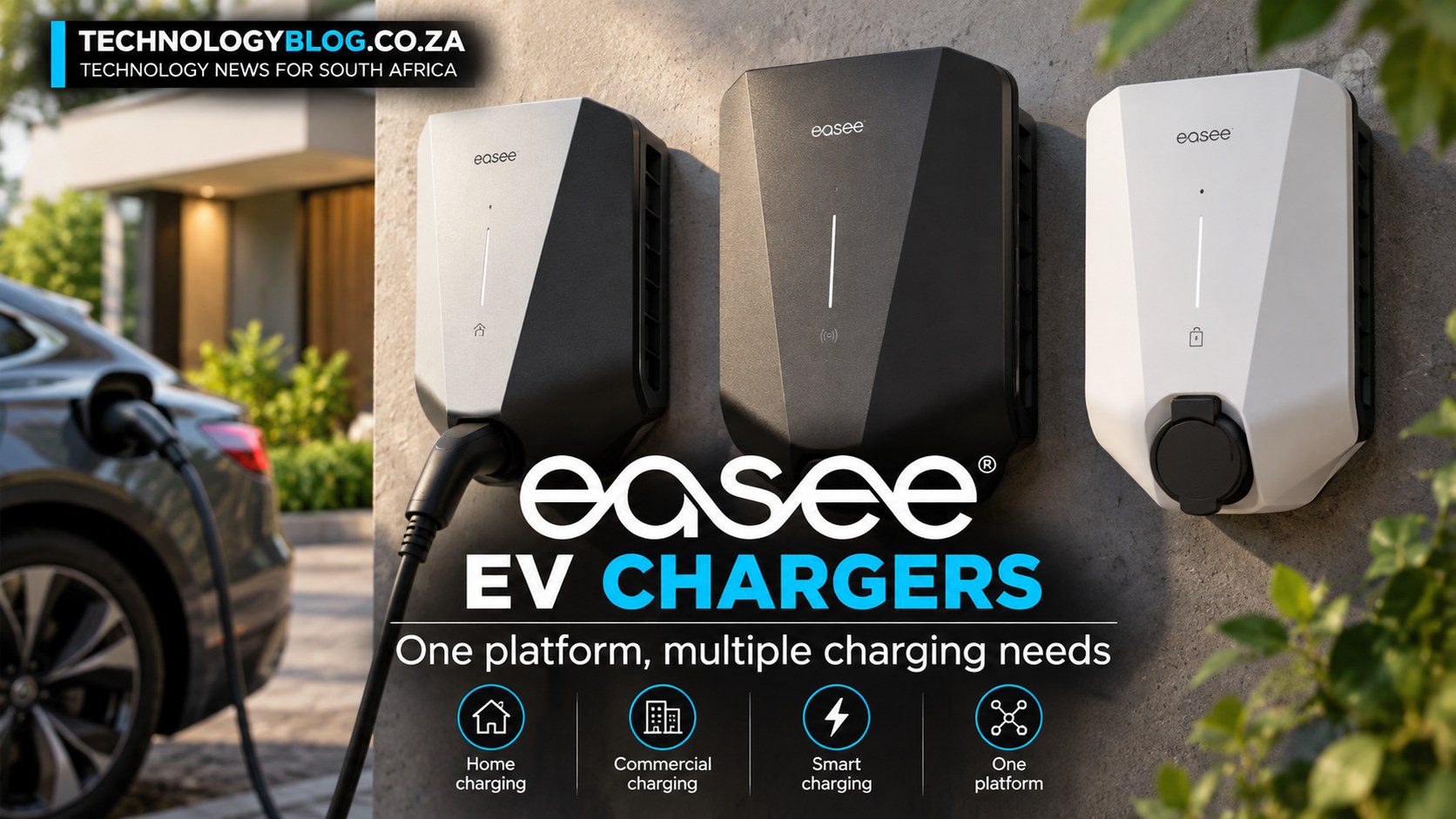
Easee EV chargers scale from home to commercial charging
Easee EV chargers use a modular approach to electric vehicle charging. Instead of creating completely different hardware for every use, Easee has built a compact platform for homes, workplaces, apartment buildings and larger commercial sites.
The current range includes residential and commercial models. Most offer connected controls, load balancing and charging speeds of up to 22kW on suitable three-phase electrical supplies.
For example, Charge Up targets home users, while Charge Max adds certified energy metering. Charge Core, meanwhile, takes the platform into larger commercial installations.
As a result, Easee offers more than a collection of individual wallboxes. Its products form an EV charging system that can grow with different charging needs.
Easee EV chargers cover home and commercial charging
The current Easee EV chargers include the Easee One, Charge Up and Charge Max for residential use. On the commercial side, the company offers Easee Charge, Charge Core and Charge Pro.
Market-specific Max Eichrecht and Pro Eichrecht models also form part of the wider range.
However, Easee does not sell every charger in every country.
That distinction matters for South African readers. Easee currently focuses its international product information on European markets and the UK.
South Africa does not appear in the manufacturer’s current country selector.
Therefore, buyers should not treat technical compatibility as proof of official South African distribution, certification, warranty support or installation approval.
Readers can explore the current range on the official Easee EV charger website.
Charge Up targets home charging
The Easee Charge Up is one of the company’s main residential chargers.
On a suitable 32A single-phase circuit, it supports charging at up to 7.4kW. With an appropriate 32A three-phase TN supply, the maximum rises to 22kW.
In addition, Easee supports IT and TT grid arrangements. Available charging power will vary according to the electrical setup.
This flexibility forms an important part of Easee’s approach.
Rather than requiring completely different hardware for every electrical arrangement, the charger can work with several grid and phase configurations.
Nevertheless, a qualified installer still needs to assess the electrical supply and local requirements.
A 22kW Easee EV charger will not make every EV charge at 22kW
The 22kW figure needs some context.
An EV charger cannot force 22kW into every connected vehicle.
Instead, actual AC charging speed depends on several factors. First, the property needs a suitable electrical supply. The circuit must also support the required current.
Most importantly, the vehicle’s onboard AC charger determines how much AC power the car can accept.
For example, a vehicle limited to 11kW AC will still charge at no more than 11kW when connected to a 22kW wallbox.
A single-phase electrical supply creates another limit.
Easee specifies up to 7.4kW at 32A on single phase for Charge Up, Charge Max and its main commercial models.
TechnologyBlog explored the same issue in our Wallbox Pulsar Max Socket EV charger article. In both cases, the vehicle and property determine how much of the charger’s maximum output owners can actually use.
Charge Max adds certified energy metering
The Easee Charge Max serves a different role in the residential range.
Its main addition is an integrated MID-compliant energy meter.
MID refers to the European Union’s Measuring Instruments Directive. Easee specifies a Class B meter with ±1% accuracy according to EN 50470-3.
This feature matters when owners need accurate charging data for billing or reimbursement.
For instance, a household may only want to monitor its EV’s electricity use. A company reimbursing an employee for home charging may need more formal energy measurements.
Charge Max addresses that requirement while retaining the core features of Easee’s home charging platform.
Charge Max still targets home users
Despite its more advanced metering, Charge Max remains a residential charger.
Like Charge Up, it supports installations with up to three chargers at a home site.
Consequently, a household with several EVs can expand beyond one charging point without treating every charger as a completely separate system.
Easee’s load and phase balancing can coordinate those chargers and share the available electrical capacity.
This feature becomes increasingly useful as households move from one EV to several electric vehicles.
Charge Core takes Easee EV chargers into commercial sites
The Easee Charge Core moves the platform towards commercial charging.
Easee targets workplaces, apartment buildings, car parks and fleets with this model.
Charging performance remains familiar. Charge Core supports up to 7.4kW on single phase and up to 22kW on an appropriate three-phase TN supply.
However, scalability creates the biggest difference.
Charge Up supports up to three chargers at a home site. By contrast, Easee lists Charge Core as supporting unlimited chargers per site.
Therefore, energy management becomes just as important as the individual charger when a site expands.
Large charging sites need smart energy management
Consider a parking area with dozens of EV chargers.
If every vehicle requested maximum charging power at the same time, the combined electrical demand could become enormous.
For this reason, commercial EV charging also becomes an energy-management challenge.
Compatible Easee chargers can communicate locally and coordinate available power.
The system then uses load and phase balancing to distribute electricity between connected vehicles.
Furthermore, a queuing system can manage charging order when demand exceeds the site’s available capacity.
Consequently, the charging network can work within the property’s electrical limits rather than assuming unlimited power.
Easee Equalizer responds to building demand
The Easee Equalizer adds another layer of energy management.
It allows charging to respond to the electricity available at a property.
After all, an EV charger is only one electrical load in a home or building. Cooking appliances, geysers, heating, cooling and other equipment may already use a significant amount of power.
Dynamic load balancing can respond to those changing demands.
For example, the system can reduce EV charging when the property approaches its electrical limit. Later, it can increase charging again when more capacity becomes available.
Therefore, homes and businesses with limited electrical capacity may gain more from smart power management than from simply installing the fastest charger possible.
Solar power can become part of EV charging
Easee also supports solar-aware charging when owners combine compatible chargers with supporting equipment such as the Equalizer.
In this setup, EV charging can respond to available energy instead of operating as an isolated electrical load.
This approach has clear relevance to South Africa, where many homes now combine solar generation and battery storage with grid electricity.
Adding an electric vehicle introduces another major household load.
However, TechnologyBlog has not confirmed official South African support for the current Easee charger range.
Therefore, readers should view Easee’s solar features as part of its supported international ecosystem rather than proof of a locally supported installation solution.
Before importing hardware, South African buyers would need to establish local certification, electrical compatibility, installer support and warranty coverage.
Easee EV chargers offer several connection options
Connectivity plays a major role in the Easee platform.
Charge Up, Charge Max and Charge Core support 2.4GHz Wi-Fi, Bluetooth and LTE Cat M1 cellular connectivity.
They can also communicate with compatible Easee products.
As a result, the chargers do not depend on only one connection method.
Wi-Fi handles normal network access, while Bluetooth supports local communication. Cellular hardware provides another connection option where the service is supported.
However, cellular availability and associated services can differ between markets.
OCPP adds third-party charging support
Easee supports OCPP 1.6J on products including Charge Up, Charge Max and Charge Core.
OCPP stands for Open Charge Point Protocol.
In simple terms, it provides a common way for charging hardware and management platforms to communicate.
This becomes particularly useful for commercial installations.
For example, a business may want to use Easee hardware with a compatible third-party charging platform instead of relying entirely on one software provider.
OCPP can make that type of integration possible.
Even so, businesses should confirm support with their chosen management platform before deployment.
RFID and NFC control charger access
The chargers also include an RFID and NFC reader.
Access control becomes useful when a charging point sits somewhere other people can reach it.
At home, owners may want to prevent unauthorised charging. Meanwhile, a workplace may need to identify employees or vehicles.
Apartment developments face another challenge because several residents may share one charging area.
RFID-based access gives operators a straightforward way to identify authorised users.
As EV charging expands into shared parking spaces, this type of access control becomes increasingly useful.
The Easee App handles everyday controls
Owners can manage compatible chargers through the Easee App.
The software provides charging controls, monitoring and scheduling.
Scheduling can help owners move charging to specific periods. This may prove useful where electricity tariffs change during the day or where a household wants its EV to charge at a particular time.
In addition, the app lets users check their charger without standing beside it.
Commercial installations have different needs. Therefore, Easee provides Easee Control for broader site management.
This separation makes sense because managing one home charger differs greatly from operating dozens of charging points.
Easee EV chargers remain compact
Despite the electronics inside, Easee’s main wallbox design remains relatively small.
Charge Up measures about 256mm high, 193mm wide and 106mm deep. It weighs roughly 1.5kg.
Charge Core uses similar dimensions and weight, while Charge Max weighs about 1.6kg.
This common form factor plays an important role in Easee’s product strategy.
Instead of redesigning the enclosure for every application, the company changes the capabilities inside and around the charger.
Consequently, residential and commercial models can share a similar appearance while serving very different roles.
A modular backplate supports future expansion
Easee separates its charging hardware into several physical parts.
The backplate provides the installed electrical base. Meanwhile, the Chargeberry contains the main charging electronics, and a removable cover completes the unit.
This modular approach can simplify expansion.
For example, Easee Ready allows installers to prepare future charging positions with a backplate and blind cover.
When another charging point becomes necessary, compatible Easee hardware can activate the prepared position.
As a result, larger sites can plan for future EV adoption without installing every active charger immediately.
Daisy chaining can make expansion easier
Easee also supports daisy-chain installation for compatible multi-charger sites.
With a suitable design, installers can connect multiple charging points through the system instead of treating every wallbox as a completely independent installation from the distribution board.
This approach can simplify expansion.
However, EV charger installation remains professional electrical work.
These chargers can draw substantial electrical loads for several hours. Therefore, cable sizing, circuit protection, grid configuration and local electrical rules all require proper assessment.
Easee’s installation design may simplify deployment, but it does not turn an EV charger into a DIY appliance.
Safety sensors monitor the charging system
Easee says its charging platform contains around 40 sensors.
These monitor factors such as current, voltage, temperature and humidity.
In addition, several temperature sensors watch for unusual heat during operation.
If temperatures move beyond defined safety limits, Easee says the system can stop charging and alert the user.
This monitoring matters because EV charging can place a high electrical load on equipment for several hours.
Therefore, temperature monitoring at connectors, terminals and internal components adds another layer of protection.
Residual-current protection comes built in
Charge Up, Charge Max and Charge Core include Type A 30mA AC residual-current protection together with a 6mA residual DC detecting device.
Easee cites EN 60947-2 and IEC 62955 requirements for these systems.
Furthermore, the integrated protection performs automatic self-tests between charging sessions and at least once every 24 hours.
These systems protect the charger itself.
However, the rest of the electrical installation must still meet the relevant local requirements.
In other words, built-in charger protection does not replace correct circuit design and installation.
IP54 and IK10 protect the enclosure
Easee gives mainstream models such as Charge Up, Charge Max and Charge Core an IP54 rating and IK10 impact resistance.
IP54 indicates protection against limited dust entry and splashing water.
Meanwhile, IK10 describes resistance to mechanical impact under defined test conditions.
These ratings suit equipment that may operate outdoors or in parking areas.
Nevertheless, owners still need to follow Easee’s installation requirements.
Environmental ratings describe specific protection levels. They do not make electrical equipment immune to damage.
Software updates can change features over time
Easee chargers support over-the-air software updates.
This capability matters because a wallbox may remain installed for many years.
During that time, software standards, vehicle behaviour and connected services can change.
Remote updates allow Easee to modify software without replacing the physical charger.
However, connected products also depend on continued software and service support.
Therefore, Easee’s software ecosystem forms part of the long-term ownership experience alongside the physical charging hardware.
Cable locking adds physical security
Easee chargers use a Type 2 socket rather than permanently attaching one charging cable to the unit.
Owners can electronically lock a compatible cable into the charger.
Easee also provides physical theft-protection measures for the Chargeberry.
These features matter most in accessible parking areas.
Charging cables have value, while Easee designed its modular electronics so technicians can remove them from the installed backplate.
Therefore, both physical and electronic security form part of the wider charging platform.
Similar designs hide important differences
At first glance, Easee’s home and commercial chargers look remarkably similar.
However, their internal features and supporting systems determine their intended roles.
Charge Up provides mainstream residential charging. Charge Max adds certified energy metering for situations where accurate measurement matters.
Meanwhile, Charge Core expands the architecture for larger commercial sites. Charge Pro adds metering capabilities aimed at more demanding commercial applications.
Therefore, the shared enclosure does not mean every Easee charger offers the same functionality.
Instead, Easee keeps the physical platform consistent while changing metering, software and site-management capabilities.
Easee EV charger range
| Model | Intended use | Maximum AC charging | Key distinction |
|---|---|---|---|
| Easee One | Home | Up to 7.4kW | Residential charger for selected markets |
| Charge Up | Home | Up to 22kW | Main residential charging platform |
| Charge Max | Home | Up to 22kW | MID-compliant integrated meter |
| Easee Charge | Commercial | Up to 22kW | Commercial charger for selected markets |
| Charge Core | Commercial | Up to 22kW | Scalable multi-charger installations |
| Charge Pro | Commercial | Up to 22kW | MID-compliant commercial charging |
| Max Eichrecht | Home | Up to 22kW | Eichrecht-compliant metering |
| Pro Eichrecht | Commercial | Up to 22kW | Eichrecht-compliant scalable charging |
Availability varies by country.
Charge Up, Charge Max and Charge Core specifications
| Specification | Charge Up | Charge Max | Charge Core |
|---|---|---|---|
| Single-phase maximum | 7.4kW / 32A | 7.4kW / 32A | 7.4kW / 32A |
| Three-phase TN maximum | 22kW / 32A | 22kW / 32A | 22kW / 32A |
| Three-phase IT maximum | 12.7kW / 32A | 12.7kW / 32A | 12.7kW / 32A |
| Voltage | 3 × 230/400V AC | 3 × 230/400V AC | 3 × 230/400V AC |
| Frequency | 50Hz | 50Hz | 50Hz |
| Type 2 socket | Yes | Yes | Yes |
| Wi-Fi | Yes | Yes | Yes |
| Bluetooth | Yes | Yes | Yes |
| LTE Cat M1 | Yes | Yes | Yes |
| OCPP 1.6J | Yes | Yes | Yes |
| RFID/NFC | Yes | Yes | Yes |
| Easee App | Yes | Yes | Yes |
| Load balancing | Yes | Yes | Yes |
| MID-certified meter | No | Yes | No |
| Home chargers per site | Up to 3 | Up to 3 | — |
| Commercial scalability | — | — | Unlimited per site |
| Protection | IP54 / IK10 | IP54 / IK10 | IP54 / IK10 |
| Approx. dimensions | 256 × 193 × 106mm | 256 × 193 × 106mm | 256 × 193 × 106mm |
| Approx. weight | 1.5kg | 1.6kg | 1.5kg |
| Manufacturer warranty | 5 years | 5 years | 5 years |
Easee EV chargers need a South African qualification
Some Easee specifications appear relevant to South African electrical systems.
For example, the chargers operate at 50Hz and support several grid configurations.
However, those specifications alone do not establish South African approval or full compatibility.
EV charging equipment must meet local electrical standards and installation requirements. Manufacturer support, certification and warranty coverage also matter.
More importantly, Easee’s current international charger selector does not list South Africa among its supported markets.
TechnologyBlog could not verify a current official South African Easee product range, distributor network or manufacturer-backed local warranty through Easee’s published information.
Therefore, South African buyers should not assume that importing a European Easee charger will create an officially supported local installation.
Easee EV chargers form an expandable platform
Individual Easee EV chargers only tell part of the story.
At home, Charge Up can provide straightforward EV charging. Adding an Equalizer allows charging to respond to available household electricity.
Multiple compatible chargers can also share available power between vehicles.
For larger sites, Charge Core expands the same concept across commercial charging infrastructure.
Meanwhile, Easee Ready lets installers prepare charging positions before every active charger becomes necessary.
Apps, OCPP, RFID and Easee Control then add software, access control and management to the physical charging network.
Consequently, the similar appearance of Easee’s chargers makes more sense when viewed as part of one platform.
Rather than creating a completely different wallbox for every situation, Easee has built a modular architecture that can grow from one home EV to a much larger shared charging site.
For South Africa, however, one important question remains unanswered.
Until Easee confirms local availability, certification and support, the current Easee EV chargers are best viewed as an example of how connected European charging infrastructure is developing rather than as an officially supported South African charging solution.


